

Explore Categories
Agile and Scrum Training in Brisbane
Agile and Scrum Training in Brisbane in Brisbane
The Most Comprehensive Certification Course for Guaranteed Career Success
Gain a competitive edge in the global Agile industry with Simpliaxis’s foundational Agile and Scrum Training led by Certified Scrum Trainers. By becoming Scrum-qualified, you can earn 20% more than traditional project managers. By achieving Scrum-qualified status, you will unlock your potential to deliver high-quality products efficiently, using Scrum principles to thrive in a dynamic Agile environment.


Need guidance? Talk to an expert
Contact Course Advisor
450K+
Professionals trained
250+
Workshops every month
30+
Trainers

5K+ Enrolled

5% OFF
Coupon code "POP5"
Expires Next Tuesday
450K+
Professionals trained
250+
Workshops every month
20+
Trainers
Course Overview
Agile and Scrum Training offered by Simpliaxis validates the candidate's understanding of Agile methodology and Scrum practices. This foundation-level training is a stepping stone towards pursuing accredited certifications such as Certified ScrumMaster (CSM), Certified Scrum Product Owner (CSPO), SAFe Scrum Master (SSM), and Professional Scrum Master (PSM).
This foundational course, led by Certified Scrum Trainers, helps professionals align conventional project management with the Agile route. It is ideal for newbies who aspire to become project managers, scrum masters, product owners, and team members involved in Agile and Scrum development. The certification equips professionals with skills to effectively implement the Scrum framework and Scrum values, improving project success rates and career prospects. In fact, Scrum Masters report an average salary increase of 25% after certification.
Simpliaxis' Agile and Scrum course provides comprehensive learning, enabling professionals to apply Agile methodology using the Scrum principles through practical exercises. It is specifically designed for organizations adopting the Agile project management (APM) framework. Upon successful completion, participants receive a recognized Agile and Scrum certificate from Simpliaxis, advancing career opportunities in the rapidly growing Agile and Scrum job market.
Agile and Scrum Training Highlights
Career upliftment
Unsure about your prep?
Benefits focused on Individuals and corporate

Common attendees
Project Managers
Developers
Product Owners
Managers-Software Development
Architects-Software Development
Product Managers
Anyone who wants to explore opportunities in Agile and Scrum frameworks
Prerequisites for Agile and Scrum certification training
Agile and Scrum Training Eligibility

Course Curriculum
Learning Objectives:
Explain the significance of incorporating the four values and twelve principles into Agile projects and be familiar with the background of the Agile Manifesto. Describe the components that make up Agile's home.
Topics Covered:
Analyse Agile’s foundational concepts, focusing on their application in software development. Explore the history of the Agile manifesto and explain its principles, focusing on customer satisfaction, collaboration, and adaptability.
Topics Covered:
Learning Objectives:
Learn why discussions matter more than assignments. Explore methods to prioritize user stories, understand business value, and define key product terms. Master writing effective user stories and their maturity stages.
Topics Covered:
Learning Objectives:
Explore the various Agile variants, including Scrum, Kanban, XP, Lean, and FDD, at a high level. Explain the usage patterns of These variants.
Topics Covered:
Learning Objectives:
Explain APM as a 5-stage process for Agile software development. Gain an understanding of the needs, deliverables, and activities involved in the Envision/Speculate/Explore/Adapt/Close phases of an Agile project.
Topics Covered:
Learning Objectives:
Discover the Scrum Guide, a cornerstone in understanding the most popular Agile framework, Scrum. This guide plays a significant role in the framework's popularity.
Topics Covered:
Learning Objectives:
Understand the Scrum framework for Agile project management. The Product Owner, Development Team, and Scrum Master collaborate in events like sprints and daily scrums using artefacts like product backlog to create a potentially shippable product at the end of each sprint. Other stakeholders include users and customers.
Topics Covered:
Learning Objectives:
Explain why estimations are required in a project. Understand the different formats of estimation in Agile and explain the details of playing Planning Poker. List the types of agile estimates.
Topics Covered:
Learning Objectives:
Explain the different levels of Agile Planning and their purpose. Explain the need, scope, deliverables, and timing of product planning/ release planning/sprint planning.
Topics Covered:
Learning Objectives:
Explain why we have info radiators in Agile. Learn how to interpret a burn-down chart, a burn-up chart and a Cumulative Flow Diagram (CFD).
Topics Covered:
Learning Objectives:
Explain the need for Agile metrics, and describe details of a few Agile tools.
Topics Covered:
Learning Objectives:
Explain the application of Agile at the enterprise level and learn the high-level details of SAFe®, DAD, and LeSS.
Topics Covered:
Learning Objectives:
Explain the available certifications in Agile and understand the basics of Enterprise Agile.
Topics Covered:
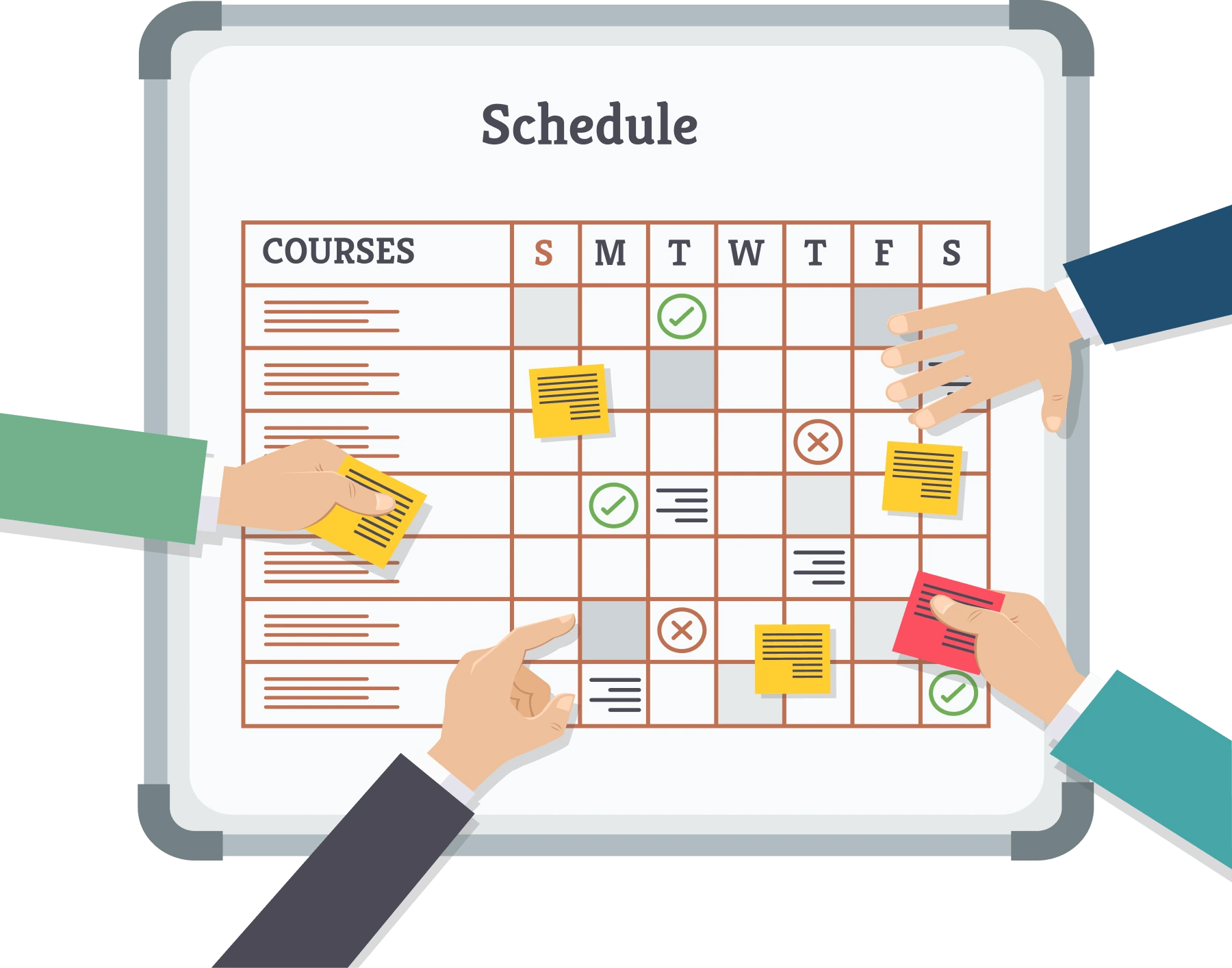
course schedules

What you will learn in this Agile and Scrum workshop
Agile Fundamentals:
Learn the core values and 12 principles of Agile methodologies and explore different variants, such as Scrum, Kanban, and XP.
Agile Business Inputs:
Master the art of creating user stories to capture customer needs and prioritize development efforts.
Agile Planning Events:
Discover how to plan projects effectively using product, release, and iteration planning workshops.
Scrum Ceremonies:
Learn how to conduct and participate in key Scrum ceremonies: Sprint, Sprint Planning, Sprint Review, Sprint Retrospective, and Daily Scrum.
Agile Estimation & Metrics:
Explore techniques like Story Points and Planning Poker for Agile estimation, and learn to calculate and utilize Agile metrics to measure progress and improve performance.
Scaling Agile:
Understand how to scale Agile practices successfully within large enterprises, ensuring alignment and collaboration across teams.
Agile and Scrum Certification Course For Corporates
With learning targeted to your unique team environment, we at SimpliAxis help to resolve your specific issues and meet your specific needs with tailored training methods. We offer corporate training globally to keep Organizations up to date by building the knowledge gap required and make them strive in the competitive world with the right skills according to the industry needs.
Our Customer words for us









Meet the Team That's Invested in Your Success

Laxman Narayan
Experience: 20+ Years
Project Management
Agile and Scrum Course FAQs
Our Agile and Scrum training can help professionals get a job, and it also has other perks, such as:
The three primary roles in Scrum are:
You can reach out to our experienced career counselor
or email us on support@simpliaxis.com
or contact any of our phone numbers
or you can chat with us anytime
or visit our contact us page https://www.simpliaxis.com/contact-us
Find out why 1,000+ professionals love SimpliAxis

Daniel Harper
Product Manager
Outstanding training from Simpliaxis! The curriculum on multi-agent architectures and RAG pipeline development using Claude was thorough and current. Real-world use cases across industries gave me the confidence to lead AI initiatives at my organization immediately.

Sarah Mitchell
Cloud AI Architect
I enrolled in this course to upskill as a software architect, and Simpliaxis exceeded my expectations. The MCP server integration labs and Claude API demos were practical and industry-relevant. The trainer's mentorship made complex agentic concepts easy to grasp.

Priya Venkataraman
AI Solutions Architect
The hands-on labs in Simpliaxis's Agentic AI Engineering course were brilliant. From context engineering to building RAG applications with Langflow, every module was structured and practical. The trainers were knowledgeable and always available for 1:1 support.

James O'Brien
Technical Lead
Simpliaxis's Agentic AI Engineering with Claude course was a game-changer. The 48-hour live sessions covering RAG, LangChain, and multi-agent systems were incredibly hands-on. I went from theory to deploying a production-grade AI agent within weeks. Highly recommended!

Arjun Krishnamurthy
AI/ML Engineer
Simpliaxis delivered exceptional value through this Agentic AI Engineering course. Building autonomous agents with Claude SDK, integrating MCP servers, and deploying on cloud platforms gave me skills that no other training provided. My career in AI has taken a huge leap forward.
Jai Kumar Jadhav
I’m happy to share that I’ve obtained a new certification: Certified Scrum Product Owner (CSPO) from Scrum Alliance🙏 A heartfelt thank you to Simpliaxis for a well-structured training experience and to our amazing Naveen Nanjundappa for thoroughly covering the CSPO concepts and making the learning engaging and practical
Global Recognition
Every Course is recognized by the most reputable certification organizations globally that ensure credibility and acceptance in all industries.
Expert Trainer
Gain knowledge from trained and experienced trainers who impart real-world business insights as well as practical experience to the classes.
Flexible Learning
Provides a variety of methods of learning, such as classes, online, and corporate Training, that meet the needs of different individuals and their schedules.
Lifetime Access
Enjoy all-year access to the recordings of sessions, course materials, and study tools.
Proven Track Record
A reputable training provider with impressive experience in helping professional and business organizations improve their abilities and meet their career ambitions.
End-to-End Assistance
Simpliaxis Offers ongoing assistance prior to, during, and after Training and includes study material exams, guidance for participants on certification, and career choices.
Interactive and engaging Training
Our Training sessions are designed to be extremely interactive, featuring real-world scenarios with group participation, questions & answers to aid in understanding.
A wide range of courses
Simpliaxis offers various internationally acknowledged certification courses in Agile, Scrum, SAFe, DevOps, Project Management, and more.


Thank you!
We’ve successfully received your request.
Our Learning Advisor will reach out to you shortly.

Brisbane, the capital of Queensland, Australia, is known for its thriving economy and diverse workforce. According to the Australian Bureau of Statistics, Brisbane had a labour force of over 1.1 million people in 2021, with a significant percentage of the population aged 15 and over having a post-secondary education. In addition, the city has a strong presence in several key industries, including healthcare, retail, and finance.
The healthcare sector in Brisbane is one of the largest and most vibrant in Australia, with over 50 healthcare facilities providing a wide range of services to the local population. This industry employs many professionals, including doctors, nurses, and healthcare administrators, who play a critical role in ensuring that residents have access to high-quality medical care.
Another key industry in Brisbane is retail, home to several major shopping centres and retail chains. The retail sector employs a significant number of professionals, including managers, sales associates, and marketing specialists, who are responsible for driving the industry's growth and success.
The finance sector is also an important contributor to Brisbane's economy, with several major banks and financial institutions having a solid presence in the city. Professionals in this industry include financial advisors, investment bankers, and accountants, who play a crucial role in helping businesses and individuals manage their finances effectively.
Finally, the tech industry in Brisbane has been experiencing significant growth in recent years. According to the Australian Computer Society, there are over 30,000 tech employees in Brisbane, with the number of professionals in this field continuing to grow. Tech occupations make up 5% of total employment in the city, with many tech companies have set up operations in Brisbane due to its strong labour force and growing economy.
In conclusion, Brisbane has a diverse and skilled labour force with a strong presence in several key industries, including healthcare, retail, finance, and technology. With a growing population and a steady increase in the number of professionals, Brisbane is an attractive location for businesses and job seekers.
Your mastery of Agile methodology and Scrum processes is validated by the Agile and Scrum certification in Brisbane. Agile and Scrum certification training in Brisbane is an advanced-level program that aids in the thorough understanding of Agile techniques and Scrum practices by both individuals and businesses. You may optimize value and reduce risk in your organization by taking the Agile and Scrum certification in Brisbane. Your market value will increase, and new chances will become available once you earn your certification by Agile Scrum in Brisbane.
This Agile and Scrum certification in Brisbane consists of two days of instructor-led instruction and hands-on training. Participants in this 2-day Agile Scrum training in Brisbane will also get knowledge of the Scrum Master position within an organization. In this Agile and Scrum Training in Brisbane, you will put the skills, tools and techniques you are taught to work. You can connect with professors and gain from in-person learning by taking our classroom courses. Since every one of our educators has worked with Agile "in the trenches," they can respond to queries with knowledge gained from actual experience. The key learning outcomes from this Agile and Scrum certification training in Brisbane are that you can demonstrate a thorough understanding of Agile and Scrum concepts, as well as the Scrum Master Role with regards to assisting the Scrum team in adhering to Scrum theory, practices, and rules. You will take a one-hour exam on the last day of the Agile and Scrum training in Brisbane to verify your understanding. With useful information and a clear road map for success, you will leave the class.
Courses based on location




Our privacy policy © 2018-2026, Simpliaxis Solutions Private Limited. All Rights Reserved

 Call Us












 Boost your confidence before the final exam




















 USA
 Canada
 India
 UK
 Australia
 Singapore


