


 Call Us



Introduction
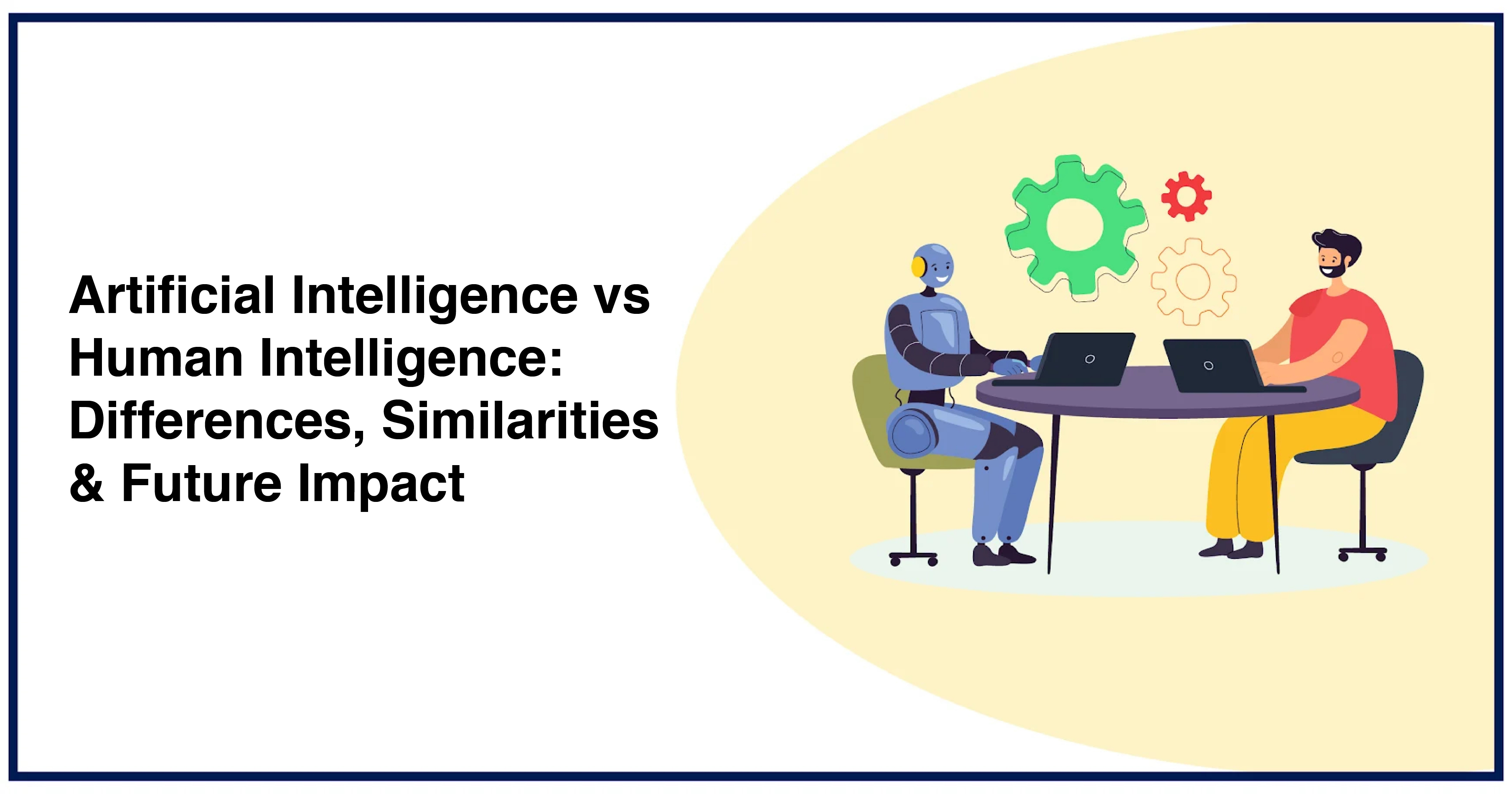
Today, we live in a world that is heavily driven by artificial intelligence. Even if we fail to realize it, it has largely become an inevitable part of our viability and functioning. Not only has it impacted our personal and professional lives, but influenced the world around us. However, AI has largely taken over roles that humans previously held. By replacing human efforts in automated jobs, artificial intelligence has given a whole new way to perform and execute operations seamlessly, without calling for human intervention. However, human intelligence still cannot be emulated by machines. Hence, the discussion continues.
What Is Artificial Intelligence?
Artificial Intelligence, or AI, is technology, or the competence of computers to execute human-oriented tasks seamlessly, without disrupting the day-to-day business operations. The reason why it is referred to as “artificial intelligence” is that it is machine-created and does not require human involvement. AI is a core part of computer science designed to perform all the activities that supposedly only a human is capable of executing.
What Is Human Intelligence?
Human intelligence is all about an individual’s evolving intellect, which involves their ability to understand, realize things, study facts and figures, recollect information, form opinions, and make decisions driven by proper reasoning.
In simple terms, human intelligence is a clear interpretation of different aspects of an individual’s cognitive ability that defines how evolved and informed they are. This comprises an individual’s capability to make the most of their minds, to adjust to situations, gain a deeper insight into others' ideas, and communicate clearly.
How AI Learns vs How Humans Learn?
Humans and artificial intelligence (AI) have contrasting ways of learning and thinking, where AI relies on the massive data sets of information to recognize patterns and inputs from the users, to fetch you the closest appropriate answers. On the other hand, humans operate in an entirely different way as they learn and grow through their own experiences and also by observing others around them. They make decisions based on their understanding, contexts, ideas, memories, intuitions, and emotions.
Here is a detailed explanation of the same, represented through varied aspects:
| Factors of Comparison | How AI Learns? | How Humans Learn? |
Data-Driven Training Models vs Real-Life Learning
| AI identifies patterns through algorithms and predicts responses by processing significant data to produce a relevant output. | Humans learn from various situations, including studies, experiments, and applications, which build their cognitive ability. |
Trial-and-Error vs Emotional Feedback
| AI learning by trial and error works with reinforcement learning, where the AI system communicates with the user to take actions and achieve goals. | Feedback in any form remains a constructive way of learning. Emotional feedback is defined by our range of emotions that define our take on learning new things. |
Structural Learning vs Flexible Thinking
| Structural learning in artificial intelligence is all about teaching models that have underlying patterns, developed through data. | An individual’s mental competence to look above and beyond and explore ways to develop new perspectives about things defines flexible thinking. |
What are the key differences between AI vs Human Intelligence?
As most of us know how human psychology and human intelligence work, we must also know how AI works with a distinct approach, and it is primarily known for its complex information handling and speedy deliverables. Though humans are way more superior than AI, owing to the emotional facets that they possess, AI remains an incredible performer, due to its unparalleled speed, perfection, efficacy, and computations.
| Basis of Differentiation | Artificial Intelligence | Human Intelligence |
| Basis of Thinking | AI responses and the basis of thinking depend on the previously fed data and algorithms that identify users’ commands and prompts to generate answers. | Humans process information through plans, patterns, ideas, and communication, where their thoughts are based on concepts and cognition. |
| Processing Speed and Accuracy | AI is trusted by users only for its quick responses and streamlined data arrangement without compromising on its accuracy. | The term “processing speed” refers to the promptness of human responses, alongside keeping the accuracy intact. |
| Emotional Understanding | Despite being software, AI uses various forms of analysis to imitate human actions and emotions to give responses that resonate with the users, much like a human. | To be able to listen, identify, comprehend, and handle the emotions of self and those around is a core aspect of human intelligence. |
| Creativity and Problem-Solving | AI works as a reliable source of information and assistance to its users and gives them multiple reasons to look beyond the already known details. It builds creativity and immediately resolves problems that the users bring to it. | Two incredible facts about human intelligence are its ability to create new things and handle problems. Humans have an innate ability to look for solutions to problems and to be creative with things around - opportunities and ideas. |
Scalability and Memory
| AI promises scalability in every aspect with its massive data storing capacity - irrespective of where, how, and what you use it for. Once a query is received, AI promptly addresses it without compromising on the quality of the output. | Scalability and memory in human intelligence are all about how data storage and recall work in the human memory and processes information. Human intelligence is nothing but the ability to identify patterns and resolve issues. |
Consciousness and Self-Awareness
| AI is known to be self-aware and conscious, as it holds an individual identity; has its own thought processes, much like a human, and also knows how to imitate human emotions. | Humans are intellectual beings who are known for their self-awareness and understanding. They can think, reflect, decide, and reason for their thoughts. |
What are the Important Similarities Between AI and Human Intelligence
Here is a glance at the similarities that you will find in artificial intelligence and human intelligence
| Grounds of Comparison | Artificial Intelligence | Human Intelligence |
| Pattern Recognition Skills | AI operates on data, and pattern recognition is something that artificial intelligence interprets really well. It uses structures, patterns, and algorithms to understand the inputs fed. | Humans have a unique ability to recognize even the minutest of details and track patterns through words, language, actions, and sounds. This capability makes them cognitively strong and decisive. |
| Learning and Adaptation | AI is sensibly structured to address the growing demands of the users. It can self-analyse, fix issues, and suggest options based on the data fed, feedback from users, and other changes around. | Human intelligence comprises continuous learning and its ability to adapt to new things. This again involves perception, ideation, and understanding from different perspectives to push the mental boundaries. |
| Language Processing Abilities | “Natural Language Processing” is the name given to AI’s language processing methodology, where the software inspects, comprehends, and interprets information to deliver human-like responses to the users using software. | The ability of humans to understand and process languages through active listening, comprehension, and deciphering their meaning is influenced by emotions, cognitive abilities, and intelligence. |
| Goal-Oriented Behavior | Artificial Intelligence’s goal-oriented behavior helps achieve the defined goals of the organization by offering smart, real-time solutions, strategizing for the future, and considering user feedback. | The decisions taken by an individual, the strategies and ideas laid out by them to achieve certain objectives for the company, are what define the goal-oriented behavior of humans. This includes adapting to changes and planning. |
| Problem-Solving Approaches | When AI receives an issue or query from a user, it defines it and uses the database of information to look for answers and ways to fix the problem. This also involves actions, logic, procedures, strategy, and planning before a solution is discovered for the problem. | Humans rely on several major problem-solving strategies that involve trial-and-error methodology, working memory, and emotional intelligence, among others. Human problem-solving is all about identifying problems and eventually looking for ways to develop solutions for them. |
What is the Human Strengths That AI Cannot Replace
While many of us remain apprehensive about our jobs, since the time AI arose in full swing, there are certain aspects that AI can never replicate, no matter how smart and efficient it is. Because, at the end, it is just a machine imitating human responses, without a sense of emotion and empathy. So, which are the core human attributes that artificial intelligence can not replace?
We have explained how it will be impossible for AI to imitate the following human attributes. Let’s dive straight into it.
Emotional Intelligence and Empathy
Artificial intelligence is nothing but a systematized technology that does not even remotely understand or resonate with the vivid human experiences. Therefore, to expect something human-like from a machine, which is only trained to respond like a human, is not ideal. As we know how AI has no connection with the fundamental human emotions, it is evident that it lacks emotional intelligence and empathy. After all, a machine can never make up for human sentiments and feelings.
Ethical Decision-Making
Decision-making is a fundamental aspect of human life that involves making cognitive decisions. As AI operates on pre-fed data sets and other complex functionalities, it cannot decide on behalf of humans, nor can it suggest ethically based on your situations. It will ultimately be an individual’s call. AI lacks primary human emotions like understanding, consciousness, apprehension, etc., and so, cannot help individuals with ethical decision-making.
Imagination and Innovation
Humans have a strong sense of imagination and innovation due to their creative ability. This is something that artificial intelligence cannot replicate because it does not have a mind to drive ideas and thoughts. Most of AI’s decisions are based on the information that is already available in its database. And because it does not have human emotions and vivid experiences, it cannot offer extensive imagination and innovation.
Cultural Understanding and Values
Artificial intelligence is all about identifying patterns and giving responses according to the prompts received. As a human community and culture holds strong values, emotions, rituals, and more, a technology like AI cannot frame its answers that fully encompass the intricacies of humans and their psychology. AI does not have in-depth human understanding, and it lacks lived experience, moral judgements, etc.
Common Sense and Moral Judgment
Humans are distinguished beings who possess a salient characteristic of common sense and moral judgments. AI cannot make practical decisions or quick, correct judgments about things, because it is unaware of the basic human responses and other nuances such as empathy, comprehension, communication, understanding, listening, and decision-making.
Where does AI Outperform Humans?
It is not ideal to compare human capabilities with what AI can do for us. Humans and software (technology-driven platforms) cannot be compared in any aspect. As explained above, AI can easily handle complex data, even in significant amounts, and detailed commands, without consuming a lot of time. Moreover, it can perform exceptionally well irrespective of the massive datasets with its smart data processing, complex problem solving, automation, and pattern identification.
- Large Data Processing - The most incredible feature of AI is that it can efficiently handle and process large amounts of information and deliver you exactly what you need, promptly and consistently. It can even automate, organize, and prioritize data to assist you with your concerns. Whereas humans are not designed to process such large amounts of information error-free.
- Multitasking at Scale - AI can be a single platform for people, but it can efficiently multitask as and when required. You can give multiple prompts for your complex problem, and AI will produce a desired result that will have the context and solution properly explained. The reason why AI is a considerable choice for multitasking is that it mimics human actions easily and executes bulk actions efficiently, with minimal scope for errors.
- Repeated Task Mechanisation (Automation) - Repetitive tasks often take up a lot of time. This time can very well be managed by working on something more important, without taking up a significant time. Here, AI plays a key role in synchronizing things by regulating the operational workflow by seamlessly fulfilling all the repetitive tasks without involving humans, and boosts the overall productivity of the business.
- Consistency and Speed - Artificial intelligence delivers consistent results with its structured principles and procedures, which easily replace human intervention during the process. This assists in assessing huge sets of data promptly, while leaving only minimal chances of human fallacies.
Check:Advantages and Disadvantages of AI
Can Artificial Intelligence Surpass Human Intelligence?
Absolutely! It certainly can, but it would definitely not, because of certain key factors that will come into play. Even if AI delivers exceptional results in certain tasks, it will fail to address the core emotional aspects, which play an equally important part in decision-making. With AI, one can expect prompt results delivered at incredible speed, easy handling of heavy data, and understanding of multiple commands simultaneously to generate appropriate results. But when there remains human involvement, there is emotional intelligence, a logical sense behind every decision, along with great rapport, background, and experience of humans.
Will AI Replace Humans or Work Alongside Them?
AI cannot entirely replace humans and their efforts, irrespective of their responsiveness and efficiency. Rather, AI and humans can work simultaneously, where AI can manage the automated tasks and help with generating substantial referral information, and humans can prioritize logical reasoning, empathy, decision-making, and planning.
What are the Ethical Concerns of Artificial Intelligence
Today, artificial intelligence has taken precedence over new developments and technologies coming up alongside. It is rapidly growing, and nearly every small and large industry is moving towards it. Companies are now managing their operations way more efficiently than they used to, before, when AI was not this popular. But there are certain ethical grounds where AI often fails, which directly impacts the user’s decision-making ability. As AI software is fed with massive amounts of information regularly, it generates information that only remotely coordinates with an individual’s concern or query.
We have shed light on the popular aspects where AI has not delivered satisfactory results.
- Bias in Algorithms - All of us know how AI relies on human inputs, which we refer to as “data.” This data is nothing more than pieces of information prepared by humans and fed into the database of AI software, which is then generated as and when a relevant prompt is given by a user. Bias in algorithms refers to the biased opinions and information in the database, defective algorithms, design issues, incorrect or invalid information, etc.
- Data Privacy Issues - The foundation and development of AI is still in process. As the data in AI is largely human-fed, it often results in misuse, unauthorized access, and unclear data sharing consent. Additionally, AI collects data from any and every resource on the internet, which often is neither relevant nor secure. This, as a result, causes poor data handling and compromised privacy.
- AI Accountability - The companies and their developers are closely responsible for the results we get when a command is given. Additionally, there are other groups involved behind an individual getting a particular result or answer to your query. As nobody knows who is behind all those answers, it becomes challenging for people to rely entirely on the information provided by AI.
- Responsible AI Development - What we find through AI also needs to be validated before we utilize that information for personal or professional requirements. For that, responsible AI development is integral so that the users can be sure of the data reliability, moral goodness, transparency, and usability. For this, there goes a set of structured protocols that define what the design, development, and deployment of AI would be like.
Real-World Use Cases: AI vs Humans in Action
If we look around, we can spot multiple scenarios in our day-to-day life that highlight how both AI and Humans can have varied effects on a situation or event. We shall explain how both can impact the following industries.
- Healthcare - With well-integrated AI systems, the healthcare industry can manage complex operations (including data assessment, pattern analysis, and automation) easily. But with humans in action, there will be more room for understanding, emotions, and communication, and therefore, ethical decision-making.
- Business & Marketing - The field of business and marketing sees a generous integration of artificial intelligence and human involvement. Where AI makes automation tasks easy and synchronized, human inputs and ideas help strategize well, and take the right call owing to their emotional and intelligence quotients.
- Education - The mode of learning and education can be scaled to new heights with the right use of technology and practices. The use of AI will help generate study materials, curate study modules, and provide information accessibility to the users 24*7, whereas with the guidance and companionship of teachers, students can dive into new experiences, deeper lessons, and life insights.
- Finance - The finance sector involves a lot of system work and data management, which humans alone cannot handle. So, for all the iterative tasks that involve constant development and the automation tasks that only need prompts, AI can be a game-changer. But for the crucial financial decisions, strategy-building, and client handling, human involvement will be more important.
Future of Intelligence: Humans and AI Together
No matter how much we disagree about the two (human creativity and artificial intelligence) being incompatible with each other, the beaming future of intelligence with humans and AI is here to stay. With the right integration of AI in operations, there will be heightened efficiency and increased productivity. Henceforth, AI should not be considered a threat to humans; rather, it should be taken as a supporting agent in healthy collaborations and companionships.
Conclusion
Artificial intelligence is a smart technology model that involves significant data and operates according to formulas, patterns, and algorithms within the systems. It comprises automated responses (replies and reciprocations), scheduled solutions, and other useful actions by the platform, which often do not appear as human-centric. Companies find the use of AI beneficial when they are required to generate massive amounts of data or need efficiency, not precision, in their deliverables. But, with human resourcefulness, there always remains a fair probability of experimenting with new things. When humans get involved in any project, they bring along their multiple emotions and perspectives that help companies and businesses to tackle real-time, complex sets of problems seamlessly.
FAQs
What is the main difference between Artificial Intelligence and human intelligence?
Artificial Intelligence (AI) is a simulated form of intelligence built using data, algorithms, and computing power, whereas human intelligence is shaped by lived experiences, emotions, context, and conscious understanding. AI can generate outputs that look intelligent, but it does not “feel,” “live,” or “understand” in the human sense. Human intelligence includes empathy, moral judgment, and personal meaning that come from real-life experiences.
Can AI ever develop emotions like humans?
AI can imitate emotional responses by analyzing patterns in language, voice, or behavior, but it does not genuinely experience emotions the way humans do. Human emotions come from biological processes and personal experiences, while AI operates as software that predicts and responds based on training data. So, AI may sound emotionally aware, but it does not truly “feel” empathy or emotional connection.
Will AI replace human jobs completely?
AI is likely to replace or reduce roles that involve repetitive, rule-based, and highly automated tasks, such as data entry, routine reporting, basic customer support, and some administrative work. However, many jobs will still require human judgment, creativity, leadership, ethical decision-making, and relationship-building. In most cases, AI will transform jobs rather than eliminate them entirely by taking over routine tasks and supporting humans in higher-value work.
How does human creativity differ from AI-generated content?
Human creativity is driven by original thought, personal perspective, emotion, lived experience, and the ability to create meaning and narrative. AI-generated content is produced by learning patterns from existing data and recombining them in new ways. AI can be fast and helpful, but it may lack true originality, deeper intent, and authentic storytelling that comes from human insight and real-world experience.
What industries benefit most from AI-human collaboration?
Industries that benefit most from AI-human collaboration include banking and finance, healthcare, retail and e-commerce, transportation and logistics, and supply chain management. AI improves speed, accuracy, predictions, and automation, while humans provide decision-making, ethical oversight, empathy, customer trust, and strategic direction. Together, they create better outcomes than either one alone.



_1738229341.jpg)



 Lowest-Price Challenge










 Personalized Path


.webp)


 USA
USA  Canada
  India
India  UK
UK  Australia
  Singapore


