


 Call Us



Quick Answer
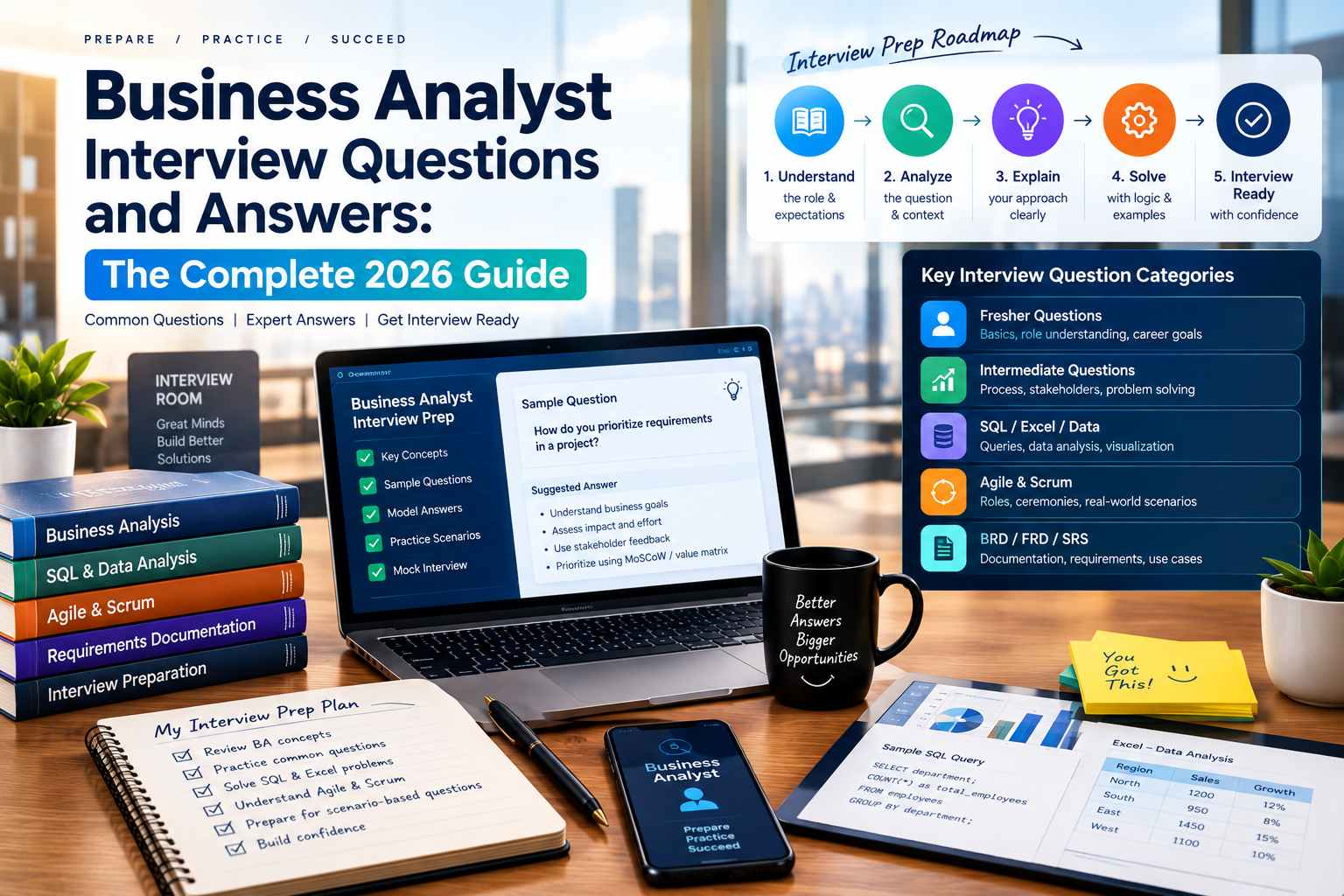
Business analyst interviews test three things together: whether you understand core business analysis concepts (requirements, elicitation, documentation, and the BABOK knowledge areas), whether you can work with data and tools (SQL, Excel, Jira, Tableau, Power BI), and whether you can manage stakeholders and communicate under ambiguity. Most interview loops run through four stages, a recruiter screen, a functional or technical round, a case study or scenario exercise, and a stakeholder or hiring-manager panel, and each stage rewards specific, structured answers over generic textbook definitions. The sections below give real, detailed answers organized by career level and question type, plus the documentation, tools, and certification context that separates a prepared candidate from one reciting definitions.
Key Highlights of Business Analyst Interview Questions and Answers
- Business analyst interviews are structured around four core competency clusters: business analysis fundamentals, technical/data skills, documentation and requirements management, and stakeholder communication.
- The BABOK Guide from the International Institute of Business Analysis (IIBA) defines six knowledge areas that shape most interview questions asked at the intermediate and senior level.
- Technical rounds increasingly test practical SQL skills (joins, GROUP BY, aggregate functions) alongside spreadsheet and BI tool fluency, not just conceptual knowledge.
- Documentation questions on BRD vs FRD vs SRS vs use cases vs user stories are among the most commonly asked and most commonly answered poorly, because candidates blur the business-technical-system distinction.
- In 2026, interviewers are adding questions about how candidates use AI tools such as ChatGPT and Copilot for drafting user stories and requirements, while still expecting strong independent judgment and stakeholder validation skills.
- Certifications such as ECBA, CCBA, CBAP, and IIBA-AAC signal structured BABOK knowledge and can differentiate similarly experienced candidates in a competitive interview pool.
Who Is a Business Analyst, and What Do Interviewers Actually Test For
A business analyst sits between business stakeholders and technical delivery teams, translating organizational goals and pain points into requirements that a project, product, or system can actually address. Before diving into question lists, it helps to understand what interviewers are really probing when they ask seemingly simple questions.
Most interview panels are evaluating four things at once, even when a single question looks narrow:
- Conceptual grounding: do you understand the business analysis lifecycle, from planning and monitoring through elicitation, requirements analysis, and solution evaluation?
- Technical fluency: can you query a database, build a pivot table, read a process diagram, or work inside Jira and Confluence without hand-holding?
- Communication and influence: can you extract what stakeholders actually need (as opposed to what they say they want) and document it so both business and technical audiences can act on it?
- Judgment under ambiguity: when requirements conflict, timelines slip, or stakeholders disagree, do you have a repeatable way to resolve the situation rather than freezing or escalating everything?
Reviewing the core business analysis practices guide before an interview is a useful way to refresh how these lifecycle stages connect, since many interview questions are really asking you to narrate one stage of that lifecycle in your own words.
How Business Analyst Interviews Are Usually Structured
Business analyst hiring loops typically follow a recognizable pattern, whether the employer is a bank, a product company, or a consulting firm:
- Recruiter or HR screen: role fit, salary expectations, notice period, and a light pass on your resume's project history.
- Functional or domain round: a business analysis manager or senior BA asks conceptual and process questions (elicitation techniques, documentation types, BABOK knowledge areas, Agile ceremonies).
- Technical round: SQL, Excel, and sometimes a light data modeling or wireframing exercise, especially for roles adjacent to data or systems analysis.
- Case study or take-home exercise: you are given a rough business problem (for example, "checkout abandonment is up 20 percent") and asked to describe how you would investigate, gather requirements, and propose a solution.
- Stakeholder or hiring-manager panel: behavioral questions using the STAR method (Situation, Task, Action, Result), plus questions about handling conflicting priorities and difficult stakeholders.
Not every company runs all five stages, and smaller companies often compress the technical and case study rounds into one. Knowing this structure in advance lets you calibrate depth: give crisp, framework-based answers in the functional round, and switch to narrative, outcome-focused answers in the panel round.
Entry-Level and Fresher Business Analyst Interview Questions
These questions test whether you understand the fundamentals well enough to be trained on the job. Interviewers expect clear, simple definitions with a practical example, not textbook recitation.
1. What does a business analyst do, day to day?
A business analyst identifies business needs, gathers and documents requirements from stakeholders, analyzes current processes for gaps or inefficiencies, and works with technical teams to design and validate solutions. Day to day, this can mean running stakeholder interviews, writing user stories, updating a requirements traceability matrix, reviewing wireframes, or facilitating a sprint planning session.
2. What is the difference between a risk and an issue?
A risk is a potential future problem that has not yet happened but could affect the project, and it is managed proactively through a risk response plan. An issue is a problem that has already occurred and must be addressed reactively. A strong answer gives an example: "data migration might fail" is a risk you plan for; "the migration failed and duplicated 500 customer records" is an issue you now have to resolve.
3. What is a feasibility study, and why does a business analyst run one?
A feasibility study evaluates whether a proposed solution is practical across technical, financial, operational, legal, and scheduling dimensions before a project is approved. A business analyst runs one to prevent the organization from investing in a solution that cannot realistically be delivered, adopted, or afforded.
4. What is a business model, and how would you analyze one?
A business model describes how an organization creates, delivers, and captures value, covering elements like customer segments, revenue streams, cost structure, and key partners. Analyzing one typically means mapping these elements (a tool like the Business Model Canvas is common) and identifying where value is leaking or underexploited.
5. What are the stages of a typical business project?
Most projects move through initiation, planning, requirements gathering and analysis, design, development or implementation, testing, deployment, and closure or evaluation. A business analyst is most heavily involved in initiation, planning, and requirements, but stays engaged through testing to validate that delivered functionality matches the documented requirements.
6. What is a gap analysis?
Gap analysis compares the current state of a process, system, or capability against the desired future state, and identifies the specific actions needed to close the difference. It is one of the most frequently used business analysis techniques because it turns a vague improvement goal into a concrete action list.
7. What is stakeholder analysis, and why does it matter?
Stakeholder analysis identifies everyone affected by or influential over a project, then maps them by their level of interest and power or influence (a power-interest grid is the common tool). It matters because it tells a business analyst who needs to be consulted deeply, who just needs to be informed, and who could quietly block a project if ignored.
8. What is the difference between a functional requirement and a non-functional requirement?
A functional requirement describes what a system must do, such as "the system shall allow a customer to reset their password." A non-functional requirement describes how well the system must do it, covering qualities like performance, security, availability, and usability, such as "the password reset email must arrive within 60 seconds."
9. What is a requirements traceability matrix (RTM)?
An RTM is a document that links each requirement to its source (a stakeholder need or business objective), its design element, its test case, and its final delivery status. It exists so that no requirement gets lost, changed without review, or delivered without being tested.
10. Why do you want to be a business analyst?
This is a personal-fit question. A strong answer connects a specific experience, such as untangling a confusing process at a previous job or internship, to the satisfaction of finding a clear solution, and ties that back to the specific company's industry or product.
Intermediate-Level Business Analyst Interview Questions
At two to five years of experience, interviewers expect you to connect concepts to real project decisions, not just define terms.
11. Walk me through your typical approach to a new project.
A strong structured answer: first, clarify scope and objectives with the sponsor; second, identify and prioritize stakeholders; third, select elicitation techniques appropriate to the stakeholder group and constraints; fourth, document and validate requirements; fifth, support design and development with ongoing clarification; sixth, support testing and user acceptance; seventh, measure whether the delivered solution actually achieved the original business objective.
12. What elicitation techniques have you used, and how do you choose between them?
Common elicitation techniques include stakeholder interviews, facilitated workshops, document analysis, observation (job shadowing), surveys and questionnaires, prototyping, and focus groups. The choice depends on stakeholder availability, the complexity of the domain, and whether requirements are largely known or still being discovered; workshops work well when several stakeholders need to reach consensus quickly, while document analysis and observation work better when you are reverse-engineering an undocumented legacy process.
13. What is the MoSCoW method, and when would you use it?
MoSCoW is a prioritization technique that sorts requirements into Must have, Should have, Could have, and Won't have this time. It is most useful when a team has more requested features than time or budget allows, and stakeholders need a structured, defensible way to agree on what gets cut from the current release rather than arguing feature by feature.
14. What is the Kano model, and how does it differ from MoSCoW?
The Kano model classifies features by the type of customer satisfaction they create: basic (expected, causes dissatisfaction if missing), performance (satisfaction scales with how well it is delivered), and delighter (unexpected features that create excitement). Where MoSCoW helps a team decide what to build first given fixed capacity, Kano helps a team decide which features are actually worth building at all based on customer impact.
15. How do you handle a situation where two stakeholders want contradictory requirements?
The structured approach is to document both positions precisely, trace each back to the underlying business objective it supports, and then facilitate a session where both stakeholders can see the trade-off in terms of that shared objective rather than personal preference. If no agreement is reached, escalate to the project sponsor with a clear options memo rather than choosing unilaterally.
16. What is SWOT analysis, and how does a business analyst use it?
SWOT stands for Strengths, Weaknesses, Opportunities, and Threats, and it is a structured technique for evaluating a business situation from both an internal (strengths, weaknesses) and external (opportunities, threats) perspective. A business analyst commonly uses it early in strategy analysis to frame why a project is needed before diving into detailed requirements.
17. What is a use case diagram, and what does it show?
A use case diagram is a UML diagram showing actors (users or external systems) and the use cases (goals or interactions) they perform with a system, along with relationships like include and extend between use cases. It gives a high-level visual map of system scope before detailed requirements are written.
18. How do you validate requirements before development begins?
Validation typically involves a formal walkthrough or sign-off session with stakeholders, checking each requirement against acceptance criteria, confirming there are no conflicting or duplicate requirements, and confirming traceability back to a business objective. Some teams also run a peer review or a "requirements freeze" checkpoint before development starts.
19. What is scope creep, and how do you manage it?
Scope creep is the uncontrolled expansion of a project's requirements beyond what was originally agreed, usually through small, seemingly reasonable additions that add up. It is managed through a formal change control process: every new request is logged, assessed for impact on timeline and cost, and explicitly approved or rejected by the appropriate authority rather than absorbed silently.
20. What is a business process model, and which notation have you used?
A business process model visually maps how work flows through an organization, typically using Business Process Model and Notation (BPMN) with symbols for tasks, gateways (decision points), events, and swimlanes for different roles or departments. It is used to document current-state processes and to design improved future-state processes.
Technical Business Analyst Interview Questions (SQL, Excel, and Data)
Data fluency has become close to mandatory for business analyst roles, especially in product, fintech, and analytics-heavy organizations. Expect a mix of conceptual and hands-on questions.
21. Write a SQL query to find the number of orders placed by each customer.
The standard pattern uses a JOIN between the orders and customers tables and a GROUP BY on the customer identifier, with COUNT applied to the order id:
SELECT c.customer_id, c.customer_name, COUNT(o.order_id) AS total_orders FROM customers c JOIN orders o ON c.customer_id = o.customer_id GROUP BY c.customer_id, c.customer_name;
Interviewers are checking whether you instinctively reach for GROUP BY with an aggregate function, and whether you remember to include every non-aggregated column in the GROUP BY clause.
22. What is the difference between INNER JOIN and LEFT JOIN, and when would a business analyst use each?
An INNER JOIN returns only rows with matching values in both tables, while a LEFT JOIN returns all rows from the left table plus matched rows from the right table (with NULLs where there is no match). A business analyst often uses LEFT JOIN specifically to find gaps, for example, listing all customers and their orders to identify customers who have never placed one (where the order columns come back NULL).
23. What is the difference between WHERE and HAVING in SQL?
WHERE filters individual rows before any grouping happens, while HAVING filters groups after a GROUP BY and aggregate calculation has been applied. A common interview trap is asking a candidate to filter "departments with average salary above 80000," which requires HAVING because the condition depends on an aggregated value.
24. How would you use a pivot table to summarize sales data by region and month?
In Excel or Google Sheets, you would drag the region field to Rows, the month field to Columns, and the sales amount field to Values (set to Sum), which produces a cross-tabulated summary instantly without writing formulas. This is one of the most commonly tested practical Excel skills because it mirrors real reporting requests from stakeholders.
25. What is the difference between VLOOKUP and INDEX-MATCH in Excel?
VLOOKUP searches a specified column range from left to right and can break if columns are inserted or reordered, while INDEX-MATCH separates the lookup and return logic, is more flexible (it can look right to left), and is generally considered more robust for large or changing datasets.
26. How would you check for data quality issues before building a report?
A structured answer covers checking for duplicate records, missing or null values in key fields, inconsistent formatting (like date formats or category naming), outliers that suggest data entry errors, and referential integrity (foreign keys that do not match any parent record).
27. What data visualization tool have you used, and how do you decide what chart type to use?
Common tools are Tableau and Power BI. The decision on chart type follows the nature of the comparison: use a line chart for trends over time, a bar chart for comparing categories, a scatter plot for relationships between two variables, and a pie chart sparingly and only for simple part-to-whole comparisons with few categories.
Agile and Scrum Business Analyst Interview Questions
Most modern business analyst roles operate inside Agile or Scrum teams, so interviewers test whether you understand your specific responsibilities within those ceremonies rather than general Agile theory.
28. What is the role of a business analyst in an Agile team?
In Agile delivery, a business analyst typically works closely with the product owner to elaborate the backlog, write and refine user stories, define acceptance criteria, support sprint planning with clarifying detail, and validate delivered functionality against the story's intent during review. Reviewing what an agile business analyst role actually involves day to day is useful preparation, since interviewers often ask you to distinguish this from the product owner's accountability for the backlog itself.
29. What is the difference between a user story and a use case?
A user story is a short, value-focused statement of a feature from the end user's perspective (commonly in the format "As a [role], I want [goal], so that [benefit]"), while a use case is a more detailed, structured description covering the main flow and alternate or exception flows, often expressed as a UML diagram. User stories favor speed and conversation; use cases favor completeness and are more common in regulated or complex-system contexts.
30. How do you write good acceptance criteria for a user story?
Good acceptance criteria are specific, testable, and written from the user's or system's observable behavior, often using a Given-When-Then format (Given a starting condition, When an action occurs, Then an expected outcome results). They should cover the happy path plus the most important edge cases, and they should be agreed with the team before development starts, not written afterward to match what was built.
31. How do you handle backlog prioritization when everything feels urgent?
A structured answer references a prioritization framework such as MoSCoW, a value-versus-effort matrix, or weighted scoring against business objectives, combined with regular backlog grooming sessions where the product owner and stakeholders re-rank items as new information arrives. The key point interviewers want to hear is that prioritization is a repeatable process, not an ad hoc reaction to whoever asks loudest.
32. What is the difference between a sprint backlog and a product backlog?
The product backlog is the full, ordered list of everything that might be needed in the product, owned and prioritized by the product owner. The sprint backlog is the subset of items the team has committed to complete within the current sprint, plus the plan for delivering them.
33. What is definition of done, and why does it matter to a business analyst?
Definition of done is the agreed checklist a story or increment must satisfy before it is considered complete, commonly including coding standards met, tests passed, documentation updated, and acceptance criteria verified. It matters to a business analyst because it prevents "done" from becoming a subjective or inconsistent judgment call across the team.
Documentation Questions: BRD, FRD, SRS, Use Cases, and User Stories
This category is asked in nearly every business analyst interview and is where many candidates lose points by blurring definitions. Precision here signals genuine hands-on experience.
34. What is a Business Requirements Document (BRD), and what does it contain?
A BRD is a high-level document describing the business needs, objectives, current challenges, and expected outcomes of a project, written for a business audience without technical implementation detail. It typically includes the business objective, project scope, stakeholder list, high-level requirements, assumptions, and constraints.
35. What is a Functional Requirements Document (FRD), and how is it different from a BRD?
An FRD translates the BRD's business needs into specific functional behavior the system must exhibit, such as exact fields, business rules, and workflow steps. Where the BRD answers "what does the business need," the FRD answers "what must the system do to satisfy that need."
36. What is a Software Requirements Specification (SRS), and when is it used instead of an FRD?
An SRS is typically a more detailed and formal document combining functional requirements, non-functional requirements, constraints, data rules, process flows, and acceptance criteria, and is common in regulated industries or larger custom software builds where a single authoritative specification is required for both business sign-off and technical build.
37. Which document comes first: BRD, FRD, or SRS?
The BRD comes first because it defines the high-level business need and justification for the project. The FRD or SRS follows, translating that business need into detailed, buildable specifications. In practice, many teams combine FRD and SRS content into a single document, particularly on Agile projects that favor a lighter documentation footprint.
38. How do you handle a change request after requirements have been signed off?
The standard process: log the change request formally, assess its impact on scope, timeline, cost, and any dependent requirements, present that impact assessment to the appropriate approval authority (change control board or sponsor), and only proceed once it is formally approved and the RTM and affected documents are updated.
39. What makes a requirement "good" or well-written?
A well-written requirement is clear, unambiguous, testable, feasible, and traceable to a business objective. A common technique interviewers look for is avoiding vague words like "user-friendly" or "fast" in favor of measurable criteria, such as "the page must load within 2 seconds for 95 percent of requests."
Behavioral and Situational Business Analyst Interview Questions
Behavioral questions test how you actually behave under real pressure, not what you know in theory. The STAR method, structuring an answer around Situation, Task, Action, and Result, is the most widely recommended framework for these answers, and interviewers can usually tell within the first sentence whether a candidate is using a structured approach or rambling.
40. Tell me about a time you had to gather requirements from a stakeholder who was difficult to pin down.
Structure the answer around a specific project: the situation (a stakeholder who kept giving vague or shifting answers), the task (you needed concrete requirements by a deadline), the action (you switched from open interviews to a structured workshop with prepared questions and visual prototypes to react to), and the result (requirements were finalized on time and validated in a sign-off session).
41. Describe a time your requirements or assumptions turned out to be wrong.
Interviewers are testing honesty and learning orientation here, not looking for a perfect record. A strong answer names the specific miss, explains how it was caught (usually in testing or user feedback), and describes the process change you made afterward, such as adding an extra validation step or prototype review.
42. How do you handle a stakeholder who keeps changing their mind?
A strong answer describes documenting each version of the requirement with a timestamp, tying each change back to a business rationale, and, if changes are frequent enough to threaten the timeline, proposing a formal change control step so that changes are deliberate rather than casual.
43. Tell me about a time you had to say no to a stakeholder.
This tests the "discipline to say no" that senior business analysis roles require. A good answer shows you did not simply refuse, but explained the trade-off (timeline, cost, or conflicting priority) and offered an alternative path, such as deferring the request to a later release.
44. How do you handle working with a technical team that pushes back on your requirements?
The strongest answers describe treating pushback as useful information rather than an obstacle: asking developers to explain the specific technical constraint, and then working jointly to adjust either the requirement or the technical approach so both business intent and technical feasibility are respected.
Case Study and Scenario-Based Business Analyst Interview Questions
Case study rounds present an open-ended business problem and evaluate your process, not a single correct answer.
45. "Our e-commerce checkout abandonment rate just increased 20 percent. How would you investigate?"
A structured response: first clarify the baseline and timeframe (when did the increase start, is it across all devices or one segment); second, review any recent changes to the checkout flow, pricing, or payment providers around that timeframe; third, pull funnel analytics to identify exactly which step in checkout is losing the most users; fourth, run a small set of user interviews or session recordings on the affected step; fifth, form a hypothesis, propose a fix, and define the success metric before implementing.
46. "You have two feature requests from two departments and only enough capacity to build one this quarter. How do you decide?"
A strong answer proposes a scoring framework (such as business value against implementation effort), gathers the actual data behind each request rather than relying on stakeholder assertion, presents the trade-off transparently to both departments and a shared sponsor, and documents the decision rationale so it is not revisited without new information.
47. "A key stakeholder was unavailable for the entire requirements-gathering phase, and now they disagree with what was delivered. What do you do?"
The answer should show a recovery process: schedule an urgent review session, walk the stakeholder through what was gathered and why, identify the specific gaps between their expectations and what was documented, and formally log any resulting change requests through the normal change control process rather than quietly reworking the solution.
48. "How would you redesign the onboarding process for a SaaS product that has a high drop-off in the first week?"
A structured approach: map the current onboarding journey step by step, identify where the drop-off concentrates using product analytics, interview a sample of churned users to understand why, benchmark against similar successful onboarding flows, and propose specific, testable changes (such as reducing setup steps or adding contextual guidance) with a clear metric to measure improvement.
Business Analyst vs Related Roles: How Interviewers Draw the Line
Interviewers frequently ask candidates to distinguish the business analyst role from adjacent titles, both to test your self-awareness about scope and to confirm you understand how you will collaborate with these roles on the job.
| Role | Primary Focus | Typical Deliverables | Relationship to a Business Analyst |
| Business Analyst | Translating business needs into requirements and validating solutions against them | BRD, requirements traceability matrix, process maps, user stories | Core role covered in this guide |
| Product Owner | Owning product vision and backlog prioritization based on user and market value | Product backlog, roadmap, release priorities | Business analysts often support product owners by refining and detailing the stories the product owner prioritizes |
| Data Analyst | Working directly with data to answer specific analytical questions | Dashboards, statistical reports, ad hoc data analysis | Business analysts define what questions matter to the busiess; data analysts often provide the underlying data answners |
| Business Systems Analyst | Bridging business needs and IT systems with a stronger technical/systems focus | System requirements, integration specs, configuration documentation | Often a more technical variant of the business analyst role, common in IT-heavy organizations |
49. How would you explain the difference between a business analyst and a product owner to a new stakeholder?
A product owner owns the "what and why" at the product and roadmap level, deciding what gets built and in what order based on business value. A business analyst supports that decision by digging into the detailed "how," gathering and documenting the specific requirements, edge cases, and acceptance criteria the team needs to build it correctly.
50. How is a business systems analyst different from a business analyst?
A business systems analyst typically has a stronger technical and IT systems focus, often working on system configuration, integration, and data flow between platforms, while a general business analyst has a broader process and stakeholder focus that can span any business function, not only IT systems.
Tools and Software Business Analysts Are Expected to Know
Interviewers commonly ask which tools you have used, partly to gauge experience level and partly to check whether you can start contributing without a long ramp-up period. The most frequently referenced tools across current job postings and interview guides include:
- Requirements and collaboration: Jira and Confluence for backlog management, requirements documentation, and team collaboration.
- Process and diagramming: Visio or Lucidchart for process maps, workflow diagrams, and use case diagrams.
- Data analysis and reporting: Excel (including pivot tables and lookup formulas), SQL for querying relational databases, and Tableau or Power BI for dashboards and visualization.
- Wireframing and prototyping: Balsamiq or Figma for low-fidelity mockups used to validate requirements visually with stakeholders before development.
- Documentation and word processing: Microsoft Word and PowerPoint remain standard for formal BRDs, FRDs, and stakeholder presentations.
51. Which tool would you use to communicate a complex process to a non-technical stakeholder, and why?
A process flow diagram (built in Visio or Lucidchart) is usually the strongest choice for non-technical audiences because it shows the sequence and decision points visually, without requiring the reader to parse technical or written detail. A well-prepared candidate notes that they would tailor the notation's complexity to the audience, using simplified swimlanes rather than full BPMN notation for a purely business audience.
Certifications That Strengthen Your Interview Profile
Business analysis certifications from the International Institute of Business Analysis (IIBA) are built around the BABOK Guide to the Business Analysis Body of Knowledge, which organizes the discipline into six knowledge areas: business analysis planning and monitoring, elicitation and collaboration, requirements life cycle management, strategy analysis, requirements analysis and design definition, and solution evaluation. According to IIBA's own certification FAQ, the three core credentials scale with experience:
- ECBA (Entry Certificate in Business Analysis): designed for those new to the field, with no required business analysis work experience, making it a common entry point for career changers preparing for their first business analyst interviews. Simpliaxis publishes a detailed ECBA certification guide and an ECBA exam pattern breakdown for candidates evaluating this route.
- CCBA (Certification of Capability in Business Analysis): aimed at professionals with roughly 3,750 hours of business analysis work in the last seven years, distributed across the BABOK knowledge areas.
- CBAP (Certified Business Analysis Professional): the senior-level credential, requiring 7,500 hours of business analysis experience within the past ten years, with a minimum of 900 hours in each of at least four of the six BABOK knowledge areas, plus 35 hours of qualifying professional development.
- IIBA-AAC (Agile Analysis Certification): a specialization certificate focused on business analysis practices within Agile delivery environments.
Mentioning one of these credentials, or active preparation toward one, in an interview signals structured BABOK-level knowledge rather than only on-the-job pattern matching, which can matter when two candidates otherwise have similar years of experience.
52. Do you need a certification to become a business analyst?
No, certification is not a legal or universal hiring requirement, and many working business analysts do not hold one, especially at the entry level. It becomes more valuable for career changers who lack a track record of BA-titled roles, and for mid-to-senior candidates competing for roles where a structured BABOK-aligned skill set is explicitly preferred.
Business Analyst Salary Expectations in 2026
Salary questions come up in most recruiter screens, and having a data-backed number ready avoids either underselling yourself or naming a figure the role cannot support. The U.S. Bureau of Labor Statistics reports a median annual wage for management analysts (the closest official occupational category to business analyst roles) of roughly $101,190 as of its most recent published data, with wide variation by state, industry, and seniority; Massachusetts and the Washington, D.C. metro area report among the highest mean annual earnings for this occupational category. Entry-level business analyst roles commonly start well below that median, while senior business analysts with specialized domain expertise (finance, healthcare regulatory, or enterprise systems) can exceed it substantially. Because BLS occupational categories are broader than the single job title "business analyst," treat this figure as a directional benchmark rather than an exact number for any specific employer or region, and always validate current, location-specific compensation against a recent local salary survey before negotiating.
53. How do you answer "what are your salary expectations" in a business analyst interview?
Give a researched range rather than a single number, anchored to your specific years of experience, domain, and location, and note that you are open to discussing the full compensation package (bonus, benefits, remote flexibility) rather than base salary alone. Avoid naming a number before understanding the role's scope and seniority level, since a generic "business analyst" title can span a wide band of responsibility.
AI and the Modern Business Analyst Interview
By 2026, questions about AI tool fluency have become a standard part of business analyst interviews, reflecting how quickly generative AI has entered day-to-day BA workflows for drafting user stories, summarizing stakeholder interviews, and producing first-pass requirements documents.
54. How do you use AI tools like ChatGPT or Copilot in your business analysis work?
A strong, credible answer is specific rather than sweeping: for example, using an AI assistant to draft an initial set of user stories or a first-pass BRD structure from meeting notes, which is then reviewed, corrected, and validated against actual stakeholder intent before anyone treats it as final. Interviewers are listening for evidence that you understand AI output still requires human verification, not that you can prompt a chatbot.
55. What are the risks of relying on AI-generated requirements without review?
AI-generated requirements can sound complete and well-formatted while missing domain-specific nuance, misinterpreting ambiguous stakeholder language, or hallucinating plausible-sounding but incorrect business rules. A business analyst's core value increasingly lies in verifying that AI-assisted drafts actually reflect real stakeholder intent and business context, not in producing the first draft itself.
How to Prepare for a Business Analyst Interview
- Rehearse two or three STAR-format stories in advance covering a requirements conflict, a missed assumption you corrected, and a time you had to say no to a stakeholder, since variations of all three come up repeatedly.
- Refresh SQL and Excel fundamentals hands-on rather than only reviewing concepts; being asked to write or trace through a query live is common, and rustiness shows immediately.
- Study the target company's product or industry so your case-study answers reference real, plausible business context rather than generic examples.
- Bring one real work sample if allowed, such as a sanitized BRD, process map, or user story set, since concrete artifacts are more convincing than a description of your process.
- Prepare your own questions for the panel about team structure, how requirements get validated, and what tools the team uses daily, since this signals genuine interest in how the role actually operates day to day.
- Know your documentation vocabulary precisely, since BRD, FRD, SRS, use case, and user story distinctions are asked often enough that any hesitation on these terms stands out.
For candidates specifically targeting Agile-heavy teams, it is also worth reviewing how agile business analyst roles and responsibilities differ from traditional waterfall BA roles, and revisiting core requirement elicitation techniques, steps, and best practices the night before an interview, since elicitation questions appear in almost every round regardless of seniority level.
Conclusion
- Business analyst interviews test four things together: conceptual grounding, technical/data fluency, documentation precision, and stakeholder communication under ambiguity.
- Master the exact distinctions between BRD, FRD, SRS, use cases, and user stories, since these documentation questions appear in nearly every interview regardless of seniority.
- Practice writing real SQL queries (joins, GROUP BY, WHERE vs HAVING) and working Excel pivot tables hands-on, not just reviewing definitions.
- Prepare STAR-format stories for stakeholder conflict, a missed assumption you corrected, and a time you pushed back on a request.
- Understand how AI tools fit into modern BA workflows and be ready to explain how you verify AI-assisted drafts rather than accept them at face value.
- Know the BABOK knowledge areas and the ECBA, CCBA, CBAP, and IIBA-AAC certification tiers, since they frame how many intermediate and senior interview questions are worded.
- Anchor salary conversations to current, location-specific data rather than a single remembered number, and be ready to discuss the full compensation package.

_1738228702.jpg)




 Lowest-Price Challenge











 Personalized Path


.webp)


 USA
USA  Canada
 India
India UK
UK Australia
 Singapore


