


 Call Us



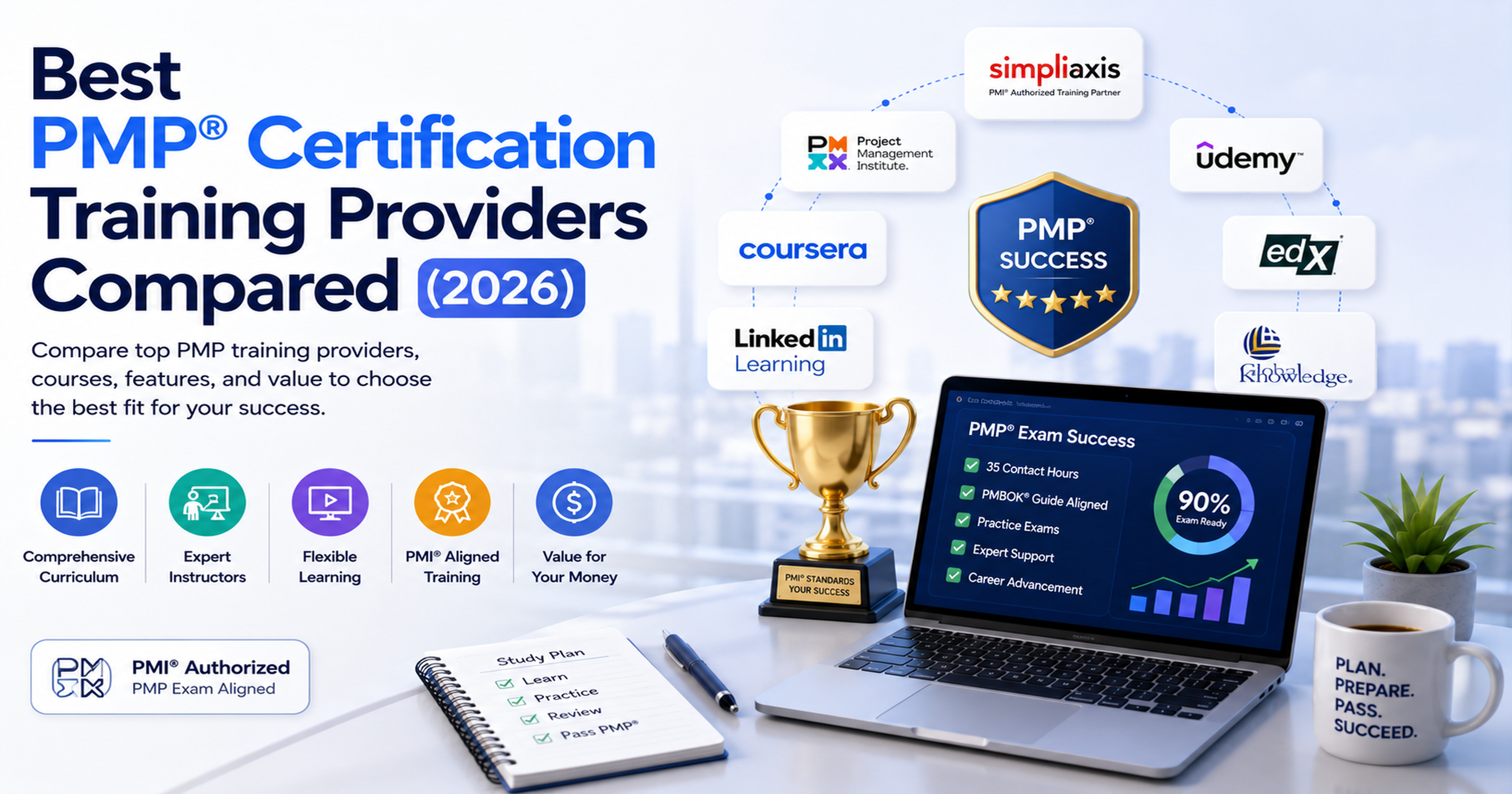
There is no single provider that is objectively "best" for every candidate; the right choice depends on whether you need PMI Authorized Training Partner (ATP) content to document your 35 contact hours, how much structure and live coaching you want, and your budget. Candidates who want live cohorts, an exam-focused curriculum aligned to the 2026 PMP Examination Content Outline, and a published pass-rate guarantee typically look at ATP-accredited providers such as Simpliaxis, Simplilearn, PMTI or Velociteach. Candidates who already have solid project management experience and mainly want a low-cost refresher often choose Udemy, Coursera or LinkedIn Learning, provided they independently confirm the course documents contact hours in a form PMI will accept.
Key Highlights of the Best PMP Certification Training Providers
- PMI does not publish a ranked list of "best" training providers; it maintains a searchable Authorized Training Partner directory at atp.pmi.org, and verifying a provider there takes under two minutes.
- Not every course that helps you study for the PMP exam is delivered by a PMI ATP. Marketplace platforms such as Udemy host independent instructors, and individual course quality on those platforms varies widely.
- Total PMP certification cost, training plus the PMI exam fee, generally lands between roughly $800 and $3,500 depending on format, provider and country, with instructor-led bootcamps at the higher end and self-paced video courses at the lower end.
- The PMP exam that took effect on 9 July 2026 rebalanced the Examination Content Outline: People moved from 42% to 33%, Process from 50% to 41%, and Business Environment from 8% to 26%, with agile and hybrid approaches now woven through roughly 60% of questions.
- The 35 contact-hour requirement has not changed, but PMI now explicitly accepts agile-focused and hybrid methodology training toward those hours, not only traditional waterfall content.
- Pass-rate and "guarantee" claims made by commercial training companies, including Simpliaxis's stated 92% first-attempt pass rate, are self-reported; PMI itself does not publish provider-level pass-rate data, so treat every provider's number as a marketing claim to be weighed alongside accreditation and curriculum fit.
- Unusually low prices, guaranteed passes without study, or generic mass emails offering PMP certification are the clearest warning signs of a non-legitimate training operation.
How the Main PMP Training Options Actually Differ
The market for PMP preparation splits into four broad categories: PMI Authorized Training Partners running live cohorts, large edtech platforms selling self-paced or blended courses, open marketplaces hosting independent instructors, and university-affiliated continuing-education programmes. Each category trades off price against structure, live support and how easily the training documents your 35 contact hours. The table below summarises the main named options that recur in market research and comparison roundups, with figures attributed to each provider's own published claims where an independent third-party figure does not exist.
| Provider | Delivery Format | Approx. Price Range | PMI ATP Status | Pass-Rate / Guarantee Claim | Best For |
| Simpliaxis | Live online, in-person and on-demand cohorts | Varies by region and format; see published cost breakdown | States PMI Authorized Training Partner status | Self-reported 92% first-attempt pass rate; published money-back terms on class satisfaction | Candidates who want a live instructor, flexible scheduling and a named ATP on record |
| PMI Authorized Training Partners generally (e.g. PMTI/4PMTI, PMTraining, Velociteach) | Multi-day live bootcamps, in-person or virtual | Roughly $800 to $2,500 for a bootcamp | Yes, each is independently PMI-authorized (verify per provider) | Several publish multi-attempt refund guarantees, terms vary by provider | Candidates who want an intensive, exam-focused bootcamp with a written guarantee |
| Simplilearn | Blended: self-paced modules plus live online sessions | Mid-range, typically a few hundred to just over $1,000 | States PMI-authorized content | Publishes a 100% money-back offer if you fail on the first attempt | Self-directed learners who still want scheduled live sessions and simulation exams |
| Udemy | Self-paced video, no live instruction | Listed around $50 to $200, frequently discounted to $10 to $20 | Not listed as a PMI ATP; instructors are independent | Platform-wide 30-day refund policy, not exam-outcome based | Budget learners with existing PM background wanting supplementary content, not primary contact-hour documentation |
| Coursera (e.g. university-hosted PMP prep specialisations) | Self-paced, subscription or per-course | Subscription roughly $49 to $79 per month, or per-course fees | Varies by course; some are produced with accredited institutions, confirm individually | Standard Coursera refund window; no pass-rate guarantee | Learners who want academic pacing and a recognised institutional name alongside PMP prep |
| LinkedIn Learning | Self-paced video library within a subscription | Bundled in a LinkedIn Learning subscription rather than sold standalone | Library courses reference PMI content; confirm the specific course's contact-hour documentation | No pass-rate guarantee | Professionals who already hold a subscription and want a low-cost review resource |
| University-affiliated programmes (e.g. Georgia Tech Professional Education) | Blended, cohort or semester-based | Typically comparable to bootcamp pricing | Some university continuing-education units are themselves PMI ATPs | Rare; academic credit or badge rather than a refund guarantee | Learners who want a recognised academic institution's name and corporate reimbursement-friendly billing |
If price and live coaching matter most, start by comparing Simpliaxis's PMP certification training against other ATPs' bootcamp pricing, and cross-check every number against PMI's own Authorized Training Partner directory before you commit.
What Each Type of Provider Is Actually Best For
Live, ATP-backed instructor-led providers
Providers such as Simpliaxis, PMTI and Velociteach centre their offer on a named instructor, a fixed cohort schedule and a documented PMI ATP relationship. This suits candidates who want accountability, a study cadence they cannot skip, and someone to ask questions of in real time. Simpliaxis, for example, offers online live-instructor PMP training as well as in-person and on-demand formats, which is useful if your schedule or location changes mid-preparation. PMTI publishes its own 100% pass guarantee terms directly on its site, which is the kind of detail every bootcamp-style provider should make easy to find.
Large edtech platforms (Simplilearn, Coursera, LinkedIn Learning)
These platforms scale a standard curriculum to a large audience and typically cost less than a dedicated bootcamp per learner. Simplilearn's own published PMP course page states a first-attempt refund policy, which is worth reading in full before assuming it covers your specific circumstances. Coursera's university-branded specialisations, such as those built with academic partners, can be attractive if you value an institutional name on your transcript, but Coursera itself is a hosting marketplace, not an ATP, so the accreditation status sits with the specific course producer, not the platform.
Open marketplaces (Udemy)
Udemy is genuinely useful as a low-cost way to hear a second explanation of a difficult topic or to get extra practice questions, and several instructors have built large, well-reviewed PMP libraries there. The caveat is structural rather than a quality judgement on any one course: Udemy does not appear in PMI's ATP directory, and individual instructors are independent sellers rather than an accredited training organisation, so a completion certificate from Udemy needs to be checked against PMI's contact-hour documentation rules before you rely on it for your application.
University-affiliated and corporate programmes
Some university continuing-education arms, such as Georgia Tech's professional education division, have themselves been named PMI ATPs, which combines institutional credibility with genuine accreditation. These programmes tend to run on academic terms (semester-length or fixed cohort dates) rather than on-demand access, and pricing is often comparable to or higher than a private bootcamp. For teams rather than individuals, providers that offer corporate group training arrangements can also negotiate cohort pricing and custom scheduling that public course pages do not show.
How to Verify a Provider's PMI ATP Status Yourself
You can confirm PMI ATP status directly, without relying on any provider's marketing copy, in a few minutes.
- Step 1: Open PMI's own Authorized Training Partner directory at atp.pmi.org (linked above) and search the exact legal or trading name of the provider you are considering.
- Step 2: Check that the listing is current. PMI ATP agreements are renewed on a schedule, and an ATP badge without a current year attached is worth asking the provider about directly.
- Step 3: Ask the provider for the digital access key or activation code tied to PMI's LOChoice learning portal for the specific course you would be enrolling in. A genuine ATP course issues one of these per learner because it is how PMI's own systems recognise the training as authorized.
- Step 4: Confirm in writing what the completion certificate will state, specifically the number of contact hours and whether it names the ATP and course code PMI will expect on your application.
- Step 5: If the course is not delivered by an ATP at all (common with marketplace or subscription-library courses), ask the provider directly how PMI has historically accepted their completion certificate as proof of the 35 contact hours, since PMI's eligibility rules require documented project management education, not exclusively ATP-sourced hours.
This same verification process works regardless of which provider you are evaluating, including Simpliaxis, and taking five minutes to run it before paying is the single highest-value step in this entire comparison.
Red Flags and Questions to Ask Before You Pay
Most PMP training scams share a small set of recognisable patterns, and asking direct questions before paying filters out nearly all of them.
- An unsolicited email or message addressed generically ("Dear Professional") from an unfamiliar sender name, often promoting a certification timeline that sounds too fast for the stated content.
- A guaranteed pass with no exam attempt, or a certificate offered without any study material, live class or assessment at all.
- A price so far below every other provider's published range that it cannot plausibly cover 35 contact hours of live or produced content.
- No verifiable ATP listing, no named instructors, and no way to confirm the organisation's registration or physical business address.
- Refusal to put pass-rate or guarantee claims in writing, or guarantee terms that only appear after you have already paid.
Before enrolling with any provider, ask these questions directly: What is your current PMI ATP status, and can I verify it independently? What exactly does your pass-rate or guarantee claim cover, and what are the conditions attached to a refund? What will my completion certificate say, and has PMI accepted this exact documentation from your organisation before? How many of your total contact hours are delivered live versus self-paced video? A provider confident in its accreditation and outcomes will answer all four without hesitation; a provider that deflects any of them is a reason to keep comparing before you commit.
Does the Curriculum Match the 2026 PMP Examination Content Outline?
The PMP exam that took effect on 9 July 2026 changed both the emphasis and the format of the test, and a training provider's materials should reflect that update, not the pre-2026 syllabus.
The domain weightings shifted from People 42%, Process 50%, Business Environment 8% under the previous outline to People 33%, Process 41% and Business Environment 26% under the 2026 outline, with agile and hybrid approaches now represented across roughly 60% of the exam rather than confined to a separate agile section.
PMI also consolidated the underlying task list to 26 tasks (8 People, 10 Process, 8 Business Environment) and introduced case-study and graphic-based question formats within a 180-question, 240-minute exam that includes two 10-minute breaks.
When you review a provider's syllabus, look for these specific signals that the content has actually been rebuilt for 2026 rather than relabelled:
- The syllabus states the current domain percentages (33/41/26) rather than the older 42/50/8 split still printed on many outdated course pages.
- Agile and hybrid concepts appear inside People and Business Environment material, not only in a standalone "agile module" bolted onto a traditional syllabus.
- Practice exams include case-study-style and graphic-based item formats, not only single-best-answer multiple choice.
- The provider references the current 180-question, 240-minute format with two breaks, matching PMI's published exam specification.
- The 35 contact hours explicitly credit agile or hybrid coursework, not exclusively traditional predictive project management content.
You can cross-check any provider's stated syllabus against Simpliaxis's own published PMP syllabus breakdown as one reference point for what an updated curriculum should cover, and against PMI's own exam content outline document directly if you want the primary source.
Price vs Value: What Actually Drives PMP Training Cost
Total PMP certification cost has two separate components that are easy to conflate: PMI's own exam fee, which is fixed and identical regardless of who trained you, and the training fee, which varies enormously by format. PMI's exam fee changed in 2026, so figures published before that update are no longer accurate; always confirm the current fee directly on pmi.org rather than trusting an older blog post. The training component is where provider choice actually changes your total spend, roughly from a few hundred dollars for a self-paced video course up to $2,500 or more for a multi-day live bootcamp, with instructor-led virtual training typically landing in the $800 to $1,800 range.
The honest way to think about that spread is not "cheapest" versus "most expensive" but what you are actually paying for at each price point: self-paced video buys you content and practice questions only; blended courses add scheduled live sessions and an instructor you can ask questions of; full bootcamps add intensive scheduling, cohort accountability and, in many cases, a written guarantee.
PMI membership is worth factoring into the same calculation, since the discounted member exam fee combined with digital access to PMI's own standards documents can offset most or all of the annual membership cost even before you consider any training-provider discount for members. For an itemised breakdown of exam fees, membership costs and typical training price bands, Simpliaxis's PMP certification cost guide lays out each component separately, which makes it easier to compare like for like against any other provider's quoted price.
Where PMP Fits Among Other Project Management Certifications
PMP is not the only credential worth weighing before you commit budget and study time, and part of choosing a training provider well is confirming PMP is the right target credential for your career stage in the first place. Candidates earlier in their career, or those working primarily in agile teams, sometimes find a narrower certification, or a staged path toward PMP, fits their current role better. Simpliaxis's overview of leading project management certifications is a useful comparison point if you are still deciding between PMP and an adjacent credential before shortlisting training providers at all.
Conclusion
Choosing a PMP training provider comes down to three checks that matter far more than brand recognition or a polished landing page: verified PMI ATP status where accreditation matters to you, a syllabus that has genuinely been rebuilt for the 2026 Examination Content Outline's agile and hybrid weighting, and guarantee or pass-rate claims you can see in writing rather than take on faith. Live, ATP-backed providers such as Simpliaxis, PMTI, Velociteach and Simplilearn suit candidates who want structure, accountability and a documented accreditation trail, while Udemy, Coursera and LinkedIn Learning serve candidates who already have PM experience and want a lower-cost supplement, provided they separately confirm how their chosen course documents the 35 contact hours PMI requires. No single provider in this comparison is right for every candidate; the right one is whichever passes your own verification checklist, fits your schedule and format preference, and prices your specific mix of live support and content at a level you consider fair for the outcome you need.

_1785144543.jpg)






 Lowest-Price Challenge











 Personalized Path


.webp)


 USA
USA  Canada
 India
India UK
UK Australia
 Singapore


