


 Call Us



Quick Answer
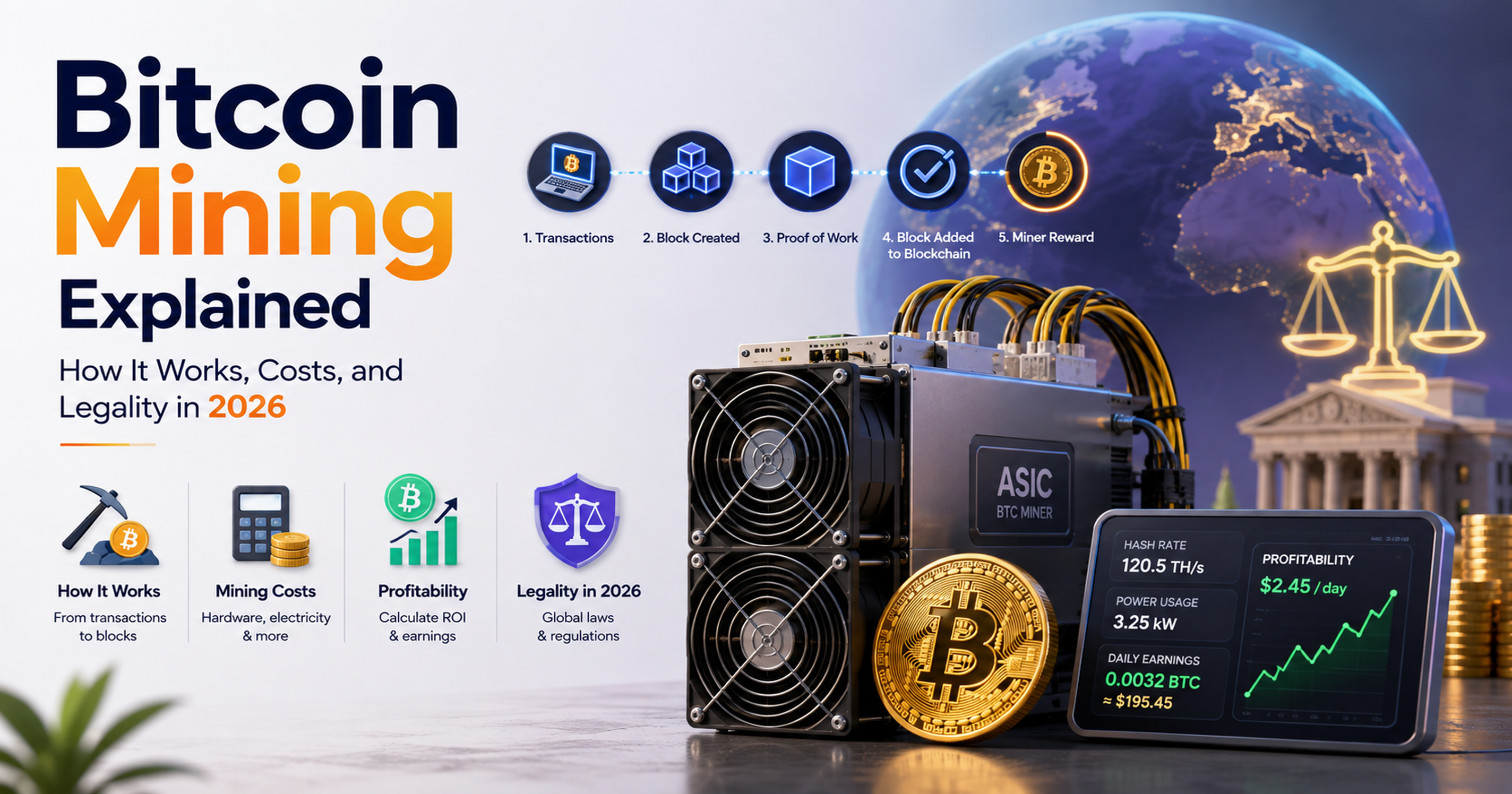
Bitcoin mining is the process by which specialized computers (ASICs) compete to solve a cryptographic puzzle roughly every 10 minutes; the winner adds the next block of verified transactions to the blockchain and earns a block reward, currently 3.125 BTC plus transaction fees. In 2026, mining is dominated by large-scale operations with cheap electricity and the latest efficient hardware, since the global network hash rate has climbed past 600 to 800 exahashes per second, making home mining with a single machine essentially unprofitable outside of extremely low-cost power regions.
Key Highlights of Bitcoin Mining
- Bitcoin mining secures the network and issues new bitcoin using a "proof-of-work" system, where miners race to solve a cryptographic puzzle.
- The current block reward is 3.125 BTC per block, set by the April 2024 halving; the next halving, expected in 2028, will cut it to 1.5625 BTC.
- Network hash rate has reached new highs in 2026, with reported figures ranging from roughly 600 to over 800 exahashes per second depending on the measurement source.
- Modern mining is almost exclusively done with ASIC hardware, such as the Bitmain Antminer S21 Hyd. and MicroBT M60S, rather than consumer GPUs.
- Bitcoin mining is estimated to consume between roughly 138 and 155 terawatt-hours of electricity annually, comparable to a mid-sized country's total consumption.
- Legality varies significantly by country: mining is broadly legal (though regulated) in the US, EU, and most of the world, but remains banned in China.
How Bitcoin Mining Actually Works
Bitcoin runs on a decentralized ledger called the blockchain, and mining is the mechanism that keeps that ledger secure and synchronized without a central authority. When someone sends bitcoin, the transaction is broadcast to the network and grouped with other pending transactions into a candidate block.
Miners then compete to find a specific numeric value (a "nonce") that, when combined with the block's data and run through the SHA-256 hashing algorithm, produces a result below a target threshold. This is deliberately hard to compute but easy to verify once found, a design known as proof-of-work. The first miner to find a valid solution broadcasts it to the network; other nodes verify it almost instantly, and the block is added to the blockchain. That miner receives the block reward plus any transaction fees included in that block.
Because this process requires attempting an enormous number of calculations per second with no shortcut, it makes rewriting past transactions computationally impractical, which is what gives Bitcoin's ledger its security guarantee without needing a bank or central authority to vouch for it.
The Block Reward and Halving Schedule
Bitcoin's issuance is fixed by code, not policy. Roughly every four years (every 210,000 blocks), the block reward is cut in half in an event called "the halving." Following the April 2024 halving, the current reward stands at 3.125 BTC per block, plus transaction fees. The next halving, expected around 2028, will reduce this to 1.5625 BTC per block. This diminishing issuance schedule continues until the maximum supply of 21 million bitcoin is reached, expected around the year 2140.
Mining Hardware: ASICs in 2026
Bitcoin mining today is dominated almost entirely by ASICs (Application-Specific Integrated Circuits), chips purpose-built for SHA-256 hashing and vastly more efficient than general-purpose GPUs, which were phased out of competitive Bitcoin mining years ago. Leading 2026 hardware includes machines like the Bitmain Antminer S21 Hyd. (around 335 terahashes per second) and the MicroBT M60S (around 330 terahashes per second), both rated near 16 joules per terahash in efficiency. Buying, powering, and cooling this hardware, plus securing reliably cheap electricity, represents the majority of a serious mining operation's cost structure.
Hash Rate and Mining Difficulty Explained
Hash rate measures the total combined computing power miners are pointing at the network, expressed in hashes per second. As more miners join and hardware gets faster, total hash rate rises, and reported figures for 2026 range from roughly 600 exahashes per second to over 800 EH/s depending on the data source and measurement window.
To keep block production steady at roughly one block every 10 minutes regardless of how much hash power joins or leaves the network, Bitcoin automatically adjusts its mining difficulty every 2,016 blocks (about every two weeks). In 2026, difficulty has generally sat in the range of 90 to 95 trillion. Rising hash rate pushes difficulty up, which is why casual or under-equipped miners are progressively squeezed out over time.
Is Bitcoin Mining Still Profitable in 2026?
Profitability now depends on three variables working together: electricity cost per kilowatt-hour, hardware efficiency (joules per terahash), and the current bitcoin price relative to network difficulty. Interestingly, even though hash rate grew significantly year over year, total network energy consumption grew more slowly, because newer ASIC generations deliver meaningfully more hashing power per watt than the hardware they replaced.
For an individual, mining with a single machine at typical residential electricity rates is generally not profitable once hardware cost, cooling, and noise are factored in; most viable mining today happens at industrial scale with negotiated, often sub-5-cents-per-kWh electricity contracts, frequently near stranded energy sources like flared natural gas or surplus renewable capacity. Cloud mining contracts and mining pools exist as lower-barrier alternatives, but come with their own counterparty and fee-structure risks that should be independently researched before committing funds.
Energy Consumption and Environmental Debate
Estimates for Bitcoin's annual electricity consumption in 2026 range from roughly 138 to 155 terawatt-hours, placing it in the range of a mid-sized country's national electricity use. The United States, China, and Kazakhstan together are estimated to account for over 75 percent of global Bitcoin mining electricity use. Proponents argue that a growing share of mining is shifting toward stranded, flared, or curtailed renewable energy that would otherwise be wasted, while critics point to the network's substantial absolute energy footprint regardless of its source mix. Both claims can be true simultaneously, and readers should treat any single source's framing (miner-funded research versus environmental advocacy groups) with appropriate skepticism.
Is Bitcoin Mining Legal? A Country-by-Country Snapshot
| Region | Legal Status in 2026 | Notes |
| United States | Legal, regulated at state level | Regulation varies significantly by state, especially around energy use and permitting |
| European Union | Legal, regulated | Subject to broader EU crypto-asset regulation frameworks |
| China | Banned | Active enforcement continues against underground mining operations |
| Kazakhstan | Legal, heavily regulated | One of the largest mining hubs by electricity use; subject to grid-strain restrictions |
| El Salvador | Legal | Bitcoin holds legal tender status alongside the US dollar |
Regulatory trends in 2026 increasingly tie a mining operation's legal standing to factors like tax compliance, permitting, and grid impact rather than treating "mining" as a single, uniformly regulated category. Always verify current local law directly with a qualified local legal or tax advisor before starting a mining operation, since crypto regulation changes frequently and varies even within countries by state or region.
How Someone Would Actually Start Mining Today
- Confirm mining is legal and permitted for your specific electricity connection and location before purchasing any hardware.
- Calculate real profitability using your actual electricity rate, current network difficulty, and a specific ASIC model's efficiency rating, not general averages.
- Join a mining pool rather than mining solo, since solo mining with a small amount of hardware against a multi-hundred-exahash network has a statistically negligible chance of finding a block independently.
- Factor in noise, heat, and cooling requirements; consumer-grade ASICs are loud and generate substantial heat, which often rules out typical residential use.
- Treat mining as a capital-intensive, thin-margin business decision, not a passive side income, and model a scenario where bitcoin price drops significantly before committing.
Because mining sits at the intersection of hardware operations, energy markets, and blockchain fundamentals, professionals evaluating whether to get involved in crypto infrastructure at a business level often benefit from formal grounding first; Simpliaxis's Introduction to Blockchain training course covers the underlying concepts, including proof-of-work consensus and cryptocurrency fundamentals, for professionals who need more than a surface-level explainer.
Key Takeaways
- Bitcoin mining secures the network through proof-of-work, where ASIC hardware competes to solve a cryptographic puzzle roughly every 10 minutes.
- The current block reward is 3.125 BTC, halving to 1.5625 BTC around 2028 under Bitcoin's fixed issuance schedule.
- Rising network hash rate and difficulty have made small-scale, individual mining largely unprofitable outside of very cheap, reliable electricity access.
- Energy consumption remains substantial and genuinely debated, with estimates ranging from 138 to 155 terawatt-hours annually in 2026.
- Legality varies by country and increasingly by factors like grid impact and tax compliance rather than a simple legal-or-illegal label; always verify current local regulation before investing in hardware.










 Lowest-Price Challenge











 Personalized Path


.webp)


 USA
USA  Canada
 India
India UK
UK Australia
 Singapore


