


 Call Us
_1787812134.jpeg)


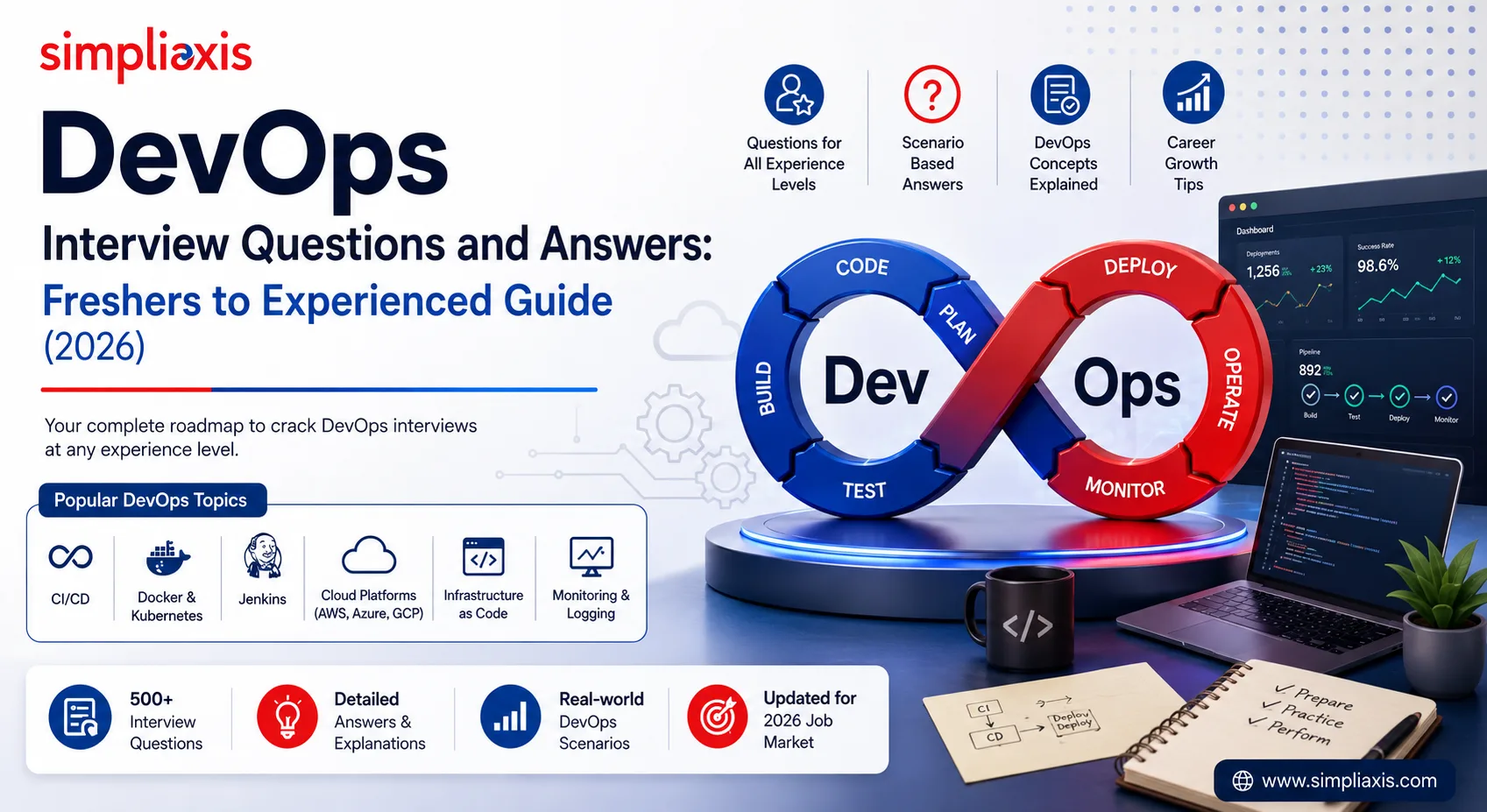
DevOps interview questions and answers in 2026 fall into five buckets: fundamentals (CI/CD, Agile vs DevOps), pipelines and Jenkins, containers (Docker and Kubernetes), infrastructure as code (Terraform, Ansible), and scenario-based troubleshooting involving cloud platforms like AWS and Azure.
Freshers should focus on concepts and lifecycle stages, while experienced candidates need to demonstrate real production judgment, incident handling, and the ability to design scalable workflows.
Key Highlights of DevOps Interview Questions and Answers
- Interviews now test judgment, not just definitions. Since most teams already run CI/CD and containers, interviewers focus on root cause thinking, automation mindset, cost/security trade-offs, and calm communication during simulated outages rather than asking “what is Docker.”
- Hiring loops run three to five structured rounds screening, fundamentals (Git, Linux, CI/CD concepts), hands-on problem-solving (writing a Jenkinsfile, debugging a Kubernetes manifest live), scenario/system design, and a culture-fit round covering collaboration and ownership.
- Questions cluster into five revision buckets: fundamentals (Agile vs DevOps, CI/CD, lifecycle stages), pipelines and Jenkins, containers (Docker and Kubernetes troubleshooting), infrastructure as code (Terraform vs Ansible), and cloud scenarios spanning AWS and Azure services.
- Experience level changes the bar. Freshers should master lifecycle stages, Git, and Linux basics, while candidates with 3–5 years of experience need to design scalable pipelines, debug live Kubernetes issues, and narrate real production incidents with specific tools, timelines, and measurable outcomes like reduced MTTR.
- Scenario answers need the STAR + Reflection framework — Situation, Task, Action, Result, and crucially Reflection, since explaining what safeguard was added afterward (a new test, stricter deployment gate, better runbook) is what separates a complete answer from an incomplete one.
- Common mistakes sink otherwise strong candidates: memorizing definitions without practical context, overclaiming tool expertise, ignoring the business "why" behind DevOps practices, skipping the reflection step in incident stories, underestimating soft-skills rounds, and giving generic answers instead of tailoring examples to the target cloud platform.
DevOps interviews have changed considerably over the last few years. Hiring managers no longer stop at "what is a Dockerfile" or "what is Git." Since most engineering teams already run CI/CD pipelines and containerized workloads, interviewers are far more interested in
- How a candidate thinks under pressure,
- How they debug a stalled deployment at 2 a.m.,
- Whether they understand the business impact of downtime.
This shift means that DevOps interview questions and answers in 2026 skew heavily toward applied reasoning rather than definitions alone.
This guide is built for every stage of the DevOps career ladder. Whether you are searching for DevOps interview questions for freshers, preparing for DevOps interview questions for 3 years experience, or brushing up on DevOps interview questions for 5 years of experience, you will find structured answers, scenario walkthroughs, and a practical revision plan below.
It also includes dedicated sections on Azure DevOps interview questions and AWS interview questions for DevOps, since cloud platform fluency is now a baseline expectation rather than a bonus skill.
How DevOps Interviews Work in 2026?
DevOps hiring loops today are structured to test three things together: conceptual clarity, hands-on tool proficiency, and production judgment. A candidate who can recite the CI/CD process but freezes when asked to debug a failing pipeline will struggle to clear mid-to-senior rounds.
Interviewers favor open-ended, judgment-based DevOps interview questions over rote definitions. This is because most tooling knowledge is now assumed rather than tested from scratch.
DevOps Interview Rounds Explained
Most companies run DevOps hiring across three to five rounds, though the exact structure varies by organization size and seniority level.
- Screening round: A recruiter or hiring manager verifies your resume claims, tools used, and years of hands-on experience with CI/CD, cloud, and automation.
- Technical round 1 (fundamentals and tools): This covers DevOps interview questions and answers on Git, Linux, CI/CD concepts, and basic scripting.
- Technical round 2 (hands-on or live problem-solving): Candidates may be asked to write a Jenkinsfile, debug a Kubernetes manifest, or explain a Terraform plan output live.
- Scenario or system design round: This is where DevOps scenario-based interview questions dominate, such as designing a CI/CD pipeline for a production application or handling a failed deployment.
- Managerial or culture-fit round: Focuses on collaboration, incident communication, and ownership, often paired with HR interview questions and answer-style discussions about past projects.
What Interviewers Evaluate Beyond Tool Knowledge?
Knowing that Jenkins has a master-agent architecture or that Terraform uses declarative syntax is necessary but not sufficient anymore. Interviewers are now evaluating:
- Root cause thinking: Can you isolate whether an issue is a build failure, a networking problem, or a configuration drift, rather than guessing?
- Automation mindset: Do you default to scripting a repeatable fix, or do you patch things manually each time?
- Cost and security awareness: Can you weigh trade-offs like scaling cost versus reliability, or explain how you would secure a pipeline against credential leaks?
- Communication under pressure: In a scenario-based question about a production outage, can you explain your steps clearly and calmly, the way you would to a real team during an incident call?
- Collaboration across roles: Since DevOps sits between development, QA, and operations, interviewers often probe how you communicate blockers, similar to what shows up in Scrum Master interview questions around cross-functional facilitation.
Top 25 DevOps Interview Questions and Answers
This section is organized by theme so you can revise in focused blocks. Each answer is written to be interview-ready, concise, and technically accurate for 2026 hiring standards.
DevOps Fundamentals Interview Questions
1. What Is DevOps and Why Is It Important?
DevOps is a cultural and technical practice that unifies software development (Dev) and IT operations (Ops) to shorten the software delivery lifecycle while improving reliability. It relies on automation, continuous feedback, and shared ownership between teams that historically worked in silos.
DevOps matters because it reduces the time between writing code and getting it safely into production, lowers deployment failure rates, and improves how quickly issues are detected and resolved.
Organizations adopt DevOps to ship features faster without compromising system stability, which is the core reason it remains one of the most asked DevOps interview questions across experience levels.
2. What Is the Difference Between Continuous Integration and Continuous Delivery?
Continuous Integration (CI) is the practice of merging code changes frequently into a shared repository, where automated builds and tests validate each change immediately.
Continuous Delivery (CD) extends this by ensuring that every validated build is automatically prepared for release to production, though the actual deployment may still require manual approval.
Continuous Deployment, a related but distinct concept, removes that manual gate and pushes every passing build live automatically.
Interviewers ask this because confusing CD's two meanings, delivery versus deployment, is a common mistake among freshers.
3. What Are the Key Principles of DevOps?
The core DevOps principles include automation of repetitive tasks, continuous integration and delivery, infrastructure as code, proactive monitoring and feedback loops, and a culture of shared responsibility between development and operations.
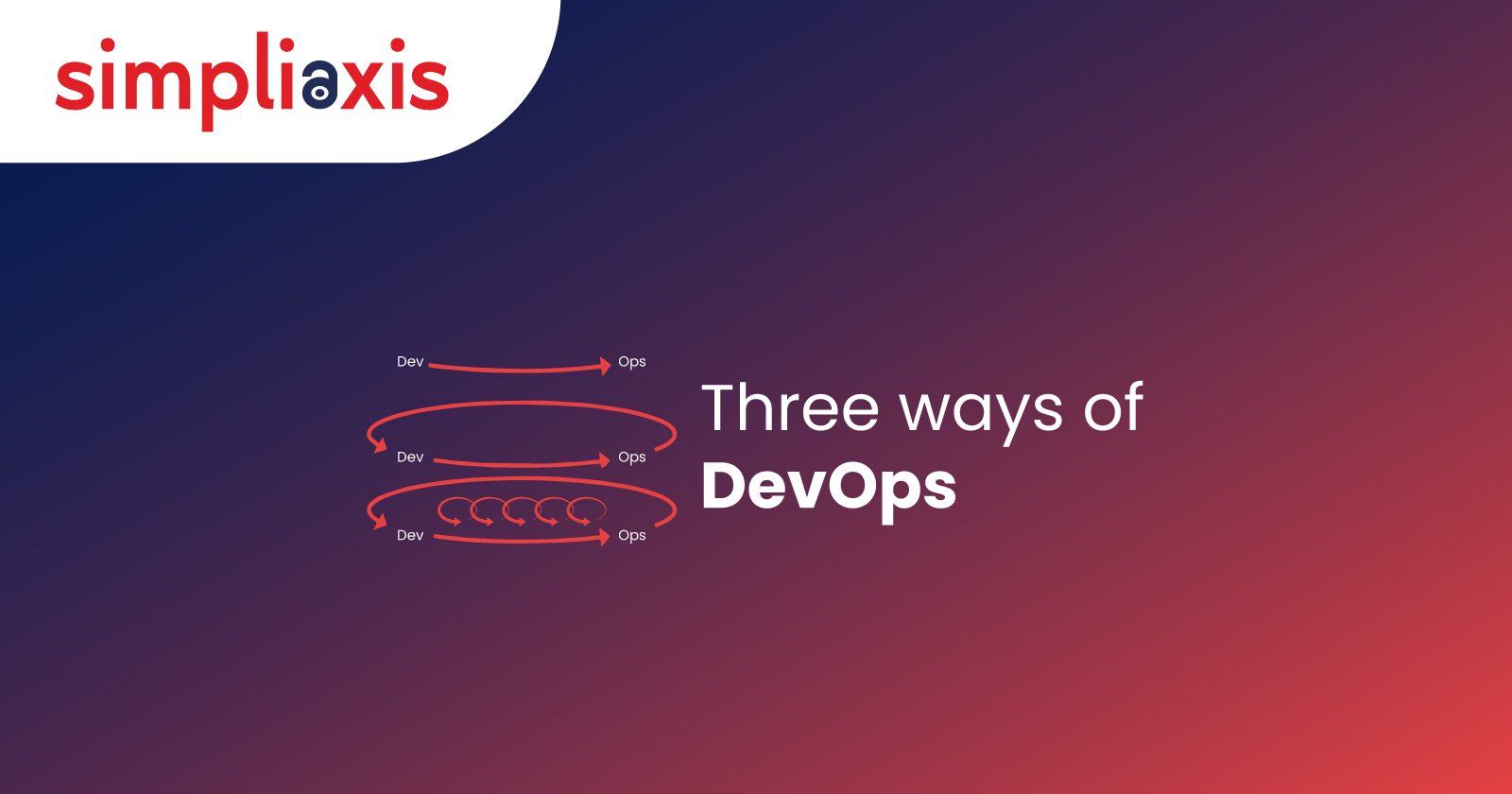
Collaboration and communication underpin all of these, since tools alone cannot fix a siloed organization. Many interviewers also expect candidates to mention the "three ways" from DevOps philosophy: optimizing flow, amplifying feedback loops, and fostering continuous experimentation and learning.
4. Explain the DevOps Lifecycle.
The DevOps lifecycle is typically described as a continuous loop with these stages: plan, code, build, test, release, deploy, operate, and monitor.
Planning defines requirements and sprint goals, coding and building produce the application artifact, testing validates functionality and performance, and release and deploy push that artifact into production environments.
Operate and monitor close the loop by tracking system health and feeding insights back into planning. This lifecycle is intentionally circular rather than linear, which is what separates DevOps from traditional waterfall delivery.
5. What Is the Difference Between Agile and DevOps?
Agile vs DevOps are known for their contrasting differences.
Agile is a project management methodology focused on iterative development, frequent stakeholder feedback, and adaptive planning, typically expressed through sprints and backlogs.
DevOps is a broader engineering and cultural practice focused on automating and streamlining the path from code commit to production deployment. Agile answers "how do we plan and build software in short cycles," while DevOps answers "how do we deliver and operate that software reliably and fast."
In practice, most modern teams run Agile for planning and DevOps for delivery, and interviewers often follow this up with a scenario about how the two intersect in a sprint-based release cycle.
Also read:DevOps Foundation certification cost
CI/CD Pipeline Interview Questions
6. What Is a CI/CD Pipeline and How Does It Work?
A CI/CD pipeline is an automated sequence of stages that takes code from a commit to a deployable, tested artifact and often all the way to production.
A typical pipeline includes source control triggers, build compilation, automated unit and integration testing, artifact packaging, deployment to staging, and a final release step to production, often gated by approvals or automated quality checks.
Tools like Jenkins, GitHub Actions, GitLab CI/CD, and Azure Pipelines orchestrate these stages, triggering each step automatically once the previous one succeeds.
7. How Would You Design a CI/CD Pipeline for a Production Application?
A strong answer walks through the full design rather than naming tools. Start with source control triggers on pull request merges, run unit tests and static code analysis first since they are fastest; then build and containerize the application.
Push the image to an artifact registry, deploy to a staging environment for integration and smoke tests, and gate production deployment behind either manual approval or automated canary analysis. Include rollback automation, secrets management through a vault service, and monitoring hooks so that a failed deployment triggers an alert immediately.
This is one of the most common DevOps scenario-based interview questions because it reveals whether a candidate thinks in terms of resilience, not just automation.
8. Explain Jenkins Architecture and Its Components.
Jenkins follows a master-agent (also called controller-agent) architecture. The Jenkins controller manages the web UI, schedules jobs, and stores configuration, while agents, which can run on separate machines or containers, execute the actual build and test tasks.
Key components include Jobs or Pipelines (defined via Jenkinsfile using Declarative or Scripted syntax), Plugins that extend functionality for source control, notifications, and deployments, and the Build Queue that manages job scheduling across available agents.
Distributing builds across agents allows Jenkins to scale horizontally and isolate workloads by environment or hardware requirement.
9. What Is the Difference Between Jenkins, GitHub Actions, and GitLab CI/CD?
| Feature | Jenkins | GitHub Actions | GitLab CI/CD |
| Hosting | Self-hosted, plugin-based | Cloud-native, integrated with GitHub | Cloud or self-hosted, integrated with GitLab |
| Configuration | Jenkinsfile (Groovy-based) | YAML workflow files | YAML |
| Setup effort | Higher, requires server maintenance | Low, built into repository | Low, built into repository |
| Best fit | Complex, highly customized pipelines | Teams already using GitHub | Teams already using GitLab, strong built-in DevSecOps |
Jenkins offers the most flexibility through its plugin ecosystem but demands more maintenance overhead.
GitHub Actions and GitLab CI/CD trade some flexibility for tighter integration and lower operational burden, which is why many newer teams default to them unless they have legacy Jenkins pipelines already in place.
10. How Do You Troubleshoot a Failed CI/CD Pipeline?
Start by checking the pipeline logs for the exact stage and error message rather than assuming the cause. Common failure points include dependency resolution errors, failing test cases, environment variable or secrets misconfiguration, insufficient build agent resources, and permission issues with the artifact registry or deployment target.
A structured approach is to isolate whether the failure is a code issue, a configuration issue, or an infrastructure issue, then reproduce it locally or in a sandboxed environment before pushing a fix.
Always confirm the fix by re-running the exact failed stage rather than the full pipeline, to save time and confirm the root cause was addressed.
Docker and Kubernetes Interview Questions
11. What Is Docker and Why Is It Used in DevOps?
Docker is a containerization platform that packages an application along with its dependencies, libraries, and runtime into a single portable image. This image runs consistently across development, testing, and production environments, eliminating the "it works on my machine" problem.
Docker is central to DevOps because it enables faster, more consistent deployments, supports microservices architecture, and integrates cleanly into CI/CD pipelines where each build can be tested and shipped as an immutable image.
12. What Is the Difference Between Containers and Virtual Machines?
Virtual machines virtualize entire hardware stacks, each running its own full operating system on top of a hypervisor, which makes them heavier and slower to start. Containers virtualize at the operating system level, sharing the host OS kernel while isolating processes, filesystems, and networking for each application.
This makes containers significantly lighter, faster to start, and more efficient in resource usage, though VMs still offer stronger isolation for workloads with strict security or compliance boundaries.
Most interviewers expect candidates to also mention that containers are ephemeral by design, which shapes how state and storage are handled differently than in VM-based systems.
13. Explain Kubernetes Architecture.
Kubernetes architecture is split into a control plane and worker nodes. The control plane includes the API server (the entry point for all commands), etcd (a key-value store holding cluster state), the scheduler (which assigns pods to nodes), and the controller manager (which maintains desired state).
Worker nodes run the kubelet (which communicates with the control plane), kube-proxy (which handles networking), and the container runtime that actually runs the pods.
Pods, the smallest deployable unit in Kubernetes, can contain one or more tightly coupled containers that share networking and storage.
14. A Kubernetes Pod Is Continuously Restarting. How Would You Troubleshoot It?
This is a classic DevOps scenario-based interview question testing methodical debugging. Start with kubectl describe pod to check events, resource limits, and recent state changes, followed by kubectl logs on the current and previous container instance using the-- previous flag.
Common causes include failing liveness or readiness probes, insufficient memory causing OOMKilled events, missing environment variables or misconfigured secrets, or an application crash on startup due to a dependency not being ready.
Once the root cause is identified, whether it is a probe misconfiguration or a resource limit that is too tight, the fix should be applied through the deployment manifest so it persists across future rollouts rather than a one-off manual patch.
15. Explain Kubernetes Deployment Strategies.
The most common strategies are rolling updates, blue-green deployment, and canary deployment.
Rolling updates gradually replace old pods with new ones while keeping the application available throughout, and this is Kubernetes' default strategy. Blue-green deployment runs two identical environments, only switching traffic to the new version once it is fully validated, which allows instant rollback but requires double the infrastructure temporarily.
Canary deployment routes a small percentage of traffic to the new version first, monitors for errors, and gradually increases traffic if metrics stay healthy, making it the safest option for high-risk releases.
Infrastructure as Code and Automation Questions
16. What Is Infrastructure as Code (IaC)?
Infrastructure as Code is the practice of defining and provisioning infrastructure, such as servers, networks, and storage, through machine-readable configuration files rather than manual setup.
This makes infrastructure version-controlled, repeatable, and testable in the same way application code is. IaC eliminates configuration drift between environments and allows teams to spin up or tear down entire environments consistently using tools like Terraform, AWS CloudFormation, or Azure Resource Manager templates.
17. Explain Terraform and Its Workflow.
Terraform is a declarative IaC tool that lets you define infrastructure across multiple cloud providers using HashiCorp Configuration Language (HCL).
The core workflow follows four steps: terraform init to initialize the working directory and download provider plugins, terraform plan to preview what changes will be made, terraform apply to execute those changes, and terraform destroy to tear down resources when no longer needed.
Terraform maintains a state file that tracks the current infrastructure so it can calculate exactly what needs to change on each application, rather than reapplying everything from scratch.
18. What Is the Difference Between Terraform and Ansible?
Terraform is primarily a provisioning tool, built to create and manage cloud infrastructure like virtual machines, networks, and load balancers using a declarative approach.
Ansible is primarily a configuration management tool, used to install software, manage configurations, and orchestrate tasks on already-provisioned servers using an agentless, YAML-based playbook model. Many production environments use both together:
Terraform provides the servers, and Ansible then configures the software running on them. Interviewers ask this to check if candidates understand that these tools solve different problems rather than being interchangeable.
19. What Are Configuration Management Tools?
Configuration management tools automate the setup, maintenance, and consistency of software configurations across servers.
Popular tools include Ansible (agentless, YAML-based), Chef (Ruby-based, uses a client-server model), Puppet (declarative, also client-server based), and SaltStack (fast, supports both push and pull models).
These tools ensure that every server in a fleet, whether ten or ten thousand, has an identical, predictable configuration, which is essential for eliminating "works on one server but not another" issues.
20. What Is Idempotency in DevOps?
Idempotency means that running the same automation script or configuration multiple times produces the same end result without unintended side effects. For example, an idempotent Ansible playbook that ensures a package is installed will simply confirm it is already installed on a second run rather than reinstalling it or throwing an error.
This property is critical in DevOps automation because scripts and pipelines often run repeatedly, whether by design or due to retries after a failure, and non-idempotent scripts can cause duplicate resources, broken states, or inconsistent environments.
Cloud, Monitoring, Security, and Scenario-Based Questions
21. Explain AWS DevOps Services You Have Worked With.
A strong answer names specific services mapped to their function rather than listing everything AWS offers.
Common ones include AWS CodePipeline and CodeBuild for CI/CD orchestration, CodeDeploy for automated deployments across EC2, ECS, or Lambda, CloudFormation for infrastructure as code, CloudWatch for monitoring and alerting, and IAM for access control.
For candidates targeting AWS-heavy roles, it helps to mention real usage, for instance, describing how CodePipeline triggered a CodeBuild job that ran tests before CodeDeploy rolled the build out to an Auto Scaling group.
This is a frequent theme in AWS DevOps interview questions, since interviewers want proof of hands-on exposure rather than textbook recall.
22. Explain Azure DevOps and Its Key Components.
Azure DevOps is Microsoft's integrated suite of tools covering the entire software delivery lifecycle.
Its five core components are
- Azure Repos (Git-based source control),
- Azure Pipelines (CI/CD automation using YAML or classic pipelines),
- Azure Boards (work item tracking, backlogs, and sprint planning),
- Azure Artifacts (package management for NuGet, npm, and Maven feeds)
- Azure Test Plans (manual and exploratory testing).
Azure Pipelines specifically supports multi-stage YAML pipelines that can build, test, and deploy to multiple environments, including non-Azure targets like AWS or on-premises servers, which is a nuance interviewers often probe in Azure DevOps interview questions and answers to see if candidates understand it is not locked to Azure infrastructure alone.
23. How Do You Monitor Applications in Production?
Production monitoring typically spans three layers: infrastructure metrics (CPU, memory, disk, network), application performance metrics (response times, error rates, throughput), and business metrics (user sign-ups, transaction success rates).
Tools like Prometheus and Grafana handle metrics collection and visualization, the ELK stack or Loki handles centralized logging, and distributed tracing tools like Jaeger or OpenTelemetry help track requests across microservices.
A mature monitoring setup also includes alerting thresholds tied to Service Level Objectives (SLOs), so teams get notified before customers notice a problem, not after.
24. Production Deployment Failed After Release. How Would You Handle It?
This scenario tests composure and process, not just technical skill. The first step is to assess impact and decide quickly whether to roll back or forward-fix, generally favoring rollback if the fix is not immediately obvious.
Next, communicate the incident status to stakeholders, since silence during an outage damages trust more than the outage itself. Once traffic is stable, investigate logs and monitor dashboards to find the root cause, whether that is a bad configuration, an untested edge case, or a dependency failure.
Finally, document the incident and add a safeguard, such as a new automated test, a stricter deployment gate, or an improved rollback script, so the same failure cannot recur silently.
25. How Would You Design a Scalable DevOps Workflow for a Large Application?
For a large application, the workflow needs to separate concerns clearly: microservices with independent CI/CD pipelines per service, a shared artifact registry, and infrastructure as code templates that are reusable across environments.
Use feature flags to decouple deployment from release, canary or blue-green strategies to reduce blast radius, and centralized observability so issues in one service are visible across the whole system.
Auto-scaling policies tied to real traffic metrics, combined with cost monitoring, ensure the system scales efficiently rather than just scaling blindly.
This question often overlaps with interview questions for DevOps engineer roles at senior levels, where system design thinking matters as much as tool familiarity.
How to Answer Scenario-Based DevOps Interview Questions?
Scenario questions are where most candidates lose points, not because they lack knowledge, but because they answer too generically. Interviewers want to see a structured thought process applied to a specific, believable situation.
The STAR + Troubleshooting Framework
The standard STAR framework (Situation, Task, Action, Result) works well for behavioral questions, but DevOps scenarios benefit from an extended version: Situation, Task, Action, Result, and Reflection.
The Reflection step matters most in technical interviews because it shows whether you learned something systemic from the incident, such as adding monitoring or improving a runbook, rather than just fixing the immediate symptom.
When faced with a DevOps scenario-based interview question, briefly restate the problem, walk through your diagnostic steps in order, state the fix, and close with what you changed to prevent recurrence.
Also read: HR interview questions and answers
How to Explain Real Production Incidents?
When describing a real incident from past experience, be specific about the timeline and your exact actions rather than speaking in vague generalities.
Mention the tools you used to diagnose the issue, the decision points where you had to choose between options like rollback versus forward-fix, and the measurable outcome, such as reduced downtime or mean time to recovery.
Avoid overstating your individual role if it was a team effort; interviewers value honesty about collaboration, especially since DevOps incidents rarely involve just one person.
7-Day DevOps Interview Preparation Roadmap
This roadmap works whether you are preparing DevOps interview questions for freshers or brushing up as an experienced candidate targeting a lead role.
Day 1: Master DevOps Fundamentals and Lifecycle
Revise the DevOps lifecycle stages, the difference between Agile and DevOps, and core principles like automation and shared ownership. Freshers should focus heavily here since fundamentals carry more weight in entry-level interviews.
Day 2: Revise Linux, Git, and Version Control Concepts
Practice common Linux commands for process management, file permissions, and networking, alongside Git workflows including branching strategies, merge conflict resolution, and rebase versus merge. Almost every DevOps interview questions and answers list includes at least one Git scenario, such as recovering a lost commit or resolving a merge conflict.
Day 3: Practice CI/CD Pipeline and Jenkins Questions
Go through pipeline design questions, Jenkins architecture, and the differences between major CI/CD tools. Try writing a sample Jenkinsfile or GitHub Actions YAML file from memory to test your practical recall, not just conceptual understanding.
Day 4: Learn Docker and Kubernetes Troubleshooting
Focus on container fundamentals, Kubernetes architecture, and common troubleshooting scenarios like crash loops, failed probes, and resource limits. This is often the most heavily tested area in interview questions for DevOps engineer roles above the fresher level.
Day 5: Prepare Terraform, Ansible, and Cloud DevOps Topics
Review Terraform workflow commands, the difference between provisioning and configuration management tools, and cloud-specific services. Split time evenly between Azure DevOps interview questions and AWS DevOps interview questions if you are unsure which platform the target company uses, since many job descriptions mention both interchangeably.
Day 6: Practice Scenario-Based DevOps Interview Questions
Run through five to six scenario questions using the STAR + Troubleshooting framework, ideally out loud or with a peer. Focus on scenarios involving failed deployments, scaling issues, and security incidents, since these dominate mid-to-senior interviews.
Day 7: Review Projects, Mock Interviews, and Common Mistakes
Revisit your own resume projects and prepare to explain them in technical depth, since interviewers frequently drill into specifics. Do at least one full mock interview covering fundamentals, tool-specific questions, and one scenario, then review the common mistakes list below to avoid last-minute slip-ups.
Also read: Scrum Master interview questions
Common DevOps Interview Mistakes Candidates Make
- Memorizing definitions without practical context: Reciting what Kubernetes is without being able to explain a real troubleshooting flow signals shallow knowledge to interviewers.
- Overclaiming tool expertise: Listing every tool under the sun on a resume but failing to answer basic follow-up questions damages credibility quickly.
- Ignoring the "why" behind DevOps practices: Focusing purely on tools while missing the business reasoning, such as why faster deployment cycles matter for customer retention.
- Skipping the reflection step in incident stories: Describing a fix without mentioning what was changed afterward to prevent recurrence makes the answer feel incomplete.
- Underestimating soft skills rounds: Treating collaboration and communication questions, similar to what appears in HR interview questions and answers, as less important than technical rounds.
- Not tailoring answers to the target cloud platform: Giving generic answers when the role specifically requires AWS or Azure depth, instead of anchoring examples to that platform's actual services.
- Failing to ask clarifying questions on scenario prompts: Jumping straight into an answer for a DevOps scenario based interview question without confirming assumptions about scale, team size, or constraints.
DevOps Certifications That Improve Interview Readiness
Certifications will not replace hands-on experience, but they signal structured knowledge and give you a shared vocabulary with interviewers, which matters especially for freshers or professionals transitioning from adjacent roles.
TheDevOps Foundation certification is a strong starting point for candidates new to DevOps, covering core principles, the DevOps lifecycle, CI/CD, and automation fundamentals through a globally recognized credential accredited by the DevOps Institute. It requires no strict prerequisites, making it accessible to developers, testers, and IT operations staff alike, and it directly maps to many of the fundamental questions covered earlier in this guide.
For candidates targeting cloud-heavy roles, theAWS DevOps Engineer certification training goes deeper into CI/CD implementation on AWS, infrastructure as code, monitoring, incident response, and security automation, aligning closely with the AWS Certified DevOps Engineer - Professional exam.
This certification is particularly useful preparation for AWS DevOps interview questions and AWS interview questions for DevOps roles at the 3- to 5-year experience level, since the curriculum mirrors real production scenarios rather than just tool syntax.
Conclusion
DevOps interviews in 2026 reward candidates who can move fluidly between concepts, tools, and real production judgment. Freshers should anchor their preparation in fundamentals, Git, and Linux basics, while experienced professionals need to demonstrate scenario handling, cloud platform depth, and the ability to explain past incidents with clarity and ownership. Whether you are revising DevOps interview questions for 3 years of experience or preparing for senior interview questions for a DevOps engineer role, the strongest answers always connect a technical fact to a real-world consequence.
Use the 25 questions and answers in this guide as your core revision material, follow the 7-day roadmap to structure your final week of preparation, and consider a certification like DevOps Foundation or the AWS DevOps Engineer training if you want a more structured path into the field. Preparation that combines conceptual clarity with hands-on scenario practice is what ultimately separates candidates who pass technical screening from those who get the offer.





 Lowest-Price Challenge










 Personalized Path


.webp)


 USA
USA  Canada
 India
India UK
UK Australia
 Singapore


