


 Call Us



Quick Answer
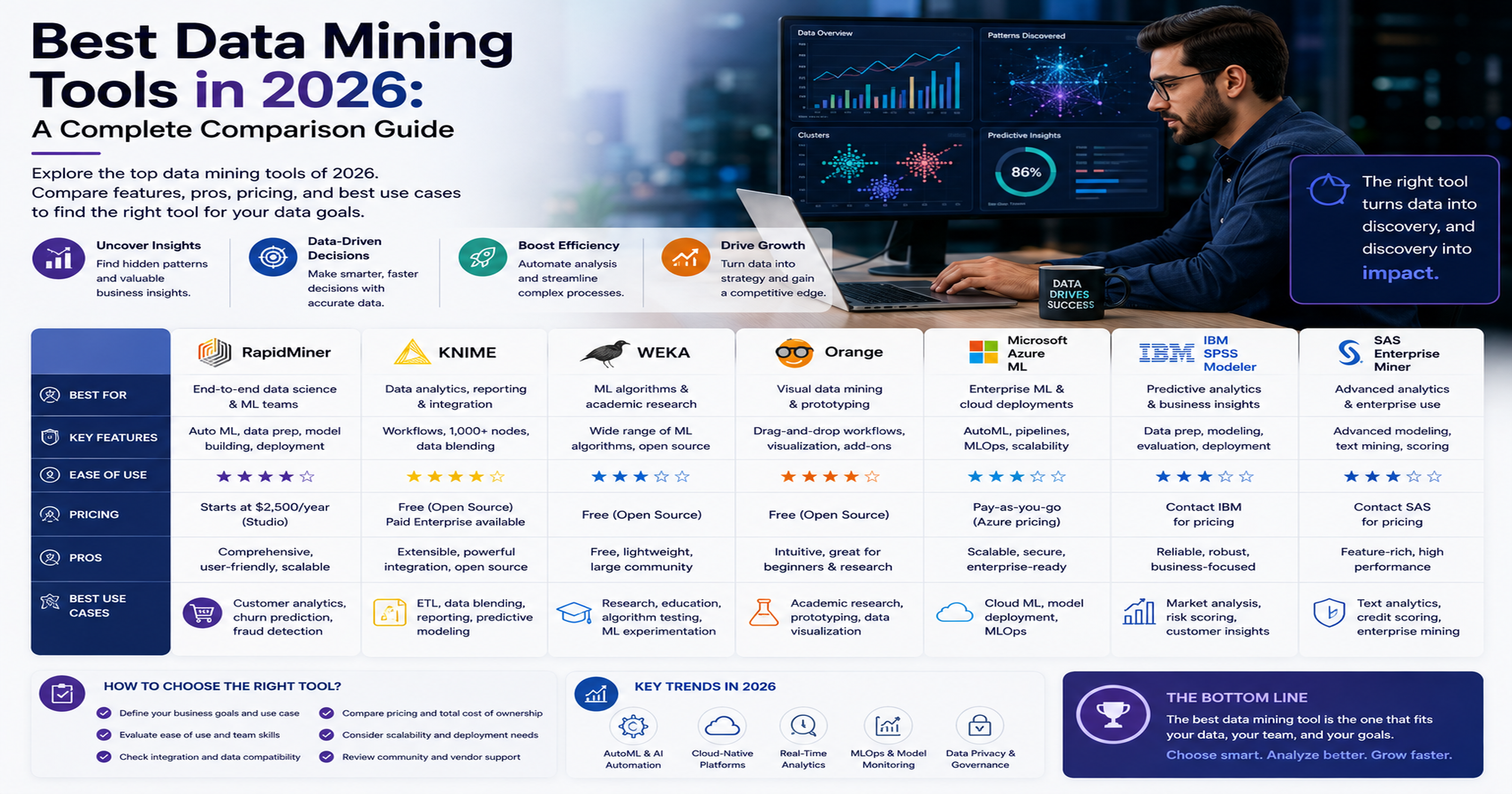
The best data mining tool depends on your team's skill level and budget. For teams that want a free, no-code option, KNIME Analytics Platform and Orange are the strongest open source choices, while Weka remains the standard for academic algorithm research. Teams that want enterprise governance and support should look at IBM SPSS Modeler, SAS Enterprise Miner, or Altair AI Studio (formerly RapidMiner), and organizations already running Oracle Database can use Oracle Data Miner at no extra license cost. Coding-first data science teams typically build custom pipelines with Python's scikit-learn and pandas instead of a packaged GUI tool.
Key Highlights of Data Mining Tools
- Data mining tools split into two broad licensing models: free and open source (KNIME, Orange, Weka, Rattle, scikit-learn, Apache Mahout) and commercial or subscription based (IBM SPSS Modeler, SAS Enterprise Miner, Altair AI Studio, Qlik Sense, MonkeyLearn).
- Since December 2019, Oracle bundles its Advanced Analytics option, including Oracle Data Miner, free with Oracle Database Enterprise Edition, removing what used to be a separate paid license.
- No-code, drag-and-drop platforms such as KNIME, Orange, and Altair AI Studio suit business analysts, while code-first libraries such as scikit-learn and pandas suit teams with programming skills who want full control.
- Specialized tools exist for specific mining tasks: Apache Mahout for distributed machine learning on Hadoop or Spark, and MonkeyLearn for no-code text and sentiment mining.
- Enterprise commercial tools carry meaningfully higher costs than open source alternatives; published estimates for IBM SPSS Modeler Professional start near $529 per month, while SAS Enterprise Miner licensing is typically negotiated per organization and can run into six figures annually.
- The global data mining tools market is forecast to keep growing through the late 2020s, though independent research firms differ widely on the exact market size, so any single figure should be treated as directional rather than exact.
What Are Data Mining Tools
Data mining tools are software applications that help analysts and data scientists find patterns, correlations, anomalies, and predictive relationships hidden inside large datasets. They sit at the analysis and modeling stage of a broader data pipeline: raw data is first collected and cleaned, then a data mining tool applies statistical and machine learning techniques such as classification, clustering, regression, association rule mining, and anomaly detection to surface insights a person could not find by manually scanning spreadsheets.
Data mining tools are related to but distinct from a few adjacent categories worth separating out:
- Business intelligence (BI) tools like dashboards mainly visualize known metrics; data mining tools discover previously unknown patterns.
- ETL (extract, transform, load) tools move and clean data; data mining tools analyze it once it is ready.
- General machine learning frameworks such as TensorFlow or PyTorch are usually used for building custom deep learning models, while classic data mining tools focus on structured or semi-structured tabular and text data with built-in algorithms that need less custom code.
Learners who want the underlying statistics and machine learning theory behind these tools, not just the software, often start with a structured course. Simpliaxis' Data Science Certification Courses and the Data Science with Python Training cover the classification, clustering, and regression concepts that every data mining tool in this guide implements under the hood.
Categories of Data Mining Tools
Open Source vs Commercial
Open source data mining tools, such as KNIME Analytics Platform, Orange, Weka, Rattle, and Apache Mahout, are free to download and modify, with development driven by a community or an academic institution. They are ideal for learning, prototyping, and cost-sensitive teams, though large-scale deployments often still need to budget for a paid support layer (for example, KNIME's Business Hub) once a project moves from an individual analyst's laptop into production.
Commercial tools, such as IBM SPSS Modeler, SAS Enterprise Miner, Qlik Sense, and MonkeyLearn, charge a subscription or license fee in exchange for vendor support, service-level agreements, pre-built connectors, and enterprise governance features like role-based access and audit trails. These are generally the better fit for regulated industries such as banking, insurance, and healthcare, where formal vendor accountability matters.
Programming-Based vs GUI or No-Code
Programming-based tools, most notably Python's scikit-learn and pandas libraries and R packages behind Rattle, require coding skills but give complete control over the modeling pipeline, custom feature engineering, and integration with modern MLOps workflows. GUI or no-code tools, such as KNIME, Orange, RapidMiner or Altair AI Studio, and IBM SPSS Modeler, use drag-and-drop visual workflows so business analysts without a programming background can still build classification or clustering pipelines.
Standalone vs In-Database or Embedded
Standalone tools like Weka or Orange run as a desktop application against data you load in. In-database tools like Oracle Data Miner run mining algorithms as native SQL functions directly inside the database, avoiding the need to move large volumes of data anywhere else. This in-database approach can matter a great deal for performance and governance once dataset sizes reach into the billions of rows.
General Purpose vs Specialized
Most tools on this list are general purpose, supporting classification, clustering, regression, and association rules across any structured dataset. A smaller group of tools specializes: Apache Mahout focuses on distributed machine learning for very large datasets on Hadoop, Spark, or Flink, and MonkeyLearn focuses specifically on text mining tasks like sentiment analysis, topic detection, and keyword extraction from unstructured text such as support tickets or survey responses.
Comparison Table of Leading Data Mining Tools
| Tool | Vendor / Maintainer | License / Pricing Model | Key Features | Best For
|
| KNIME Analytics Platform | KNIME AG | Free and open source (GPL) desktop app; paid KNIME Business Hub tiers for collaboration and automation | Visual drag-and-drop workflow builder, 300+ data connectors, native Python and R integration, large community node library | Teams that want a free tool with a clear upgrade path to enterprise deployment |
| Orange | University of Ljubljana Bioinformatics Laboratory | Free and open source (GPL-3.0) | Visual programming widgets, built on NumPy, SciPy, and scikit-learn, add-ons for text mining, bioinformatics, and network analysis | Students, educators, and researchers learning data mining concepts visually |
| Weka | University of Waikato | Free and open source (GNU GPL) | Large built-in library of classification, regression, clustering, and association-rule algorithms in Java, plus an Experimenter module for comparing algorithms | Academic research, teaching, and rigorous algorithm benchmarking |
| Altair AI Studio (formerly RapidMiner) | Altair | Free community tier plus paid annual subscription tiers for enterprise features | Drag-and-drop pipelines, AutoML for clustering and predictive modeling, generative AI and LLM integrations, enterprise deployment tooling | Cross-functional teams that want AutoML with a governed path to production |
| Rattle | R community / R Journal project | Free and open source (GNU GPL) | Tab-based GUI over the R language, logs every action as reusable R code, built-in data partitioning for training and validation | R users who want a GUI layer for exploratory data mining and teaching |
| scikit-learn and pandas (Python) | Open source community | Free and open source (BSD-3-Clause) | Extensive classification, regression, clustering, and dimensionality-reduction algorithms; deep integration with the broader Python data science ecosystem | Data scientists who prefer code-first, fully customizable pipelines |
| IBM SPSS Modeler | IBM | Commercial subscription; Professional tier reported from roughly $529 per month, with Premium and Gold tiers above that | Visual modeler, in-database mining and SQL pushback, text analytics, automated data preparation, geospatial analytics | Enterprises that need governed predictive analytics with formal vendor support |
| SAS Enterprise Miner | SAS Institute | Commercial enterprise licensing, individually negotiated; published estimates range widely and can reach well into six figures annually | Visual process-flow diagrams, advanced statistical and predictive modeling, model deployment and monitoring | Large regulated enterprises already standardized on the SAS platform |
| Oracle Data Miner (Oracle Advanced Analytics) | Oracle | Included at no extra license cost with Oracle Database Enterprise Edition since a December 2019 licensing change (previously a separate paid option) | In-database SQL-based mining algorithms for classification, regression, clustering, and anomaly detection, accessed through a SQL Developer GUI extension | Organizations with data already in Oracle Database that want in-database mining without moving data or paying an extra option fee |
| Apache Mahout | Apache Software Foundation | Free and open source (Apache License 2.0) | Distributed linear algebra framework, mathematically expressive Scala DSL, runs on Hadoop, Spark, or Flink | Big data teams that need scalable machine learning on distributed infrastructure |
| Qlik Sense | Qlik | Commercial subscription; Business tier reported around $31 per user per month, Enterprise Professional around $72.50 per user per month, capacity-based pricing above that | Associative data engine, natural language and cognitive query engine, embedded analytics, broad connector library | Self-service analytics teams that want pattern discovery built into a BI workflow |
| MonkeyLearn | MonkeyLearn | Commercial subscription; Pro tier reported around $299 per month, with a free tier and custom enterprise pricing | No-code text classification and extraction, sentiment analysis, topic detection, keyword extraction, intent classification | Teams mining unstructured text from support tickets, surveys, or social media |
Pricing figures above are drawn from vendor marketplaces and third-party software review sites current as of 2026 and can change; always confirm current pricing directly with the vendor before budgeting.
Deep Dive Into the Top Data Mining Tools
KNIME Analytics Platform
KNIME uses a node-based visual workflow where each node represents a step, such as reading a file, cleaning data, or training a classifier, connected into a repeatable pipeline. Because the desktop Analytics Platform is completely free, it has become a common entry point for teams that want to combine data preparation, statistical analysis, and machine learning without committing to a paid license up front. Organizations that outgrow single-user workflows can move to KNIME's paid Business Hub tiers for scheduling, collaboration, and automation.
Orange
Orange is built on top of familiar Python scientific libraries, including NumPy, SciPy, and scikit-learn, but wraps them in a widget-based visual canvas so users can build a data mining workflow by connecting boxes rather than writing code. Its add-on ecosystem extends it into bioinformatics, text mining, and network analysis, and because it doubles as a teaching tool, it is frequently used in introductory data mining and machine learning courses.
Weka
Developed at the University of Waikato in New Zealand and first released in the 1990s, Weka remains one of the most widely used open source machine learning toolkits in Java. Its Explorer interface supports point-and-click classification, regression, clustering, and association rule mining, while its Experimenter module is specifically built for systematically comparing algorithms and settings, which makes it a favorite in academic research and coursework.
Altair AI Studio (RapidMiner)
RapidMiner was acquired by Altair, and the product is now marketed as Altair AI Studio. It keeps the drag-and-drop pipeline building that made RapidMiner popular, and adds AutoML capabilities for clustering, predictive modeling, and time series forecasting, plus more recent generative AI and large language model integrations for teams that want to combine classic data mining with modern AI workflows.
IBM SPSS Modeler
IBM SPSS Modeler is a long-established commercial data mining workbench, historically popular in market research, healthcare, and government analytics teams. Its Professional and Premium tiers add in-database mining with SQL pushback (running computation inside the database rather than pulling all data out first), text analytics, and geospatial analytics on top of the base visual modeling canvas. Full details are on IBM's SPSS Modeler product page.
Oracle Data Miner
Oracle Data Miner is the graphical extension inside SQL Developer for Oracle's Advanced Analytics option, which runs mining algorithms as native SQL functions directly inside the Oracle Database. Since Oracle changed its licensing in December 2019, Advanced Analytics, including Data Mining, is included with Oracle Database Enterprise Edition at no additional option fee, which significantly lowers the cost of entry for organizations that already run Oracle. Details are documented in Oracle's licensing change FAQ.
Apache Mahout
Apache Mahout, maintained under the Apache Software Foundation, focuses on distributed linear algebra and scalable machine learning for teams working with Hadoop, Spark, or Flink clusters. It suits organizations mining datasets too large to fit comfortably into a desktop tool like Weka or Orange.
Python: scikit-learn and pandas
Rather than a single packaged application, many data science teams build custom data mining pipelines directly in Python using scikit-learn for classification, regression, clustering, and dimensionality reduction, paired with pandas for data wrangling. Because both libraries are released under permissive BSD-style licenses with no cost and no restriction on commercial use, this route is popular wherever a team already has programming skills and wants full control over the pipeline rather than a fixed GUI workflow. Simpliaxis' Data Science with Python Training covers this exact stack for learners moving from GUI tools to code-first data mining.
How to Choose the Right Data Mining Tool
Use the following checklist to narrow down the right tool for your context.
- Team skill level. If your analysts are not programmers, a GUI tool like KNIME, Orange, or IBM SPSS Modeler will get results faster than a code-first library. If your team already codes in Python or R, scikit-learn, pandas, or Rattle may be more flexible with less overhead.
- Budget and total cost of ownership. Open source tools remove license fees but may still require budget for support, hosting, and training. Commercial tools bundle vendor support and SLAs into the subscription, which can be worth it for regulated industries but adds real recurring cost.
- Data volume and where the data lives. If your data already sits in Oracle Database, Oracle Data Miner avoids extra data movement and cost. If you are working with distributed big data on Hadoop or Spark, Apache Mahout is built for that scale, while desktop tools like Weka or Orange are better suited to datasets that fit on one machine.
- Structured data vs text. General purpose tools handle tabular data well, but if your primary goal is mining unstructured text, such as support tickets or reviews, a specialized tool like MonkeyLearn will get you to sentiment and topic insights faster than building custom NLP pipelines from scratch.
- Governance and compliance needs. Regulated industries (finance, healthcare, insurance) often need audit trails, role-based access, and a vendor support contract, which points toward IBM SPSS Modeler, SAS Enterprise Miner, or Qlik Sense over a purely open source stack.
- Deployment path. Consider whether you need the tool to stay a single analyst's desktop workflow or eventually move into a scheduled, production pipeline. Tools like KNIME and Altair AI Studio are explicitly designed with that upgrade path from free desktop to paid production hub.
Professionals building this decision-making skill as part of a broader analytics career often benefit from formal training; Simpliaxis' Big Data Analytics Training covers tool selection criteria alongside the underlying statistical methods, and the Business Analyst vs Data Analyst guide is a useful read for anyone deciding which role, and which tool skill set, fits their career path.
The Data Mining Process These Tools Support
Almost every tool in this comparison, whether GUI-based or code-based, is designed around the same general workflow, often described by the industry-standard CRISP-DM (Cross-Industry Standard Process for Data Mining) model:
- Business understanding. Define what question the mining exercise needs to answer, such as predicting churn or detecting fraud.
- Data understanding and preparation. Load, clean, and transform raw data; this is where tools like KNIME's connectors or pandas' data wrangling functions do most of the heavy lifting.
- Modeling. Apply classification, regression, clustering, or association rule algorithms, the core function every tool in this guide provides.
- Evaluation. Test model accuracy and business relevance, often using train and validation splits, a feature Rattle and Weka's Experimenter both make explicit.
- Deployment. Put the model into production, whether that means an in-database scoring function in Oracle Data Miner, a scheduled workflow in KNIME Business Hub, or a deployed API from IBM SPSS Modeler or Altair AI Studio.
Data Mining Tools by Industry Use Case
- Retail and e-commerce. Association rule mining (market basket analysis) in tools like Weka or KNIME identifies which products are frequently bought together, informing bundling and cross-sell strategy.
- Banking and finance. Classification and anomaly detection algorithms in Oracle Data Miner, SAS Enterprise Miner, and IBM SPSS Modeler are commonly used for credit scoring and fraud detection.
- Healthcare. Clustering and predictive modeling help identify patient risk groups and support clinical decision support, often within governed commercial tools that meet compliance requirements.
- Customer experience and marketing. Text mining tools like MonkeyLearn extract sentiment and topics from support tickets, reviews, and survey responses at scale, feeding directly into customer experience programs.
- Manufacturing and IoT. Distributed tools like Apache Mahout support mining sensor and machine telemetry data at a scale that would overwhelm a desktop tool.
Market Size and Adoption Trends
Independent market research firms track the data mining tools market and broadly agree it is growing, though their exact size estimates diverge considerably depending on scope and methodology. Fortune Business Insights is one of several established research firms publishing a market sizing and forecast for this category; because different firms define the market boundary differently (for example, whether they include adjacent big data platforms), readers should treat any single dollar figure as directional rather than an exact, universally agreed number. What is consistent across reports is the direction: enterprise adoption of both open source and commercial data mining tools continues to grow, driven in large part by cloud deployment and the integration of AutoML and generative AI features into established platforms like Altair AI Studio.
Key Takeaways
- There is no single best data mining tool; the right choice depends on team coding skill, budget, data volume, and governance requirements.
- Open source tools (KNIME, Orange, Weka, Rattle, scikit-learn, Apache Mahout) remove license cost and suit learning, prototyping, and many production use cases.
- Commercial tools (IBM SPSS Modeler, SAS Enterprise Miner, Qlik Sense, MonkeyLearn, Altair AI Studio) add vendor support, governance, and enterprise features at a recurring cost.
- Oracle Data Miner is now included free with Oracle Database Enterprise Edition, a meaningful change from its older paid-option licensing.
- Specialized tools exist for specific needs: Apache Mahout for distributed big data mining, MonkeyLearn for text and sentiment mining.
- Every tool in this guide ultimately supports the same underlying process, from business understanding through modeling to deployment, so the strongest long-term investment is in understanding that process, not just picking a tool.
Schema recommendation: mark up this page with both Article schema and FAQPage schema (using the questions and answers in the FAQ section above) to support rich results and improve visibility in AI-generated answer summaries.
Facts that could not be independently verified through primary sources at the time of writing: exact current subscription pricing for IBM SPSS Modeler, SAS Enterprise Miner, Qlik Sense, and MonkeyLearn (figures above are drawn from third-party software review and marketplace listings rather than direct vendor quotes and can change); the precise current global data mining tools market size, since independent research firms publish figures that differ by an order of magnitude depending on scope and methodology. These points are presented above as approximate or attributed to their source rather than as verified fact.









 Lowest-Price Challenge











 Personalized Path


.webp)


 USA
USA  Canada
 India
India UK
UK Australia
 Singapore


