


 Call Us



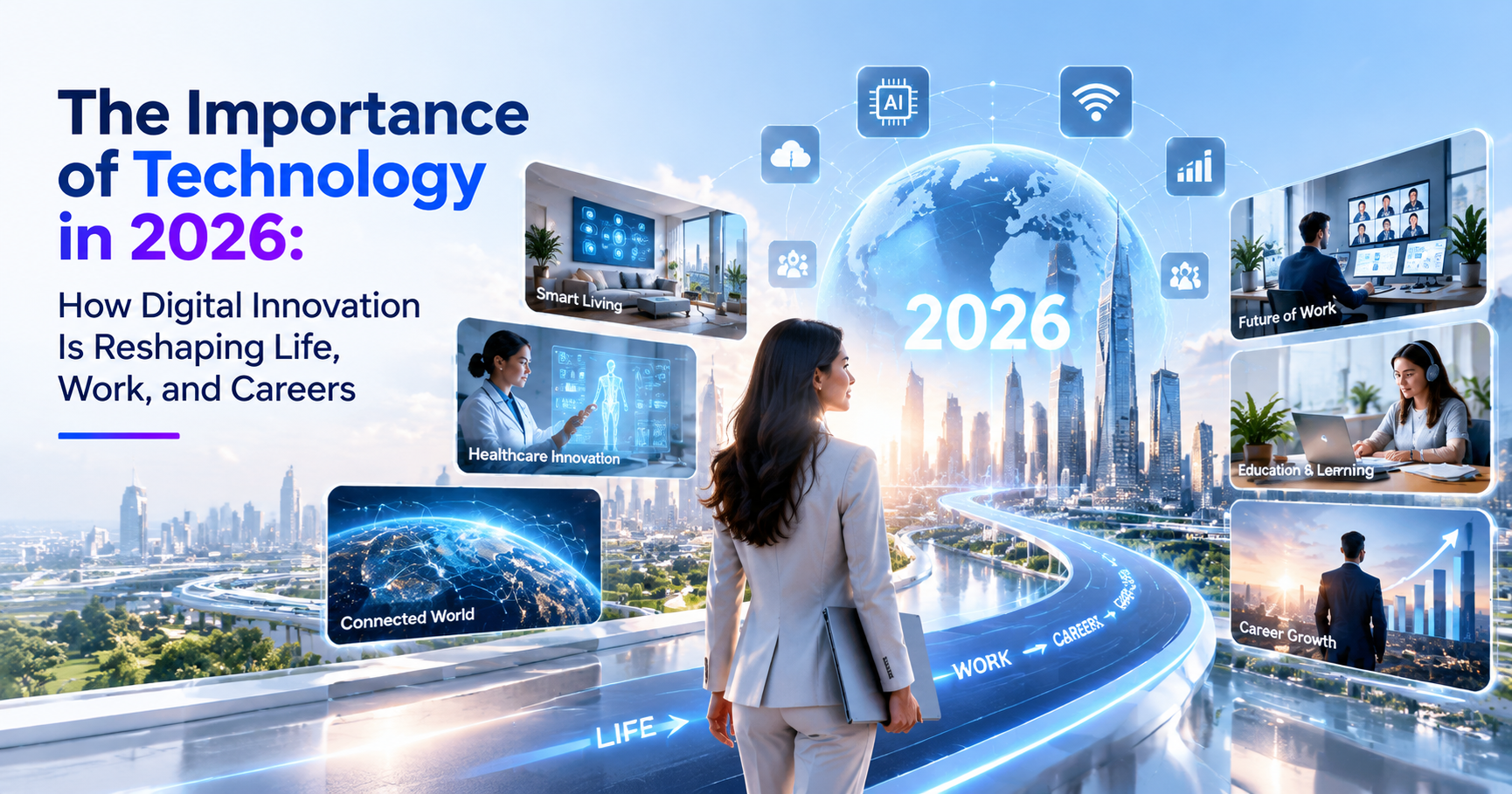
Technology matters because it multiplies human capability. It compresses the time needed to communicate, learn, diagnose illness, move money, and make decisions, while opening entirely new categories of work that did not exist a decade ago. According to the International Telecommunication Union's Facts and Figures 2025 report, roughly 6 billion people, about three quarters of humanity, are now online, and the World Economic Forum's Future of Jobs Report 2025 projects that 39 percent of core workplace skills will change by 2030 largely because of technology. For individuals and organizations alike, the real importance of technology today lies less in owning the latest device and more in building the skills to apply it well.
Key Highlights of Importance of Technology
- Technology now touches nearly every part of daily life, from communication and finance to healthcare and home automation, with the ITU reporting about 6 billion global internet users in 2025.
- In business, 88 percent of organizations report using AI in at least one function as of 2025, up from 78 percent a year earlier, according to McKinsey's State of AI survey, though most have not yet scaled it into measurable profit impact.
- The World Economic Forum projects 170 million new jobs will be created and 92 million displaced by 2030, a net gain of 78 million roles, with technological skills growing in demand faster than any other skill category.
- Telehealth adoption has become mainstream in healthcare: the American Hospital Association reports the large majority of US hospitals now offer some form of telemedicine, though it still represents a modest share of total visits.
- Companies with strong digital and AI capability earn two to six times higher shareholder returns than laggards in the same sector, per McKinsey research, showing technology adoption is now a direct business differentiator, not a side project.
- The gap between technology's potential and its payoff is a skills gap. Employers consistently cite a shortage of trained talent, which is why structured upskilling and certification have become central to how professionals stay relevant.
What Is Technology and Why Does It Matter
In its broadest sense, technology is the practical application of knowledge, tools, and systems to solve problems and extend human ability. That includes everything from a simple spreadsheet to a cloud-hosted large language model, from a hospital's diagnostic imaging system to the sensors inside a smart thermostat. What separates today's technology landscape from earlier eras is speed of diffusion. Radio took decades to reach fifty million users; generative AI tools reached hundreds of millions of users within roughly two years of public release.
That speed is exactly why understanding the importance of technology is no longer optional for professionals, students, or business leaders. Three forces are converging at once:
- Ubiquity: Connected devices, cloud platforms, and mobile access have made digital tools available to a majority of the world's population, not just wealthy institutions.
- Intelligence: Software has moved from simply storing and transmitting data to actively analyzing it, predicting outcomes, and in the case of AI agents, taking action.
- Interdependence: Business models, healthcare delivery, education, and government services increasingly assume digital access as the default, not the exception.
The result is that technology is not a single trend to track. It is the operating environment in which careers, companies, and daily routines now function. The sections below break down exactly where its importance shows up, with sourced data rather than generic claims.
Importance of Technology in Daily Life
The most visible importance of technology is in the small, repeated decisions of everyday life. Consider a typical day: a smartphone alarm synced to a calendar, a UPI or digital wallet payment for breakfast, a navigation app rerouting around traffic, a video call with a family member overseas, and a smart speaker managing home lighting in the evening. None of these require a person to think of themselves as "using technology," which is precisely the point. Technology's importance today is measured by how invisible it has become.
At a global scale, the numbers behind this shift are significant. The ITU's Facts and Figures 2025 release puts the global internet-using population at roughly 6 billion people, up from a revised 5.8 billion in 2024, an increase of more than 240 million people in a single year. Regional gains have been especially sharp in historically under-connected areas: internet penetration in Africa rose from about 24 percent in 2019 to 35 percent in 2025, while penetration across the Americas climbed from 76 percent to 88 percent over the same period. Fifth-generation (5G) mobile networks now reach more than half of the world's population and account for over a third of all mobile broadband subscriptions, though that coverage still skews toward higher-income countries.
These are not abstract statistics. They describe a rapidly closing gap between people who can access digital services, banking, telehealth, remote learning, government portals, and those who cannot. The ITU also notes that around 2.2 billion people remain offline, and that in roughly 60 percent of low- and middle-income countries, meaningful internet access is still unaffordable relative to average income. That divide is itself a reason technology's importance extends beyond convenience: closing it is treated by international development bodies as a precondition for economic participation.
Importance of Technology in Business and the Workplace
Nowhere is the importance of technology clearer, or more contested, than inside organizations. Adoption is now nearly universal, but the return on that adoption is uneven. McKinsey's State of AI 2025 global survey of nearly 2,000 respondents across 105 countries found that 88 percent of organizations now report regular AI use in at least one business function, up from 78 percent the previous year. Yet the same survey found only 39 percent of organizations can point to any measurable effect on their bottom line from that usage, and just 6 percent report AI contributing more than 5 percent of earnings before interest and taxes. In other words, most companies have adopted the tools but have not yet built the processes, data foundations, or trained workforce needed to convert adoption into results.
This adoption-impact gap is one of the most important, and least discussed, facts about workplace technology in 2026. It reframes the conversation away from "should we use this tool" toward "do our people know how to use it well." McKinsey's broader research on digital and AI capability found that companies with strong digital and AI skills across their workforce earn two to six times higher total shareholder returns than sector peers that lag on those capabilities, a gap large enough that skills, not software licenses, appear to be the real differentiator.
Collaboration and hybrid work technology tell a similar story. Cisco's 2025 Global Hybrid Work Study found that 93 percent of employers and 90 percent of employees consider collaboration technology essential to making flexible work models function, yet only about 32 percent of employers report investing in the higher-grade collaboration technology that would actually support it, and only 49 percent of employees feel consistently equipped with the tools they need across locations. The importance of technology here is not just having it, but having it consistently and well-integrated.
On the human side, Microsoft and LinkedIn's 2024 Work Trend Index Annual Report, based on a survey of 31,000 people across 31 countries plus analysis of Microsoft 365 usage signals, found that three in four knowledge workers already use AI at work, and among them, 90 percent say it helps them save time, 85 percent say it helps them focus on their most important work, and 84 percent say it makes them more creative. Power users, those most fluent with the tools, reported even stronger gains: 93 percent said AI helped them focus on important work and 92 percent said it boosted their creativity. That gap between casual users and power users is itself evidence that skill level, not tool access, determines how much value an individual gets from workplace technology.
For project-driven organizations specifically, technology choice has become a core part of project planning rather than an afterthought. Selecting the right digital tools and platforms for a given project, and matching them to team skill levels, directly affects delivery outcomes, a point explored in more depth in Simpliaxis's guide to understanding the project environment.
Importance of Technology in Education and Skill Building
Education is one of the sectors most visibly reshaped by technology, and also one of the clearest illustrations of why access alone is not enough. Digital classrooms, adaptive learning platforms, and on-demand video instruction have made it possible for a learner in a small town to access the same certification curriculum as someone in a major metro area. But the World Economic Forum's Future of Jobs Report 2025 frames this shift in stark terms for employers and workers alike: it estimates that 39 percent of the core skills workers use today will change by 2030, down slightly from a projected 44 percent shift in the 2023 edition of the same report, meaning skill turnover, while easing marginally, is still historically fast. Technological literacy, AI and big data skills, and networks and cybersecurity skills top the list of capabilities employers expect to grow fastest in importance over that period.
This is precisely why structured, verifiable upskilling, not just casual exposure to new software, has become the practical response to technology's importance in education. A course certificate or professional certification functions as a credential that signals verified competence to an employer, which matters more as skill half-lives shrink. Professionals exploring how to formalize AI and automation knowledge can review options such as introductory generative AI training or a broader artificial intelligence certification course designed around applied, project-based learning rather than passive video watching.
It is worth being precise about what the data does and does not show. Claims that circulate widely online, that certain e-learning formats improve retention by a specific fixed percentage compared to traditional classrooms, vary enormously by study design, subject matter, and learner population, and no single number can be treated as a universal law. The more defensible claim, supported by the WEF's skills-turnover data, is narrower but still significant: the pace at which required skills change has made continuous, verifiable learning a career necessity rather than a periodic option.
Importance of Technology in Healthcare
Healthcare shows the importance of technology in its most literal, life-or-death form. Telemedicine, once a niche convenience, is now embedded infrastructure. According to a 2025 American Hospital Association fact sheet and AHA's annual hospital surveys, the share of US hospitals offering at least one form of telemedicine service rose from 46 percent in 2017 to 72 percent in 2021, and industry data since then puts current implementation above three-quarters of hospitals. Even so, the U.S. Centers for Medicare & Medicaid Services has reported that telehealth visits still represent a modest single-digit percentage of total medical encounters nationally, showing that infrastructure has outpaced routine utilization, an important nuance often missing from general "technology is transforming healthcare" claims.
Utilization is also uneven across specialties. Research from Epic Research, cited across multiple 2025 healthcare industry analyses, found that 38 percent of mental health visits occurred remotely in 2023, more than three times the remote-visit rate of other medical specialties, reflecting both patient preference and the practicality of talk-based care over video. Wearable health devices, AI-assisted diagnostic imaging, and electronic health record interoperability are the other major technology threads reshaping care delivery, though rigorous, large-scale studies on wearables' effect on long-term health outcomes are still more limited than marketing claims suggest, a gap worth noting rather than glossing over.
Importance of Technology in Communication and Society
Communication technology has arguably done more to reshape social behavior in the last twenty years than any other category. Instant messaging, video calling, and social platforms have compressed geographic distance to the point where remote work, long-distance caregiving, and cross-border collaboration are now default assumptions rather than exceptions. The ITU's connectivity data described earlier is the infrastructure layer underneath all of this: without the roughly 6 billion people now online, none of the collaboration or remote-work statistics cited in the business section above would be possible at scale.
At the same time, the ITU's 2025 report flags an important caveat that deserves more attention in general coverage of this topic: most of the world's internet users have only basic digital skills, while more advanced capabilities, such as evaluating online information critically, managing digital safety, and creating original digital content, are developing far more slowly. This "usage gap" (having access but lacking depth of skill) is arguably now a bigger societal challenge than the older "access gap" (not being connected at all), and it applies just as much to working professionals as it does to the general public.
Technology and the Future of Work: What the Data Shows
Perhaps the single most consequential dimension of technology's importance is what it is doing to the structure of employment itself. The World Economic Forum's Future of Jobs Report 2025, drawing on data from employers representing more than 14 million workers globally, projects that by 2030 job creation and displacement combined will affect the equivalent of 22 percent of today's jobs: roughly 170 million new roles created against 92 million roles displaced, for a net gain of about 78 million jobs worldwide. Technological change, alongside economic uncertainty and demographic shifts, is identified as the leading driver of that churn.
Crucially, the report does not describe this as purely a story of machines replacing people. It finds that AI and big data skills top the list of fastest-growing skill demands, followed by networks and cybersecurity and general technological literacy, but that durable human skills, creative thinking, resilience, flexibility, and analytical thinking, remain equally critical and are expected to be in demand alongside technical skills rather than displaced by them. The practical takeaway for individual professionals is that betting on either pure technical skill or pure "soft skill" development is a weaker strategy than building both together.
Table: how selected sectors are experiencing technology-driven change, based on the sources cited throughout this article.
| Sector | Primary Technology Shift | Key Data Point | Source |
| Global connectivity | Internet and mobile broadband expansion | ~6 billion people online in 2025, up 240M year over year | ITU Facts and Figures 2025 |
| Business operations | AI adoption in core functions | 88% of organizations use AI in at least one function (2025), vs 78% in 2024 | McKinsey State of AI 2025 |
| Employment | Skill turnover and role creation/displacement | 78 million net new jobs projected by 2030; 39% of skills will change | WEF Future of Jobs Report 2025 |
| Healthcare | Telemedicine infrastructure | 72%+ of US hospitals offer telemedicine (rising from 46% in 2017) | American Hospital Association |
| Hybrid work | Collaboration technology | 93% of employers, 90% of employees call it essential; only 32% invest adequately | Cisco Global Hybrid Work Study 2025 |
| Knowledge work | Generative AI use | 75% of knowledge workers use AI at work; 90% say it saves time | Microsoft/LinkedIn Work Trend Index 2024 |
The Risks and Responsible Use of Technology
A balanced account of technology's importance has to include its costs, since a purely promotional view is exactly what makes so much generic content on this topic forgettable. Three risk categories deserve explicit mention.
- The adoption-impact gap. As McKinsey's data shows, most organizations that adopt AI or new digital tools have not yet converted that adoption into measurable financial or operational gains. Buying software is not the same as capturing value from it, and treating the two as identical leads to wasted investment.
- The digital skills gap. The ITU's finding that basic access has outpaced advanced digital literacy means many users, including working professionals, can operate a tool without understanding its limitations, security risks, or ideal use cases. This is a training and governance problem, not just a technology problem.
- The equity gap. With roughly 2.2 billion people still offline and internet access remaining unaffordable in a majority of low- and middle-income countries relative to local incomes, technology's benefits are not distributed evenly, a fact that should temper any claim that technology is a universal solution.
Responsible use also means being honest about what current evidence can and cannot support. Several widely repeated statistics about technology's benefits, for example specific percentage improvements in learning retention from e-learning, or specific percentages of users whose habits improve from wearable devices, circulate across marketing content without a traceable primary source and should be treated with caution rather than repeated as settled fact. This article has avoided citing such figures as verified and instead has stuck to statistics traceable to named organizations and reports.
How Professionals Can Keep Pace with Technological Change
Given the data above, the practical question for most working professionals is not whether technology matters, that much is settled, but how to keep personal and organizational skills aligned with how fast it changes. A few evidence-based approaches stand out.
- Treat certification as a skills audit, not a formality. Because the WEF projects that roughly two in five core skills will change by 2030, a periodic, structured skills review, rather than ad hoc learning, is the more defensible strategy. Reviewing current professional certification courses against your role's evolving requirements is a practical starting point.
- Close the gap between access and depth. The ITU's usage-gap finding applies inside companies too. Simply having access to an AI tool or analytics platform is not the same as being able to use it critically and safely; targeted training closes that gap faster than self-directed experimentation.
- Pair technical skills with durable human skills. The WEF explicitly finds that creative thinking, resilience, and analytical thinking remain in demand alongside AI and data skills, not in competition with them. Professionals building expertise in areas like business agility or agile delivery are effectively building both categories at once.
- Understand both the capability and the limits of AI tools. Since most organizations have not yet converted AI adoption into measurable results, professionals who understand where these tools genuinely add value versus where they introduce risk, covered in resources such as this breakdown of AI's advantages and disadvantages, are positioned to lead adoption rather than simply follow it.
- Revisit skills on a fixed schedule, not just when a crisis hits. Waiting for a role change or a company-wide mandate to learn a new tool means learning under pressure. Building a habit of periodic review keeps skill gaps small rather than letting them compound.
Key Takeaways
- Technology's importance in 2026 is best measured by scale of access (about 6 billion people online per the ITU) combined with depth of skill, and the two are not growing at the same pace.
- Business adoption of AI and digital tools is now nearly universal (88 percent of organizations per McKinsey), but converting that adoption into measurable financial impact remains rare, achieved by only a small minority of companies.
- The job market is being reshaped rather than simply shrunk: the WEF projects a net gain of 78 million jobs by 2030 alongside a 39 percent shift in required core skills.
- Healthcare, education, and communication have all been restructured around digital access, but utilization data (such as telehealth's modest share of total visits) often lags behind infrastructure headlines.
- A persistent digital divide and a widening "usage gap" between basic and advanced digital skills mean technology's benefits are not automatically or evenly distributed.
- For individual professionals, the practical response to all of this data is the same: pair verifiable, structured upskilling in technical domains with continued investment in durable human skills like critical thinking and adaptability.
Frequently Asked Questions
1. What is the single biggest reason technology matters today?
It multiplies what one person or organization can accomplish in a given amount of time, whether that is diagnosing a patient, closing a sale, or learning a new skill. The scale of this effect is visible in adoption data: roughly 6 billion people are online globally as of 2025, according to the ITU, and 88 percent of organizations report using AI in at least one business function, according to McKinsey.
2. Is technology adoption the same as getting value from technology?
No. McKinsey's 2025 State of AI survey found that while 88 percent of organizations use AI somewhere in their business, only 39 percent can point to a measurable bottom-line impact from it, and just 6 percent report a meaningful profit contribution. Adoption without trained people and clear processes rarely converts into results.
3. How is technology changing the job market specifically?
The World Economic Forum's Future of Jobs Report 2025 projects that by 2030, 170 million new jobs will be created and 92 million displaced, a net gain of 78 million roles, with AI, big data, cybersecurity, and networks skills topping the list of fastest-growing skill demands.
4. Does technology actually improve workplace productivity, or is that overstated?
There is credible evidence of individual-level gains: Microsoft and LinkedIn's 2024 Work Trend Index found 90 percent of AI-using knowledge workers say it saves them time and 85 percent say it helps them focus on important work. However, organization-wide financial impact is much harder to prove, per McKinsey's findings above, so individual productivity gains do not automatically translate into company-wide ROI.
5. What is the "digital divide" and does it still exist in 2026?
Yes. The ITU reports about 2.2 billion people remain offline globally in 2025, and internet access remains unaffordable relative to local incomes in roughly 60 percent of low- and middle-income countries. Regional gaps are also significant, for example internet penetration in parts of East Africa remains far below the global average.
6. How has technology changed healthcare delivery?
Telemedicine has moved from a niche offering to standard infrastructure, with American Hospital Association data showing telemedicine availability in US hospitals rising from 46 percent in 2017 to over 72 percent by 2021 and higher since. However, CMS data shows actual telehealth visit volume remains a modest share of total medical encounters, so infrastructure availability and utilization are two different measures.
7. Do soft skills still matter if technology is advancing this fast?
Yes, and the data supports this directly. The WEF's Future of Jobs Report 2025 lists creative thinking, resilience, flexibility, and analytical thinking among the skills expected to remain critical alongside technical skills through 2030, not skills being phased out by automation.
8. What is the most practical way for a working professional to keep up with technology?
Structured, verifiable learning, such as a recognized certification course, tends to be more durable than informal exposure to new tools, because it forces a systematic skills review rather than ad hoc familiarity. Given that the WEF projects 39 percent of core skills will change by 2030, treating upskilling as a recurring habit rather than a one-time event is the more defensible long-term strategy.







 Lowest-Price Challenge











 Personalized Path


.webp)


 USA
USA  Canada
  India
India  UK
UK  Australia
  Singapore


