


 Call Us




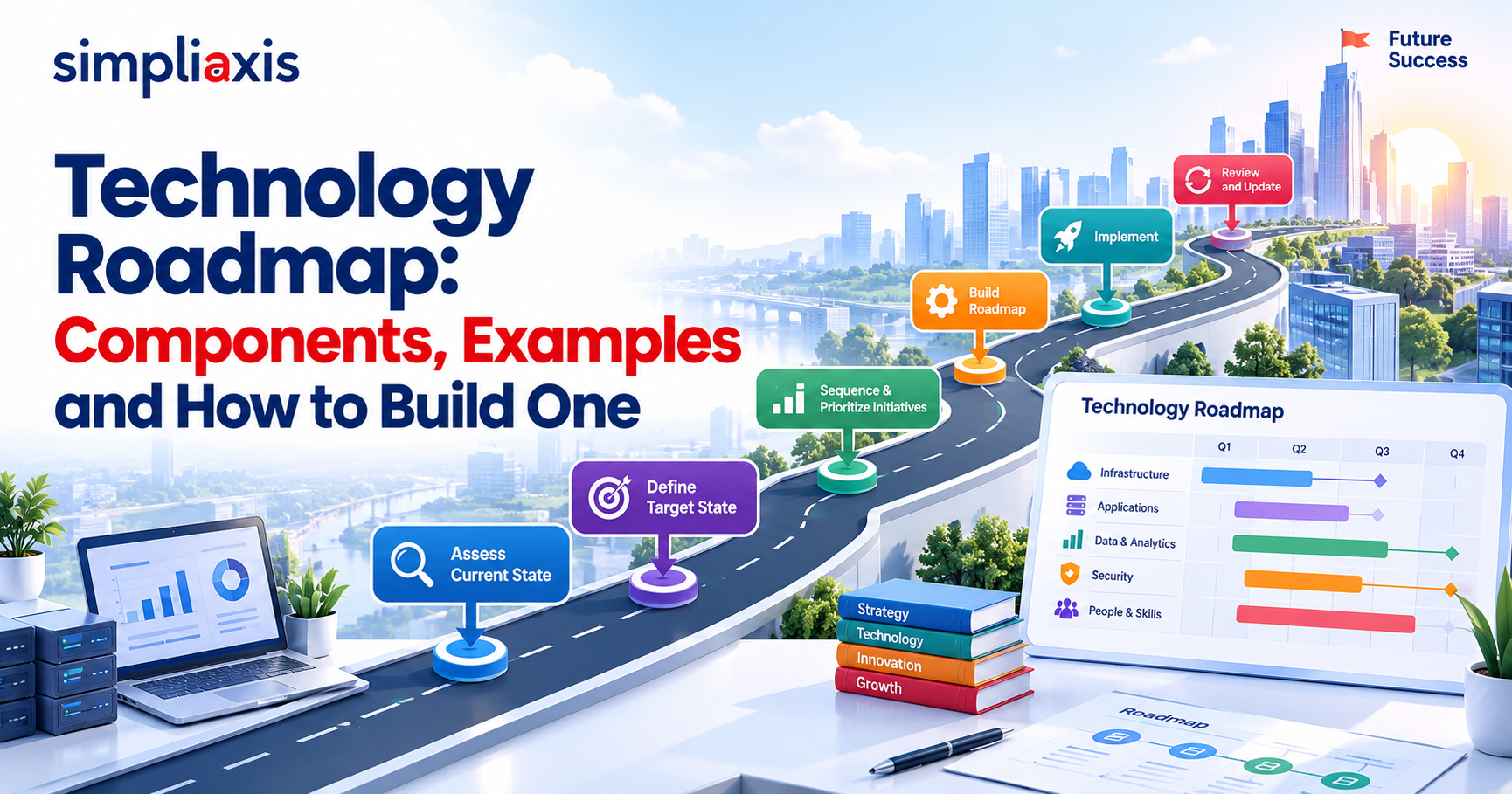
Technology Roadmap: Components, Examples and How to Build One

A technology roadmap is a plan that shows how an organization will introduce, upgrade, maintain, or replace technology to meet its business goals. It connects long-term technology decisions with practical actions, giving teams a shared view of what needs to happen, when it should happen, and why it matters.
A typical technology roadmap includes business objectives, the current technology environment, the desired future state, major initiatives, timelines, dependencies, risks, milestones, and success metrics. Organizations use it to plan cloud migrations, modernize legacy applications, strengthen cybersecurity, improve data management, and coordinate digital transformation.
Unlike a simple project schedule, a technology roadmap explains how individual technology investments fit into a larger business strategy.
Key Highlights of Technology Roadmap
- A technology roadmap connects technology investments with business priorities, helping organizations avoid spending on tools that do not solve meaningful problems.
- It documents the current technology environment, the desired future state, and the changes required to move between them.
- Cloud migration, application modernization, cybersecurity, data platforms, and enterprise architecture are common areas covered by a roadmap.
- A technology roadmap template provides a consistent structure for recording initiatives, owners, timelines, dependencies, budgets, and expected outcomes.
- Regular reviews help organizations adjust their plans when business needs, budgets, technical requirements, or market conditions change.
- Linking roadmap initiatives to epics and backlog items makes it easier to turn strategic decisions into actual delivery work.
Introduction
A company can invest heavily in technology and still struggle to make progress. It might purchase a new cloud platform, introduce analytics software, upgrade its internal applications, and experiment with artificial intelligence, yet find that these initiatives compete for the same people and budget.
The problem is not necessarily the technology. It is often the lack of a clear plan connecting these investments.
Imagine a retail business preparing to expand into three new markets. Its leadership team wants faster inventory reporting, a better online shopping experience, and stronger protection for customer information. The IT team, meanwhile, is dealing with aging servers, disconnected databases, and applications that are difficult to maintain.
Trying to tackle every requirement at once would create unnecessary pressure on the organization. Some initiatives also depend on others: reliable analytics requires accessible, trustworthy data, while a new customer-facing application may depend on improvements to the underlying infrastructure.
This is where a technology roadmap becomes useful. It helps the business decide which changes are most important, what should happen first, and how progress will be measured.
The need for structured planning is particularly relevant as organizations adopt emerging technologies. McKinsey's Technology Trends Outlook 2024 reported that 48% of surveyed respondents had fully scaled or were scaling cloud and edge computing, while 36% reported the same adoption stage for generative AI. These findings illustrate the growing attention businesses are giving to technologies that can change how they operate.
Adoption alone, however, does not guarantee value. Organizations still need to consider implementation costs, integration challenges, security, employee readiness, and long-term maintenance.
A well-planned technology roadmap brings these considerations together. In this guide, we'll examine its main components, look at practical technology roadmap examples, and explain how to build a roadmap that connects business strategy with day-to-day execution.
What Is a Technology Roadmap?
A technology roadmap is a strategic planning document that outlines the technologies, technical capabilities, and initiatives an organization plans to adopt, upgrade, or replace over a defined period. It connects the current technology environment with future business goals, identifying the changes, timelines, dependencies, and resources required to achieve them.
For example, a financial services company relying on outdated applications may prioritize cloud migration, application modernization, identity management, API integration, and centralized reporting to reduce costs, improve security, and enhance operational efficiency. Each initiative should have a clear business objective, a realistic timeline, and measurable outcomes.
To make this process more structured, organizations can refer to NASA's 2020 Technology Taxonomy, which organizes technology disciplines into a structured hierarchy. Although developed for NASA's technology planning needs, it provides a useful reference for classifying technologies, assessing existing capabilities, identifying gaps, and prioritizing future technology investments.
The roadmap could cover several areas:
- Infrastructure and cloud: Servers, networks, cloud services, storage, and disaster recovery.
- Applications and software: Application upgrades, integrations, system consolidation, and legacy modernization.
- Data and analytics: Data platforms, reporting, business intelligence (BI), data governance, and AI readiness.
- Cybersecurity: Identity and access management, vulnerability management, monitoring, and compliance.
- Product technology: APIs, development platforms, technical capabilities, and architecture improvements that support product delivery.
- Enterprise architecture: The relationships between business processes, applications, data, and infrastructure.
The scope depends on the organization. A startup might create a simple 12-month plan for improving its development platform and security controls. A large enterprise may need an enterprise technology roadmap that coordinates infrastructure, applications, data, and compliance initiatives across multiple departments.
A useful roadmap answers five practical questions:
- What does our technology environment look like today?
- What capabilities will the business need in the future?
- Which changes will help us reach that state?
- In what order should those changes happen?
- How will we know whether the investment has delivered value?
These questions make roadmap planning more meaningful than simply listing upcoming software purchases or infrastructure upgrades.
Technology Roadmap vs Product Roadmap
A technology roadmap focuses on the technical changes needed to support business goals, while a product roadmap outlines how a product will evolve to meet customer needs and business objectives. For example, an online retailer's product roadmap may prioritize personalized recommendations, while its technology roadmap covers the data pipelines, recommendation engine, APIs, and security controls needed to deliver them. Both roadmaps must align to ensure technical investments support product priorities. Learn more about what is a product roadmap and how it guides product planning.
Product managers and Product Owners help bridge business strategy and delivery by prioritizing requirements and managing stakeholder expectations. Professionals can strengthen these skills through CSPO certification training, while experienced Product Owners can explore A-CSPO certification training to develop advanced capabilities in product strategy and value-driven decision-making.
IT Roadmap vs Technology Strategy
An IT roadmap describes the major technology initiatives an organization plans to undertake and the sequence in which they are expected to happen. Technology strategy establishes the principles and long-term direction behind those decisions.
Suppose a company's technology strategy emphasizes secure cloud adoption, reliable data sharing, and automation. Its IT roadmap could translate those priorities into specific initiatives, such as migrating suitable applications, introducing centralized identity management, and replacing disconnected reporting systems.
The distinction matters because a roadmap without a strategy can turn into a collection of unrelated projects. Teams might complete upgrades successfully without making meaningful progress toward business goals.
The opposite problem is also common. An organization may have an ambitious digital strategy but no practical plan for funding, sequencing, or delivering the work.
A strong IT strategic plan connects the two. The strategy establishes the direction, while the roadmap turns that direction into decisions about investment, timing, ownership, and execution.
Key Components of a Technology Roadmap
There is no single format that every organization must follow. A small IT department may need only a spreadsheet and a timeline, while a large enterprise may use dedicated roadmap tools linked to architecture and portfolio management systems.
Regardless of the format, four components provide a useful foundation.
Goals and Business Drivers
Every major technology initiative should have a reason for existing.
That reason might be reducing operating costs, meeting a compliance requirement, improving application reliability, supporting business expansion, or making product delivery faster. Recording the business driver helps stakeholders understand why the work deserves time and funding.
Consider an organization whose employees spend several hours each week combining reports from different systems. Purchasing a new BI platform may seem like an obvious solution, but the underlying problem could be inconsistent data definitions rather than inadequate reporting software.
A proper assessment helps the organization invest in the right improvement.
Business goals should be specific enough to evaluate. Pairing objectives with measurable indicators, as in OKR vs KPI, helps. For example, an organization might aim to reduce reporting preparation time from two days to four hours, improve application availability, or reduce the cost of maintaining a particular legacy system.
These targets should be based on actual performance data and realistic expectations, not arbitrary figures chosen to make a business case look attractive.
A technology strategy roadmap should also explain the business drivers behind major investments. This creates a useful basis for comparing initiatives when the available budget cannot cover everything.
Initiatives and Releases
Initiatives represent the major areas of work needed to achieve the roadmap's objectives. They may include migrating applications, improving security, introducing a data platform, consolidating software, or modernizing an existing architecture.
Grouping related work into initiatives keeps the roadmap readable. Individual configuration changes, bug fixes, and development tasks generally belong in delivery plans or backlogs rather than on an executive-level roadmap.
For example, a legacy modernization initiative might include assessing application dependencies, updating the architecture, refactoring selected components, migrating data, and validating performance before deployment.
Initiatives can be organized into broad planning horizons:
- Now: Work that is underway or needs immediate attention.
- Next: Work expected to begin after current priorities or dependencies are addressed.
- Later: Longer-term opportunities that require further investigation, funding, or technical validation.
These labels are often more honest than assigning exact dates to initiatives whose scope is still uncertain.
Where delivery dates are important, the roadmap can include release windows, decision gates, and major milestones.A release plan may provide more detail about when specific capabilities become available, while the technology roadmap maintains the wider strategic picture.
Capabilities and Dependencies
A technology initiative describes the work being undertaken. A capability describes what the organization should be able to do as a result.
For example, implementing a cloud platform is an initiative. Being able to scale application capacity during periods of high demand is a capability.
Similarly, introducing a centralized data platform is a project, while giving different departments access to consistent, governed business information is the capability it may enable.
This distinction helps stakeholders evaluate technology investments based on their practical benefits rather than the tools being purchased.
Dependencies are equally important. A project may look straightforward in isolation but become difficult to deliver if another system, team, or process is not ready.
Suppose a company wants to launch a new analytics service. It may first need to standardize customer records, connect data sources, assign data owners, and establish access permissions. Without those foundations, the analytics project could face delays or produce unreliable results.
An architecture roadmap and enterprise architecture documentation can help identify such dependencies. They show how applications, infrastructure, integrations, and business capabilities relate to one another.
Risks and Milestones
Technology projects rarely unfold exactly as planned. Data migration can reveal unexpected inconsistencies, vendors can change their pricing, and older applications may have undocumented dependencies.
A roadmap should make significant risks visible before they affect delivery.
A structured risk assessment helps document each risk’s impact, probability, owner and mitigation.A cloud migration, for instance, might require validated backups, a rollback procedure, performance testing, and a clear plan for managing service interruptions.
Milestones provide opportunities to confirm that the work is progressing as expected.Treat key milestones as phase gates, where leaders decide whether to proceed, adjust or stop. These could include approval of a target architecture, completion of a security assessment, successful migration of an initial application, or formal acceptance of a new platform.
The organization should also define how success will be measured. Depending on the initiative, useful measures may include application availability, deployment frequency, migration completion, infrastructure costs, reporting speed, or the number of unresolved security findings.
This makes it easier to distinguish between completing the planned work and achieving the intended outcome. A project can meet its delivery date without delivering the expected business value, so both need attention.
Technology Roadmap Template
You don’t need special software to build a technology roadmap. A simple table is enough to start. Each row is one initiative, and the columns make sure nothing important gets missed, from why the work matters to how you’ll know it worked.
Copy the template below into a spreadsheet or your roadmap tool, add one row per initiative, and review it every quarter.
Technology Roadmap Template[a][b][c][d][e][f]
Blank templatehttps://docs.google.com/spreadsheets/d/17y24pmXjx1FOxGlEoBsqJ8f5qgIdOnho/edit?gid=1933269874#gid=1933269874
| Initiative | Business driver | Capability enabled | Owner | Horizon (Now/Next/Later) | Dependencies | Key risks | Milestone | Success metric[g] |
Example: a mid-sized company planning its next 12 months
The rows below are illustrative. Replace them with your own initiatives, owners and targets.
| Initiative | Business driver | Capability enabled | Owner | Horizon (Now/Next/Later) | Dependencies | Key risks | Milestone | Success metric |
| Centralized identity management | Reduce security risk and simplify user access | Single sign-on and consistent access control across apps | IT Security Lead | Now | Identity and access assessment | Users locked out during switchover | All core apps connected to the new identity system | Fewer access-related incidents |
| Core application cloud migration | Hardware is ageing and costly to maintain | Scale capacity up or down when demand changes | Infrastructure Manager | Next | Identity management, network and backup readiness | Downtime during migration; unexpected cloud costs | First three applications running in the cloud | Uptime maintained or improved; infrastructure costs tracked against the baseline |
| Centralized BI platform | Monthly reports take days of manual work | Shared, trusted reporting across departments | Data and Analytics Head | Next | Standard metric definitions, data owners and clean data sources | Poor data quality carried into new dashboards | Priority dashboards live for finance and sales | Report preparation time cut against the current baseline |
| AI-powered product recommendations | Improve the online shopping experience | Personalized suggestions for customers | Product and Data Leads | Later | Reliable customer data and a working analytics platform | Weak data leads to poor suggestions; privacy concerns | Pilot launched with a small customer group | Click-through and conversion compared with non-pilot users |
How to fill in each column
- Initiative: A short name for the piece of work. Keep it at the level leaders care about, such as “cloud migration”, not individual tasks.
- Business driver: The reason this work exists. If you can’t explain it in one line, question whether the initiative belongs on the roadmap.
- Capability enabled: What the business will be able to do once the work is done. This is the benefit, not the tool.
- Owner: One named person or role who is responsible. “The IT team” is not an owner.
- Horizon (Now/Next/Later): “Now” is work underway or urgent. “Next” starts once current priorities or dependencies are cleared. “Later” needs more research, funding or validation before you commit.
- Dependencies: Other work, systems, teams or decisions that must be ready first.
- Key risks: The one or two things most likely to cause delays or problems.
- Milestone: A clear checkpoint that shows real progress, such as “first applications live in the cloud”.
- Success metric: How you’ll know the initiative delivered value. Measure it against a baseline you recorded before the work began.
Tips for using the template
- Keep it to the big pieces of work. Detailed tasks belong in team backlogs, not on the roadmap.
- Fill in the “Business driver” column first. It’s the quickest way to spot initiatives that don’t have a strong reason to exist.
- Be honest with the horizon labels. It’s better to mark something “Later” than to give it a date you can’t keep.
- Review the table every quarter, and sooner if something big changes, such as a security incident, a budget cut or a new regulation.
How to Build a Technology Roadmap: Step by Step
A technology roadmap is most useful when the people responsible for delivery help shape it. Business leaders understand the desired outcomes, technical teams know the constraints, and operational teams can explain how proposed changes may affect existing processes.
The following steps bring these perspectives together.
Assess the Current State
Start by building an accurate picture of the existing technology environment.
Document applications, infrastructure, databases, integrations, software licenses, vendors, security controls, and major operational processes. Identify systems that are expensive to maintain, approaching end of support, difficult to integrate, or unable to meet expected demand.
Useful sources of information include architecture diagrams, incident reports, maintenance costs, performance data, security assessments, and interviews with employees who use the systems every day.
For example, a company may discover that its sales, finance, and customer service teams each maintain a separate customer database. This leads to duplicate records, inconsistent reports, and time-consuming manual reconciliation.
That discovery points to a business problem that technology planning can address.
The assessment should also recognize what already works well. Replacing a stable, supported application simply because a newer alternative exists may offer little value. In some cases, improving integration or fixing a specific performance issue may be more cost-effective.
Document the current state, technical debt, known risks, system ownership and the most significant gaps. This becomes the baseline against which future improvements can be evaluated.
Define the Target State
Next, describe the technology environment the organization needs to support its future goals.
The target state should be based on business requirements rather than a desire to adopt the latest tools. Ask what the organization must be able to do, which systems need to communicate, and what levels of reliability, security, scalability, and performance are required.
A retailer expanding into new markets, for example, might need a more scalable commerce platform, consistent inventory data, centralized identity controls, and reliable reporting across locations.
These requirements can then guide architectural and investment decisions.
The target state does not have to be a complete technical blueprint for the next five years. In fast-changing environments, a clear set of architectural principles and measurable capability goals may be more useful than detailed specifications for systems that have not yet been selected.
Document important constraints as well, including regulatory requirements, existing contracts, budget limitations, and internal skill gaps.
A future technology roadmap can include emerging opportunities, such as AI-enabled forecasting or process automation, but speculative ideas should be separated from initiatives that have an approved business case.
Sequence and Prioritize Initiatives
Once the current and target states are clear, identify the initiatives required to close the gap.
Prioritization should consider business value, urgency, cost, delivery effort, technical dependencies, risk reduction, and available skills.A simple scoring model, such as a value vs effort matrix, can help stakeholders compare proposals.provided they agree on the criteria and weights.
For example, a mid-sized organization might consider the following initiatives:
| Initiative | Main benefit | Key dependency | Illustrative timing |
| Centralized identity management | Better access control and security | Identity and access assessment | Months 1–3 |
| Core application cloud migration | Improved scalability and infrastructure flexibility | Network, backup, and security readiness | Months 4–7 |
| Centralized BI platform | Consistent reporting across departments | Data integration and quality improvements | Months 6–9 |
| AI-powered recommendations | More personalized customer experiences | Reliable customer data and analytics | Months 9–12 |
The timing is illustrative, not a universal sequence. Actual dates depend on complexity, staffing, architecture, and business constraints.
The important point is that the organization should not treat all initiatives as equally urgent. Security improvements may need to come first, while advanced analytics may need to wait until the underlying data is reliable.
Teams can use MoSCoW prioritization to distinguish must-have requirements from should-have, could-have, and lower-priority work.
Once priorities are agreed upon, create a technology implementation roadmap with realistic delivery windows, initiative owners, dependencies, and decision points. Detailed commitments should become firmer as teams gain more information.
Review and Update Quarterly
A roadmap should guide decisions without becoming a rigid promise that cannot respond to changing circumstances.
Quarterly reviews provide a regular opportunity to assess completed work, reconsider priorities, examine risks, and confirm whether planned investments still make sense. Significant changes, such as a security incident, regulatory requirement, acquisition, or unexpected budget reduction, may require an earlier review.
During the review, ask whether initiatives are delivering the expected results, whether dependencies have changed, and whether teams have the capacity to continue as planned.
For instance, an organization might discover that migrating one application requires substantial database redesign. Rather than forcing the original schedule, the team could move that application to a later phase while continuing with less complex systems.
That decision should be communicated clearly, including its effect on costs, benefits, and other initiatives.
Quarterly reviews should not replace regular project reporting. Delivery teams should raise significant issues as soon as they arise. The purpose of roadmap reviews is to revisit the bigger picture and make informed decisions about direction and investment.
Technology Roadmap Examples
The best technology roadmap examples reflect actual business problems. The following scenarios show how organizations might sequence initiatives over a year. They are illustrative examples rather than descriptions of specific companies.
Cloud Migration Roadmap
Imagine a mid-sized company running customer applications, internal reporting tools, and databases on aging on-premises infrastructure. Hardware maintenance is becoming expensive, capacity planning is difficult, and recovery from infrastructure failures takes longer than the business would like.
The company decides to develop a cloud migration roadmap.
The objective is not simply to move everything to the cloud. It is to improve scalability and resilience while managing costs, protecting data, and minimizing disruption to existing services.
A possible 12-month plan could look like this:
| Period | Planned work | Expected result |
| Months 1–3 | Inventory applications, assess dependencies, compare migration options, and design the target architecture | Prioritized migration plan and approved architecture |
| Months 4–6 | Establish cloud environments, identity controls, monitoring, backup, and network connectivity | Secure foundation for migration |
| Months 7–9 | Migrate suitable applications, test performance, and validate recovery procedures | Initial workloads operating in the cloud |
| Months 10–12 | Migrate remaining prioritized workloads and optimize resource usage | Improved scalability and a clearer view of operating costs |
Before migration begins, the team should decide how each application will be handled. Some may be suitable for rehosting, while others require refactoring or replacement. Certain systems may be better left in their current environment until a stronger business case emerges.
This assessment prevents the common mistake of treating every application as an identical migration exercise.
The company can measure progress through migration completion, application availability, recovery performance, infrastructure costs, and unresolved security issues. It should compare these results with a documented baseline to determine whether the project is delivering value.
A successful cloud migration roadmap also accounts for training and operating procedures. Teams need to know how to manage cloud resources, monitor costs, respond to incidents, and maintain the new environment after migration.
Data Platform Roadmap
Consider a retail business that stores sales, customer, inventory, and marketing data across separate systems. Different departments use different definitions for key metrics, and preparing monthly reports requires hours of manual reconciliation.
The company wants to establish a centralized data platform and improve business intelligence.
A practical BI technology roadmap would address data quality and governance alongside platform implementation.
| Period | Planned work | Expected result |
| Months 1–3 | Map data sources, standardize important metrics, assign data owners, and identify quality issues | Clear data inventory and governance responsibilities |
| Months 4–6 | Build ingestion pipelines and introduce validation and access controls | More consistent, accessible data |
| Months 7–9 | Implement a centralized analytics platform and priority BI dashboards | Shared reporting across selected departments |
| Months 10–12 | Pilot forecasting and selected AI use cases | Evidence of value from advanced analytics |
The order matters. If the company builds sophisticated dashboards before resolving conflicting definitions of revenue or inventory, the new platform may simply make inconsistent information easier to access.
A better approach is to establish common definitions, assign ownership, and introduce data quality checks before expanding analytics.
The organization could set a target to reduce monthly reporting preparation time by 50%. It would first measure the current time spent preparing reports, then compare it with the results after implementation.
Other useful measures include data freshness, reconciliation errors, dashboard adoption, and the time required to answer common business questions.
The organization should also establish who can access sensitive information, how data quality problems are reported, and who maintains each dashboard. Without these responsibilities, a technically successful platform can gradually become difficult to trust.
Technology Roadmap vs Product Roadmap Comparison
The two roadmaps should support one another, but they need different information to do their jobs.
| Comparison factor | Technology roadmap | Product roadmap |
| Primary focus | Infrastructure, architecture, platforms, and technical capabilities | Product direction, customer needs, features, and outcomes |
| Main question | What technology changes are needed, and in what order? | What product improvements should be prioritized, and why? |
| Typical owner | CIO, CTO, IT leader, enterprise architect, or technology program lead | Product manager or product leadership |
| Key inputs | System health, technical debt, security, architecture, operating costs, and business strategy | Customer feedback, market research, product metrics, and business goals |
| Typical initiatives | Cloud migration, API modernization, security improvements, and data platforms | New features, user experience improvements, pricing changes, and product expansion |
| Success measures | Reliability, scalability, security, technical efficiency, and cost | Adoption, retention, customer satisfaction, revenue, and product outcomes |
| Typical dependencies | Infrastructure, integrations, compliance, and technical architecture | Customer research, design, engineering capacity, and commercial priorities |
Consider a software company planning to introduce a new subscription tier. The product roadmap would describe the customer problem, the proposed offering, and the commercial outcomes the company wants to achieve.
The technology roadmap might include billing system changes, entitlement management, payment integrations, analytics updates, and security testing.
The product initiative could be delayed if the billing platform cannot support the new pricing model. Conversely, upgrading the billing platform without considering the product's commercial direction could result in unnecessary work.
That is why the two plans need regular coordination.
For more context on how product direction connects to execution, explore product roadmap vs product backlog.
Presenting the Roadmap to Stakeholders
Even a well-researched technology roadmap can lose its value if stakeholders cannot understand it.
A presentation filled with application names, technical abbreviations, and detailed implementation tasks may work for an engineering workshop but will not necessarily help executives decide where to invest.
Start with the business context. Explain what needs to improve, why it matters now, and what the proposed roadmap is expected to change.
A useful presentation generally covers the main priorities, expected timing, investment requirements, dependencies, major risks, and measures of success. It should also identify decisions that require approval or additional funding.
Visuals can make the plan easier to follow. A timeline grouped into quarters, for example, can show how foundational work supports later initiatives. A dependency diagram can explain why a data platform must be established before certain analytics projects can proceed.
Avoid presenting every activity at the same level. A major modernization initiative deserves more attention than a routine software update unless that update introduces a material business or security risk.
It is also worth explaining what is not included in the roadmap. Stakeholders may assume that every proposed improvement will be delivered immediately unless the organization makes its priorities and constraints explicit.
Tailoring the View for Executives and Engineers
Different stakeholders need different levels of detail, even when they are working from the same roadmap.
Executives generally need to understand the business outcomes, funding requirements, major risks, and decisions that require their attention. An executive view might summarize the three most important initiatives for the next two quarters, their expected benefits, and the investment needed to deliver them.
Engineering and IT teams need a more detailed view of technical dependencies, architecture decisions, migration waves, integration requirements, testing, and operational readiness. These details help teams identify delivery constraints before they become schedule problems.
Product and business teams need to see how the planned technical changes enable customer-facing improvements, new services, or more efficient operations.
Maintain one agreed source of truth and create different views from it. This reduces the chance that teams will work with conflicting dates or priorities.
For additional guidance on presenting product direction, see the Atlassian product roadmaps guide.
Linking the Technology Roadmap to the Product Backlog
A technology roadmap explains the direction of travel and identifies major initiatives.A Product Backlog organizes the smaller pieces of work teams deliver to achieve product and technical outcomes.
Connecting them gives developers context for their work and helps business stakeholders see how technical investments contribute to wider objectives.
For example, a roadmap might include an initiative to modernize an organization's APIs. The work could support faster partner integrations, improve application reliability, and make it easier to introduce new customer services.
The backlog would contain the work required to deliver those improvements, including API design, implementation, testing, documentation, migration, and deployment.
This distinction is important because a roadmap should not become a long list of tickets. Its purpose is to communicate strategic priorities and sequencing, while the backlog remains flexible enough to accommodate technical discoveries and changing requirements.
Teams can also use the backlog to track progress against roadmap initiatives, provided the relationship between strategic objectives and delivery work remains clear.
Turning Initiatives Into Epics
An epic is a substantial body of related work that can be broken down into smaller stories or tasks. It provides a practical link between a roadmap initiative and the work a delivery team performs.
Consider a roadmap initiative to modernize customer identity management.
The team might create three epics:
- Centralized authentication: Implement a shared authentication service and establish the required access policies.
- Application migration: Move selected applications to the new identity platform and validate existing user access.
- Access monitoring: Introduce improved monitoring, reporting, and processes for responding to suspicious activity.
Each epic can then be divided into stories and tasks covering implementation, integration testing, security validation, user communication, and operational documentation.
The team should identify dependencies between the epics. For instance, application migration may need to wait until the authentication service has passed its security and performance tests.
A practical workflow looks like this:
- Define the roadmap initiative and the business problem it addresses.
- Create epics that represent meaningful parts of the solution.
- Break the epics into stories and implementation tasks.
- Identify dependencies, owners, and acceptance criteria.
- Track delivery progress against the original business objective.
This process helps teams avoid a common problem: completing technical work without measuring whether it solved the issue that justified the investment.
It also makes prioritization easier when new requests arrive. Teams can evaluate proposed backlog items against the roadmap's goals rather than treating every request as equally urgent.
For teams working in scaled Agile environments, the SAFe implementation roadmap offers additional context on coordinating organizational change and delivery.
Conclusion
Technology decisions become harder as an organization grows. Systems accumulate, business requirements change, and new tools create opportunities as well as additional complexity. Without a clear plan, teams can spend significant time and money on improvements that do not address their most important needs.
A technology roadmap provides a way to bring these decisions together. It connects business goals with technical capabilities, identifies dependencies, establishes realistic priorities, and gives stakeholders a shared understanding of what needs to happen next.
The process does not need to begin with an elaborate enterprise planning exercise. Start by documenting the current environment, identifying the most pressing problems, and agreeing on the capabilities the business needs. From there, prioritize a manageable set of initiatives, assign ownership, and establish measures that show whether the work is delivering results.
A technology roadmap template can make this process easier by providing a consistent place to record objectives, initiatives, milestones, risks, and dependencies. As the organization matures, the roadmap can become more detailed and connect with architecture documentation, portfolio planning, and delivery backlogs.
The most useful roadmap is not necessarily the most complicated one. It is the one that helps people make better decisions, explains why those decisions matter, and remains relevant as circumstances change.
Whether you are planning cloud migration, legacy modernization, a BI platform, or an enterprise-wide digital transformation roadmap, focus on the business problem first. Choose technologies based on the capabilities they enable, and review the plan regularly enough to respond to new information.









 Lowest-Price Challenge












 Personalized Path



.webp)


 USA
 Canada
 India
 UK
 Australia
 Singapore


