


 Call Us



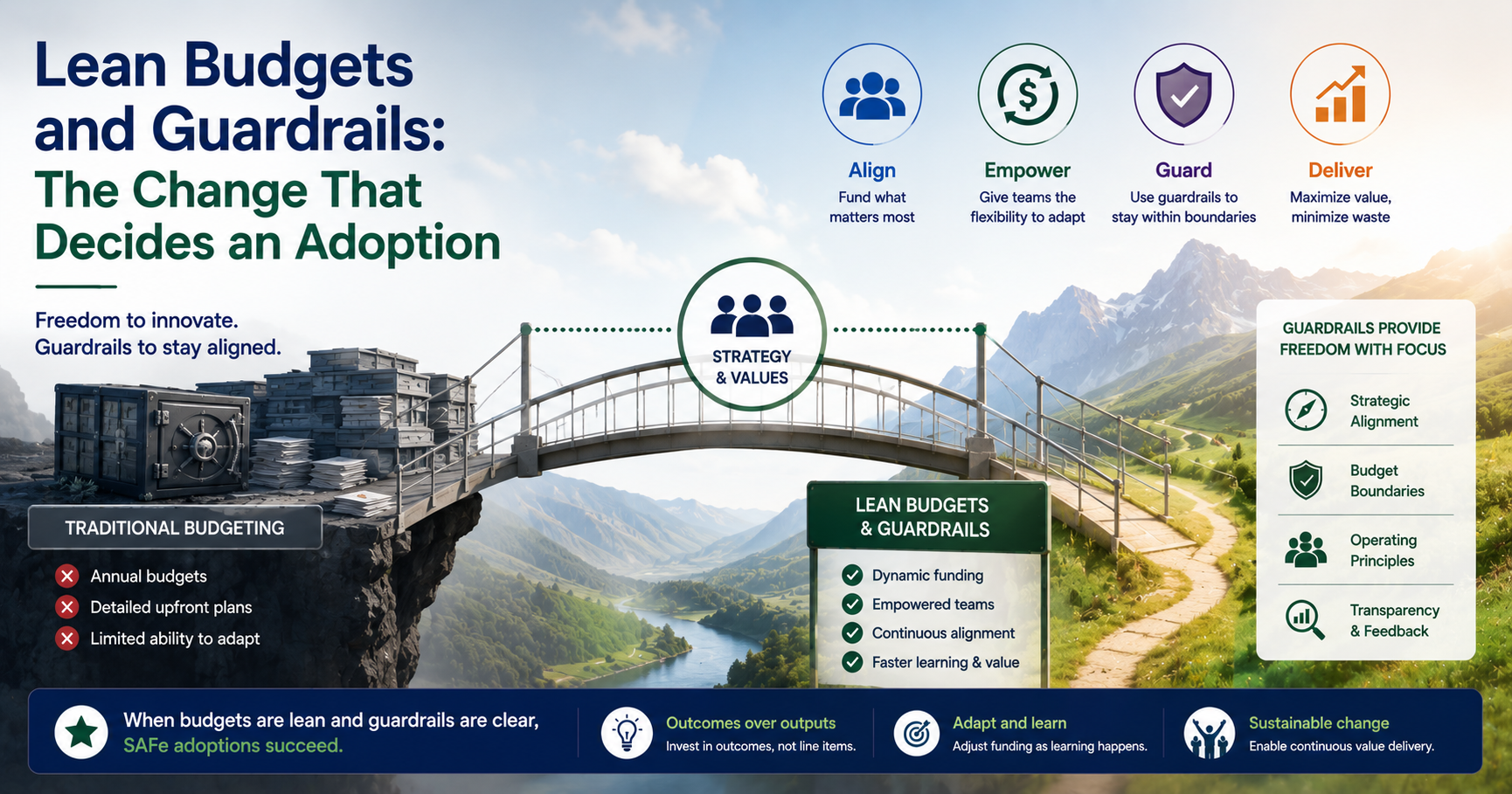
Scaled Agile defines Lean Budgets as a financial governance approach that funds value streams instead of projects, accelerating value delivery and reducing the overhead and cost of traditional project cost accounting. Guardrails are the budgeting, spending and governance policies for a specific portfolio. Between them they are the single change that determines whether a SAFe adoption produces anything, and they are the change organisations defer longest because they sit in finance rather than in delivery.
Key Highlights
- Scaled Agile defines Lean Budgets as funding value streams rather than projects, explicitly to reduce the overhead of traditional project cost accounting.
- Lean Budget Guardrails are the policies and practices for budgeting, spending and governance within a portfolio.
- Guardrails are not approval gates. A guardrail defines what can be decided without asking, which is the opposite of a gate.
- Project funding forces scope to be fixed at the point of least knowledge, which is the structural problem the model exists to solve.
- An adoption that keeps annual project funding and adds SAFe events underneath will produce ceremonies and no outcome.
- This is the change most often deferred, because it belongs to finance and every other part of the adoption can proceed without it, right up until it cannot.
The problem with funding projects
Worth stating precisely, because the argument for change depends on it.
A project is approved with a scope, a budget and a date. To get approval, someone has to specify what will be built and what it will cost. That specification happens at the beginning, which is the moment when least is known about the work.
Everything downstream inherits that. The scope is fixed because the budget was approved against it. Changing it requires a change request, which is administratively expensive, so it happens rarely and late. Teams therefore build what was specified rather than what turns out to be needed.
The overhead is substantial too. Tracking cost against project codes, allocating people's time across multiple projects, and reconciling all of it consumes real capacity and produces information nobody uses to make a decision.
That is what the framework means by the overhead and cost of traditional project cost accounting. It is not a complaint about finance being difficult. It is an observation that the model forces the wrong decisions at the wrong time.
What funding a value stream changes
Money goes to a long-lived value stream rather than to a specified piece of work.
Three things follow. The value stream has a budget for a period and decides what to build within it, so scope decisions move to the people with the most current information. There is no project to open or close, which removes the accounting overhead. And stopping a piece of work does not mean handing budget back, which is what makes stopping possible at all.
That last point connects directly to the SAFe Agile Product Management training. An Epic funded as a hypothesis can only be stopped if stopping does not cost the value stream its money. Under project funding, stopping is a loss. Under value stream funding, it frees capacity for the next thing in the portfolio.
The change sounds administrative and is behavioural. It alters who decides what gets built, which is why it meets resistance that has nothing to do with accounting.
Guardrails are not gates
The most common and most damaging misunderstanding in this whole area.
A guardrail is a policy defining what can be decided without asking. Spending within these parameters, on this kind of work, up to this threshold, does not require approval. That is the point: it decentralises the decision while keeping it governed.
A gate is the opposite. It requires approval before proceeding, which centralises the decision.
Organisations routinely implement guardrails as gates, because the existing approval process is what they know and the word governance suggests control. The result is a value stream with a budget it cannot spend without asking, which is project funding with new vocabulary.
The diagnostic is a single question: what can this value stream spend without asking anyone. If the answer is nothing, the guardrails are gates and the funding model has not changed.
What guardrails actually cover
Guardrails address budgeting, spending and governance for a specific portfolio. In practice organisations tend to define them across four areas.
Investment horizons. How the budget splits across different kinds of work: maintaining what exists, extending it, and building something new. This is where architectural and Enabler work gets protected, or fails to be.
Capacity allocation. What proportion of a value stream's capacity goes to which category of work, agreed in advance rather than negotiated each Program Increment. Our piece on the SAFe DevOps certification covers why this specific guardrail matters more than it appears.
Approval thresholds for Epics. Above what size does an Epic require portfolio-level review rather than being decided within the value stream.
Continuous business owner engagement. That the people accountable for value stay involved rather than approving once and departing.
The first two are where most of the practical benefit sits, and they are the two most often left undefined, which means they default to whatever pressure produces.
Why this is the change that gets deferred
Every other part of a SAFe adoption can proceed without touching funding, which is exactly why funding gets left until last.
Teams can be trained. Trains can be launched. PI Planning can run. Events can operate on cadence. All of it is visible progress and none of it requires finance to do anything differently.
Then the train starts making decisions and discovers that every one of them still queues behind an approval process designed for annual projects. Delivery does not improve. The adoption is eighteen months old, the ceremonies are running well, and the outcome has not moved.
At that point the diagnosis usually lands on the framework or on the teams. It belongs on the funding model, and the evidence was available from the first Program Increment for anyone asking what the train could decide without escalating.
Our piece on leading the change covers why the implementation sequence puts leadership commitment first for precisely this reason.
The conversation with finance
This is a finance conversation and it goes badly when conducted in framework vocabulary.
Do not lead with SAFe. A finance director does not need to know what a Program Increment is to evaluate a funding model change. Leading with the framework signals that this is an IT initiative asking for special treatment.
Lead with the decision timing problem. Project funding requires scope to be committed when least is known. That is a proposition a finance audience can evaluate on its own terms, and most will recognise it from experience.
Address control directly. The immediate concern is loss of control, and the honest answer is that control moves rather than disappears. Guardrails are the control, they are set by finance, and they operate continuously rather than at approval points.
Offer a bounded trial. One value stream, one budget period. That is a far easier decision than changing portfolio governance, and it produces the evidence for the larger conversation.
The organisations that get through this generally did so because someone made the argument in finance's language rather than waiting for finance to learn theirs.
What it looks like when it works
Five observable signs, none requiring access to the accounts.
A value stream can name what it spends without asking. There is a threshold and people know it.
Something got stopped and the money stayed. Budget released from an abandoned Epic went to the next thing in the same value stream rather than back to a central pot.
Capacity allocation for Enablers is agreed rather than argued. A percentage exists and it is protected.
Nobody is tracking time against project codes. If they are, project accounting is still running underneath.
The portfolio review is about what to fund next rather than about variance to plan. The question changed, which is the clearest signal the model did.
That last signal is worth dwelling on, because it is the one that distinguishes a genuine change from a relabelled one. A review asking whether initiatives are on track against their approved plan is project governance regardless of what the budget lines are called. A review asking what the portfolio should fund next, given what has been learned, is operating a different model. The vocabulary can be identical in both cases, which is why the question being asked is a better test than anything on the agenda.
Any organisation can check all five in a short conversation, which makes this a practical diagnostic for a SAFe Agilist assessing whether an adoption is real.
The partial version, and whether it helps
Most organisations cannot change portfolio funding in one step, so the realistic question is what a partial move achieves.
Funding one value stream properly is genuinely useful. It produces a working example, gives you evidence, and tests the guardrail design at low risk.
Raising approval thresholds without changing the funding model helps less than it appears. Decisions get faster and scope is still fixed annually, so the fundamental problem remains.
Renaming project budgets as value stream budgets achieves nothing. This is the most common partial adoption and it is worth naming as such, because it lets an organisation believe the change has happened when only the labels moved.
The order that works is to fund one value stream genuinely, define its guardrails, run it for two or three Program Increments, and use what happens as the argument for the rest. Attempting portfolio-wide change first almost always stalls in the budget cycle.
What changes for the people involved
Beyond the mechanics, the funding change alters what several roles actually do, and anticipating that reduces the resistance.
Finance stops approving projects and starts setting guardrails. That is a shift from transactional approval to policy design, and for many finance professionals it is more interesting work. It is also less frequent, which is the part that causes anxiety: a function whose value was measured by approvals processed has to be measured differently.
Business sponsors stop writing business cases for fixed scope. They write hypotheses instead, which is harder and more honest. Our piece on Lean Startup in SAFe covers what that looks like in practice.
Value stream leadership gains real decision authority. This is the benefit and it is also a burden, because decisions previously escalated now have to be made and defended locally.
Delivery leadership loses the ability to blame the approval process. A genuine constraint disappears, which is uncomfortable if it was doing useful work as an explanation.
Naming these shifts before the change rather than after is the difference between resistance you can address and resistance that arrives as unexplained delay.
The measurement question
An objection that arrives reliably from finance and deserves a proper answer: if we are not tracking cost against projects, how do we know what anything cost.
The answer is that you know what the value stream costs, which is a real and stable number, and you know what it delivered, which is visible. What you lose is the ability to attribute cost to a specific feature, and the honest position is that this attribution was mostly fictional anyway. Time recorded against project codes by people working across several is an allocation exercise rather than a measurement.
What replaces it is outcome measurement at the value stream level, which our piece on Lean Portfolio Management training covers, plus the Epic-level hypothesis testing that establishes whether specific investments worked.
That trade is usually acceptable to finance once stated plainly, because most finance professionals know exactly how reliable project time allocation is. What is not acceptable is pretending nothing is lost, which invites a reasonable person to distrust the rest of the argument. Understanding that trade properly is part of what Leading SAFe certification training covers in the portfolio material, and the free Leading SAFe practice test will tell you whether the vocabulary is solid enough to hold the conversation.
Where this sits on the exam
Lean Budgets and guardrails sit within the Lean Portfolio Management domain, which carries 25 to 28 percent of the SAFe Agilist paper and is jointly the largest alongside Product Development Flow.
Expect definitional recall on Lean Budgets and on what guardrails cover. Expect at least one question testing the guardrail-versus-gate distinction, since it is the conceptual heart of the topic. And expect the connection to Epics and the portfolio to appear.
This domain is consistently under-revised by delivery-side candidates, who find it unfamiliar and assume its unfamiliarity means it is peripheral. It is a quarter of the exam. Our breakdown of the the SAFe Agilist certification process covers the full weighting, and the free Leading SAFe practice test will show you quickly whether portfolio material is your weak area.
Starting the conversation without authority
Most people reading this cannot change a funding model, which raises a fair question about what to do instead.
Collect the evidence. How long does a decision take from a train needing something to getting it. Measure it for one Program Increment. That number is the argument and it is not currently written down anywhere.
Find who feels the cost. Someone senior is experiencing unpredictable delivery and does not know the cause is approval latency rather than team capacity. They are the route, and they will be more receptive than finance initially is.
Ask for one exception rather than a policy. A single value stream, funded differently, for one budget period. That is a decision someone can take without changing anything institutional, and it produces the evidence that makes the larger case.
Be honest about what it will not fix. Overselling this as a solution to delivery problems generally will damage your credibility when delivery does not transform in one increment. It removes a specific constraint, which matters where that constraint is binding and not otherwise.
None of that requires authority. It requires someone paying attention to where decisions actually wait, which is the diagnostic skill Leading SAFe certification training is built to develop.
The two-year view
Worth setting expectations, because this change does not resolve inside one budget cycle.
Year one is usually one value stream funded differently while everything else continues as before. That produces evidence and it produces friction, because the organisation is now running two funding models simultaneously and the reporting does not reconcile.
Year two is where the decision gets made properly, on the evidence from year one. Either the model extends, or the exception gets quietly reabsorbed into the old process.
That second outcome is common and it is worth naming in advance. An exception with no plan to extend it tends to revert, because maintaining a special case is administratively annoying and the person who championed it eventually moves on.
The organisations that get through the transition treated the first value stream explicitly as a trial with a decision date, rather than as a permanent exception nobody would revisit. The difference is whether anyone is accountable for making the call.
The short version
If you want one test for whether a SAFe adoption is real, ask what a value stream can spend without asking permission.
Everything else can be in place and looking healthy while the answer to that question is nothing, and where it is nothing the adoption will produce well-run ceremonies and unchanged outcomes. The teams will be blamed, then the framework, and both diagnoses will be wrong.
This is the least glamorous part of the framework and the part that decides the result. It is also the reason the material sits in a leadership course rather than a delivery one, since nobody below the portfolio can change it.
Leading SAFe certification training covers Lean Budgets and guardrails alongside the rest of the portfolio layer, across two days including the exam attempt. Current certification costs are listed separately.



_1738223178.jpg)



 Lowest-Price Challenge











 Personalized Path


.webp)


 USA
USA  Canada
  India
India  UK
UK  Australia
  Singapore


