


 Call Us



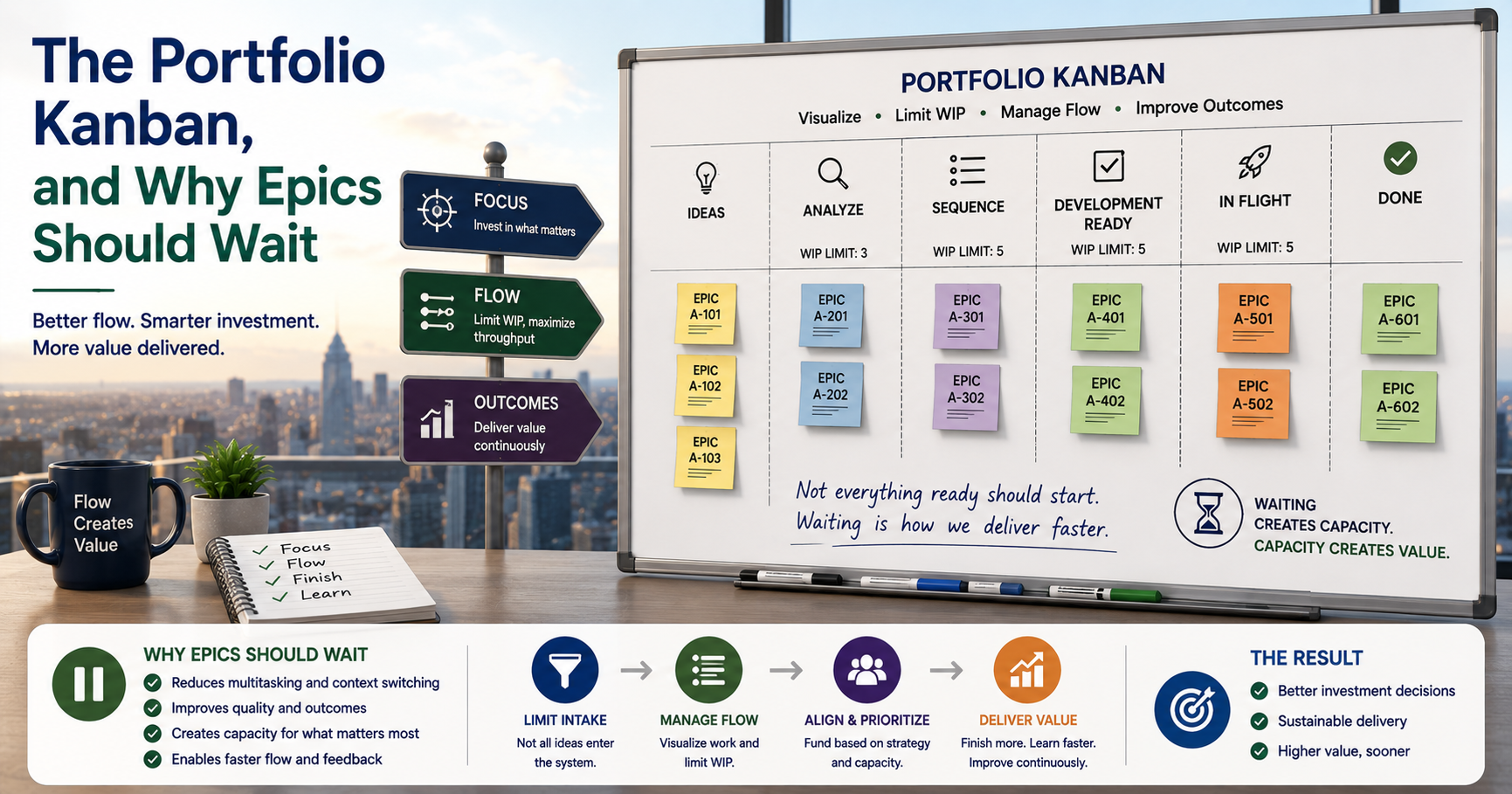
Scaled Agile defines the Portfolio Kanban as a method to visualise and manage the flow of portfolio Epics, from ideation through analysis and implementation. The word doing the work is flow. A portfolio Kanban is not a list of approved initiatives, it is a system with limits, and the limits are the point. An organisation that approves everything and starts everything has not built a Kanban system, it has built a queue with a nicer board.
Key Highlights
- Scaled Agile defines the Portfolio Kanban as a method to visualise and manage the flow of portfolio Epics from ideation through analysis and implementation.
- An Epic is a significant solution development initiative, and it moves through defined states rather than being approved and started.
- Work-in-progress limits are what make it a Kanban system. Without them it is a list of approved initiatives.
- Analysis before implementation is a deliberate state, which is where the Epic hypothesis and MVP get defined.
- Starting more Epics than the organisation can finish lengthens everything and improves nothing, which is the failure the limits exist to prevent.
- The Epic Owner shepherds an Epic through the system, from definition to implementation.
Why a Kanban system rather than an approval list
The distinction is the same one that separates a Team Backlog from a wish list, and it matters more at portfolio level because the items are larger.
An approval list records what has been agreed. Items are added when approved and removed when finished, and there is no constraint on how many can be in progress. Adding one costs nothing to whoever approves it.
A Kanban system has states, limits and pull. An Epic moves from ideation, through analysis, into implementation, and there is a cap on how many can occupy each state. New work enters when capacity exists rather than when someone decides it is important.
Most organisations adopting SAFe build the first and call it the second. The board exists, the states are drawn, and there are no limits, which means the system does nothing except display work that was going to happen anyway.
The diagnostic is direct: what is the limit on Epics in implementation, and has anything ever waited because of it. If there is no limit, or nothing has ever waited, it is a display rather than a system.
The states, and what each is for
The flow runs from ideation through analysis to implementation, and the middle state is the one organisations skip.
Ideation is where Epics are captured. Anyone can propose one, and the cost of proposing is deliberately low, because you want ideas visible rather than filtered before anyone sees them.
Analysis is where an Epic becomes decidable. The hypothesis gets written, the MVP is defined, the rough cost and the value stream affected are established. This is real work, it takes capacity, and it is where most of the value of the system is created.
Implementation is where the MVP gets built and measured.
Skipping analysis is the most common structural failure. Epics move from someone's idea directly into a train's backlog, arriving without a hypothesis, a defined MVP or an owner. The train then builds something nobody can evaluate, because there was never a statement of what success would look like. Our piece on SAFe Agile Product Management training covers what analysis is supposed to produce.
Why the limits matter more than the board
The board is the visible part and the limits are the mechanism.
Consider an organisation with capacity for three Epics in implementation that has started nine. Each is progressing at a third of the rate it could. Every one takes three times as long. Nothing finishes sooner because everything started earlier, and the total delivered in a year is lower than it would have been with three at a time, because context switching and coordination overhead consume real capacity.
That is not an argument about focus or discipline. It is arithmetic, and it is the same argument as flow load at team level, which our piece on Lean Portfolio Management training covers.
What makes it hard at portfolio level is that each individual decision to start an Epic is defensible. Someone senior wants it, the business case is sound, and saying no requires an explicit refusal rather than a passive delay. The limit exists to make that refusal structural rather than personal.
Where the Epic Owner fits
The Epic Owner shepherds an Epic through the portfolio Kanban, from definition through to implementation.
That accountability matters because Epics are large, cross-cutting and slow, which means without a named owner they drift. The analysis does not get done, the hypothesis does not get written, and the Epic either stalls in a state indefinitely or gets pushed into implementation unexamined.
Two failure patterns recur. Appointing an Epic Owner who is the requester rather than someone accountable for the outcome, which produces advocacy rather than analysis. And appointing someone without the seniority to get time from the people whose input the analysis needs.
The role is not full-time and it is not nominal either. An Epic in analysis needs someone actively moving it, and an organisation where Epics sit unchanged for several months usually has Epic Owners in name only.
The relationship with funding
The portfolio Kanban and the funding model are two halves of one thing, and either alone accomplishes little.
Under project funding, an Epic's budget is approved as part of an annual cycle. The Kanban then displays work whose funding was already committed, which means the limits have nothing to constrain: the decision was made elsewhere and earlier.
Under Lean Budgets, value streams are funded and Epics compete for capacity within them. Now the Kanban is doing real work, because the decision about what enters implementation is being made in the system rather than in a budget round.
That connection explains a common frustration. Organisations build a portfolio Kanban, find it changes nothing, and conclude the practice is administrative. The practice is fine; it was installed on top of a funding model that had already made the decisions it was meant to make.
What analysis should actually produce
Concrete, since this is the state that gets skipped and the one where value is created.
A hypothesis. What is believed, about whom, with what expected outcome and what measure. Specific enough to be wrong.
An MVP definition. The smallest thing sufficient to prove or disprove that hypothesis, which is usually smaller than the proposer's instinct.
A rough cost and duration. Not an estimate to be held to. An order of magnitude sufficient to compare against other Epics.
The value streams affected. Which trains would build it, and whether it crosses more than one.
The measure, and how it will be captured. Including whether the instrumentation exists, because discovering it does not at the decision point wastes the entire exercise.
Analysis that produces less than this has not made the Epic decidable, and it will be approved on advocacy instead.
How Epics reach the trains
The mechanism, since this is where portfolio and delivery connect.
An Epic entering implementation gets decomposed into Features, which enter the SAFe Scrum Master certification of one or more trains, and then into stories at team level.
Two things commonly go wrong. The MVP boundary is not communicated, so the train scopes and sequences as though the whole Epic is committed, and the MVP arrives late bundled with work that was only justified if the hypothesis held. And the Epic crosses several trains without anyone owning the coordination, so each builds its portion on a different schedule and nothing integrates.
Both are communication failures rather than framework gaps. The framework provides the constructs; whether the MVP boundary and the cross-train dependency are made explicit is a matter of someone doing it.
Why saying no is the whole point
The uncomfortable observation, and the reason portfolio Kanban systems get quietly disabled.
Every Epic on the board has a sponsor. Every sponsor believes their Epic matters, and in most cases they are right. The limit forces a choice between things that are all genuinely worth doing, which is a harder conversation than choosing between good and bad ideas.
Without the limit, that conversation never happens. Everything is approved, everything starts, everything moves slowly, and nobody has to tell a senior colleague that their initiative is waiting. The cost is diffuse and the discomfort is avoided, which is exactly why organisations drift into it.
With the limit, someone has to say that three things go now and the fourth waits. That is unpopular and it is the only mechanism that produces focus.
The organisations that hold it tend to do one thing differently: they make the limit a portfolio decision agreed in advance rather than a judgement made in the moment. A limit set in a calm review is defensible when someone senior wants an exception. A limit defended in the moment by one person is not, and it will not survive the first serious challenge.
Connecting the board to what actually happens
A practical failure worth naming, because it is common and it makes the whole system decorative.
An Epic sits in implementation on the board. Meanwhile the trains are working on Features, and nobody can say which Epic a given Feature belongs to. The board and the delivery are two separate realities.
Where that happens, the board records intentions and delivery proceeds on its own logic. The portfolio review discusses Epics that bear an uncertain relationship to what teams are actually building, which makes every decision taken in it unreliable.
The fix is not tooling. It is that Features entering the ART Backlog carry their Epic, and that someone checks the connection holds. A train that cannot say which Epic a Feature serves is building something whose justification has been lost somewhere between portfolio and delivery.
That check is cheap and it is the difference between a portfolio Kanban that governs and one that displays. Understanding how the layers connect is a substantial part of what Leading SAFe certification training covers, and the free Leading SAFe practice test is a quick way to confirm the vocabulary is solid.
Reviewing the portfolio
The portfolio Kanban needs a review cadence or it becomes a static board, and most organisations review too rarely.
A useful rhythm is aligned to the Program Increment boundary, which gives roughly quarterly review with enough elapsed time for something to have changed. At each review the questions are narrow: what has moved between states, what is stuck and why, what should enter implementation given available capacity, and whether anything in implementation should stop.
That last question is the one that gets omitted, and its absence is why portfolios only grow. A review that can only add work is not a review, it is an intake process.
Where an Epic has been in analysis for three review cycles without moving, it should be removed rather than carried. Carrying it costs nothing visible and it accumulates, until the board is unreadable and the limits become meaningless because nobody trusts the states.
Signs it is working
Five observable characteristics.
There is a limit and something has waited. The single most important signal.
Epics have hypotheses that someone can state. Analysis is happening rather than being skipped.
Something has been removed from the board. Either stopped in implementation or dropped from analysis.
The review discusses stopping as well as starting. Both directions are live.
A train can name which Epic a Feature belongs to. The connection between portfolio and delivery is real rather than notional.
A sixth signal, harder to observe and worth watching for: the people proposing Epics have started proposing fewer and better ones. Where a portfolio genuinely constrains what can start, proposers adjust, because a weak proposal now competes against strong ones rather than simply joining a queue. That behavioural shift is the clearest evidence the system is doing something, and it usually appears two or three review cycles after the limits are first held.
An organisation with none of these has a board. With three or four, it has a working system, and the missing ones tell you where to look next.
What the exam asks
The portfolio Kanban sits within the Lean Portfolio Management domain, which carries 25 to 28 percent of the SAFe Agilist paper and is jointly the largest.
Expect definitional recall on what the portfolio Kanban is and on the flow from ideation through analysis to implementation. Expect the Epic Owner accountability to appear. And expect at least one question connecting Epics to the MVP and hypothesis, since that is where the portfolio layer meets the Lean Startup approach.
Portfolio material is consistently under-revised by candidates from a delivery background, who find it unfamiliar and assume unfamiliarity means peripheral. It is a quarter of the paper. Our breakdown of the the SAFe Agilist certification process covers the full weighting, and the free Leading SAFe practice test will show you quickly whether this is your weak area.
Setting the first limit
The practical starting question, since a limit set arbitrarily will not survive its first challenge.
Count what is genuinely in progress now. Not what is approved. What has people actively working on it. That number is usually higher than anyone expects and it is the honest starting point.
Establish how many finished in the last year. If nine are in progress and three finished, the system's actual throughput is three, whatever the board says.
Set the limit near observed throughput rather than near current work in progress. Setting it at the current number changes nothing; setting it near throughput forces the queue to become visible.
Expect the first challenge quickly. Someone senior will want an exception within weeks. What happens then determines whether the limit exists, which is the same dynamic as every other constraint in the framework.
Understanding why the limit produces faster delivery rather than slower, well enough to defend it in that conversation, is the reasoning Leading SAFe certification training develops. Current certification costs are listed separately.
What happens to the ideas that wait
A fair objection deserves an answer: if the limit means good ideas wait, is that not a cost.
It is, and it is smaller than the alternative. An idea waiting in ideation costs nothing except the frustration of its proposer. An idea started and then progressing at a third of its potential rate costs capacity, coordination overhead and the delay it imposes on everything else in flight.
There is also a benefit to waiting that gets overlooked. An Epic that sits for a review cycle or two is frequently reconsidered by its own proposer, because circumstances change and the idea was less compelling than it appeared. Some proportion of a portfolio's ideas withdraw themselves given a little time, which is a cheaper form of prioritisation than any review.
What the limit does require is honesty about the queue. An idea told it is waiting is being treated respectfully. An idea approved and then starved of capacity is being told it will happen while quietly ensuring it does not, which is worse for everyone and considerably more common.
The short version
The portfolio Kanban is where an organisation decides what it is not going to do, which is why it is uncomfortable and why the limits get quietly dropped.
A board with no limits displays decisions made elsewhere. A board with limits forces the conversation about which three things matter most, and that conversation is the entire value of the practice. Everything else is visualisation.
The organisations that get this right tend to have done two things: they installed the funding model underneath so the decisions are genuinely being made here, and they held the limit the first time someone senior wanted an exception. The second is harder than the first and it is what everyone watching remembers.
Leading SAFe certification training covers the portfolio layer including the Kanban, the funding model and the Epic lifecycle, across two days including the exam attempt. Current certification costs are listed separately.


_1738229054.jpg)




 Lowest-Price Challenge











 Personalized Path


.webp)


 USA
USA  Canada
  India
India  UK
UK  Australia
  Singapore


