


 Call Us



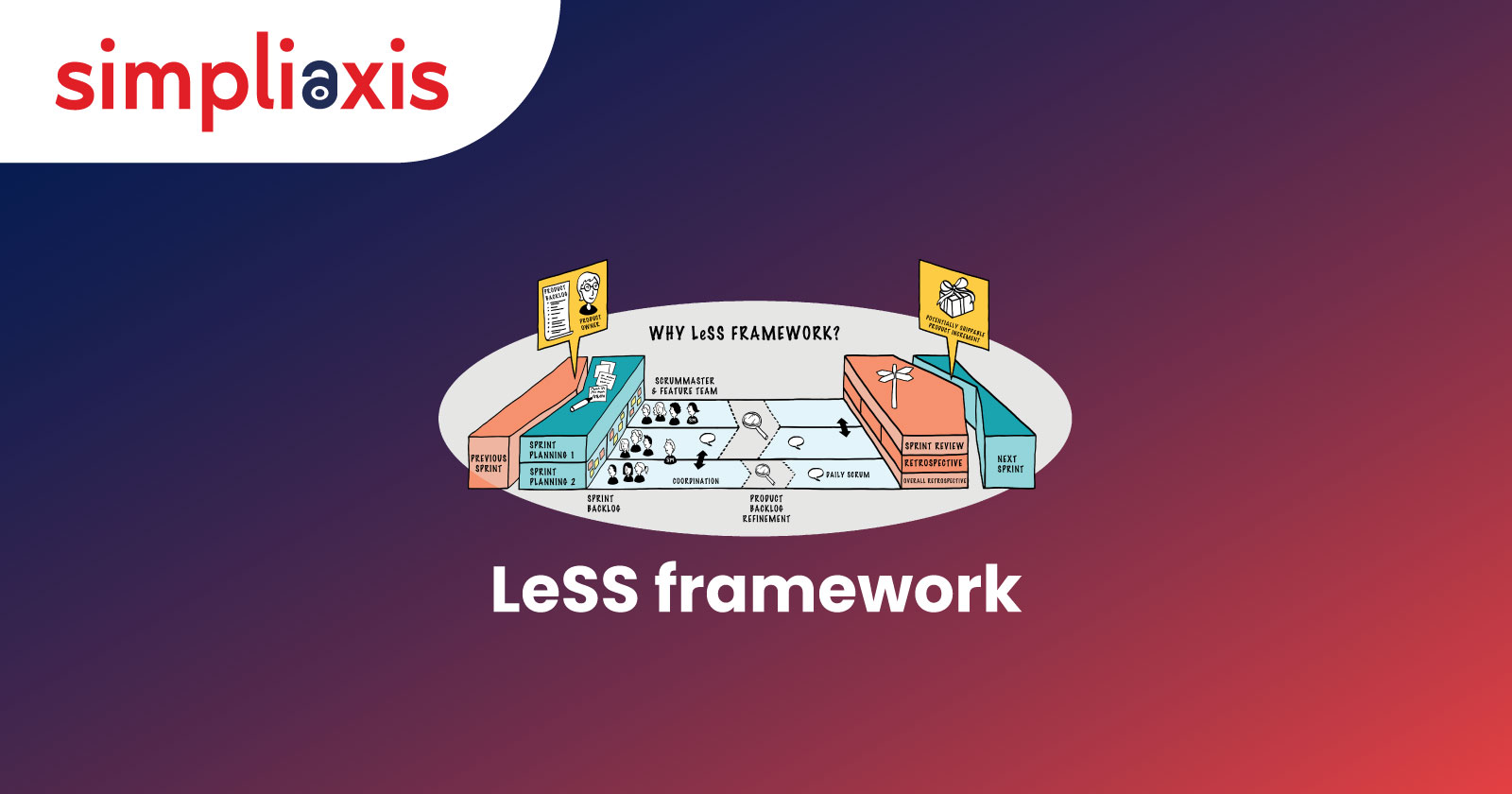
In the dynamic and competitive business landscape, software development teams employing Agile methodologies possess a distinct advantage. However, when the scope of a project surpasses the capacity of a single team, a more comprehensive approach is required. This is where the LeSS framework emerges as a potent solution.
The LeSS framework full form, is Large-Scale Scrum and is explicitly designed as a scaling framework for applying Scrum principles. LeSS offers a structured methodology for scaling Agile principles to multiple teams collaborating on a single product. This blog post delves into the intricacies of the LeSS framework, LeSS Structures, LeSS Principles, LeSS team operations, and challenges of adopting LeSS, examining its benefits and comparing it with other notable scaling frameworks, such as the SAFe framework.
What is the LeSS Framework?
The LeSS framework provides a set of principles and practices for scaling Scrum to multiple teams working on a large-scale product. It is based on the idea that Scrum is a lightweight and practical framework for managing complex software development projects. It can be scaled to larger teams and projects by following certain principles and patterns.
The LeSS is designed to be simple and easy to understand, and it is based on the following key principles:
- Self-organization: Teams are self-organized and self-managed and are responsible for delivering a working product increment in the scrum at the end of each sprint.
- Transparency: All work is transparent to all team members, and there is a shared understanding of the project goals and objectives.
- Inspection and adaptation: The team regularly inspects its progress and adapts its plans based on what it learns.
Several large organizations, including Spotify, Ericsson, and ING, have successfully used the LeSS. It is a robust framework that can help teams deliver high-quality software products on time and within budget.
Read moreAbout Self Organizing Teams in an Agile
LeSS Structures
LeSS provides two main variations for structuring a software development organization: Basic LeSS and LeSS Huge.
Basic LeSS
- Designed for organizations with up to eight teams working on a single product
- Each team has its own Product Owner, Scrum Master, and development team
- All teams share a common Sprint Backlog and Product Backlog
Teams coordinate their work through daily stand-ups and regular refinement meetings
Read More : Top Scrum Master Interview Questions and Answers
LeSS Huge
- Designed for organizations with more than eight teams working on a single product
- Teams are organized into Feature Teams, Component Teams, and System Teams
- Feature Teams are responsible for developing new features
- Component Teams are responsible for maintaining and evolving existing components
- System Teams are responsible for integrating the work of the Feature Teams and Component Teams
- All teams share a common Sprint Backlog and Product Backlog
- Teams coordinate their work through daily stand-ups, regular refinement meetings, and LeSS ceremonies such as the LeSS Retrospective
Both Basic LeSS and LeSS Huge are designed to be scalable and adaptable to the specific needs of an organization. The key principles of LeSS, such as self-organization, transparency, inspection, and adaptation, are essential for both variations.
LeSS Principles
The LeSS framework is guided by a set of principles that serve as guidelines for teams to collaborate and produce successful outcomes. These principles consist of:
- Self-Organization: Teams operate autonomously, managing their tasks independently and assuming responsibility for delivering functional product increments at the end of each sprint.
- Transparency: All project aspects are visible to team members, promoting clarity and a shared understanding of project objectives and goals.
- Inspection and Adaptation: The team regularly assesses its progress and adjusts plans based on accumulated knowledge, ensuring adaptability and continuous improvement.
- Whole-Product Focus: The team prioritizes delivering a comprehensive and cohesive product rather than focusing on individual components in isolation.
- Customer-Centricity: The team is committed to delivering value to the customer and actively seeks regular feedback to align with customer requirements.
- Continuous Improvement: The team is dedicated to finding ways to enhance its processes and products, fostering a culture of ongoing optimization.
These principles are fundamental to the success of LeSS. They empower teams to work cohesively, deliver high-quality software products, meet deadlines, and remain within the allocated budget.
How Teams Operate within the LeSS Framework?
In the LeSS framework, teams operate in a self-organized and cross-functional manner. This means that teams are responsible for all aspects of the software development process, from planning and design to development and testing. Teams are also given the autonomy to make decisions about how they work, which allows them to be more responsive to changing requirements.
One of the key features of the LeSS is the daily stand-up meeting. The daily stand-up is a short meeting where each team member shares what they worked on the previous day, what they are working on today, and any blockers they are facing. The daily stand-up helps to keep the team informed about each other's work and to identify any potential problems early on.
Another important feature of the LeSS is the sprint retrospective. The sprint retrospective is a meeting held at the end of each sprint where the team reflects on how the sprint went and identifies areas for improvement. The sprint retrospective helps the team to learn from their mistakes and to continuously improve their process.
Check out the Purpose of the Sprint Retrospective Meeting
The LeSS also focuses attention on the importance of customer feedback. Teams are encouraged to get feedback from customers on a regular basis and to use this feedback to improve their product. Customer feedback helps the team to ensure that they are building a product that meets the needs of their customers.
By following the principles of the LeSS, teams can create a more agile and effective development process.
Benefits of the LeSS Framework
The LeSS framework offers several benefits to organizations looking to scale their Agile practices to larger teams and projects.
- Reduced Overhead: LeSS avoids the creation of excessive roles or processes, keeping the focus on value delivery. This streamlined approach reduces unnecessary complexity and bureaucracy, enabling teams to work more efficiently.
- Improved Agility: Teams working within the LeSS operate with greater autonomy and a whole-product mindset. This fosters a culture of innovation and adaptability, allowing teams to respond more quickly to changes in the market or customer needs.
- Improved Transparency: LeSS promotes transparency by focusing on shared events and a single Product Backlog. This ensures that everyone involved in the development process is aligned with the direction of the product and has a clear understanding of the priorities.
- Adaptability: The LeSS is designed to be adaptable to different organizational contexts. It provides a set of principles and practices that can be customized to meet the specific needs and challenges of each organization without sacrificing its core principles.
Challenges of Adopting LeSS
Adopting LeSS can present several challenges for organizations. Here's an overview of some common pitfalls:
- Cultural Resistance: Transitioning to LeSS requires a significant shift in mindset and organizational culture. Resistance to change from traditional hierarchical structures and processes can hinder the successful implementation of LeSS.
- Lack of Leadership Support: LeSS adoption can face obstacles without strong leadership support. Leaders must actively adopt and promote LeSS principles to create an environment conducive to its success.
- Scaling Agile Practices: Expanding Agile practices to larger teams and projects requires careful planning and execution. Organizations must address issues related to team coordination, dependency management, and scaling ceremonies effectively.
- Managing Technical Debt: Balancing the need for quick delivery with maintaining technical quality can be challenging in large-scale Agile environments. Organizations must establish effective practices for managing technical debt and ensuring long-term sustainability.
- Organizational Silos: Breaking down silos and fostering cross-functional collaboration can be difficult in large organizations. LeSS emphasizes the importance of shared ownership and collective responsibility, which can challenge existing organizational structures.
Also read,Scaling agile challenges and how to overcome them
Two Agile Scaling Frameworks: LeSS vs. SAFe
LeSS and SAFe are two popular Agile scaling frameworks. LeSS is a lightweight framework based on self-organization, transparency, and inspection and adaptation. It is easy to implement and use and suitable for organizations familiar with Scrum.
SAFe is a more heavyweight framework with a structured approach to scaling Agile. It is often used by organizations new to Agile or with many teams and projects to manage.
LeSS framework is a good fit for organizations comfortable with Scrum, smaller organizations, and those valuing self-organization and autonomy. SAFe is suitable for organizations new to Agile, larger organizations with complex coordination needs, and those desiring a structured approach to scaling Agile.
Read more about SAFe vs. LeSS: Choosing the Right Agile Framework for Your Organization
Conclusion:
The LeSS framework is a powerful tool for scaling Scrum to large teams and projects. It provides a set of principles and practices that help teams to deliver high-quality software products on time and within budget. The framework focuses on self-organization, transparency, inspection, and adaptation, and it is designed to be simple and easy to understand.
Agile and Scrum Training by Simpliaxis can help you master the concepts of the LeSS and apply them to your own organization. Our experienced trainers will guide you through the framework principles and practices and help you develop the skills you need to succeed in a large-scale Agile environment.





 Lowest-Price Challenge











 Personalized Path


.webp)


 USA
USA  Canada
 India
India UK
UK Australia
 Singapore


