


 Call Us



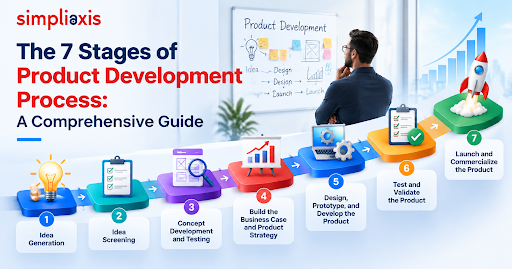
The 7 Stages of Product Development Process: A Comprehensive Guide
The product development process is a six-stage plan, helping grow product levels from the initial concept to the market launch. This includes identifying a market need, developing a product roadmap, ideating a solution, and creating a robust minimum viable product (MVP).
Key Highlights of 7 Stages of Product Development Process
- The seven stages of new product development are idea generation, idea screening, concept development and testing, business case and product strategy, design and development, testing and validation, and launch and commercialization.
- Product development is about building and delivering a product. Product management is about setting a direction for what is built and for whom. Both work closely together.
- An effective, efficient, and well-defined process reduces time and costs and increases market potential, product-market fit, and customer satisfaction. It aligns staff and keeps them all focused on the same goal.
- After launch, teams focus on customer satisfaction and look for ways to improve the product. Teams find opportunities by analyzing product usage data, looking for trends and acting on feedback.
- Best practices include: starting with a validated customer problem, using agile and MVP approaches, aligning cross-functional teams, setting clear stage gate decisions, defining success metrics and continually improving.
- Challenges include limited resources, poor market validation, unclear customer needs, scope creep, misalignment amongst staff, and a lack of go-to-market strategy. Focusing on high-value product features and early product testing can address these challenges.
Introduction
Whether you're steering a startup or leading a team in a larger organisation, understanding the product development process is critical for bringing innovative products from concept to reality. It is all about taking your groundbreaking ideas and sculpting them into market-ready products.
The product development process involves a series of strategic and creative stages that ensure your product not only meets market needs, but also stands out in the competitive landscape.
In this article, we will explore the seven important stages of the product development process. Let's dive in and learn how to turn your innovative concepts into successful realities.
What is the product development process?
Product development process refers to the steps taken to build a new product from the initial concept to the market launch. Here, we follow a 7-stage process: identify product ideas, validate product ideas, test the product concept, build the business case and product strategy, develop the product, test the product, and launch the product.
We follow a structured approach, helping teams to move from brainstorming sessions to launching the product by keeping the creativity and strategy aligned.
Product development vs product management
In simple terms, product development looks at turning ideas into a successful product and product management is more into setting the direction or goal towards achieving product deliverables. see the product management workflow.
| Aspect | Product Development | Product Management |
| Core focus | Building, testing, and delivering the product. | Defining the right product to build and guiding its market success. |
| Central question | How can we create this product effectively? | What should we build, for whom, and why? |
| Nature of work | Execution-oriented and technical. | Strategic, customer-oriented, and business-focused. |
| Main responsibilities | Design, engineering, prototyping, coding, quality assurance, testing, and release. | Customer research, market analysis, product vision, roadmap creation, prioritisation, and stakeholder alignment. |
| Typical roles | Engineers, designers, developers, QA testers, UX specialists, and technical leads. | Product managers, product owners, and product strategists. |
| Key outputs | Working features, prototypes, product releases, technical documentation, and bug fixes. | Product strategy, roadmap, requirements, prioritised backlog, and success metrics. |
| Time horizon | Usually focused on a release, sprint, or defined build cycle. | Covers the full product lifecycle, including discovery, launch, growth, and improvement. |
| Decision criteria | Technical feasibility, quality, reliability, cost, and delivery timelines. | Customer value, market demand, business goals, revenue potential, and strategic fit. |
| Success measures | On-time delivery, product quality, stability, performance, and low defect rates. | Adoption, retention, customer satisfaction, revenue, engagement, and market fit. |
| Collaboration | Works most closely with engineering, design, and QA teams. | Coordinates across engineering, design, marketing, sales, support, and leadership. |
| Example | Creating a grocery-delivery app’s checkout flow and testing it before release. | Deciding that faster checkout is a priority because customers abandon carts during payment. |
Why is the Product Development Process Important?
The product development process enables organizations to evolve their idea of a new product from fuzzy, vague notions to market readiness with the utmost transparency, effectiveness, and confidence.
1. Validates what customers want and need
Prior to full-scale development, teams investigate the wants, needs, and expectations of potential customers. This increases the likelihood of developing a product that is not only desired, but also exists to fulfill a genuine market need.
2. Tacks product and market risks
Through user research, teams are able to identify the most prominent risks that could lead to a product’s failure and/or profitability issues.
3. Maximizes potential of product-market fit
It becomes easier to gain a competitive advantage by being the first to introduce a product to a given market and/or modifying a product in alignment with the demands and preferences of a market.
What Are the 7 Stages of the Product Development Process?
The 7 stages of the product development process include the following:
1. Idea generation:
Strong ideas usually come out of product discovery, where teams explore customer problems before proposing solutions.
- Pain points and customer needs.
- Concept testing with potential users.
- Market research and trends.
During this stage, you need to collect ideas from different sources: internal and external.

Let’s consider the following factors during initiating a new product concept
- Target market: When you are building your product, focus on your target market, helping your new product concept connect with customers effectively.
- Analyse your current products:It is advisable to look at your current product portfolio analysis and see if the new concept is unique to be viable.
- Functionality: Having clarity of what your product will serve is important, highlighting the importance of product functionality.
- SCAMPER method: Implement different brainstorming methods like SCAMPER. This involves adapting, substituting, combining, modifying, or rearranging your product concept.
For product concept validation, document your ideas on an idea board or in a business case. This provides all your team members with a better understanding of the initial product objectives and features.
2. Idea screening
Once you generate your ideas, the next important step is to screen them. This involves evaluating and filtering your ideas to understand which idea can be taken forward. The goal of this stage is to ensure the most promising ideas can advance to the next stage.

For better filtering of ideas, kindly use one of the following methods
- Feasibility analysis
- Idea scoring
3. Concept development and testing:
This is the third stage where we transform selected ideas into well-crafted product concepts that need to be tested with potential customers. The goal of this phase is to evaluate the appeal and feasibility of the product concept. We will be looking at whether further improvements are required prior to making suitable investments.
Here, the R&D and product teams need to:
- Define product features and value proposition. A value proposition canvas helps map features to customer gains and pains.
- Develop a detailed presentation of your idea via prototypes or mock-ups to demonstrate the product’s practicality.
- Evaluate key factors like target audience, product strategy, pricing strategy, product metrics, and distribution channels.
4. Build the Business Case and Product Strategy
In this stage, you need to define product positioning and goals that you are looking to achieve. Your primary focus should be on coordinating marketing, sales, and distribution teams, plan product launch, and improve its reach in the market.
During this phase, the commercialization strategy needs to be defined as shown in the image below

By looking at the components, you will get clarity on how to proceed further to the next step in the product development process.
5. Design, Prototype, and Develop the Product
In this stage, the product concept is transformed into a functional solution. Teams begin by defining clear product requirements, which include features, user needs, and technical specifications, and by describing the expected outcomes.
Next, product experience is defined through user flows, wireframes, interfaces, and visuals, and finally, the development team creates prototypes. This is done for a minimum viable product (MVP) to test the core value proposition.
As part of assessing the value proposition, it is important to analyze the technical feasibility to determine if the solution can be built within the constraints of the budget and time, and using the available technology. Feedback from customers, as well as from stakeholders and employees helps define the product and helps pinpoint areas for improvement.
Stage 6: Test and Validate the Product
This stage is devoted to verify that the product performs as anticipated and brings value to the customer. Usability testing evaluates the product from the customer’s point of view to access if the product is easy to use. Quality testing validates the performance of the product, functions and technical requirements.
Once a product is developed, the development team is responsible for testing the product in the market, assessing customer interest, and evaluating pricing and other elements of the product offering to determine if the customer is going to make the purchase.
Based on the results of the test, product features and functions are defined, and the product is improved in order to bring the best value proposition. Testing is carried out until the product is ready for its commercial launch.
Stage 7: Launch and Commercialize the Product
This phase encompasses the introduction and adoption of the product by the market being targeted. The team creates strategies for the marketing of the product by considering the target customers, positioning, communication and means of marketing and selling the product.
The team creates strategies for pricing, distribution and promotion of the product to facilitate discovery and purchase of the product. In order to ensure that the launch is flawless, the product, marketing, sales, customer service and operations team work hand in hand.
Upon launch, the team tracks the performance of the product in the market through various measurements such as number of sales, signups, customer interaction, conversion rate, product reviews and customer support requests. Through the feedback generated during product launch, the team works on ways of improving the product and answering any customer questions.
Product development process examples
Strong examples of product development show the same habits: starting with a real problem, repeatedly testing and improving after launch. Below are some examples from well known companies, matched to the stages in your blog.
1. Amazon: Working backward
Amazon starts with the customer in mind. Before writing code, the team drafts an internal press release describing the product in terms of the customer problem it solves and the product experience. This method was used for the development of Kindle, Echo, and Alexa.
Stages shown: Idea generation, design and prototyping, and testing and validation.
2. Facebook: Build a Minimum Viable Product
Facebook started with a simple, very basic interface. With each new feature, the team would work to improve the simplicity of the design. During the first five years, Facebook was only accessible to students of a limited number of colleges.
Stages shown: Idea generation, design and prototyping, and testing and validation.
3. Tesla: Beta testing
When Tesla launched the Model S and Model X, both cars had autopilot, even though the cars' full autopilot software was not yet complete. After launch, the software was continually updated, and the vehicles improved, making them closer to a complete version of autopilot. With each new improvement, the design became simpler and cleaner.
Stages shown: screening ideas and concept development.
4. Netflix: Hypothesis and Testing
To boost member engagement and retention, the Netflix team proposes a hypothesis and builds a quick prototype to capture the essence of the idea. They don't build the perfect prototype. The prototype is then tested on a user cohort, and a single test can involve hundreds of thousands of users.
Stages shown: concept testing and product validation.
5. Dropbox: Validate Before Building
The Dropbox founders made a cheap demo video showing how their product worked. They validated the idea and built up an early user base before they invested in the full product. It's a low-cost way to verify early product market fit.
Stages shown: idea validation and business case.
What happens after product launch?
The development of a product does not end with the launch. Launch is only the start of the product life cycle, which moves through growth, maturity and decline.Once a product is launched, a number of activities need to be carried out concurrently by various teams. These include but are not limited to; measuring product performance, analyzing customer journey, identifying opportunity areas, strategizing for growth and enhancing the product and service offering.
1. Evaluate Product Performance
In order to evaluate the performance of a product in the market, product teams need to define product performance indicators. Product performance can be evaluated based on a number of factors which may include but are not limited to; number of sales and sign ups, conversion and retention rates, average revenue and customer support tickets, and features which are most used by the customers.
2. Collect customer feedback
Mapping the customer journey shows where users struggle and where feedback is most useful. Some of the sources may include but are not limited to; product usage, competitive landscape, sales and marketing, support, and product exploration.
Product teams should prioritize customer experience enhancements based on the value and impact it is expected to deliver to the customers.
Feedback can uncover bugs, features, and usability issues. Feedback helps set and manage expectations, and can identify opportunities to enhance the service or product. We are primarily concerned with identifying and addressing trends rather than focusing on individual feedback.
Over time, a service or product can be enhanced based on feedback and performance data. This can allow a service or product to gain a competitive edge by, for example, facilitating a simpler workflow or offering enhanced usability.
3. Improve the product to better meet customer and business needs
To maximize the potential of a service or product and better meet customer needs, a plan outlining the anticipated growth and longer-term enhancements should be created. Anticipated upgrades can also better address and integrate the service or product with respect to emerging business needs.
A well-articulated plan allows the service or product to mature and offers the potential to further engage customers and promote sustainable growth.
What Are the Best Practices for Product Development?
There are a few things that help create effective product development processes. Teams should get to know their customers, execute with discipline, and continually assess and improve their processes. With the practices below, teams can reduce risk and create products with greater value.
1. Begin with a Validated Customer Problem
In order for product development to be successful, the process has to start with the customer. In many cases, teams feel they have a good understanding of a customer problem and can proceed to build a solution.
However, teams should take the time to validate the problem is legitimate and pertinent to the customer, as well as determine whether it is worth solving. A variety of research and analysis tools can help teams evaluate the problem they wish to solve.
2. Solicit Customer Feedback for All Stages of the Process
The team can continue to interact with the customers in the development process and make sure that the end result addresses customer requirements. This could be done through concept and prototype assessment and testing.
3. Shorten the Development Time
Use Agile product development approaches to break work into smaller stages and track progress.Apply design thinking approach to assist in prototyping and creation of MVPs to prove user needs. In case there is a problem with the product solution, this approach will assist in identifying usability and technical problems.
4. Use Clear Stage-Gate Decisions
At predetermined points, progress is evaluated through phase gates. If a project is to advance, the project team must have evaluated customer validation, feasibility, cost, quality, and business potential, and have decided to proceed, revise, or hold the project.
5. Align Cross-Functional Teams
Alignment across the product, design, engineering, marketing, sales, operations, and customer support teams is imperative for successful product development.
6. Define Success Metrics
Prior to a product’s launch, success metrics should be agreed upon by the product development team. These are often identified as product usage rate, customer retention, customer conversion rate, customer satisfaction, revenue, and/or defect rate.
7. Continuously Iterate
Product development activities do not stop at the time of launching the product. The performance of the product in the market, customer feedback, and changes in competition can help in prioritizing the improvements and upgrades for the product.
What Are the Common Product Development Challenges?
There are many factors to consider in product development, such as, customer expectations, market realities, technical considerations, budgets, and timelines. Let’s look at some of the common product development challenges in detail
1. Unclear Customer Needs
It is very common for a product to flop because teams build a product based on assumptions instead of validating the customer’s needs. Understanding the problem the customer is trying to solve requires customer research. Customer research can also help define the most important, or highest, value features and the expected customer experience. These and other product discovery techniques help teams validate needs before building.There are multiple ways to gain customer feedback and research, like surveys, interviews, and user testing to name a few.
2. Poor Market Validation
Having a good idea can sometimes feel like having a market opportunity, but that is not always the case. Poor market validation can lead to a product with very little differentiation and demand, and/or an inadequate price.
Market research should be done to determine customer’s willingness to pay, the competition, and the market opportunity before committing a large investment.
3. Scope Creep
While product development is continuously evolving, and new features and requirements may be added, there should be a process in place to adequately evaluate the impact of these before development continues. If this becomes uncontrolled, it may lead to the release of a sub-par product, and ultimately affect the bottom line.
4. Constraints on Product Team Resources
Product teams are constrained by budgets, timelines, employee headcount, and the sophistication of the team’s technical skills.
These constraints affect the number of product features teams are able to build and the extent of product testing teams are able to perform. Product teams have an advantage by directing their resources at product features which address the highest valued customer concerns and building a minimum viable product.
5. Misalignment Among Cross-Functional Teams
Cross-functional teams include product, design, engineering, sales, marketing, operations, and customer service. Misalignment by any of these teams can lead to a lack of progress. Alignment is necessary to drive joint ownership of business outcomes, transparency around the rationale for key decisions, and frequent, structured communication.
6. Too Much Work Done at the End
To be effective, product testing should occur early and often. Some development teams operate under the fallacy that they can postpone testing until the end of a development cycle, thinking the product will be easier to test at that later stage. If the team has not thought about testing and product learning, the final product will likely leave much to be desired by the consumer.
7. Weak Go-To-Market Planning
Even the best built product can be a dud if the market is not ready to sell the product. It is critical to plan and integrate the efforts of the marketing, sales, customer service, and operations teams early to ensure they are prepared for the anticipated demand at launch.
If you are looking at navigating complex projects effectively, enroll in the Professional Scrum Product Owner Advanced Certification Training. With this training program, professionals can scale up the ladder and advance into senior project management roles.
Conclusion:
A product development process helps organisations consistently turn their ideas into successful, customer-focused products. From identifying and validating a customer problem to designing, testing, launching and improving the product, the process helps reduce uncertainty and provide clarity for better decision-making.
An idea in isolation will not lead to the development of a successful product. A clear goal supported by cross-functional collaboration and a feedback mechanism with the customer to help identify and prioritise what features to build, and planning for the right improvement of the product over time will increase the probability of achieving a successful product.
Using a structured approach, teams can develop products that satisfy customers, build the business and defend market share.
To acquire and improve product development and product management skills, visit Simpliaxis and enroll for industry-specific programs aimed at building your knowledge in product strategy and management as well as Agile and Scrum, Project management and business transformation.






 Lowest-Price Challenge












 Personalized Path



.webp)


 USA
 Canada
 India
 UK
 Australia
 Singapore


