


 Call Us



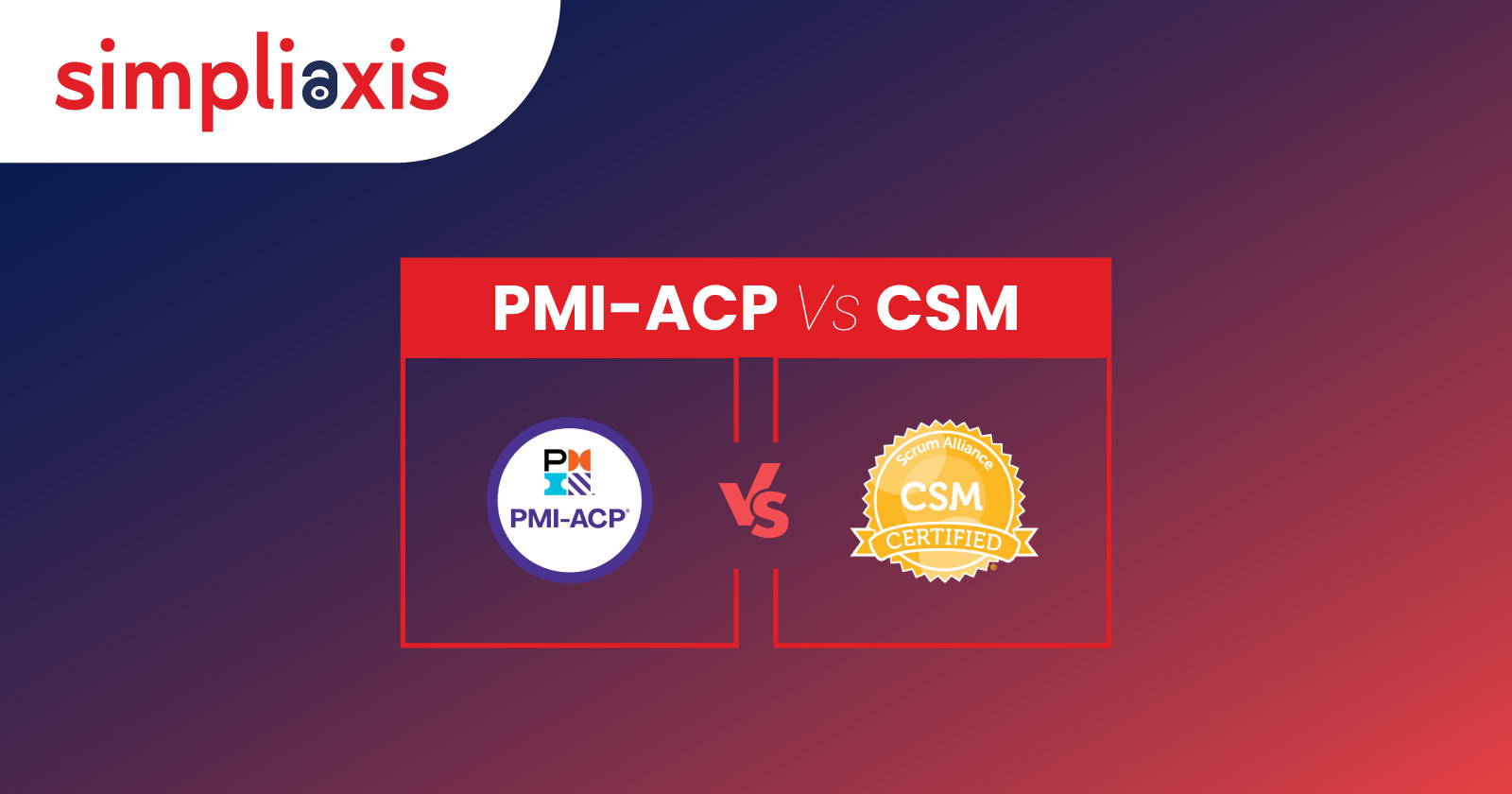
CSM has no prerequisites. Attend an approved two day course, pass a one hour open book test, and you are certified. PMI-ACP requires 12 months of general project experience within the last five years plus 8 months of agile experience within the last three, before you can apply. For anyone new to agile, this is not really a choice between two certifications, because only one of them is available.
Key Highlights
- The decisive difference is eligibility. PMI-ACP has a verified experience requirement; CSM has none at all.
- CSM certifies Scrum specifically. PMI-ACP validates broad agile experience across Scrum, Kanban, Lean, XP and others.
- The exams are not comparable. CSM is 50 questions in 60 minutes, open book and unproctored. PMI-ACP is 120 items over 3 hours in exam conditions.
- Twenty of PMI-ACP's 120 items are unscored pretest questions, so only 100 count toward your result.
- CSM renews every two years with 20 SEUs and a fee. PMI-ACP renews every three years with 30 PDUs.
- Most comparisons call PMI-ACP the higher-level credential. The more useful description is that it is gated, which is a different thing.
The Gate Is the Real Difference
Most comparisons open by describing PMI-ACP as advanced and CSM as entry-level. That framing implies a progression you can choose to climb, and it misses what actually decides this for most people.
PMI-ACP has hard eligibility requirements that PMI verifies. You need a secondary diploma or international equivalent, 21 hours of formal training in agile practices, 12 months of general project experience within the last five years, and 8 months of agile project experience within the last three. An active PMP or PgMP satisfies the general project experience requirement, though not the agile one.
CSM has none of that. There are no prerequisites to enrol, which our guide to CSM certification eligibilityconfirms. Anyone can book a course.
The consequence is direct. Someone trying to move into agile cannot use PMI-ACP to do it, because the credential requires the experience they are trying to obtain. It certifies existing practice rather than granting entry to it. That is not a criticism of the certification, and it does mean that for a large share of people asking which to take, the question resolves itself.
If Scrum is where you are heading, our free CSM practice test gives a quick read on your starting point.
Side by Side
| CSM | PMI-ACP | |
| Awarding body | Scrum Alliance | PMI |
| Experience required | None | 12 months project, plus 8 months agile |
| Training required | Mandatory approved course | 21 hours of formal agile training |
| Scope | Scrum only | Scrum, Kanban, Lean, XP and others |
| Exam length | 50 questions, 60 minutes | 120 items, 3 hours |
| Exam conditions | Open book, not proctored | Exam conditions |
| Scored items | All 50 | 100 of 120, the rest are pretest |
| Renewal cycle | 2 years | 3 years |
| Renewal requirement | 20 SEUs plus a fee | 30 PDUs |
| Time to obtain | About a week | Weeks to months, plus qualifying experience |
The exam rows deserve expanding, because the gap is wider than a question count suggests.
The Two Exams Are Not Comparable
Worth setting out properly, since candidates frequently assume both are similar tests of similar material.
CSM: Fifty multiple-choice questions, 60 minutes, 37 correct to pass. It is open book, so you may reference the Scrum Guide, your course notes and any other written or online material. It is not proctored and is taken online at a time you choose. Two attempts are included free. The full format is covered in our guide to the CSM exam pattern.
PMI-ACP: One hundred and twenty items over three hours, including multiple choice, multiple response, drag and drop and exhibit-based questions. Twenty of those items are unscored pretest questions used to trial future content, so your result is calculated from 100. There is a ten-minute break after the first sixty items. Detail is in our guide to the PMI-ACP exam format.
Three things follow from this.
Preparation effort differs by an order of magnitude: A CSM candidate who attended the course and reads the Scrum Guide is prepared. A PMI-ACP candidate is studying several frameworks across a substantial syllabus for a three-hour exam.
The pretest items change how to read your performance: Twenty questions do not count, and you cannot tell which. Encountering something unfamiliar is not necessarily a problem, which is worth knowing because candidates otherwise lose confidence mid-exam over questions that were never being scored.
The formats reflect different philosophies: Scrum Alliance puts the substantive requirement in a mandatory course and uses a light exam to confirm it landed. PMI puts the requirement in verified experience and a demanding exam. Neither is lax; they gate at different points.
Breadth Against Depth
The genuine content difference once eligibility is not the deciding factor.
CSM covers Scrum thoroughly: The accountabilities, the events, the artefacts, and the Scrum Master role in particular. It does not cover Kanban, Lean, or Extreme Programming, because those are outside the framework.
PMI-ACP covers agile broadly: Scrum among several approaches, alongside Kanban, Lean, XP and related practices, tested at a level that assumes you have worked with them.
Which is more useful depends on your environment. Someone in a Scrum team wants depth in Scrum, and knowing the theory of Kanban helps them very little on a Tuesday. Someone consulting across several teams using different approaches, or working somewhere with a mixed delivery model, benefits from the breadth.
The role matters too. CSM is attached to a job title organisations recruit for, so it functions as a screening credential for Scrum Master positions. PMI-ACP is not tied to a specific title and works more as a validation of experience, which suits people whose roles do not map neatly onto Scrum Master. What that job actually involves is covered in our guide to Scrum Master roles and responsibilities.
Cost and Renewal
Both are ongoing rather than one-off, and the shapes differ.
CSM: The course fee covers certification and two exam attempts, ranging from 250 to 2,495 US dollars depending on format, location and provider. Renewal is 100 US dollars plus 20 SEUs every two years. Details are in our guides to CSM certification cost and CSM renewal cost.
PMI-ACP: An application and exam fee, with PMI charging members considerably less than non-members, plus the cost of the 21 required training hours. Renewal requires 30 PDUs every three years, earned through education and giving back to the profession. Current pricing is covered in our guide to PMI-ACP certification cost, and the process is in PMI-ACP renewal.
Two points people miss.
Continuing education loads are similar per year: Twenty SEUs over two years against 30 PDUs over three is roughly ten a year in both cases.
PMI membership usually pays for itself if you are taking a PMI exam, since the member rate is meaningfully lower than the non-member rate. Worth checking before registering rather than after.
There is also a difference in what the fee buys. The CSM course fee is a single payment covering training, the exam and the certification together, so there is no second invoice. PMI-ACP separates them: you pay for the 21 training hours from whichever provider you choose, then pay PMI separately to apply and sit the exam. Neither arrangement is cheaper by design, and the bundled one is easier to budget for because the total is visible upfront.
Which One for Whom
The decision, stated plainly.
New to agile, no relevant experience: CSM. PMI-ACP is not available to you, and CSM is designed for exactly this position.
Working in a Scrum team, want to formalise it: CSM. It matches your daily work and it is the credential your job title attracts.
Several years of mixed agile experience across frameworks: PMI-ACP validates that breadth in a way CSM cannot, since CSM only speaks to Scrum.
Moving into a Scrum Master role from a project management background: CSM first. It is the screening credential for the role. PMI-ACP can follow and it will not get you the first interview.
Consulting or coaching across teams using different approaches: PMI-ACP suits the work better, and many people in this position hold both.
An existing PMP wanting agile credibility: PMI-ACP fits your existing relationship with PMI, and the PMP satisfies the general project experience requirement. You still need 8 months of agile experience.
Your employer has a preference. Take theirs. It usually reflects their environment and it is a shorter conversation than the analysis.
What Each One Is Actually Testing
Beyond scope, the two credentials assess fundamentally different things, and this is where the choice becomes clearer for anyone eligible for both.
CSM tests comprehension of a framework: Do you understand what a Sprint is for, who owns the Product Backlog, why the Retrospective exists, where the accountabilities sit? The material is finite, published, and can be learned in two days by someone with no prior exposure. The exam confirms it landed.
PMI-ACP tests judgement across situations: Questions are largely scenario-based, asking what should happen given a set of circumstances, drawing on several approaches rather than one. That is harder to prepare for by study alone, which is why the experience requirement exists. Someone who has only read about Kanban tends to struggle with questions about when to apply it.
The distinction matters practically for two reasons.
Study strategy differs completely: For CSM, read the Scrum Guide and attend the course. For PMI-ACP, the reading list is broad and the more valuable preparation is reflecting on situations you have actually been in, because the exam rewards recognising patterns you have seen.
The credentials say different things to an employer: CSM says you understand Scrum and have been trained in the Scrum Master role. PMI-ACP says you have been doing agile work for a while across more than one approach and can reason about it. Neither claim is stronger; they answer different questions a hiring manager might have.
This is also why the common framing of PMI-ACP as the natural next step after CSM is slightly off. It is not a deeper version of the same test. Someone could hold CSM, work in Scrum for five years, and still find PMI-ACP challenging in areas they have never encountered, because a single framework practised well does not automatically produce breadth. Deepening within Scrum instead through the Scrum Alliance track, starting from CSM Certification Training, is an equally legitimate direction.
Can You Hold Both
Yes, and it is a reasonably common pairing, usually acquired in that order for a structural reason rather than a strategic one.
CSM comes first because it can. There is no gate, so people take it when they enter the field. PMI-ACP comes later because the experience requirement takes years to satisfy, so it tends to arrive once someone has been practising for a while.
That sequence is worth understanding as the natural shape rather than a recommended path. Nobody needs to plan it. If you are in agile long enough to qualify for PMI-ACP, you will be in a position to judge whether the breadth validation is useful to you at that point.
The practical caution is the same as with any pair of credentials. Two renewal cycles, two sets of continuing education, two fees. Holding both when only one is doing work for you is an ongoing cost with no return.
What Neither One Gives You
Worth stating, because both are frequently oversold.
Neither makes you effective. CSM is a two-day course. PMI-ACP is an exam validating experience you already had. Competence comes from doing the work over months on a real team.
Neither resolves an organisational problem. A Scrum Master with either credential still cannot fix a company that wants fixed scope on a fixed date. That is above the team, and no certification changes it.
Neither guarantees a salary increase. Certification bodies publish figures suggesting a premium, and the dominant variables in every market are experience, location, and industry. A credential can affect access to roles, which is a real effect and a different one from a premium attached to the certificate itself.
That last point is the one to hold onto when weighing the cost of either. The question worth asking is not which certification pays more, but which one gets you considered for the roles you actually want, and job postings in your market answer that faster than any comparison.
If You Do Not Yet Qualify for PMI-ACP
A common position, and the useful question is what to do about it rather than which certification is theoretically better.
The requirement is 8 months of agile project experience within the last three years, plus 12 months of general project experience within the last five. Three practical points for anyone short of that.
Agile experience does not require the job title: Working as a developer, tester, analyst or Product Owner on a team running Scrum counts. You do not need to have been a Scrum Master. People frequently assume they do not qualify when they have been on an agile team for two years in another role.
The clock is a rolling window, not a total: Experience must fall within the last three years, so an eighteen-month stint five years ago does not count. If you have moved away from agile work, the qualifying period erodes.
CSM is the sensible move in the meantime: It has no gate, it is available now, and it is the credential attached to the role most people in this position are moving toward. It also does not conflict with taking PMI-ACP later, since neither is a prerequisite for the other.
The mistake to avoid is waiting. People sometimes defer certifying at all because PMI-ACP looks like the more prestigious destination, and spend two years holding nothing while accumulating experience they could have been holding a credential alongside. Taking CSM now and PMI-ACP when you qualify is strictly better than waiting, and the sequencing costs nothing.
For anyone in that position, CSM Certification Training is a two-day commitment with no prerequisites, and the free CSM practice test is a reasonable way to see how much of the framework you have already absorbed on the job.
Frequently Asked Questions
1. Which is better, PMI-ACP or CSM?
Neither in general. CSM suits people entering Scrum or working in a Scrum team. PMI-ACP suits experienced practitioners validating broad agile experience. Eligibility usually decides it, since PMI-ACP requires experience CSM does not.
2. Can I take PMI-ACP without experience?
No. You need 12 months of general project experience within the last five years and 8 months of agile experience within the last three. PMI verifies this.
3. Is PMI-ACP harder than CSM?
Considerably, in both preparation and exam conditions. CSM is 50 questions in 60 minutes, open book and unproctored. PMI-ACP is 120 items over three hours under exam conditions.
4. Do I need CSM before PMI-ACP?
No. They are independent credentials from different bodies. Many people hold both, usually because CSM was available earlier.
5. Which is more recognised?
CSM is named more often in Scrum Master job postings, since it maps to a job title. PMI-ACP carries PMI's recognition and is more common among experienced practitioners in mixed environments.
6. How long does each take?
CSM takes about a week from course to certification. PMI-ACP takes weeks to months of preparation, on top of the qualifying experience.
7. Does PMI-ACP cover Scrum?
Yes, among several approaches including Kanban, Lean and XP. It covers Scrum less deeply than CSM does, since it is one topic among many.
8. What are the pretest items on the PMI-ACP exam?
Twenty of the 120 items are unscored questions PMI uses to trial future content. Your result comes from the remaining 100, and you cannot tell which are which.
9. Does a PMP count toward PMI-ACP eligibility?
It satisfies the 12 months of general project experience. It does not satisfy the 8 months of agile experience, which you still need separately.
10. Can I count agile experience from a role that was not Scrum Master?
Yes. Working on an agile team as a developer, tester, analyst or Product Owner counts. The requirement is agile project experience, not time spent in a specific role.
11. Is there a break during the PMI-ACP exam?
Yes, a ten-minute break after the first sixty items, once you have reviewed your answers to that point.
12. Which should I take first if I want both?
CSM, almost always, because it has no eligibility gate and is available immediately. PMI-ACP requires qualifying experience that takes years to accumulate, so it naturally comes later.
13. Do the two certifications overlap?
Partially. PMI-ACP covers Scrum as one of several approaches, so there is shared ground. It covers Scrum considerably less deeply than CSM does, and CSM covers nothing outside Scrum.
Closing Thoughts
The comparison people expect is which credential carries more weight. The more useful question is which one you are eligible for, because that settles it for a large share of people asking.
PMI-ACP validates agile experience you already have. CSM teaches Scrum to people who may have none. Describing one as advanced and the other as entry level makes them sound like steps on a ladder, when they are better understood as credentials that gate at opposite ends: PMI-ACP before you start, CSM not at all.
If you have the experience and work across several frameworks, PMI-ACP says something CSM cannot. If you are entering Scrum, moving into a Scrum Master role, or want depth in the framework your team actually uses, CSM is the one, and it is available now rather than after two more years of qualifying practice.
For the Scrum path, CSM Certification Training covers the two day course, the exam and the certification in one package. Request the curriculum to see the agenda and upcoming dates, or start with the free CSM practice test to find your gaps first. If you already have the agile experience and the broader validation is what you need, PMI-ACP Certification Training covers the 21 required training hours and the exam preparation.





 Lowest-Price Challenge











 Personalized Path


.webp)


 USA
USA  Canada
 India
India UK
UK Australia
 Singapore


