


 Call Us



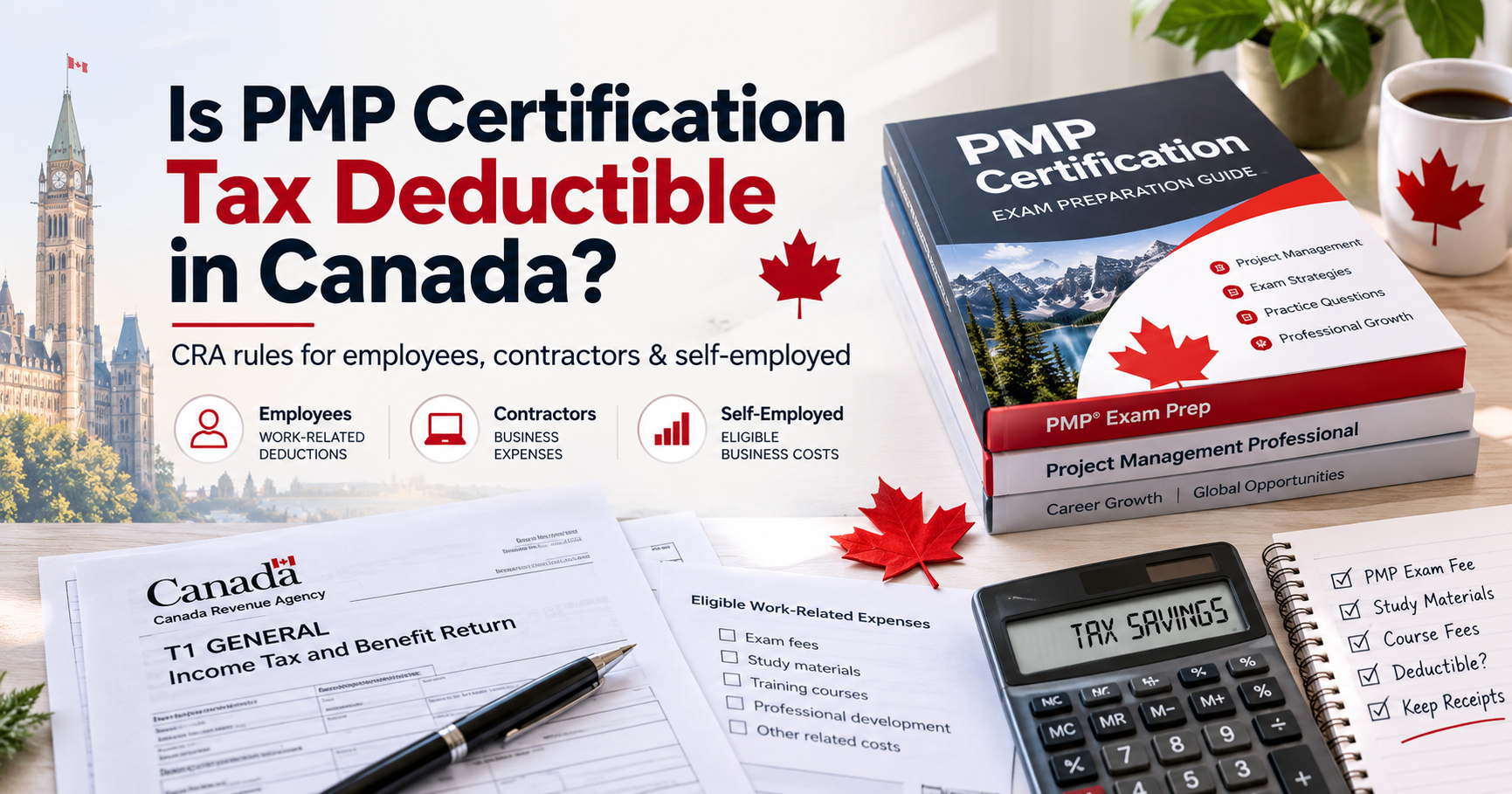
PMP certification costs are deductible in Canada, but the rules differ sharply depending on whether you are self-employed or a salaried employee. Self-employed project managers and contractors can generally write off the exam fee, PMI membership and training costs as a business expense on the T2125 form. Salaried employees face a narrower path under Line 21200 of the T1 return, and can only claim professional dues that are required to keep a professional status recognised by law, a test the PMP credential does not automatically pass in every province. Employer-paid training adds a further wrinkle, since it can appear as a taxable benefit on your T4 depending on how it is structured.
Key Highlights: Is PMP Certification Tax Deductible in Canada?
- Self-employed project managers can generally deduct PMP exam fees, PMI membership and training costs on Line 8760 or Line 9270 of the T2125 business statement.
- Salaried employees claim professional dues on Line 21200, but the Canada Revenue Agency's Income Tax Folio S2-F2-C1 sets a stricter bar for what counts.
- PMI is a US-based association, and PMP membership is not a legal requirement to practise project management in any Canadian province, which is the detail that most often decides whether an employee's claim survives review.
- If your employer pays for your PMP training and the course is required for your current role, the benefit is typically non-taxable and does not appear on your T4.
- The PMI exam fee itself is billed in US dollars, so your CAD cost shifts with the exchange rate, and PMI's own fee increase effective 6 August 2026 raises both member and non-member pricing.
- Contractors operating through a corporation can typically expense PMP-related costs directly against corporate income, which is often the cleanest route of the three.
- Employers funding certification for multiple staff at once should evaluate the deduction question at the organisational level, not just the individual one, since group training changes both the cost structure and the tax treatment.
How the CRA Actually Splits This Question in Two
The Canada Revenue Agency does not have a single rule for "professional certification costs." Instead, it applies two entirely separate frameworks depending on your employment status, and conflating the two is the single most common reason Canadian project managers get PMP deduction claims wrong. If you are self-employed, a contractor invoicing through your own business, or operating through a corporation, your PMP-related spending is assessed as a business expense under the rules that also govern deductions for office supplies, software subscriptions and marketing. If you are a salaried employee working for someone else's payroll, the CRA instead applies the employment-expense rules built around Line 21200 and the Income Tax Folio S2-F2-C1, which sets a materially higher bar.
This distinction matters because a large share of the PMP candidate population in Canada sits in the second category. Project managers are frequently full-time employees of construction firms, IT consultancies, banks and public-sector bodies, which means the harder employee-side test applies to most people reading this, not the more generous self-employed one.
If You Are Self-Employed or a Contractor: The T2125 Path
Self-employed project managers, including incorporated consultants and sole proprietors invoicing clients directly, report business income and expenses on Form T2125, Statement of Business or Professional Activities. Training and certification costs that maintain or upgrade skills used in your existing business are generally deductible business expenses, reported on Line 8760 (business taxes, licences and memberships) or Line 9270 (other expenses), depending on how your bookkeeping categorises the spend.
For a self-employed project manager, this typically covers:
- Exam fee. The PMI exam sitting fee, whether paid as a member or non-member.
- PMI membership. The annual USD 139 membership fee, since it is directly tied to earning and maintaining a credential used in your business.
- Training course fees. The 35 contact hours of formal project management education required for eligibility, plus any exam prep course, study guide or mock-exam simulator purchased to prepare.
- PDU-earning activities. Ongoing renewal-related education purchased to maintain the 60 PDUs required every three-year cycle.
The general test the CRA applies here is whether the expense was incurred to earn business income and is reasonable in the circumstances. Because a PMP credential is squarely aligned with a project management consulting or contracting practice, this is usually a straightforward claim, though you should still keep invoices and receipts in case of a review, and a corporation should route the expense through its own books rather than the individual's personal return.
If You Are a Salaried Employee: Line 21200 and Its Limits
Salaried employees claim eligible professional dues on Line 21200 of the T1 return, drawing on amounts shown in Box 44 of their T4 slip or on receipts they hold directly. The CRA's Income Tax Folio S2-F2-C1, Employee Professional Membership and Other Dues, sets out what qualifies, and the wording is narrower than most candidates expect
According to the CRA, deductible professional dues on Line 21200 must relate to annual dues for membership in a trade union or association of public servants, professional board dues required under provincial or territorial law, or professional membership dues required to keep a professional status recognised by law.
This last category is where PMP claims run into difficulty. Unlike a Professional Engineer's PEO membership in Ontario or a lawyer's provincial law society dues, PMI membership and the PMP credential are not required by any Canadian statute to practise as a project manager. PMI is a US-based nonprofit association, and holding a PMP is a market-recognised qualification rather than a legally mandated one
In practice, this means an employee who simply pays for their own PMP exam and PMI membership out of pocket, with no employer involvement, has a genuinely arguable but not guaranteed claim under Line 21200, and CRA reviewers have pushed back on claims of this type precisely because the legal-requirement test is not met the way it would be for a regulated profession.
Where the deduction is much more solid is when your employer reimburses the cost and adds it to your income as a taxable benefit on your T4, since the Income Tax Folio explicitly allows you to claim the offsetting deduction in that scenario. If you are unsure which category your specific role and reimbursement structure falls into, this is exactly the kind of borderline call worth confirming with a Canadian tax professional before you file, rather than guessing and inviting a review.
What Happens If Your Employer Pays for Your PMP Training?
Employer-funded training changes the analysis again, and this is increasingly the norm rather than the exception, since more organisations are funding PMP certification for delivery teams as a structured skills investment rather than leaving it to individual employees. The CRA's general position is that training primarily undertaken for the employer's benefit, and directly connected to the employee's current role, is a non-taxable benefit that does not need to appear on the T4 at all. Training that instead serves the employee's personal career advancement beyond their current job can be treated as a taxable benefit added to income.
For a working project manager, PMP training almost always falls on the non-taxable side of that line, since the certification maps directly onto skills the employer is already paying the employee to use. Where organisations get this wrong is in the paperwork trail, not the underlying tax position: if HR or finance does not document the training as job-related, an otherwise clean non-taxable benefit can get mis-coded as a taxable one on the T4, creating an unnecessary dispute at filing time.
This is also where PMOs and learning and development managers should be thinking beyond a single employee's return. When a PMO is certifying five, ten or twenty project coordinators at once, the tax treatment, invoicing structure and renewal-tracking obligations scale very differently to a single individual expensing their own exam fee, and it is usually worth evaluating Simpliaxis's corporate and group training programme specifically for this reason: a single negotiated enrolment for the team keeps the paperwork, invoicing and PDU tracking consistent across every certified employee, rather than leaving each person to sort out their own claim.
The Full Cost You Are Actually Trying to Deduct in 2026
Before working out what portion is deductible, it helps to see the full CAD cost stack you are dealing with, since PMI bills in US dollars and the exchange rate moves the Canadian figure.
Cost Component | PMI Member (approx.) | Non-Member (approx.) |
|---|---|---|
| PMI annual membership | USD 139 (~CAD 190) | Not applicable |
| PMP exam fee (before 6 August 2026) | USD 405 (~CAD 555) | USD 555 (~CAD 760) |
| PMP exam fee (from 6 August 2026) | ~CAD 585 | ~CAD 925 |
| Formal training (35 contact hours) | Roughly CAD 700 to CAD 2,500+, depending on format and provider | |
| Total realistic budget | Roughly CAD 1,100 to CAD 1,500 on a lean path; CAD 3,500 to CAD 4,500 on a fuller, instructor-led path | |
PMI's own exam fee increase, effective 6 August 2026, pushes both member and non-member pricing up, which makes the decision to join PMI before booking the exam more financially relevant, not less, since membership continues to pay for itself through the reduced exam rate alone. For a full breakdown of exam fees, membership costs and training formats, Simpliaxis maintains a detailed PMP certification cost guide that is kept current against PMI's published pricing.
Claiming the Deduction: A Step-by-Step Walkthrough
- Identify your category first. Confirm whether you are filing as self-employed (T2125), a salaried employee (Line 21200), or a mix of both if you hold a side consulting practice alongside employment income.
- Keep every receipt. PMI issues an exam confirmation and payment receipt; your training provider issues a course invoice. Both should be retained for at least six years in case of a CRA review.
- Check your T4 for Box 44. If your employer reimbursed any portion and included it as a taxable benefit, that amount is what you claim back on Line 21200, not the full original invoice.
- Self-employed filers complete the T2125. Categorise the exam fee and membership under Line 8760 or Line 9270, consistent with how you categorise other professional development spending.
- Retain proof of job relevance. A short note or job description showing that project management is a core function of your role strengthens either claim if it is ever questioned.
- When in doubt, get a second opinion. Given the legal-requirement ambiguity on the employee side, a five-minute conversation with a Canadian tax preparer before filing is cheaper than correcting a reassessment afterwards.
Common Mistakes That Attract CRA Attention
Most PMP-related deduction problems in Canada come down to a handful of recurring errors rather than genuinely grey-area disputes. Claiming the full invoice amount on Line 21200 when the employer has already reimbursed part of it is the most frequent one, since it effectively double-counts the same expense. Treating PMI membership as automatically deductible without checking whether it meets the "required by law" language in Income Tax Folio S2-F2-C1 is another, particularly for employees outside a regulated engineering or legal context. Self-employed filers sometimes under-claim by forgetting that renewal-cycle PDU spending, not just the original exam and training cost, is also a legitimate ongoing business expense across the three-year certification cycle described in PMI's PDU requirements guide. Finally, mixing personal and business use of a PMP credential, for example claiming it fully against a side consulting practice while also using it primarily in salaried employment, is a pattern the CRA specifically looks for during reviews.
Does Your Province Change the Answer?
Provincial tax rules largely follow the federal Income Tax Act for this specific question, so the CRA's Line 21200 and Income Tax Folio S2-F2-C1 framework applies the same way whether you file in Ontario, Alberta, British Columbia or Quebec, since Line 21200 flows through to your provincial return in every province except Quebec. Quebec residents file a separate provincial return through Revenu Quebec in addition to their federal T1, and Revenu Quebec applies its own, broadly similar, test for professional dues on Line 397 of the TP-1 form.
The underlying "required by law" distinction is the same in substance: Quebec's Ordre des ingenieurs or Barreau du Quebec memberships are legally mandated for their professions, while PMI membership is not mandated for project managers in Quebec any more than it is elsewhere in Canada. If you file in Quebec, treat your federal and provincial claims as two separate assessments rather than assuming an accepted federal deduction automatically carries over.
Where provinces genuinely differ is in the availability of separate provincial tuition or training tax credits layered on top of the federal deduction question. Some provinces have wound down standalone tuition credits in recent years, so check your current provincial guidance rather than relying on rules from a previous tax year, since this area has shifted more than once over the past decade.
Record-Keeping That Actually Survives a Review
A CRA review of a professional dues or business expense claim typically asks for three things: the original receipt or invoice, proof of payment, and evidence connecting the expense to your income-earning activity. For PMP-related claims specifically, keep the PMI payment confirmation email showing the exam fee and membership charge separately, your training provider's invoice broken out by course fee versus optional add-ons like a mock-exam simulator, and, if you are an employee, a short written note from your manager or your job description confirming that project management is a core part of your role.
Self-employed filers should also keep a simple log showing how the certification supports specific client engagements or contracts, since a reviewer assessing a T2125 claim is looking for a plausible, documented link to business income, not just a category label on a spreadsheet.
Does the Deduction Question Change Once You're Certified?
The tax analysis does not end at the exam. Every PMP holder in Canada must accrue 60 PDUs across a rolling three-year Continuing Certification Requirement cycle to keep the credential active, and the renewal fee itself, along with any paid courses used to earn those PDUs, sits in exactly the same self-employed-versus-employee framework described above. Simpliaxis publishes the current PMP certification renewal fee schedule, which is worth checking against your own T2125 or Line 21200 claim each cycle, since PMI periodically adjusts renewal pricing alongside its exam fee changes.
If you are approaching your first renewal and want to confirm your original certification path is still the most cost-effective one for your province and employment situation, reviewing Simpliaxis's PMP certification training options in Canada alongside your tax position is a reasonable way to plan the next three-year cycle rather than treating certification as a one-off expense.
Conclusion
The honest answer to whether PMP certification is tax deductible in Canada is that it depends entirely on how you earn your income, not on the certification itself. Self-employed project managers and incorporated contractors have a comparatively clear path through the T2125, since the credential is plainly tied to earning business income.
Salaried employees face a narrower and more contested claim on Line 21200, because PMI membership is not a legal requirement to practise project management anywhere in Canada, which is the exact language the CRA's own Income Tax Folio S2-F2-C1 tests against. Employer-funded training sidesteps much of this complexity when it is properly documented as job-related, which is one more reason organisations funding certification for multiple staff at once should treat it as a structured programme rather than a series of individual reimbursements. Whichever category you fall into, keep your receipts, understand which line you are actually claiming against, and confirm anything genuinely uncertain with a tax professional before you file.






 Lowest-Price Challenge











 Personalized Path


.webp)


 USA
USA  Canada
  India
India  UK
UK  Australia
  Singapore


