


 Call Us



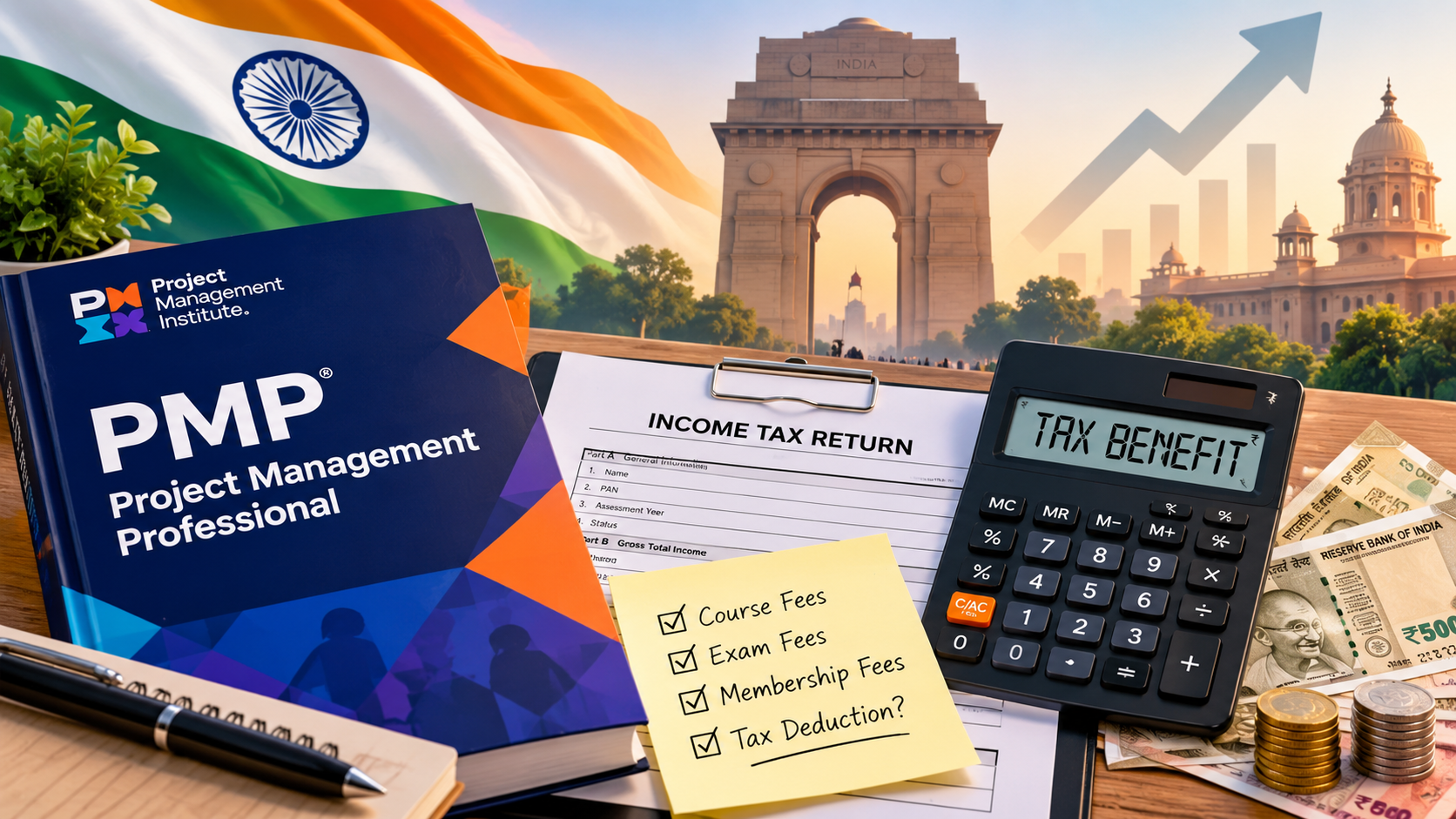
PMP certification is generally not deductible for a salaried employee who pays for it out of pocket in India, because the Income Tax Act, 1961 has no specific provision for self-funded professional certification expenses, and most such deductions are unavailable under the new tax regime in any case. Self-employed project management consultants and freelancers, however, can usually claim PMP training, exam and renewal costs as a legitimate business expense under the head "Profits and Gains of Business or Profession" if the certification is directly connected to their professional work. The most tax-efficient route by far is when a company pays for PMP certification on behalf of its project managers, since this is typically a straightforward deductible business expense for the employer and is often not taxed as a perquisite in the employee's hands when it is genuinely work-related. Because the correct treatment depends on documentation, employment structure and the regime chosen, this is a matter to confirm with a chartered accountant for your specific facts rather than to assume.
Key Highlights: Is PMP Certification Tax Deductible in India?
- There is no dedicated section in the Income Tax Act, 1961 that lets a salaried individual deduct self-funded PMP or similar certification fees from taxable salary income.
- Section 16 deductions from salary are limited to the standard deduction and, under the old regime only, professional tax; certification fees do not fall under either head.
- The new tax regime under Section 115BAC is now the default regime, and it strips out most exemptions and deductions, making the old regime largely irrelevant even where a certification-related claim might have been attempted.
- Self-employed and freelance project managers filing ITR-3 or ITR-4 can generally claim PMP-related costs under Section 37(1) as an expense incurred wholly and exclusively for their profession.
- Employer-funded PMP certification is usually the most tax-efficient structure: it is a deductible business expense for the company under Section 37(1), and when it is genuinely tied to job requirements it is generally not treated as a taxable perquisite for the employee under Section 17(2).
- GST at 18 percent typically applies to domestic training fees and to PMI's exam and membership fees, with different mechanics (ordinary GST versus reverse charge for a foreign supplier) depending on who is billing.
- The Income-tax Act, 2025, which takes effect from 1 April 2026 and replaces the 1961 Act, renumbers sections but is described by tax commentators as retaining the same underlying deduction structure, so the substantive limitations discussed here are expected to carry over rather than disappear.
How Indian Income Tax Law Actually Treats Certification Costs
Indian tax law does not treat "certification" or "professional development" as a distinct category with its own deduction the way some jurisdictions do. Instead, the outcome depends entirely on who is paying and under which head of income that person is taxed. A salaried individual is taxed under the head "Salaries" and governed by Sections 15 to 17, which contain a short, closed list of permissible deductions. A freelancer or consultant is taxed under "Profits and Gains of Business or Profession" (Sections 28 to 44), which is a much wider, expense-driven regime built around Section 37(1). A company is taxed as a separate entity and can generally deduct training spend as an ordinary cost of running the business. The reason PMP certification is treated so differently across the salaried, self-employed and corporate answers to the same question is simply that these three groups sit under three different chapters of the Act.
Can a Salaried Project Manager Deduct PMP Certification Costs?
In most cases, a salaried employee who pays for PMP training, the PMI exam fee and any related study material out of their own pocket cannot deduct that spend from taxable salary income. Section 16 of the Income Tax Act, 1961 sets out what can be deducted from gross salary, and as commentary on the section confirms, it is limited to a standard deduction (currently a flat amount available in both regimes) and, only under the old regime, professional tax paid to a state government under Section 16(iii).
Neither head accommodates a certification or examination fee, even though the total spend on training, the PMI exam fee and study material for a credential such as the PMP certification cost can run into tens of thousands of rupees.
Section 80C, which is the deduction most people instinctively reach for, is also not the right route, since 80C tuition-fee relief applies only to full-time tuition fees for a taxpayer's children at a recognised institution, not to a taxpayer's own professional exam or membership fees, and general commentary on PMP-style certification and professional body membership fees confirms they do not qualify as a specified 80C investment.
Old Tax Regime vs New Tax Regime for Certification Costs
The distinction between the two regimes matters less here than it does for house rent allowance or home loan interest, simply because self-funded certification was never squarely deductible under the old regime either. Even so, the shift to the new regime as the default under Section 115BAC is worth understanding, because it removes the few adjacent claims (such as professional tax and most Section 10 exemptions) that a salaried PMP aspirant might otherwise have stacked alongside other deductions.
Aspect | Old Tax Regime | New Tax Regime (default) |
|---|---|---|
| Self-funded PMP certification fee | Not deductible under any specific section | Not deductible under any specific section |
| Standard deduction | Available | Available, generally at a higher amount post-Budget 2025 |
| Professional tax under Section 16(iii) | Deductible | Not deductible |
| Most Section 10 exemptions (HRA, LTA and similar) | Available subject to conditions | Largely unavailable |
| Employer-paid training treated as tax-free perquisite (facts permitting) | Possible on the facts | Possible on the facts, regime choice does not change this analysis |
The practical takeaway is that a salaried project manager cannot improve their odds of deducting a self-funded PMP fee simply by picking the old regime. The old regime helps with entirely different deductions (home loan interest, 80C investments, HRA), none of which cover certification costs, so this is generally a dead end for a purely self-funded claim either way.
What If Your Employer Pays or Reimburses the PMP Fee?
This is where the picture changes meaningfully for a salaried employee. When an employer pays PMI and a training provider directly, or reimburses the employee against invoices, the question shifts from "can the employee claim a deduction" to "does this payment count as a taxable perquisite under Section 17(2)." As the official text of Section 17 sets out, a perquisite includes any obligation of the employee that is paid by the employer. On a strict reading, that could capture a certification fee paid on the employee's behalf.
In practice, however, tax commentary and long-standing assessment practice draw a distinction between a personal benefit conferred on an employee and a cost incurred by the employer for its own business purpose, such as building the skills of its project delivery staff. Where training has a clear, demonstrable connection to the employee's current role and the employer's business, and especially where it is documented as employer-initiated rather than employee-requested, it is more often treated as a business cost of the employer rather than income in the employee's hands.
This is consistent with the general principle recognised in Indian tax practice that employer-sponsored, business-linked education is treated differently from a personal benefit, provided there is a genuine nexus between the course and the employer's work and the arrangement is not simply a disguised salary top-up.
That said, this is a facts-and-documentation question, not a blanket exemption, and outcomes can differ depending on how the employer structures the payment, whether a service or retention bond is attached, and how the company's own tax advisers have chosen to treat similar payments for other employees. A salaried project manager whose employer is willing to pay directly, rather than adding a taxable allowance to be spent on training, is generally in a far stronger position than one who pays personally and hopes to claim a deduction afterwards. Many organisations that already run PMP training programmes for their teams, such as those offered through PMP certification training in India, structure the payment as a direct company-to-training-provider transaction for exactly this reason.
The Self-Employed and Consultant Route: Business Expense Deduction
For a freelance or independent project management consultant, the answer is generally far more favourable. Once income is computed under "Profits and Gains of Business or Profession," Section 37(1) allows a deduction for any expenditure, not being capital expenditure or personal expenditure, laid out wholly and exclusively for the purposes of the profession.
Training, certification and continuing-education costs that visibly maintain or improve skills used in a person's existing consulting work are widely treated by practitioners as falling within this description, provided the certification is relevant to the work actually being billed to clients. A project management consultant who bills clients for delivery, PMO or programme advisory work has a reasonably strong case that PMP training fees, the PMI exam fee, renewal or PDU-related costs, and study materials are incurred wholly and exclusively for that profession, particularly given how consistently the credential is linked to higher billing potential in independent PMP certification salary data for the Indian market.
Consultants typically report this income either on ITR-3, where a full profit and loss account and balance sheet are prepared, or on ITR-4 if they have opted into the presumptive taxation scheme under Section 44ADA, in which case individual expenses such as a certification fee are not separately claimed because profit is estimated as a fixed percentage of gross receipts instead. This is an important distinction: a consultant who elects presumptive taxation for simplicity gives up the ability to itemise the PMP fee as a deduction, because the presumptive scheme already bakes in an assumed expense ratio.
A consultant who instead maintains books and claims actual expenses under the regular Section 37(1) route can generally set the certification cost against income, subject to the usual "wholly and exclusively for the profession" test described in guides to Section 37 of the Income Tax Act.
GST Input Tax Credit for Consultants Paying for PMP Training
GST adds a second layer worth understanding. PMI's own examination and membership fees are typically billed with 18 percent GST under the Online Information and Database Access or Retrieval (OIDAR) rules that apply to digital services supplied by a foreign entity, and depending on how the invoice is structured, this can fall under the reverse charge mechanism for a GST-registered recipient.
Domestic training fees, such as those charged by an Indian training provider, are ordinarily billed with GST in the normal course, and a GST-registered consultant using that training in the furtherance of their taxable business can generally claim input tax credit on it, subject to the standard conditions in Sections 16 and 17 of the CGST Act, such as holding a valid tax invoice and using the service for taxable outward supplies. A consultant who is not GST-registered, or who is under the composition scheme, cannot claim this credit and simply absorbs the GST as part of the total cost.
Salaried vs Self-Employed vs Consultant: A Side-by-Side Comparison
Factor | Salaried Employee (self-funded) | Self-Employed / Consultant |
|---|---|---|
| Governing head of income | Salaries (Sections 15 to 17) | Profits and Gains of Business or Profession (Sections 28 to 44) |
| Relevant section for the certification fee | None specific; Section 16 and Section 80C do not cover it | Section 37(1), if genuinely connected to the profession |
| Old vs new regime impact | Largely irrelevant, since no specific deduction exists under either regime | Not applicable in the same way; business expenses are netted off before tax regardless of the individual regime chosen |
| ITR form typically used | ITR-1 or ITR-2 | ITR-3 (actual expenses) or ITR-4 (presumptive scheme, expenses not itemised) |
| GST input tax credit possible | No, since salary income is outside GST | Yes, if GST-registered and not on the composition scheme |
| Employer/company paying instead | May be treated as a tax-free business-purpose payment rather than salary, on the facts | Not applicable; the consultant is generally paying for themselves |
| Practical strength of the claim | Weak if self-funded; much stronger if employer-funded | Reasonably strong if the certification is clearly work-related and properly documented |
The Corporate Angle: Why Employer-Funded PMP Certification Is the Most Tax-Efficient Route
For a company, funding PMP certification for its project managers is almost always the cleanest and most tax-efficient path of the three. Training expenditure incurred by a business to build the skills of its own workforce is a routine, well-precedented deductible expense under Section 37(1), and unlike the salaried-individual scenario, there is no ambiguity about which head of income applies, because the company is simply deducting a cost against its business income before arriving at taxable profit.
On the GST side, a registered company paying a domestic training provider is typically charged GST in the ordinary course and can usually claim input tax credit on that spend where the training is used in furtherance of the business, subject to the standard conditions on blocked credits and documentation under GST law.
This is precisely why many organisations that need to certify several project managers at once choose to fund the training centrally rather than asking individuals to pay and seek reimbursement later. A company that engages a provider directly for its whole project management team, for example through a structured offering such as corporate and group training for project management teams, avoids the perquisite ambiguity that can arise when payments are routed through individual employees, keeps a single set of invoices for its own tax records, and can negotiate group pricing that individual employees paying out of pocket cannot access. From a pure tax-efficiency standpoint, the ranking is fairly clear: company-funded and company-invoiced training is the strongest position, employer-reimbursed training with clear business justification is the next best, and individual self-funded training with no employer involvement is the weakest.
Project managers and finance teams comparing these routes side by side often also want to see the full underlying cost of PMP certification before deciding who should pay for it. That comparison, covering training fees, the PMI exam fee, membership and renewal costs, is set out in detail in Simpliaxis's PMP certification cost in India guide, which is a useful next read once the tax question has been settled internally.
What Documentation Do You Need to Support a Claim?
Whichever route applies, a claim is only as strong as the paper trail behind it, and Indian assessing officers routinely ask for this evidence if a deduction or exemption is questioned.
- Invoices in the right name. A consultant claiming a Section 37(1) deduction needs invoices addressed to their business or professional name, not a personal, unrelated party, showing the training provider, GST amount and payment date.
- Proof of payment. Bank statements or payment gateway records that tie the invoice to an actual outflow from the business or company account, rather than cash payments that are harder to substantiate.
- A clear link to the work being done. For a consultant, this might be client contracts or scope documents that show project management or PMO work is genuinely being billed; for an employer, an internal note or policy showing the certification was required or recommended for the employee's role.
- Employer communication, where relevant. If an employer is paying or reimbursing, a written policy or approval email documenting that the training was employer-initiated strengthens the case that it is a business cost rather than a personal perquisite.
- GST invoices for input tax credit. A registered business or consultant intending to claim GST input tax credit needs a valid tax invoice showing the GST-registered supplier's details, not just a generic receipt.
Income-tax Act 2025: Does the New Law Change Anything?
The Income-tax Act, 2025 replaces the 1961 Act from 1 April 2026 and is widely described by tax commentators as a re-codification and simplification exercise rather than a substantive rewrite of deduction policy. Reporting on the new Act notes that it compresses the statute from 819 sections to 536, introduces a single "tax year" concept in place of the old previous-year and assessment-year system, and renumbers virtually every section, while retaining the same tax rates, slabs and deduction limits as the outgoing Act.
On the specific question addressed in this article, that means the underlying gaps and opportunities described above, the absence of a salaried self-funded certification deduction, the Section 37(1)-style business expense route for the self-employed, and the employer business-expense route, are expected to carry across in substance even though the section numbers referencing them will change. Anyone relying on a specific section number for a claim made on or after 1 April 2026 should confirm the corresponding provision under the new Act rather than assuming the old citation still applies.
Conclusion
The honest answer to whether PMP certification is tax deductible in India depends far more on who is paying than on the certification itself. A salaried project manager who pays for PMP training, the PMI exam and renewal fees personally is very unlikely to find a specific deduction under the Income Tax Act, and the shift to the new regime as the default has, if anything, narrowed the adjacent deductions such an individual might otherwise have used.
A self-employed or freelance project management consultant is in a genuinely stronger position, since Section 37(1) and the "Profits and Gains of Business or Profession" framework are built to accommodate exactly this kind of work-related spend, provided the connection to actual client work is documented and the taxpayer has not opted into a presumptive scheme that already assumes expenses. But the clearest win of all sits with employers: a company that pays for PMP certification directly for its project managers, whether one at a time or through a structured group programme, converts a murky personal-tax question into an ordinary, well-precedented business deduction, while also giving the employee a materially better chance of the payment being treated as a tax-free, business-purpose benefit rather than salary.
For any organisation weighing whether to fund certification centrally, or for an individual working out which route applies to them, the figures only make sense once matched against actual professional advice, since the right treatment always turns on the specific facts, the regime in force at the time, and how carefully the payment and its purpose are documented.




_1785144543.jpg)




 Lowest-Price Challenge











 Personalized Path


.webp)


 USA
USA  Canada
  India
India  UK
UK  Australia
  Singapore


