


 Call Us



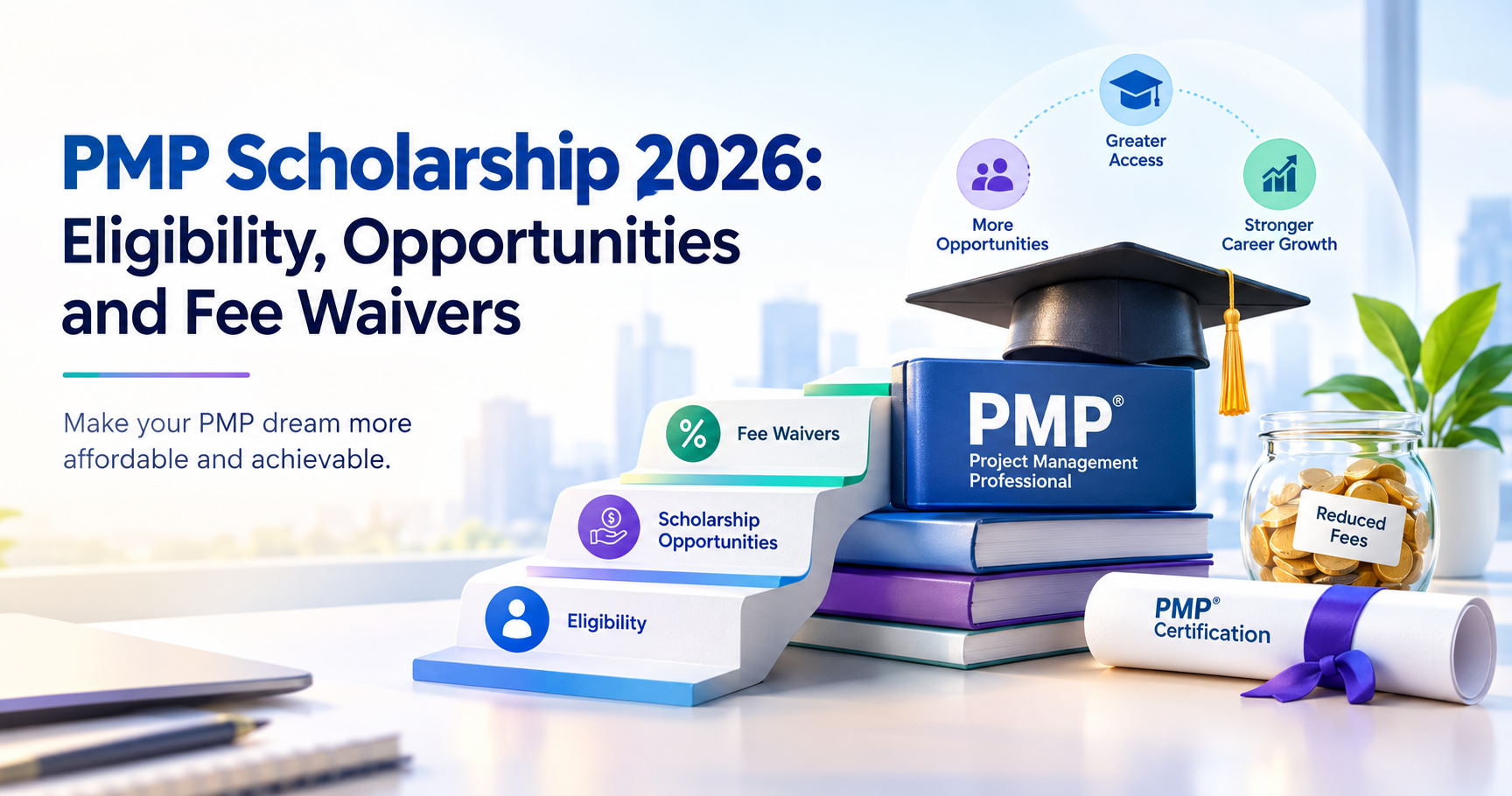
PMI does not provide a general fee waiver for the PMP exam itself. However, real cost-reduction options exist: PMI Academic Scholarships for students in credit-bearing project management programs, a built-in PMI membership discount worth roughly $250 on the exam fee, employer tuition sponsorship, and training-provider discounts. Most working professionals in India realistically reduce costs through membership savings and employer support rather than a direct scholarship.
Key Highlights of PMP Scholarship and Fee Waiver Options:
- PMI does not waive its own $675/$425 exam fee for general applicants; no universal "fee waiver" program exists
- PMI membership ($159-169/year) cuts the exam fee by roughly $250, often paying for itself immediately
- PMI Academic Scholarships are open to students in credit-bearing project management or related programs, with 2026-2027 applications due May 10
- CAPM certificationsatisfies the 35-hour training requirement automatically, a genuine cost-and-time shortcut for early-career applicants
- Employer sponsorship remains the single most common way working professionals offset the full cost
- Simpliaxis and other PMI Authorized Training Partners periodically run referral and seasonal discount programs that reduce training cost specifically, separate from the PMI exam fee itself
Searching for a "PMP scholarship" usually means one thing: you want the certification, but the cost is giving you pause. That's a fair concern. Between the exam fee, training, and study materials, the full cost of getting PMP-certified typically runs from a few hundred to a few thousand dollars depending on how you prepare.
This article gives you the honest picture, rather than the recycled "get PMP certified for free" claims that show up across search results. Some paths genuinely reduce your cost. Others get repeated online as "free PMP certification" but turn out to be free training resources, not a waived exam fee. Knowing the difference upfront will save you time, prevent a frustrating rejected application, and point you toward the option that actually fits your situation, whether that's a current student, a working professional, or someone hoping an employer will cover the bill.
Does PMI Actually Offer a PMP Fee Waiver?
For most applicants, no. PMI does not currently offer a general, apply-and-get-it fee waiver for the PMP exam itself. What exists instead is a set of legitimate cost-reduction paths: PMI's own academic scholarship program for students, a built-in membership discount, and third-party support through employers and training providers, each with its own eligibility criteria. If you've seen a website promising "free PMP certification for anyone," treat it with caution; in most cases it refers to free study resources or training content, not a waived exam fee from PMI directly.
PMP Certification Cost Breakdown: What You're Actually Paying For
Before looking at how to reduce cost, it helps to know exactly what you're paying for. As of the July 2026 update, PMI's exam fee is $675 for non-members and $425 for PMI members. That fee alone doesn't get you certified, though; it only covers the right to sit the exam once your application is approved.
On top of that, every eligibility path requires 35 hours of formal project management education, which is typically the highest additional cost if you take it through a paid training provider. This requirement applies regardless of how experienced you are; there's no waiver for the training hours based on years worked, with one exception covered later in this article. Optional costs include study materials, practice exams, and, if needed, retake fees for a second or third attempt within your one-year eligibility window, since PMI allows up to three attempts if you don't pass on the first try.
There's also a renewal cost to plan for down the line. Once certified, PMP holders need to earn 60 PDUs (Professional Development Units) every three years to maintain the credential, and the renewal fee itself runs around $60 for PMI members and $150 for non-members, according to published guidance. Simpliaxis'sFAQs on PMP Certificationcover this renewal process in more detail if you want the full picture before applying. None of this needs to be paid upfront, but it's worth factoring into your total cost of ownership rather than treating the exam fee as a one-time expense.
Understanding this full breakdown matters because different cost-reduction options target different pieces of it. A scholarship might cover training costs, PMI membership reduces the exam fee specifically, and an employer sponsorship might cover the whole package, exam fee, training, and materials together. Knowing which piece you're trying to reduce will point you to the right option faster, rather than chasing a single "scholarship" that may not exist for your specific situation. For the complete, itemized version of this breakdown, Simpliaxis'sPMP Certification Costguide covers every line item in more detail.
PMP Scholarship Options That Genuinely Exist
PMI Academic Scholarships
PMI itself runs an active academic scholarship program, but it's narrower than many searchers expect: it's designed for current or incoming students in a credit-bearing project management (or closely related) program, not working professionals studying independently for the PMP exam. One application unlocks matching against multiple PMI Academic Scholarships automatically, so applicants don't need to identify and apply to each one individually. For the 2026-2027 academic year, applications were due by May 10, so timing matters if you're a student planning ahead for a future cycle.
Eligibility generally requires being a current student or accepted incoming student with an expected graduation date after the relevant academic year, studying project management or a related field in a credit-bearing program, and being in good academic standing. A few exclusions apply, such as immediate family of PMI employees or PMI/PMIEF board members, and students at institutions in countries subject to certain sanctions.
If you're a working professional rather than a current student, this specific program likely won't apply to you directly, which is an important distinction most "PMP scholarship" articles gloss over.
The PMI Educational Foundation's History (and Why It's Different Now)
Older articles and forum posts frequently reference PMI Educational Foundation (PMIEF) scholarships administered through a third-party partner, OSP International, that provided free access to PMP, CAPM, and PMI-ACP exam preparation training. That specific partnership ended around 2021, and PMIEF has shifted its scholarship strategy since then. If you come across a page describing this older program as currently active, treat it as outdated. PMIEF's broader professional development scholarship program still exists in some form for project managers, nonprofit staff, school administrators, and teachers pursuing PM-related credentials, but program details and availability shift over time, so verify current status directly through PMI's official channels before assuming a specific historical program is still running.
The PMI Membership Discount: The Fastest, Most Reliable Savings
If you're looking for the single most reliable, immediately available cost reduction, it's PMI membership, not a scholarship. Joining PMI costs roughly $159 to $169 for the first year, and membership reduces the PMP exam fee from $675 to $425, a savings of $250. That means the membership fee essentially pays for itself through the exam discount alone, before counting the other member benefits: a free digital PMBOK® Guide, access to local chapter events, and PMI's own study resources like PMI Infinity and Study Hall.
For most applicants, especially working professionals who don't qualify for the academic scholarship, this is the most dependable "discount" available, since it doesn't depend on an application, acceptance decision, or deadline the way a scholarship does. Simpliaxis'sPMP Exam Feeguide walks through the full payment structure and additional cost-management tips if you want to plan this out in more detail.
Employer Sponsorship: The Most Common Real-World Fee Waiver
For working professionals specifically, employer sponsorship is the most common way the PMP certification ends up effectively free. Many companies recognize that PMP-certified project managers reduce delivery risk and improve project outcomes, and are willing to cover training and exam costs as part of professional development budgets, especially when the certification is relevant to the employee's current role.
If you're considering asking your employer, frame the request around business value rather than personal benefit alone: point to how certified skills reduce project risk, cite the exam's current alignment with business-outcome-focused project delivery (following the July 2026 exam update), and ask HR specifically about tuition reimbursement or training fund policies rather than assuming none exist. Many organizations have a policy already in place that employees simply haven't asked about.
A few practical tips make this conversation easier. Bring a specific cost estimate rather than a vague request, since HR and finance teams generally respond faster to a concrete number than an open-ended ask. If your company has sponsored certifications for colleagues before, reference that precedent directly. And if a full sponsorship isn't available, ask about partial support; some employers will cover the exam fee even if they won't fund a full training package, or vice versa. Timing also matters: raising the request during annual budget planning or performance review cycles, when professional development budgets are actively being allocated, tends to produce better results than an ad hoc mid-year ask.
Training-Provider Discounts and Referral Programs
Separate from PMI's own fee, PMI Authorized Training Partners frequently run their own discount and referral programs on the training portion of the cost. Simpliaxis, for example, periodically offers seasonal discount codes and a referral program where both the referrer and the new enrollee receive a benefit: a percentage cashback for the referrer and a discount for the referral. These programs reduce the training cost specifically, not PMI's exam fee, so it's worth being clear about which piece of the total cost you're actually saving on when comparing offers.
Some providers also bundle the exam fee voucher into their training package, which can simplify budgeting even if it doesn't necessarily reduce the combined total cost. Always compare the full package price against paying for training and the exam fee separately before assuming a bundle is the cheaper option.
It's also worth checking whether a training provider's discount is genuinely time-limited or a permanent, always-on offer marketed as urgent. Comparing prices across two or three PMI Authorized Training Partners over a week or two, rather than committing to the first discount code you see, usually reveals whether a "limited time" offer is actually a standard, recurring promotion.
The CAPM Shortcut: A Different Kind of Cost Savings
Here's a cost-reduction path that's easy to overlook because it doesn't look like a scholarship: if you already hold an active CAPM (Certified Associate in Project Management) certification, it automatically satisfies PMP's 35-hour training requirement. Since that training is often the highest cost after the exam fee itself, candidates who are earlier in their careers and considering both certifications may find it more cost-effective to pursue CAPM first, both as a standalone credential and as a way to fulfil PMP's education requirement without a separate paid course later.
This isn't the right path for everyone, particularly if you're already well past CAPM's target experience level, but it's worth knowing about if you're mapping out a multi-year certification budget rather than trying to solve for PMP alone. Even for candidates who ultimately skip CAPM, understanding that this shortcut exists can inform a broader conversation with a mentor or manager about the most cost-efficient certification sequence for your specific career stage.
Country-Specific and Special-Circumstance Programs
A handful of programs exist for specific populations, most notably in the US, where organizations offer full PMP training coverage for veterans and military spouses through workforce development initiatives, and some universities include PMP exam vouchers as part of professional development curricula. These programs are generally not relevant to an India-based audience, but they're worth mentioning for completeness, since a portion of "PMP scholarship" search traffic comes from exactly these circumstances. If any of these apply to you, the specific institution or program (rather than PMI directly) is the right first point of contact. Searching for the program name alongside your country or university, rather than a generic "PMP scholarship" query, will usually surface the correct application channel faster.
How to Actually Apply for a PMI Academic Scholarship?
If you do qualify as a student in a credit-bearing project management program, here's the realistic process:
- Confirm your program qualifies. It needs to be a credit-bearing program in project management or a closely related field, not independent PMP exam study.
- Check the current application window. PMI's academic scholarship applications run on an annual cycle with a fixed deadline (May 10 for the 2026-2027 cycle), so mark the date well in advance rather than discovering it after the window closes.
- Submit one application. PMI's process matches a single submission against multiple relevant scholarships automatically, so there's no need to identify and apply separately to each one.
- Prepare your academic standing documentation. Good academic standing is a baseline eligibility requirement, so have your transcript or equivalent ready.
- Watch for exclusion criteria. Immediate family of PMI employees, PMI or PMIEF board members, and students at institutions in sanctioned countries are typically excluded, so confirm none of these applies before investing time in the application.
Comparing Your Options by Who Qualifies
Option | Best For | What It Actually Reduces |
| PMI Academic Scholarships | Current students in credit-bearing PM programs | Tuition/education costs, via scholarship funds |
| PMI Membership Discount | Nearly everyone applying for the exam | Exam fee itself, by roughly $250 |
| Employer Sponsorship | Working professionals with supportive employers | Training and/or exam fee, often the full cost |
| Training-Provider Discounts/Referral Programs | Anyone comparing training providers | Training cost specifically, not PMI's exam fee |
| CAPM-First Pathway | Early-career professionals also considering CAPM | The 35-hour training requirement cost |
| Veteran/Student-Specific Programs (US) | US-based veterans, military spouses, some university students | Training and/or exam fee, program-dependent |
Building a Realistic Cost-Reduction Plan
Rather than searching for one silver-bullet scholarship, the most effective approach usually combines two or three of the options above. A typical, realistic combination for a working professional in India might look like this: join PMI to unlock the membership discount on the exam fee, ask your employer about tuition reimbursement for the training portion, and compare two or three PMI Authorized Training Partners for their current pricing and any active referral or seasonal discount. Stacking these three alone can meaningfully reduce your total out-of-pocket cost compared to paying full price for everything separately.
For students specifically, the calculation is different. If you're currently enrolled in a credit-bearing project management program, the PMI Academic Scholarship deadline should go straight into your calendar for the next application cycle, since missing it means waiting a full year. If you're a student but not in a qualifying program, or considering PMP before finishing your degree, it's worth checking whether your institution has its own arrangement with PMI or a training provider, since some academic institutions include exam vouchers as part of their curriculum.
For anyone earlier in their project management career, the CAPM-first pathway described earlier deserves serious consideration purely as a budgeting decision, independent of its value as a standalone credential.
Common Mistakes When Trying to Reduce PMP Cost
The most common mistake is assuming "free PMP certification" content found online refers to a waived exam fee, when it usually means free study resources instead, a meaningful distinction that avoids a frustrating surprise later. A second is skipping PMI membership because the upfront fee feels like an unnecessary cost, when in most cases it pays for itself through the exam discount alone. A third is not asking an employer directly; many professionals assume their company won't sponsor certification without ever actually asking HR. A fourth is applying for the PMI Academic Scholarship without confirming their program is credit-bearing, only to find out later they didn't qualify in the first place, wasted effort that a quick eligibility check upfront would have avoided.
A fifth, less obvious mistake is comparing training providers on advertised price alone without checking what's actually included. A lower headline price that excludes practice exams, application assistance, or a money-back guarantee may end up costing more once you add those pieces separately, compared to a slightly higher all-inclusive package. Reading the fine print on what a training discount actually covers is as important as finding the discount itself.
If you've worked through the options above and land on employer sponsorship or your own budget as the realistic path forward, a structured, PMI Authorized Training Partner course is worth comparing, both for its training cost and for any referral or seasonal discount options periodically available.
Conclusion
There's no single "PMP scholarship" that solves cost for everyone, and any page that claims otherwise is oversimplifying. What genuinely exists is a set of options that fit different situations: PMI's Academic Scholarships for qualifying students, a reliable membership discount for nearly everyone, employer sponsorship for working professionals, and training-provider discounts that reduce the other half of the bill. The realistic move is combining two or three of these rather than searching for one that covers everything.
If you're still deciding how to sequence your certifications on a budget, it's worth comparingCAPM certification directly, since it satisfies PMP's 35-hour training requirement automatically and stands on its own as an earlier-career credential. If cost is the main barrier right now rather than time, a self-paced PMP prep course is typically priced lower than live instructor-led training.
Simpliaxis also runs afree course libraryif you want to test the waters before spending anything, and if you're hoping your employer will sponsor a team rather than just you individually, it's worth looking at corporate group training options, which often come with better per-person pricing than individual enrollment. When you're ready to compare actual dates and current pricing, you cancheck live PMP training schedules directly.




_1785144543.jpg)




 Lowest-Price Challenge











 Personalized Path


.webp)


 USA
USA  Canada
 India
India UK
UK Australia
 Singapore


