


 Call Us



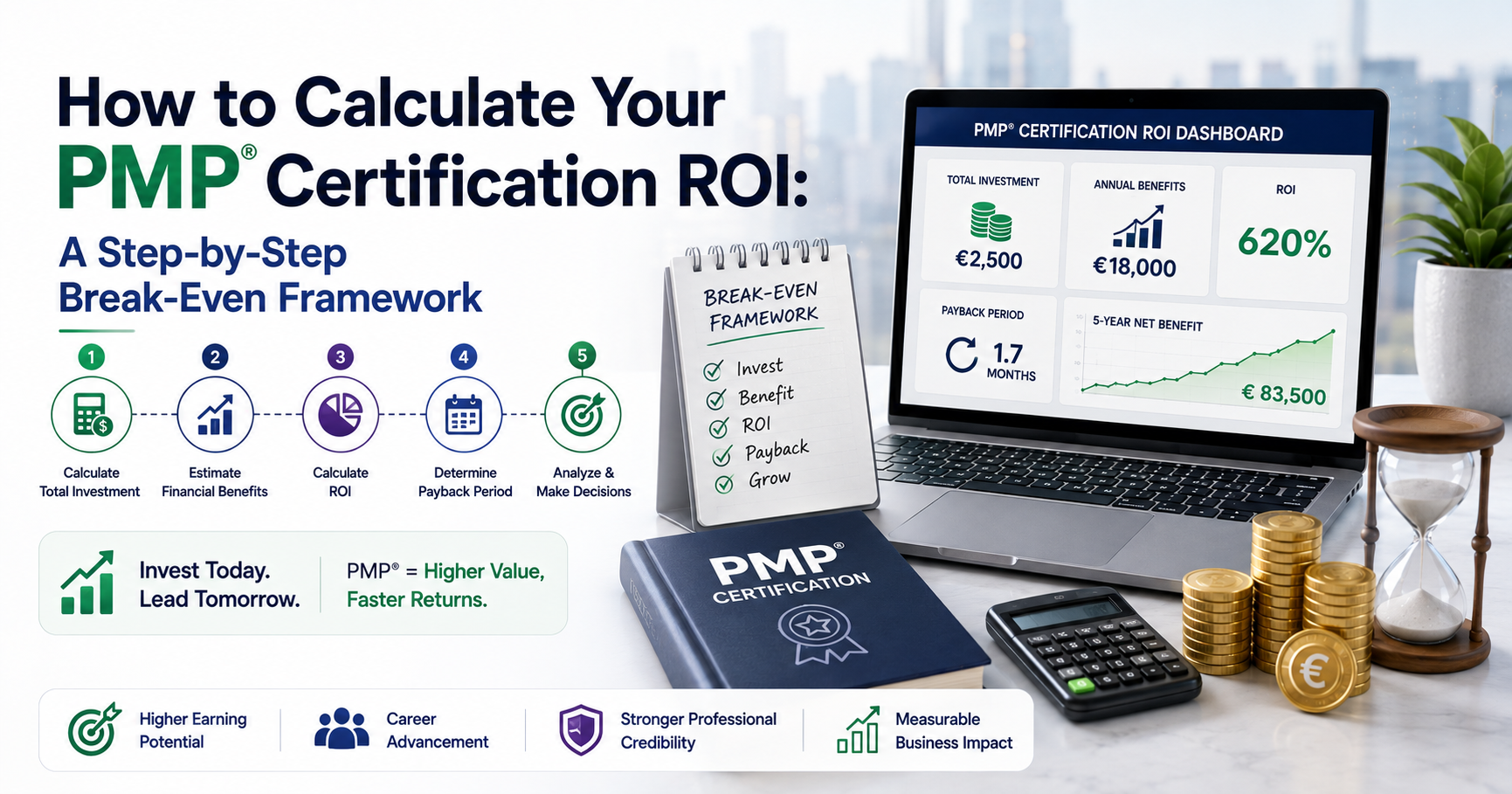
Most professionals recover the full cost of PMP certification within one to four months of earning a higher salary, based on PMI's own salary survey data and a realistic cost-of-ownership calculation spread across a three-year certification cycle. The exact payback period depends heavily on which salary premium you apply to your own situation: a same-employer raise, typically capped around 10 percent according to PMI's 14th edition survey, pays back more slowly than the 17 to 24 percent premium PMI reports for PMP holders across the wider job market. The rest of this guide walks through the actual arithmetic, attributes every figure to a named source, and works through a full example so you can substitute your own salary and reach your own answer rather than trusting a black-box calculator.
Key Highlights of PMP Certification ROI
- PMI's 14th edition Earning Power: Project Management Salary Survey (published November 2025) found PMP-certified professionals in the United States reporting a median salary of $135,000, against $109,157 for non-certified peers, a gap of roughly 24 percent.
- The same survey reported PMP holders earning 17 percent more than non-certified peers on average across the 21 countries surveyed, a more conservative benchmark than the US-only figure.
- PMI's 13th edition survey (November 2023) reported a larger 33 percent premium, a reminder that the exact percentage shifts between survey editions and should be treated as a range rather than a single fixed number.
- A realistic three-year cost of PMP certification ranges from about $1,200 for a PMI member using self-paced training to over $2,300 for a non-member using instructor-led bootcamp training, once the exam fee, membership, training and renewal PDUs are all counted.
- PMI's current exam fee schedule, effective 6 August 2026, sets the exam at $445 for members and $675 for non-members, a $230 gap that alone exceeds the $129 to $159 annual cost of PMI membership.
- Applying the framework below, a project professional earning $90,000 who secures even a conservative 10 percent raise recovers their certification cost in around three months; a 17 to 24 percent market-rate uplift shrinks that to under six weeks.
- ROI is not only about salary: PMI's 2025 survey also links PMP certification to promotion velocity and hiring preference, and found that nearly two-thirds of certified respondents reported a compensation increase in the past year alone.
What Does PMP Certification Actually Cost, All In?
A realistic three-year cost of ownership for PMP certification runs from about $1,200 to roughly $2,400 in the United States once every component is counted, not just the headline exam fee that most cost articles quote in isolation. Four separate cost items stack up over a full three-year cycle: the exam fee itself, the mandatory 35 contact hours of project management education, optional PMI membership, and the renewal fee due when your 60 required PDUs come up at the end of year three. Skipping any one of these when you calculate ROI produces a payback figure that looks better than reality.
Cost Component | PMI Member | Non-Member |
| PMP exam fee (PMI's current schedule, effective 6 August 2026) | $445 | $675 |
| PMI annual membership | $129 to $159 per year | Not applicable |
| Mandatory 35 contact hours of training | $300 (self-paced online) to $3,000 (instructor-led bootcamp) | Same range, no member discount |
| Renewal fee at end of 3-year cycle (60 PDUs required) | Around $60 | Around $150 to $164 |
| Retake fee, if a retake is needed | $275 | $375 |
Training is the widest-swinging line item, and it is also the one you have the most control over. A self-paced online course covering the required 35 contact hours can cost as little as a few hundred dollars, while a four or five day instructor-led bootcamp typically runs $1,500 to $3,000.
Simpliaxis publishes a full breakdown of current PMP certification cost components, which is worth checking against the figures above before you commit to a training format, since the format you choose changes your break-even point more than any other input in this framework. If you are comparing live, instructor-led options specifically, Simpliaxis's own PMP certification training programme is one place to see current pricing and inclusions side by side.
What Is the Real PMP Salary Premium, According to PMI?
PMI's own Earning Power: Project Management Salary Survey is the single most attributable source for the PMP salary premium, and its 14th edition, published November 2025, from data fielded in partnership with independent research firm PeriscopeIQ between 9 March and 19 April 2025 across 14,628 respondents in 21 countries, reported that PMP-certified professionals in the United States had a median salary of $135,000, against $109,157 for non-certified peers. That works out to roughly a 24 percent gap in the US market specifically. Across the full 21-country sample, the same survey reported a more conservative 17 percent median premium for PMP holders over non-certified peers, which is the figure to use if you want a global, cross-industry baseline rather than a US-only one.
It is worth comparing that to PMI's 13th edition survey, published November 2023, which reported a larger 33 percent premium for PMP-certified respondents across the same 21 countries. The gap between 17 percent and 33 percent across two consecutive editions of the same PMI survey is exactly why this guide treats the premium as a range rather than a single number: methodology, respondent mix and market conditions shift from edition to edition, and a single cited percentage without its source and year is not something you should build a financial decision on.
General job-board pay data from platforms such as Glassdoor, Indeed and PayScale points in the same broad direction, showing certified project managers clustering above non-certified peers in comparable roles, but because these platforms use self-reported, unaudited salary data with different sampling methods, they are best read as directional confirmation of PMI's figures rather than as an independent percentage in their own right. If you want to see how this premium plays out by experience band and role title, Simpliaxis maintains a PMP certification salary guide that breaks the PMI data down further.
One additional 2025 finding matters for realistic ROI modelling: PMI's 14th edition survey found that nearly two-thirds of PMP-certified respondents across the 21 countries reported an increase in total compensation over the past year, and around three-quarters of those who received a raise got up to 10 percent. That 10 percent figure is a meaningfully different number from the 17 to 33 percent cross-sectional premiums above, and the difference matters enormously for your payback calculation, as the next section explains.
The Step-by-Step ROI and Payback Period Framework
Calculating your own payback period takes five steps, and every step uses a number you can source and verify rather than take on faith. Work through them in order, using your own salary and circumstances in place of the example figures.
- Step 1: Total your three-year cost of ownership. Add the exam fee, training cost, any PMI membership fees across three years, and the renewal fee at year three, using the cost table above and PMI's own Project Management Salary Survey page for the latest edition if you want to check for newer figures. Do not stop at the exam fee alone; that understates your true investment by hundreds or thousands of dollars.
- Step 2: Separate a same-employer raise from a market-rate premium. Decide honestly which scenario applies to you. If you plan to stay with your current employer and ask for a raise after certifying, the realistic benchmark is closer to PMI's finding that most certified professionals who get a raise receive up to 10 percent. If you plan to use the credential to move employers or negotiate a new role, the 17 to 24 percent cross-sectional premiums from PMI's 14th edition survey are a more defensible benchmark, since those figures compare people already in different roles and organisations, which is closer to what a job change actually captures.
- Step 3: Apply the chosen percentage to your current salary. Multiply your current annual salary by the percentage from Step 2 to get your expected annual dollar uplift. This is the number most competitor calculators skip past quickly, but it is the step where an inflated or misapplied percentage does the most damage to the credibility of your final answer.
- Step 4: Convert the annual uplift to a monthly figure and divide it into your total cost. Divide your annual dollar uplift by 12 to get a monthly figure, then divide your total three-year cost of ownership (from Step 1) by that monthly figure. The result is your payback period in months.
- Step 5: Extend the calculation to 3 or 5 years for a net-gain figure. Multiply your annual uplift by the number of years you expect to hold the role or stay in the profession, then subtract your total certification cost. This gives you a cumulative net financial gain figure, which is a more complete picture of ROI than payback period alone, since payback period only tells you when you break even, not how much you gain afterwards.
Worked Example: One Project Coordinator's Break-Even Calculation
Here is the framework applied to a single, realistic profile: a project coordinator currently earning $90,000 a year in the United States, who becomes a PMI member, takes a self-paced online course for the required 35 contact hours, and applies the more conservative, globally-averaged 17 percent premium from PMI's 14th edition survey.
Line Item | Value |
| Current annual salary (pre-certification) | $90,000 |
| PMI membership, Year 1 | $139 |
| PMP exam fee (PMI member rate) | $445 |
| Training, 35 contact hours (self-paced online) | $300 |
| Total upfront certification cost | $884 |
| PMI membership renewal, Years 2 and 3 | $278 |
| Certification renewal fee, Year 3 (60 PDUs) | $60 |
| Total 3-year cost of ownership | $1,222 |
| Applied salary premium (PMI 14th edition, 21-country average) | 17% |
| Additional annual earnings post-certification | $15,300 |
| Additional monthly earnings | $1,275 |
| Break-even / payback period | Approximately 1 month |
Under this profile, the certification pays for itself in roughly one month once the salary premium takes effect, and every month after that is additional net gain. Over five years at the same 17 percent uplift, the cumulative gain works out to $76,500 in additional earnings against a $1,222 total investment, which is the kind of multi-year framing that turns a short payback period into a genuinely large lifetime return. If you want to sanity-check whether a salary premium in this range is plausible for your industry and location before you rely on it, Simpliaxis's page on whether PMP certification is worth it discusses the same underlying PMI data in more general terms.
Conservative vs Optimistic: How Sensitive Is Your Payback Period?
Your payback period is more sensitive to which salary premium you apply than to which cost path you choose, and the table below makes that visible using the same $90,000 base salary from the worked example. The conservative scenario uses a non-member exam fee, instructor-led bootcamp training, and the more cautious 10 percent same-employer raise that PMI's 2025 survey found was the typical outcome for most certified professionals who received a raise.
The optimistic scenario uses PMI-member pricing, self-paced training, and the 24 percent US market premium PMI's 14th edition survey reported for certified professionals overall.
Variable | Conservative Scenario | Optimistic Scenario |
| Total 3-year certification cost | $2,325 (non-member exam, bootcamp training) | $1,222 (member exam, self-paced training) |
| Salary premium applied | 10% (same-employer raise, PMI 14th edition) | 24% (US market premium, PMI 14th edition) |
| Annual salary uplift (on $90,000 base) | $9,000 | $21,600 |
| Monthly salary uplift | $750 | $1,800 |
| Payback period | Approximately 3.1 months | Approximately 3 weeks |
| 5-year cumulative net gain | $42,675 | $106,778 |
Even in the conservative scenario, which combines the higher-cost training path with the lower, same-employer raise assumption, the certification still breaks even in a single quarter and generates over $42,000 in net gain across five years. That is the honest, defensible range to quote: somewhere between three weeks and roughly three months, not the two-week payback figures that appear on some calculator pages, which typically apply the full market-wide salary gap as though it were a guaranteed personal pay rise.
Why Do Some Online PMP ROI Calculators Overstate How Fast You Break Even?
The most common inflation error is treating a cross-sectional salary comparison as a personal, guaranteed raise. PMI's survey figures compare two different groups of people, PMP holders and non-holders, who differ in experience, seniority, industry and geography, not one individual's salary before and after certifying.
When a calculator applies that entire population-level gap directly to your current salary and calls the result your "new" salary, it produces an unrealistically fast payback, sometimes claimed at under two weeks, because it is quietly assuming you jump to the full certified-population median the instant you pass the exam. In reality, most people either get a partial raise from their existing employer, which PMI's own 2025 data shows is capped around 10 percent for the majority of those who received one, or they need to change roles or employers to capture something closer to the full market premium.
The framework in this guide separates those two cases deliberately so your payback estimate reflects a decision you actually control, whether to ask for a raise or to change jobs, rather than a statistic borrowed from a different population entirely.
A second common shortcut is quoting only the exam fee as "the cost of PMP certification" and ignoring training, membership and renewal costs entirely. That understates the true investment by anywhere from a few hundred to over a thousand dollars, which then makes the payback period look faster than it really is. The cost table earlier in this guide is designed specifically to close that gap by making every component visible and attributable to a current PMI figure.
Beyond Salary: The Non-Financial Returns on PMP Certification
Salary premium is the easiest ROI input to quantify, but it is not the only return PMP certification produces, and ignoring the others understates the credential's total value. PMI's 2025 salary survey found that nearly two-thirds of certified respondents across the 21 countries surveyed reported an increase in total compensation over the past year, a figure that reflects raises, bonuses and other forms of compensation growth beyond base salary alone, suggesting certification correlates with broader career momentum, not just a one-time pay bump.
Three non-salary factors are worth building into your own decision, even though they resist a single clean dollar figure the way payback period does.
- Promotion velocity: many organisations use PMP certification as one signal, among others, when deciding who moves into senior project or programme management roles, which can shorten the time between promotions even when the immediate pay bump is modest.
- Hiring signal and job security: recruiters and hiring managers frequently use PMP certification as a screening filter for project management roles, reducing perceived hiring risk, and in periods of economic uncertainty a recognised, portable credential can function as a form of career insurance rather than a pure salary play.
- Portability across industries and geographies: PMP certification is recognised internationally and across sectors, from construction and IT to healthcare and government contracting, which matters if you expect to change industries or countries during your career, since the credential travels with you in a way that employer-specific experience does not.
These factors also change the calculation for organisations, not just individuals. When a PMO or learning and development manager is deciding whether to fund PMP certification for several team members at once, the same payback framework applies at a team level: total the group's certification costs, estimate the combined productivity and retention value of a more consistently PMI-aligned project team, and compare it against the aggregate training spend. Simpliaxis's corporate and group training programmes are built around exactly this scenario, where an employer is weighing the ROI of certifying multiple staff at once rather than a single individual footing the bill personally, and group pricing can meaningfully improve the per-person payback math compared with individual enrolment.
Conclusion
The honest answer to "is PMP certification worth the money" is that, based on PMI's own attributed salary data and a full three-year cost accounting rather than the exam fee alone, most professionals recover their investment within one quarter of a year, and often much faster once a raise or new role takes effect. The wide range you will see across different articles and calculators, from two weeks to several months, comes down almost entirely to which salary premium is applied and whether the full cost of training, membership and renewal is counted honestly.
A same-employer raise capped around 10 percent, which PMI's 2025 survey found was typical for most certified professionals who received one, still pays back a full certification cost in around three months. A market-rate premium of 17 to 24 percent, drawn directly from PMI's 14th edition survey, can shrink that to under a month. Either way, the arithmetic in this guide is reproducible with your own salary figure, which is the real test of whether an ROI claim deserves your trust: can you rebuild it yourself with numbers you can verify, or does it only work inside someone else's calculator.







 Lowest-Price Challenge











 Personalized Path


.webp)


 USA
USA  Canada
 India
India UK
UK Australia
 Singapore


