


 Call Us



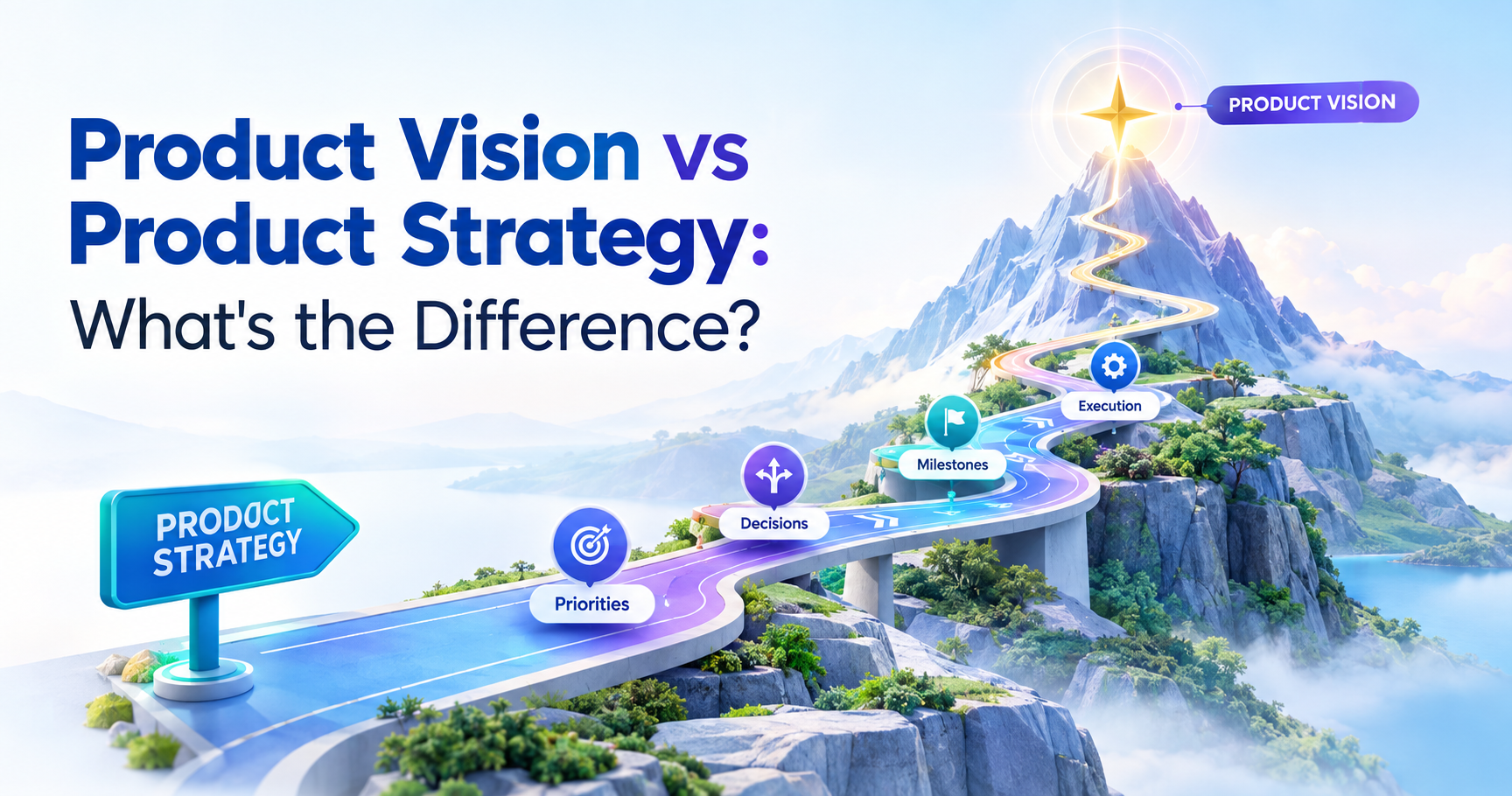
Product vision and product strategy are key concepts in product management. Both are about the future of a product. Both assist teams in determining what is important. Both may affect product objectives, roadmaps, and day-to-day choices. But they work differently.
Key Highlights
- Understand the fundamental distinction between product vision and product strategy.
- Understand how product vision guides the direction of a product.
- Identify the product strategy to drive choices and priorities.
- Understand how product vision and strategy go together.
- Find out how you can execute your plan using product roadmaps.
- How to build a clear and meaningful product vision.
- Spot typical errors when misunderstanding vision, strategy, and roadmap.
A product vision explains what kind of future a product aims to build. The product outlines its long-term orientation and shows the change or value it aims to provide to consumers.
A product plan defines the decisions the team will take to get to that future. It looks at consumers, challenges, markets, competition, objectives, resources, and priorities.
To clarify:
The product vision is where you’re going.
Product strategy is how to get there.
And the roadmap is based on these choices. It indicates the main product tasks that the team plans to focus on over time.
This is a crucial difference to make since product teams are often making decisions. The crew constantly has more ideas than they can construct. Various customers want various things. Business executives have other worries. Competitors invent new items. Technology offers new opportunities. Some ideas deserve to be followed up; others do not.
The team sees the wider picture with a vision. A plan helps the team figure out how to use its limited time and resources. A product without a vision might lose its sense of direction. An enticing vision is one that has no impact on practical choices; it’s just a statement without a plan.
A product vision explains the goal and expected value of a product. Product strategy is about the decisions required to get toward that vision.
So understanding the distinction isn’t simply a matter of utilizing the appropriate product management terminology. It's about making smarter choices.
What Is a Product Vision?
A product vision is what the product wants to make feasible for its consumers or users. It is concerned with the larger result, not with the particular means that may be utilized to attain it. A strong product vision should typically be wide enough to endure changes in technology, product design, and market circumstances.
The intention of a product vision is to guide without making all decisions up front. It should assist individuals in comprehending what they are attempting to accomplish yet let them find out the best technique to achieve it. A vision may also assist a team in determining what does not belong in the product.
If a given proposal does not fit into the future indicated in the vision, the team has grounds to challenge it. That makes vision not just essential for inspiration but also for attention.
What Are the Characteristics of a Strong Product Vision?
In general, a good product vision is brief, ambitious, and consistent across time. These traits make it valuable to product leaders and the team at large.
Short
The product vision should be simple to grasp and recall. It does not have to include a full market study, a list of goals, or a description of all consumer groups. Such material may be retained in supporting documentation.
The vision should be so basic that a member of the product team can express it without opening up a presentation. A lengthy statement may include important information, but if people forget it, then it is less effective as a decision-making tool.
A shorter vision is also simpler to repeat during planning meetings. For example, if the team is discussing two separate product concepts, a clear vision provides a shared reference point for everybody.
Aspirational
A product vision should outline something worth doing. It should not only state what the product is now.
For example,
"We provide invoicing management software" is more of a product description. Help small businesses manage their finances with confidence" is a more general outcome.
The second statement provides the team with greater space to consider what the product may be.
You don’t need to be bombastic or unreasonable with an ambitious aim. It just has to set forth a future that would be a real development for consumers.
A good question would be:
If we are successful, what changes for customers?
The response frequently leads to a greater vision.
Stable Over Time
A product vision should be relevant for a longer time than a release cycle or an annual project.
- Product subject to change.
- Characteristics may be eliminated.
- New technology may emerge.
- Customer behavior may alter.
- The team may devise better approaches to address an issue.
The vision has to be robust to a lot of those changes. That does not imply the vision is everlasting. When there's a big shift in the market, client demands, corporate direction, or product purpose, a new vision is needed. The idea is that the vision shouldn’t alter because the team adjusted a feature priority. Strategy may change so much more regularly. The vision is usually the longer-term anchor.
Scrum.org also reminds us that, as a business learns more about the market and prospects, product vision might change; therefore, stability should not be mistaken for permanency.
Product Vision Examples
Not all public firms will necessarily have anything termed a “product vision.” Some put forth a mission statement. Others provide a purpose or long-term direction.
These remarks are not to be taken as official product vision statements by default. But you can still use them to show the kind of thinking that goes into long-term product direction.
Google Photos
Google's purpose is to organize the world's information and make it widely accessible and valuable. This is technically a purpose, not a product vision. This is a good example since it's not a single product feature but the value Google intends to provide.
The statement does not specify that Google must fix the issue with a specific search interface, device, or technology. That allows the organization to evolve with technology.
The lesson for product teams is a good one: long-term direction should be linked to the value provided for consumers, not just to today's product structure.
Amazon
The official Amazon leadership principles heavily focus on consumer demands. Its “Customer Obsession” idea states that leaders start with the customer and move backwards. The firm also stresses long-term thinking, inventiveness, simplicity, and high standards.
This is not a formal product vision. They are an illustration of how a clear focus on the consumer can drive product choices.
For example, a team developing a new product may question themselves: “Does this solve a real customer problem or just add complexity?”
The big takeaway is that having defined guidelines about how to make choices makes long-term product vision more meaningful.
Peloton
Peloton now defines its mission as “empowering people to live fit, strong, long, and happy.” The company’s mission statement characterizes it as delivering comprehensive exercise and health experiences to members, any time, any place.
These phrases exemplify a useful contrast between a broad aim and how the organization fulfills it. One piece of workout equipment is not the only direction.
That is important because products may evolve or pivot while the customer result stays relevant.
Peloton has also discussed its technology, content, instructors, gear, and software as part of the experience it offers its users.
The lesson here is that a product direction may be about the customer experience, not just one particular technology.
Uber
Uber’s aim is to reimagine the way the world moves for the better. Its public information links this approach to helping people travel, receive products, and earn.
Again, this is a corporate purpose, not a formal product goal.
That's beneficial since it depicts a general result, not a specific product feature.
The greater direction might be significant even when the product changes.
Airbnb
Airbnb’s stated aim publicly is to build a world where anybody can belong anywhere.
The concept of belonging is considerably more than just reserving lodgings.
A crucial lesson for product teams. A good vision doesn’t need to explain what the product accomplishes now. It might describe the experience or change that the product is moving toward.
What a Product Vision Is Not
Product vision is not a feature list. A product task is “add AI search, improve checkout, build dashboards, and launch a mobile app." It is not describing the future the product seeks to build.
A product vision is not a road plan, either. A roadmap presents activities and anticipated priorities. The vision tells why they’re going in the bigger direction they’re going in.
A product vision isn't a business strategy. You don't need to provide revenue predictions, personnel plans, development estimates, launch dates, or extensive market estimations.
It’s not always a marketing buzzword. The marketing slogan is largely produced for market communication. A product vision has to aid the individuals who make product choices.
Lastly, a product vision is not a replacement for strategy. A vision may inform a team where it wants to go, but it can’t answer every issue about which customers to prioritize, which markets to join, or which challenges to tackle first. That's what strategy is for.
What Is a Product Strategy?
Product strategy is the collection of decisions that govern how a product will evolve toward its goal.
It takes that broad direction and applies it to actual situations.
A strategy is asking questions like:
- Who serves first?
- What is the most important problem?
- Which market should we concentrate on?
- What value are we going to bring?
- What makes this product special?
- What do we see?
- What shouldn’t we look for?
- How will we know if it is working?
This makes product strategy more real than product vision.
Strategy needs to cope with constraints. A product team does not have limitless personnel, time, money, or technical capabilities. Customer demands are diverse. Markets have rivals. Some possibilities may seem tempting yet are hard to come by.
Choice gives clarity. Product strategy is a systematic process to discover a meaningful customer issue, determine a unique way to approach solving it, and make targeted product bets that link user value to business results, according to Scrum.org.
And that’s why strategy is about saying no. A focused approach does not mean the team says yes to every client request, every product proposal, and every market opportunity.
What Are the Key Components of a Product Strategy?
Product strategy format may differ among enterprises. But there are a few places that are typically essential.
Target Market and Total Addressable Market (TAM)
A strategy must comprehend the market it targets. This means understanding who may use or purchase the product and how big the opportunity might be. TAM, or Total Addressable Market, is a technique to think about the whole market potential.
TAM may help guide thinking about whether an opportunity is big enough to sustain a firm. But TAM should not be considered the strategy itself.
An extremely big market might be hard to penetrate. It may not provide customers with a good incentive to switch. The firm may be lacking the necessary distribution channels. Legal or technological impediments might stand in the way.
The plan must thus go beyond. It should identify the segment of the market in which the product has a genuine chance of success. That might imply beginning with a smaller consumer group that has a defined issue. A well-defined beginning market may make product choices simpler since the team has clarity on whose requirements should matter most.
Personas
Personas assist the team in understanding who they are developing for.
A persona may define a user's position, objectives, requirements, frustrations, behavior, and surroundings.
Say you have a company software solution that serves 3 classes of people:
- A manager may need to see what a team is up to.
- You could require an easy approach for an employee to do everyday duties.
- A top leader could demand high-level reporting.
All three could utilize the same product. But they may not like the same characteristics. A plan should thus be clear about which users are most important and why. Personas should not be imaginary characters made for the sake of a presentation. Where feasible, they should be based on genuine consumer research and product proof. It is not meant to be a complete biography. The purpose is to assist the team in making better product decisions.
Objectives and Key Results (OKRs)
A product strategy also requires quantifiable objectives.
One popular method is to employ OKRs, or objectives and key results.
- The aim states what the team is trying to accomplish.
- The major outcomes are a sign of progress.
- The trick is to concentrate on the results, not the process.
For example,
“Deploy five new features.”
This measures the production. Increase successful completion of the first essential job for new users. That’s more of a result.
- The first one informs you that work occurred.
- The second informs you whether the work had an impact on consumers.
This is significant because releasing a feature doesn’t make the product better. Your product strategy should link effort to significant consumer or business outcomes.
Differentiation
The product strategy must also explain why buyers will buy the product. Diversification may arise from a number of sources.
It might be
- Improved user experience
- More reliable
- Speedier service
- Improved integration
- More concentration on one set of customers
- More access to
- Less complex
- Improved support
- Another model for business
A feature clients appreciate that is not offered by competitors. The crucial thing is that distinctiveness must count for the client. A product might be different technically but not different qualitatively. There’s no competitive advantage in a unique capability that no consumer wants.
What Are the Examples of Product Strategy?
Public information cannot provide every element of an organization's internal plan. The examples following are consequently focused on public missions, product orientation, and visible strategic decisions.
Zoom
Zoom claims it started with a simple objective to make video conversations effortless. The firm also claims it has moved from a video conference company to a larger AI-powered collaboration platform.
Another earlier Zoom statement likewise made a clear distinction between its purpose and vision. The aim of the mission in its 2023 public statement was to make video communications seamless and safe, and the vision was to inspire people to do more via video communications.
This is very important for seeing the contrast between the two notions. The mission is about the issue being solved. The vision talks about the bigger picture. Then the strategy might shift as the organization discovers new methods to fulfill that direction.
Zoom has moved from video meetings to a broader collaboration platform, showing why strategy cannot be a constant feature list.
Slack
Slack’s objective is to make people’s working lives easier, more enjoyable, and more productive. It also advertises its platform as uniting communications, apps, and consumers. This is a good illustration of how a product may grow up around a bigger consumer concern.
There is more to Slack than just messaging. Its public product direction is integrations, automation, apps, and other means to assist people in working. The strategic takeaway is not that all communication products should become a big platform. The lesson is that strategy has to be about the whole customer issue, not one feature as the complete product.
Amazon
There are several ways to align strategy thinking with customer demands. Amazon has public leadership principles. “Leaders start with the customer and work backwards,” the business states. It also states that leaders focus long-term and do not compromise long-term worth for short-term outcomes.
These concepts may impact product decision-making. A team could have to pick between a fast fix that gives a short-term boost in a measure and a bigger expenditure that would enhance the customer experience over time.
The idea applies to all product decisions. This gives a means to analyze the choice.
Duolingo
Duolingo is a clear public example of how purpose and strategy may operate together. The company’s aim is to provide the greatest education in the world and make it accessible to everyone, it says. It also believes its goal, principles, and strategic pillars inform day-to-day choices.
Its operational principles are putting learners first and ruthless prioritization using data and experimentation. This is helpful because it reveals the gap between the overarching aim and the decisions that support it.
The mission is wide. The strategic and operational concepts assist in establishing how the company works toward its goal.
What Makes a Product Strategy Successful?
A good product strategy doesn’t need to forecast the future exactly. That’s not feasible. Customer behavior is changing. Markets evolve. Technology develops. Competitors respond. So the goal of strategy is not to come up with a precise forecast. It is about making clear decisions based on the greatest evidence available.
A good product strategy is generally concentrated. It finds the consumers and issues that matter most instead of attempting to address them all. It’s based on research. Important judgments are backed by consumer research, product data, market knowledge, experiments, or other verifiable proof.
It is a compromise. "The team understands what it's going to concentrate on, what it's not going to focus on. It links consumer value with company value. You need to solve a client need, but you also need a strategy to generate commercial value in a sustainable fashion for the product.
And last, it is flexible. The plan has to be able to adapt if fresh evidence demonstrates an assumption was inaccurate. A strict plan is a strategy that never changes. A week-to-week plan is a sequence of responses.
The useful middle ground is a technique that is steady enough to provide focus and flexible enough to react to learning.
Product Vision vs. Product Strategy: Key Differences
The most obvious distinction is that vision and strategy function at separate levels. Vision provides a longer-term direction for the product. Product effort is focused according to strategy.
Time Horizon: Long-term vs. Medium-term
Product vision usually looks farther ahead. It talks about the future state that the product aspires to build. Product strategy generally works with a more realistic planning horizon. It is about the decisions we have to make with the existing market and current knowledge. There is no restriction that a vision has to be five years or a plan has to be three years.
A technological product may have to rethink its approach more regularly than a product in a slower-moving market. The crucial distinction is not the number of years. It's the degree of steadiness. The vision should offer continuity to the team.
The plan has to be relevant in the present situation. For example, a product vision may not change for many years despite a firm changing its target client, price strategy, product priority, or market approach. That would be a change of approach, not necessarily a change of vision.
Purpose: Why vs. How
Vision is what the product aims to develop in the future. Strategy is about the decisions that will assist in producing that. Think of a theoretical learning product.
Vision: “Provide professional learning for working adults.”
Approach: Begin with professionals who need brief, work-centric learning. Focus on flexible access and quantifiable skill results. “Prioritize those customers who need to learn while working full time.
The vision drives the overall direction. The approach tells you where to start and what to concentrate on. A vision without strategy leaves too many practical issues open. Without a greater direction, a plan might become too much about short-term action.
Audience and Tone: Inspirational and Emotional vs. Rational and Analytical
A vision must typically paint a common image of the future. This makes it possible to utilize more personal and aspirational language. Strategy must assist individuals in making choices. It is consequently more likely to include practical knowledge regarding consumers, challenges, markets, objectives, and trade-offs. That is not to say strategy should be difficult.
A strong strategy should be comprehensible to everybody who has to make choices about the product. The distinction is mostly in what each one has to do. Vision should let people see where we are going. Strategy should lead them to the options.
Flexibility: Fixed Vision vs. Flexible Strategy
The vision should typically be more steady than the approach. Let’s say consumer research suggests the product’s initial target market is too hard to reach. Perhaps we should modify the plan.
Let’s say the team realizes consumers have a different issue than the one anticipated. The plan could shift again.
If a new technology comes along that does the job better. The plan may alter again.
None of these modifications requires a new vision automatically. That’s why it’s important to separate vision from strategy. The team may adjust its course without losing the overall direction. Yet the words 'vision remains fixed' should not be interpreted literally.
The vision might alter when the underlying purpose of the product or the planned future changes. It just should not be modified as much as strategy.
How Product Vision and Product Strategy Work Together?
A vision and plan are most beneficial when integrated. The future is set by the vision. The strategy determines the “where” and “how” of effort. The product roadmap then turns those goals into intended efforts.
Vision Goes Wrong Without Strategy
A vision may be compelling but not lead to action. Think of a healthcare product with a vision: “Make healthcare easier for everyone.” The statement is general, and it is important. But it does not provide answers to critical practical concerns.
- Should the team concentrate on patients, physicians, hospitals, caregivers, or other groups?
- Is it appointment troubles, or communication problems, or records management, or payments, or anything else?
- What market should be first?
- What does success look like?
Without a plan, various teams can answer these problems differently. One group might create an appointment system. Another may focus on communication. Someone else may want analytics. Another could desire an AI helper. Individually, each of the ideas seems fair.
But the two may have fused to produce a product that lacks a distinct emphasis. What is lacking is not greater vision. “It is a strategic choice.
The Dangerous Problem of Strategy Without Vision
The reverse may happen when a team has precise plans but no clear long-term direction. Imagine a team that has defined a client group, established quarterly objectives, selected a few activities, and built out thorough KPIs. Perhaps that is a good plan. However, the team might optimize the wrong things if it doesn’t know what future it wants to build. For example, a team could push for more time in product since engagement is easier to evaluate.
But if the product exists to assist customers in getting something critical done in a hurry, then more time in the product may not be a good thing. A wider product vision might help the team question whether their approach is heading in the correct direction.

Every step adds a layer of detail. Vision is the future. The strategy highlights the key decisions. Roadmap: Shows the key objectives the team plans to undertake. Execution is what makes such efforts real product work. It’s not an entirely one-way process. Teams learn from customers and outcomes and may adjust the plan. If the new proof is persuasive enough, they’ll adjust the plan.
In the more extreme circumstances, the vision of the product may also need to be reassessed. This implies that the chain makes more sense as a linked system than a linear series. The basic idea is that each portion does something different. Scrum.org also offers a similar separation that separates product vision and strategy from product objectives and backlog choices.
Where Does the Product Roadmap Fit In?
The product roadmap is the link between strategy and the scheduled product activities.
It offers the team and stakeholders a high-level idea of what the product will be focused on over time.
A roadmap should help answer:
- What are we talking about?
- Why are these locations significant?
- What is going to happen now?
- What next?
- How does the job align with our goals?
A roadmap should not turn into a laundry list of all the work that the development team has to do.
According to Atlassian, a product roadmap is a common source of truth for product direction, objectives, and progress. It also proposes mapping roadmap elements back to product strategy and objectives and revising the roadmap as priorities change.
Consider a product with a strategic emphasis on getting new users to value quicker. The roadmap might include activities around:
- Enhancing Onboarding
- Cutting down setup time
- Improved first-use advice
- Enhancing searchability of key operations
- Testing approaches to boost activation
The work outlines the roadmap. It’s the plan that explains why those places are important. This difference is significant, since a roadmap may change without impacting the product vision.
Say data suggests consumers are having trouble with setup, not the onboarding information. The team may modify the roadmap. The consumer result remains the same; thus, the larger approach may stay the same.
Therefore, roadmaps should not be taken as fixed pledges. Future work relies on assumptions. As the team learns, the sequence and substance of future work may shift. Atlassian also points out that good roadmaps are always revised to reflect shifting objectives and input from customers.
What is the Difference Between Product Vision vs. Strategy vs. Mission vs. Roadmap?
These words are similar but not interchangeable.
Product Vision
Product vision is the future that the product aspires to build. It focuses on the result the consumer or product wants.
Main question: What future do we construct?
Product Strategy
The product strategy details the decisions that will help the product get to that future.
It looks at consumers, issues, markets, differentiation, objectives, and priorities.
Main question: What decisions will drive us toward that future?
Mission
A mission usually outlines the continuing purpose of an organization and what it is there to perform.
Big question: Why are we here?
There’s no one guideline for how all companies should use the phrases “mission” and “vision.”
Some firms see mission as the long-term orientation.
Some see vision as a future condition and mission as a present purpose.
Google officially states its aim as organizing the world’s information and making it widely accessible and valuable.
Zoom has publicly utilized both purpose and vision as different ideas, citing its goal as being about seamless video communications and its vision as being around helping people achieve more via video communications.
That’s why it’s important for teams to clarify the phrases they use, rather than assume all organizations have precisely the same model.
Product Roadmap
The Product roadmap outlines the primary product efforts anticipated over time.
Primary question: What is our work plan? One easy approach to keep the difference straight:
Vision = Desirable future
Strategy = Decisions
Mission = What we do
Roadmap = Projects underway
There might be some overlap among these notions. For example, a corporation might merge the purpose and vision into one statement. Roadmap information may also be part of a product plan. It is crucial not to stick to a certain naming scheme. What matters is that the team understands the purpose of each element.
How to Write a Product Vision Statement?
Step 1: Identify the Problem the Customer Has
Writing a product vision doesn’t need a sophisticated structure.
The beginning point is the most helpful one: the client.
Ask:
- Who are we attempting to assist?
Then ask:
- What big issue or need do they have?
- How can I make this work?
- What would be different if we did that issue right?
Then ask:
- What significant value would the product possess?
The responses may be reduced to a brief sentence.
One simple construction is, "Create a future where 'target users' can 'desired outcome ’.”
For instance:
Help small company owners feel confident that they can handle their own finances.
The example is purposefully generic. There is no mention of whether the offering will be an app, website, AI, dashboard, or other technology. This gives the product team the flexibility to examine other options. However, we have found that this is often not the case.
Begin with the issue.
For example:
“We want to develop an AI-based dashboard.”
- How do I connect my subwoofer?
- What issue does this dashboard solve?
Managers don’t always have a clear picture of what’s occurring across several teams. The client issue is more valuable to a vision than the technology itself. Technology may be different. The client need may still be there.
Step 2: Think beyond the existing product
The product vision should not be restricted by the appearance of the product today.
- A mobile app could develop into a wider platform.
- A software tool may become a service.
- The manual procedure may be automated.
- A product may reinvent how it delivers the same benefit.
The vision must be able to accommodate these changes.
Step 3: Keep it brief
An excellent vision must be memorable. If it takes the team a few minutes to describe what the vision implies, the statement is probably overly comprehensive. The companion document may offer extra context. The vision itself should be basic.
Step 4: Make it matter
A vision should be something that consumers and workers can relate to.
Avoid statements like:
“To be the world's most innovative platform.”
Ambition isn’t always a bad thing, but the phrase does not specify what the product aims to improve.
The more rigorous approach would be to define the customer result.
For instance:
Help independent businesses service clients as big enterprises do.
Now the crew has something more valuable to work on.
Step 5: Don’t Lock Product Into Technology
Technology evolves swiftly.
If the vision says:
Revolutionize Customer Support with AI.
The team could grow hooked on AI even if it’s not the best way to go.
The stronger vision might be:
Help consumers solve issues fast without waiting for help.
One possible answer is AI.
It wouldn't become the purpose.
Step 6: Validate the Vision with Actual Decisions
A vision is helpful when it affects choices. Come up with a fresh product concept and ask:
Does this assist us in advancing in the direction of the future indicated in the vision?
If the response is no, the team should ask why it is being considered.
If the answer is yes, the team may go to the following question:
Is this the proper strategic focus at this time? This second issue matters because not every vision-conforming concept should be in the present plan.
How to Build a Product Strategy?
Crafting a product strategy is more research-intensive than crafting a vision since strategy means choices and trade-offs.
For a realistic method, you may begin with the following stages.
Step 1: Know the market
Begin with the market. Consider consumer demands, market size, trends, alternatives, legislation, impediments, and developments that might impact the product. TAM can assist size the broader potential. But don't just stop at market size. Where can the product really provide value and successfully compete?
“A narrower market with an acute customer problem can be more valuable than a broad market where the product offers no clear benefit.
Step 2: Identify the target customer
Pick the most important consumer segment. This does not imply that all other customers are excluded forever. That is, the team has to have a defined priority.
The phrase “all businesses” is too broad to be useful for guiding many product selections.
You could choose to focus on smaller professional service firms with a unique administrative difficulty. The more explicitly you identify the consumer, the simpler it is to grasp their wants.
Step 3: Identify the Most Critical Problem
“Find out what customers are really struggling with. Don't only depend on internal opinion.
Useful evidence may be gained from:
- Interviews with customers
- Surveys
- Conversations with Support
- Data on product use
- Sales feedbacks
- Customer ratings
- Market research
- Experimenting
The aim is to find an issue worth tackling. A product team may design a great solution to an issue that consumers don’t care enough about. Strategy should mitigate such danger.
Step 4: Determine the Value
Once you understand the issue, tell them how the solution will assist a consumer in doing something.
Question:
- Will it take time?
- Will it save trouble?
- Will it mitigate risk?
- Will it make outcomes better?
- Will it simplify a complex process?
- Will it assist people in performing something that was not easy for them to do before?
The response should be explicit enough to impact product decisions.
Step 5: Know Your Alternatives
Customers are seldom selecting between your products and nothing.
- They may already have a procedure in place.
- They could utilize spreadsheets.
- They may be using different products.
- They may depend on manual labor.
- They might ask a staff member to deal with the situation.
- Or they may just accept the situation since change is too hard.
A smart plan takes all these choices into account. The question is not just, “Who is our competition?” It is, “What does the consumer do now instead of our product?”
Step 6: Determine How Product Will Differ
Once you know the alternatives, figure out why clients should choose your product.
That distinction ought to matter.
It may be simpler to use. It may work better for a certain consumer group. Maybe it will be better for the experience. That may minimize a key source of friction. It could be a better fit for an existing process.
The product does not have to be distinctive in all respects. It has to be significantly distinct in the places that matter most to the target client.
Step 7: Create Measurable Goals
Decide how you will know whether the plan is working. Select some helpful results.
These may include, depending on the product:
- Activation
- Retention
- Adoption
- Conversion
- Customer satisfaction
- Task completion
- Revenue
- Usage quality
- Customer success
It depends on the product and the correct metric.
- A learning product might be about learning results.
- A marketplace could care about successful transactions.
- A business software product may be concerned with adoption and retention.
The trick is linking measurement to the value the product is expected to produce.
Step 8: Balance Trade-off
This is one of the most crucial pieces of the plan. One of the things a plan should enable is finding out what not to do. If every client is a priority, every issue is urgent, and every feature request needs attention, the team has no true focus.
Trade-offs may be painful. The staff can be asked to reject a huge client request. It may need to delay a desirable feature, or it may need to concentrate on one market before moving on to another. That’s part of the plan.
Step 9: Convert Choices into Strategic Priorities
Identify the big areas in which to invest when the alternatives are apparent. These should be wide enough so that numerous solutions are possible.
For example, rather than saying, "Design a new onboard screen.”
The strategic priority could be, “Faster help for new users to their first successful outcome.”
The product team might then look at a number of strategies to get there to that outcome. This prevents the approach from locking itself into one answer too early.
Step 10: Revise & Refine
When major evidence changes, strategy should be updated.
This may occur after:
- New customer study
- A big shift in the market
- Major product outcome
- Change in business aims
- A novel technique
- Shift in consumer behavior
- An important development in the race
The aim is not to keep re-writing the plan. The aim is to see whether the alternatives are still reasonable. The strategy should be robust enough to provide direction, yet flexible enough to adapt to evidence.
What Are the Common Mistakes When Confusing Vision and Strategy?
Mixing up these notions might cause issues throughout the whole product development process.
Mistake 1: Converting the Vision Into a List of Features
A statement like “Build AI search, dashboards, alerts, and integrations" does not depict a future. It's about product work. Features will evolve as the team learns more. The vision should be result-centred on the consumer.
Mistake 2: Having an Overly Broad Strategy
"Serve everyone” is not a good strategic option. Neither is “solve all customer problems.” Strategy is about concentration. The team should recognize which clients and issues are worth solving initially.
Mistake 3: Confusing the roadmap with the strategy
A roadmap shows what the team plans to develop. That doesn't immediately tell you why that work is important.
If the sole strategy document is a roadmap, then priorities may be dictated by client demands, internal viewpoints, deadlines, or whoever shouts the loudest. The strategy should drive the roadmap.
Mistake 4: Changing the Vision Every Time the Strategy Changes
The strategy is anticipated to alter. Consider a team that aims at big companies at first but finds that smaller firms have a greater need and are simpler to service. That could mean a change of strategy.
This doesn’t always mean a fresh product vision. If one strategic assumption is false, the team should not alter its long-term path.
Mistake 5: Blurry Vision: "Become the number one platform in the world."
That may seem ambitious, but it doesn't tell the team anything.
- Leading in what?
- For who?
- What value creation?
A good vision should have enough information to be directional but not a strategy paper.
Mistake 6: Over-Detailing the Strategy
The other way around is also frequent. You may have a team put all the features, tasks, deadlines, owners, and metrics in its strategy document. The outcome is difficult to interpret.
Strategy should be about the critical decisions. Detailed delivery plans will provide lower-level detail.
Mistake 7: Copy the competition
It’s helpful to investigate your competitors. Copying your competition is not a strategy.
Just because another product has a feature that releases doesn't guarantee that your consumers need it.
The better question is, “What customer pain point is this product addressing? Is this pain point essential to our target users?”
Amazon’s public leadership principles make a similar argument. The business believes executives need to keep an eye on competition but obsess about customers and work backwards from the consumer demands.
Mistake 8: Measuring Activities, Not Outcomes
A team may deliver 10 features and not provide real customer value. Counting releases shows you that something has been done. It doesn’t say whether consumers won. Product strategy should thus link effort to results.
Mistake 9: Keeping Strategy to One Person
The product manager may set the strategy, but the plan should not be in that person's mind alone. Designers, developers, marketers, sales teams, customer success teams, and leaders all make choices that influence the product. Not everyone has to own the approach. They do need to know the crucial decisions.
Mistake 10: Failing to Revisit Strategy
What worked two years ago doesn’t work now.
- Customer demands could have altered.
- The market may have moved.
- Technology has changed.
- The business could have changed.
The right solution is not to modify your plan every time anything shifts. The solution is to evaluate it often enough to determine if its assumptions still hold.
Conclusion
Product vision and product strategy are related, yet they address separate questions. The vision defines what the future of the product aims to achieve, while the strategy spells out the decisions required to move toward that goal. The roadmap then operationalizes those decisions into significant planned projects.
A good vision is succinct, meaningful, aspirational, and steady enough to offer guidance.
A strong strategy is focused, evidence‑based, clear about trade‑offs, tied to objectives, and flexible enough to adjust when new evidence emerges.
For professionals pursuing CSPO Certification or SAFe POPM Training, this distinction is critical:
- Vision provides direction.
- Strategy defines rules and priorities.
- The roadmap indicates planned execution.
- Execution converts those decisions into a working product.
When teams understand the vision, they know where they are going. With a clear strategy, they know where to concentrate their efforts. With a roadmap, they recognize the big work ahead and can support decisions confidently.
Should new information emerge, the team may adjust the plan or roadmap without losing sight of the bigger picture. This adaptability is exactly what CSPOs and SAFe POPMs are trained to master — ensuring product delivery aligns with both customer needs and organizational goals.







 Lowest-Price Challenge











 Personalized Path


.webp)


 USA
USA  Canada
 India
India UK
UK Australia
 Singapore


