


 Call Us



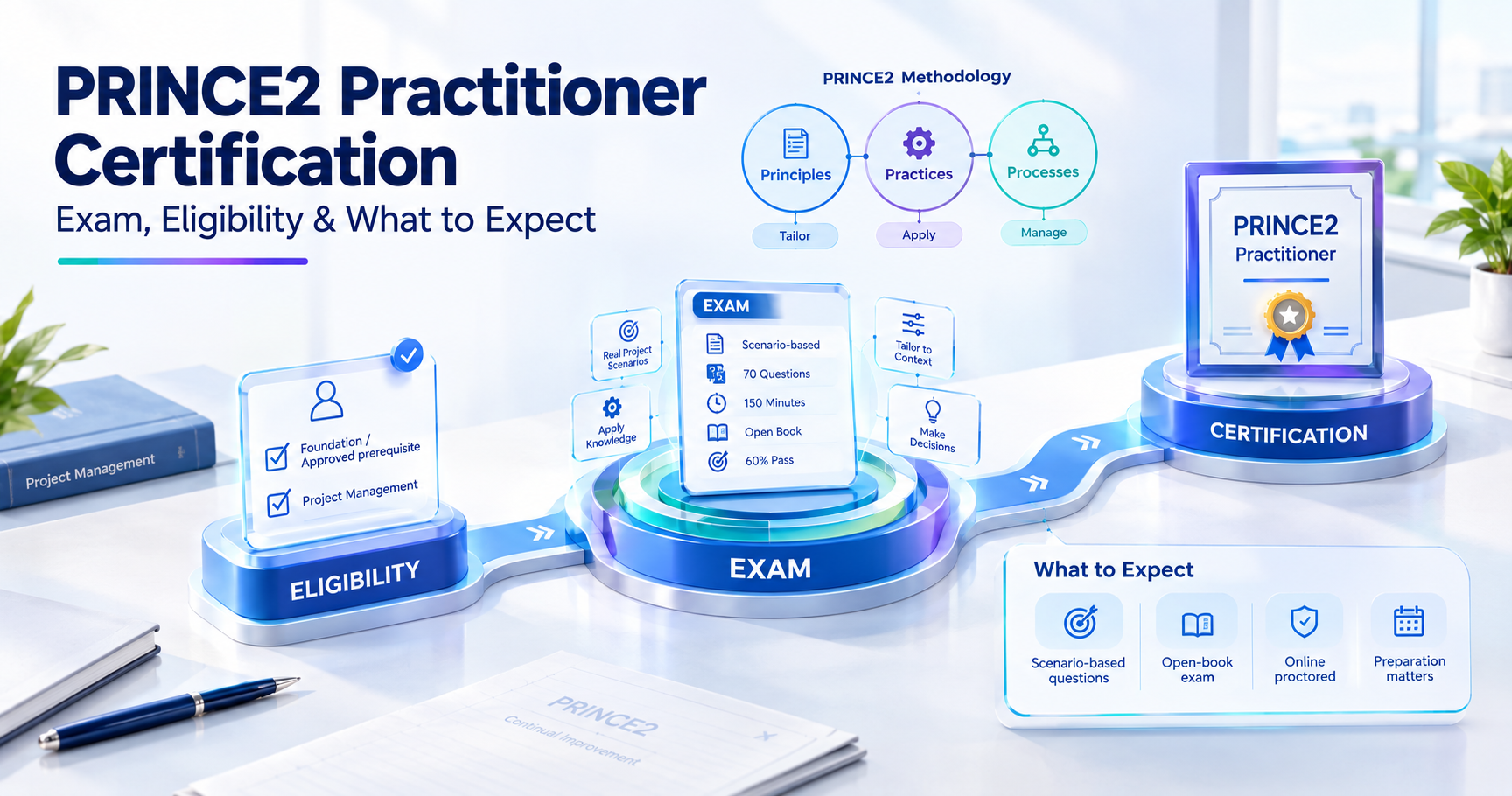
PRINCE2 Practitioner is the second and highest tier of PRINCE2 certification, proving you can apply and tailor the PRINCE2 method to a real project rather than just recognise its terms. It requires PRINCE2 Foundation (or an accepted equivalent) first, and its PRINCE2 7 exam is a 150-minute, open-book test of 56 questions and sub-questions worth 70 marks, with a 60% pass mark. The certificate is valid for three years.
Key Highlights of PRINCE2 Practitioner Certification
- PRINCE2 Practitioner sits above PRINCE2 Foundation and tests application and tailoring, not just recall of terminology.
- Foundation certification (or an accepted equivalent such as PMP or CAPM) is a mandatory prerequisite; there is no direct entry to Practitioner.
- The current PRINCE2 7 Practitioner exam has 56 questions and sub-questions worth 70 marks, runs for 150 minutes, is open-book, and requires 60% (42 marks) to pass.
- The certificate is valid for three years and is renewed through 60 CPD points (20 per year) via PeopleCert Plus, or by resitting the exam.
- It is widely used as a baseline project management credential in the UK, Europe, and Commonwealth markets, and pairs well with PRINCE2 Agile and PMP for candidates who work across methodologies.
- Simpliaxis offers Foundation, Practitioner, combined, and PRINCE2 Agile training tracks, plus corporate batches for teams certifying together.
If you search for "PRINCE2 Practitioner," you are usually trying to answer one of two questions: what does this certification actually let me do, or am I even eligible to sit the exam yet. Both are reasonable questions, because PRINCE2 Practitioner is often described in marketing language ("advanced," "next-level," "career-boosting") without much explanation of what happens between enrolling and holding the certificate.
This article works through it plainly. It covers what PRINCE2 Practitioner is and how it differs from PRINCE2 Foundation, who is eligible to sit the exam and why the prerequisite exists, what the current PRINCE2 7 exam actually contains (questions, timing, pass mark), how the certification is used day to day on projects, and what renewal looks like once you have it. Wherever a fact could vary or change over time (exam format details, renewal rules), the figures below are checked against PeopleCert's official PRINCE2 7 Practitioner certification page, the body that owns and administers PRINCE2 today.
If you are completely new to PRINCE2 and not yet sure whether Foundation or Practitioner is the right starting point, it may help to read a broader primer on what PRINCE2 is before coming back to this page.
What Is PRINCE2 Practitioner Certification?
PRINCE2 (PRojects IN Controlled Environments) is a structured project management method built around defined principles, themes, and processes. It is owned by PeopleCert, which took over the PRINCE2 portfolio from AXELOS, and it is used extensively by government departments, financial services firms, and large enterprises, particularly in the UK, Europe, Australia, and parts of the Middle East and Asia.
PRINCE2 certification is split into two main levels:
- PRINCE2 Foundation, which confirms you understand PRINCE2's terminology, principles, themes, and processes.
- PRINCE2 Practitioner, which confirms you can apply and tailor PRINCE2 to a specific project scenario, including adjusting it for project size, complexity, and organisational context.
PRINCE2 Practitioner is not a separate methodology or a "harder version" of Foundation content. It uses the same manual and the same seven principles, seven themes, and seven processes. What changes is the skill being tested: Foundation checks whether you can define and recognise these concepts, while Practitioner checks whether you can use them to make decisions in a scenario, such as which theme applies to a given project problem, how a specific process should be tailored for a small or agile-influenced project, or what a project board should do when a stage deviates from tolerance.
In practical terms, holding PRINCE2 Practitioner signals to an employer that you have gone beyond terminology and can genuinely run or contribute to a PRINCE2-governed project, including adapting the method rather than following it rigidly.
PRINCE2 Foundation vs PRINCE2 Practitioner: What's the Difference
The two levels are frequently confused, largely because many training providers, including Simpliaxis, sell them together as a combined pathway. The table below sets out the practical differences.
| Aspect | PRINCE2 Foundation | PRINCE2 Practitioner |
|---|---|---|
| What it tests | Recognition and understanding of PRINCE2 terms, principles, themes, and processes | Ability to apply and tailor PRINCE2 to a project scenario |
| Typical audience | Team members, coordinators, those new to formal project governance | Project managers, senior team members, PMO staff who run or oversee projects |
| Prerequisite | None | PRINCE2 Foundation, or an accepted equivalent certification |
| Exam style | Closed-book, multiple choice on definitions and concepts | Open-book, scenario-based questions requiring applied judgement |
| Question count (PRINCE2 7) | 60 questions | 56 questions and sub-questions, worth 70 marks |
| Duration | 60 minutes | 150 minutes |
| Pass mark | 60% (36/60) | 60% (42/70 marks) |
| Renewal | Does not expire on its own, but is a prerequisite input for Practitioner | Valid for 3 years, renewed via CPD points or re-examination |
A useful way to think about it: Foundation is the entry ticket, Practitioner is the working credential. Most professionals who need PRINCE2 for their actual job, rather than general awareness, end up sitting both, which is why Simpliaxis and most training providers package a PRINCE2 Foundation & Practitioner Certification Training course that covers both exams in one structured programme rather than requiring two separate bookings.
If you want a broader breakdown of how PRINCE2's certification tiers fit together, including where PRINCE2 Agile sits alongside them, the Simpliaxis guide to PRINCE2 certification levels covers that in more depth.
Who Should Pursue PRINCE2 Practitioner Certification?
PRINCE2 Practitioner is most relevant to:
- Project managers who are expected to run PRINCE2-governed projects, particularly in the UK public sector, financial services, and any organisation that has standardised on PRINCE2 as its house methodology.
- Programme and PMO staff who need to assess project documentation (business cases, stage plans, exception reports) against PRINCE2 standards, even if they are not the named project manager.
- Team managers and senior team members who are moving toward a project management role and want a credential that demonstrates applied capability, not just awareness.
- Consultants and contractors who work across multiple client organisations and need a portable, recognised credential rather than one tied to a single employer's internal process.
- Professionals already holding PMP, CAPM, or another project management qualification who work in, or want to work in, PRINCE2-standardised environments and need to demonstrate fluency in the method specifically.
It is less useful, at least as a first step, for someone who has never managed a project or worked inside a structured project environment. PRINCE2 Practitioner assumes you can already reason about project scenarios; if the underlying concepts (business justification, stage boundaries, risk registers) are unfamiliar, Foundation is the more sensible starting point, and possibly some general project management grounding before that.
PRINCE2 Practitioner Exam Prerequisites and Eligibility
This is the point where most confusion happens, so it is worth being precise. According to PeopleCert's official certification page, candidates must hold one of the following before they can register for the PRINCE2 Practitioner exam:
- PRINCE2 Foundation (current, PRINCE2 7 edition)
- PRINCE2 Foundation or Practitioner from the 6th or 5th edition
- Project Management Professional (PMP)®
- Certified Associate in Project Management (CAPM)®
- PRINCE2 Practitioner Qualification (PPQ) or Project Management Qualification (PMQ)
- IPMA Level A, B, C, or D
- Certified Six Sigma Project Management Professional (CSPM-2 or CSPM-3)
There is no direct-entry route into Practitioner. If none of the above certifications apply to you, you need to sit and pass Foundation first, either as a standalone PRINCE2 Foundation Certification Training course or as part of a combined Foundation and Practitioner programme.
One detail worth flagging: holding an equivalent certification like PMP satisfies the prerequisite for exam registration, but it does not teach you PRINCE2 terminology. If your only qualification is PMP and you have not studied PRINCE2's specific themes and processes, most training providers still recommend at least reviewing Foundation-level material before attempting Practitioner, because the Practitioner exam assumes fluency in PRINCE2-specific vocabulary that PMP does not cover.
For a full breakdown of who qualifies for each PRINCE2 certification tier and what documentation is typically required at registration, the Simpliaxis PRINCE2 certification eligibility guide walks through this in more detail.
Inside the PRINCE2 Practitioner Exam (PRINCE2 7)
Exam Format, Questions, and Duration
The current PRINCE2 7 Practitioner exam, per PeopleCert's official certification page, is structured as follows:
- Format: Objective testing, scenario-based, open-book
- Questions: 56 questions and sub-questions, totalling 70 marks
- Duration: 150 minutes
- Allowed materials: The official PRINCE2 7 manual only (no personal notes or annotated copies beyond what PeopleCert permits)
- Delivery: Online via PeopleCert's remote proctoring, or at an authorised test centre
- Languages: Available in 14 languages including English, French, German, Spanish, Dutch, and Japanese
- Extra time: Non-native English speakers sitting the English-language exam typically receive 25% additional time; check current PeopleCert policy at booking, since accommodations can be adjusted
This is a meaningful change from the previous PRINCE2 6th edition Practitioner exam, which used 68 questions with a pass mark of 38/68 (roughly 55%) and no additional reading time. Anyone researching PRINCE2 Practitioner using older blog posts or forum threads should be careful, since a lot of content online still quotes the 6th edition numbers as current.
Pass Mark and Scoring
To pass the PRINCE2 7 Practitioner exam, you need 42 out of 70 marks, which works out to 60%. This matches the Foundation pass mark, also 60% under PRINCE2 7 (both were raised from the 6th edition's 55% threshold when PeopleCert refreshed the qualification). What differs between the two exams is not the bar itself but what is being tested against it: Foundation checks recall of terminology in a closed-book, single-answer format, while Practitioner checks applied, scenario-based judgement in an open-book format with sub-questions worth multiple marks.
Because the exam is scenario-based, marks are not distributed evenly across "easy" and "hard" questions in the way a simple multiple-choice test might be. Some questions carry multiple marks if they test more than one applied judgement within a single scenario, which is part of why the exam is described as "56 questions and sub-questions worth 70 marks" rather than a flat 70-question exam.
What the Exam Actually Tests
Practitioner exam scenarios typically present a short project situation (for example, a stage plan that has deviated from tolerance, or a business case that needs updating after a change in scope) and ask you to identify the correct PRINCE2-consistent response. This might involve:
- Selecting which of the seven themes (business case, organization, quality, plans, risk, change, progress) is most relevant to a described problem
- Identifying the correct process step or management product that should be produced or updated
- Judging how a process or theme should be tailored for a smaller, lower-complexity, or higher-risk project
- Applying PRINCE2 principles (such as "manage by exception" or "focus on products") to decide what a project board or project manager should do next
This is why the open-book format exists. PeopleCert is not testing memorisation of the manual; it is testing whether you can locate and apply the right part of it under scenario conditions and time pressure, since 150 minutes for 56 questions and sub-questions leaves limited time to search the manual extensively for each one.
How PRINCE2 Practitioner Is Used on the Job
Certification is only useful if it maps to something you actually do at work. In practice, PRINCE2 Practitioner-certified professionals typically:
- Draft and maintain core management products such as the Project Initiation Documentation, Business Case, and Stage Plans, and know which document owns which decision
- Advise a project board on whether a stage or project should proceed, be adjusted, or be escalated, based on tolerance breaches
- Tailor PRINCE2's seven processes for smaller projects, avoiding the common criticism that PRINCE2 is "too heavy" for lightweight work, by scaling documentation and governance appropriately
- Sit on or support a Project Management Office (PMO) that needs a shared, standardised project language across multiple simultaneous projects
- Bridge PRINCE2 governance with agile delivery teams, often by pairing PRINCE2 Practitioner knowledge with PRINCE2 Agile certification, since many organisations now run PRINCE2 governance around agile delivery teams rather than traditional waterfall execution
That last point matters more than it used to. A large share of organisations that adopted PRINCE2 originally now run at least some projects with agile delivery methods underneath PRINCE2's governance layer. This is exactly the gap that PRINCE2 Agile Practitioner Certification Training and PRINCE2 Agile Foundation Certification Training were built to close, and it is common for PRINCE2 Practitioner holders to add one of these later in their career rather than starting there.
PRINCE2 Practitioner vs PMP and Other Credentials
PRINCE2 Practitioner is sometimes compared directly to PMP, but the two are not quite substitutes for each other, and understanding the difference helps you decide whether you need one, the other, or both.
PRINCE2 is a method: it defines specific processes, themes, roles, and documents that a project should follow, and PRINCE2 Practitioner tests whether you can apply that specific method. PMP, by contrast, is built around a broader body of knowledge (the PMBOK Guide) that covers project management practice generally, without prescribing one fixed method. This is why PMP is recognised more heavily in North America and PRINCE2 dominates in the UK, parts of Europe, Australia, and the public sector more broadly.
For professionals who move between regions or client organisations with different methodology standards, holding both is common and not redundant, since each is asked for by different employers and different tender or contract requirements. Someone building a PRINCE2 foundation who anticipates eventually needing PMP too (or vice versa) is not wasting effort by holding both, because the two are evaluated separately in most hiring and procurement contexts.
Certification Validity, Renewal, and CPD
Unlike some professional qualifications that never expire, PRINCE2 Practitioner certification is valid for three years from the date it is awarded. After that, it lapses unless renewed.
There are two accepted renewal routes:
- CPD (Continuing Professional Development) route: Log 20 CPD points per year for three consecutive years (60 points total) through a PeopleCert Plus subscription. Eligible activities generally include structured training, project delivery work, mentoring, and other approved professional development.
- Re-examination route: Sit and pass the PRINCE2 Practitioner exam again before the three-year validity period ends.
There is no grace period once the certificate lapses, so professionals who plan to rely on PRINCE2 Practitioner for their job title, tender submissions, or client-facing credibility should track their renewal date proactively rather than waiting for a reminder. Some employers build this into annual review conversations; individuals working independently or as contractors need to track it themselves.
How to Prepare for the PRINCE2 Practitioner Exam
Because the Practitioner exam tests application rather than recall, exam preparation looks different from a typical closed-book study plan. A reasonable preparation sequence looks like this:
| Stage | What to do | Why it matters |
|---|---|---|
| 1. Confirm eligibility | Verify your Foundation certificate (or accepted equivalent) meets the current prerequisite list | Registration will be rejected without a valid prerequisite on file |
| 2. Refresh Foundation knowledge | Review the seven principles, themes, and processes if it has been more than a few months since Foundation | Practitioner questions assume this vocabulary is already fluent, not newly learned |
| 3. Study with scenarios, not flashcards | Work through practice scenarios that mirror the exam's format rather than memorising definitions | The exam rewards applied judgement, not recall |
| 4. Practise manual navigation | Get comfortable finding specific sections of the official manual quickly | Open-book does not mean unlimited time; speed of reference matters under 150 minutes |
| 5. Sit timed mock exams | Practise full-length, timed mock papers before the real exam | Time pressure is often the main reason capable candidates run out of time on the real exam |
| 6. Book with buffer | Schedule the exam with enough lead time to redo a section of study if a mock score is weak | Reduces the temptation to sit before you are ready |
For exam-day tactics specifically, such as time allocation per question and how to use the open-book format efficiently, the Simpliaxis guide with 21 tips and tricks for acing your PRINCE2 Practitioner exam goes deeper into practical exam technique.
Simpliaxis Training Relevance
Simpliaxis runs structured, instructor-led PRINCE2 training that covers both certification levels, so the right course depends on where you currently stand.
If you have not yet completed Foundation, the PRINCE2 Foundation Certification Training course covers the terminology, principles, themes, and processes needed both to pass Foundation and to walk into Practitioner-level study already fluent in the vocabulary.
If you already hold Foundation (or an accepted equivalent like PMP or CAPM) and are ready to move directly into applied, scenario-based learning, the PRINCE2 Practitioner Certification Training course is built specifically around exam-style scenarios and tailoring exercises.
Most candidates who do not yet hold either certification choose the combined PRINCE2 Foundation & Practitioner Certification Training course, which sequences both exams into one structured programme rather than requiring separate enrolments and separate study restarts.
For professionals working in organisations that run agile delivery underneath PRINCE2 governance, or who want a credential that speaks directly to that hybrid setup, Simpliaxis also offers standalone PRINCE2 Agile Foundation and PRINCE2 Agile Practitioner courses, plus a combined PRINCE2 Agile Foundation & Practitioner Certification Training course for candidates who want to complete both agile-focused certifications together.
For organisations rather than individuals, particularly where several team members need PRINCE2 Foundation, Practitioner, or PRINCE2 Agile certification at the same time, group training is usually more efficient than separate individual bookings. The Simpliaxis corporate and group training programme is built for exactly this case, with cohorts scheduled around a team's project calendar rather than a public course timetable.
Conclusion
PRINCE2 Practitioner is not a harder exam bolted onto Foundation for the sake of difficulty. It exists because recognising PRINCE2's principles, themes, and processes is a different skill from applying and tailoring them under real project conditions, and employers who standardise on PRINCE2 need people who can do the latter. The prerequisite structure, the open-book scenario format, and the three-year renewal cycle all follow from that same logic: PeopleCert wants Practitioner-certified professionals to demonstrate current, applied competence, not a one-time memorisation exercise.
If you are deciding whether to pursue it, the honest answer depends on whether your role, or the role you want, actually requires running or governing PRINCE2 projects day to day. If it does, Practitioner is the credential that signals you; Foundation alone signals awareness but not applied capability.
If you are still deciding between certification levels, compare the PRINCE2 Foundation Certification Training and PRINCE2 Practitioner Certification Training course outlines side by side, or start directly with the combined PRINCE2 Foundation & Practitioner Certification Training programme if you know you need both. If your organisation is certifying more than one team member, the Simpliaxis corporate and group training option is usually more efficient than separate individual bookings.







 Lowest-Price Challenge











 Personalized Path


.webp)


 USA
USA  Canada
 India
India UK
UK Australia
 Singapore


