


 Call Us



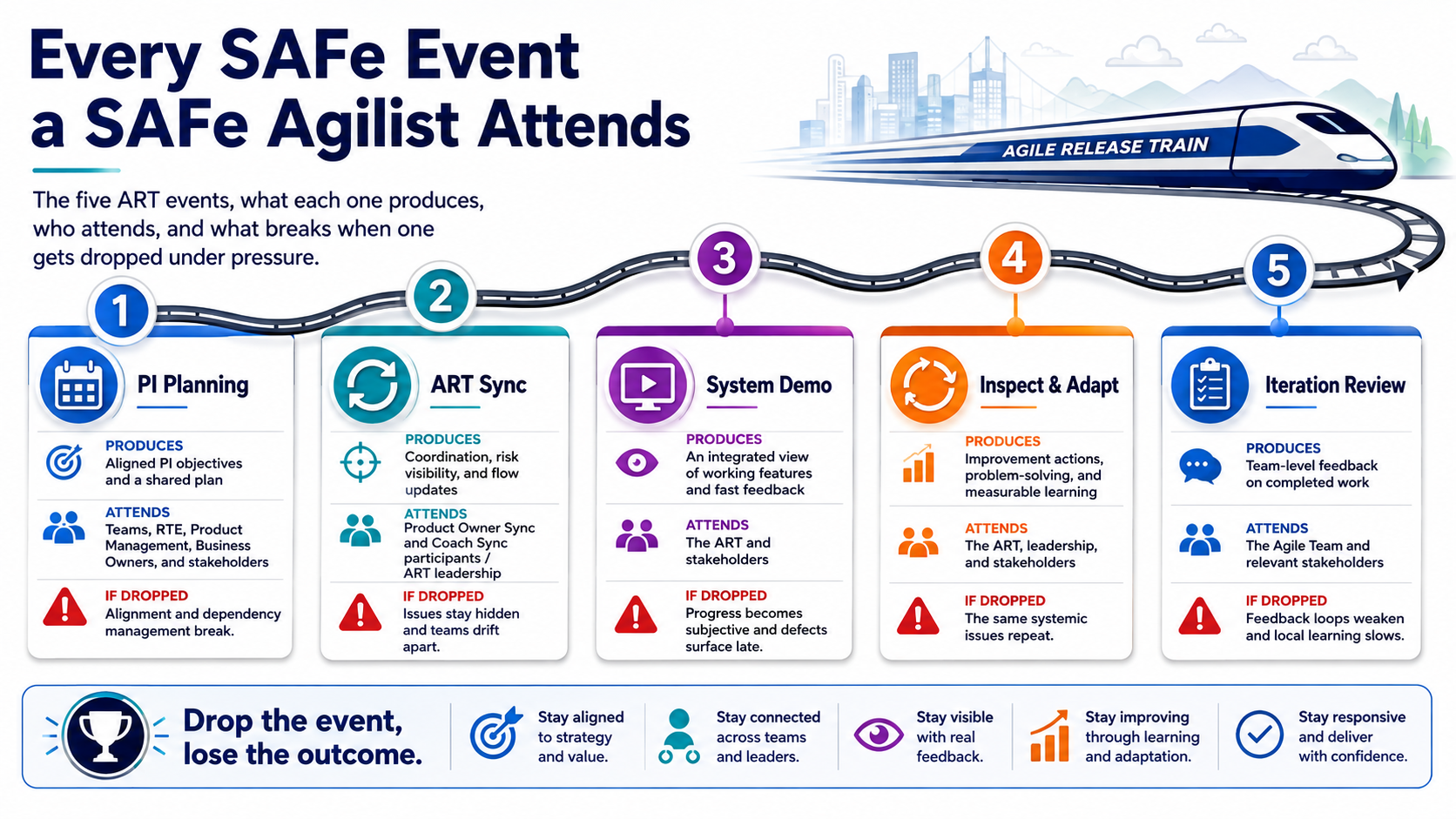
An Agile Release Train runs five recurring events across a Program Increment, and a SAFe Agilist is expected to know what each produces rather than simply when it happens. The one candidates get wrong most often is ART Sync, which is a single event containing both the Product Owner Sync and the Coach Sync, not three separate items in the calendar. The second most common error is treating the Innovation and Planning Iteration as spare capacity.
Key Highlights
- ART Sync is one event that combines the Product Owner Sync and the Coach Sync. Listing them as three separate events is the most common exam error on this material.
- The Innovation and Planning Iteration is a dedicated iteration occurring every Program Increment, providing an estimating buffer plus time for innovation, continuing education, PI Planning and Inspect and Adapt.
- Inspect and Adapt closes each PI and produces improvement backlog items through a structured problem-solving workshop, not simply a discussion.
- The System Demo shows an integrated view of new Features from all teams on the train, which is what separates it from a sequence of team demonstrations.
- PI Planning is the anchor event and the only one that produces commitment rather than information.
- Each event has a defined output, and pairing an event with the wrong output is where exam questions on this material concentrate.
The events, and what each one produces
| Event | Cadence | What it produces |
| PI Planning | Once per Program Increment | A committed plan, PI Objectives with business value, a programme board of dependencies |
| ART Sync | Regularly through the PI | Visibility of progress toward PI Objectives, coordinated dependencies, surfaced impediments |
| System Demo | Every iteration | An integrated view of new Features, with stakeholder feedback |
| Inspect and Adapt | End of each PI | Improvement backlog items from a structured problem-solving workshop |
| Innovation and Planning Iteration | Every PI | Estimating buffer, innovation time, and the container for PI Planning and I&A |
One further distinction is worth holding alongside that table. Three of the five run inside a Program Increment as it executes, and two bracket it: PI Planning opens the increment and Inspect and Adapt closes it. That bracketing is deliberate, because the improvements identified at the close feed directly into the plan at the next opening while the evidence is still fresh. Trains that let weeks pass between the two lose most of that connection.
The pattern to hold is that four of these produce information and one produces commitment. That single distinction explains why PI Planning cannot be compressed without consequence and why the others sometimes can.
PI Planning
The anchor event, and the one organisations run even when they run nothing else properly.
Scaled Agile describes PI Planning as a cadence-based event for the entire train that aligns teams and stakeholders to a shared mission and vision. It runs across two days in the standard form, and the whole train attends.
What it produces is threefold. A set of PI Objectives per team, with business value assigned by Business Owners. A programme board showing dependencies between teams and significant milestones. And, less tangibly, commitment, which is the thing that cannot be produced any other way.
The output that matters most is the last one, and it is the one most easily destroyed. A plan handed to teams rather than built by them produces identical artefacts with no commitment behind them. Our PI Planning guide covers the agenda in the detail this summary skips.
For a SAFe Agilist the thing to understand is not the schedule but the confidence vote. It is the only formal mechanism in the event where a team can say the plan is not achievable, and what happens next tells you everything about whether the organisation means it. If teams cannot genuinely express low confidence, and if a low vote does not change the plan, the event has produced a document rather than a commitment.
ART Sync, and the two syncs inside it
The event most often misunderstood, and worth being precise about because it is examined.
ART Sync is a single event that combines two things. The Product Owner Sync gives visibility into the train's progress toward its PI Objectives and allows adjustments to be made. The Coach Sync coordinates dependencies across the train and surfaces progress and impediments.
Candidates routinely list ART Sync, PO Sync and Coach Sync as three separate events. They are one event containing two conversations, which is the correct answer on the paper and the correct mental model in practice.
The distinction between the two conversations is worth holding. The PO Sync is about scope and whether the train is heading toward what it committed to. The Coach Sync is about impediments and dependencies, which is process rather than content. Different people, different questions, same event.
In practice the Release Train Engineer facilitates this, and it is where most of the week-to-week coordination of a train actually happens. PI Planning gets the attention; ART Sync does the work.
System Demo
The event that tells you whether the train is actually integrating.
Scaled Agile describes it as providing stakeholders with an integrated view of new Features delivered by all the teams on the train for the most recent iteration, giving an objective measure of progress and the opportunity for feedback.
Two words in that carry the weight. Integrated, meaning the work is combined rather than shown in sequence. And objective, meaning it demonstrates working functionality rather than reported status.
The failure mode is a sequence of team demos. Each team shows its own work, everyone applauds, and nothing has been integrated. A train can operate this way for a year believing it is fine, and discover at a release that the pieces do not fit. Where that happens, the System Demo has been running in name and not in substance.
The other failure mode is running it too rarely. It is an iteration-level event, and a train demonstrating once per Program Increment has a twelve-week feedback loop, which defeats the purpose of having it. This is one of the more common compressions a train under pressure makes, because the demo is visible effort with no immediate deadline attached, and its absence produces no symptom until integration fails.
Inspect and Adapt
The event that closes each Program Increment and produces the train's improvements.
Scaled Agile describes it as a significant event at the end of each PI where the current state of the solution is demonstrated and evaluated, after which teams reflect and identify improvement backlog items through a structured problem-solving workshop.
Three parts, and the third is the one that gets dropped. There is a PI System Demo covering the full increment. There is a quantitative and qualitative review of the measures. And there is a structured problem-solving workshop that produces improvement items.
Skipping the workshop turns Inspect and Adapt into a review meeting. Running the workshop but not funding what it produces turns it into theatre, and a train that raises the same items across three consecutive PIs has learned that the event does not lead anywhere. Our piece on Inspect and Adapt covers the structure in more depth.
The word structured is doing real work. This is not an open retrospective. It is a defined problem-solving approach applied to a root cause, which is what makes the output actionable rather than a list of complaints.
The Innovation and Planning Iteration
Not an event exactly, and it belongs here because it contains two of them.
Scaled Agile describes the IP Iteration as a unique dedicated iteration occurring every Program Increment. It provides an estimating buffer for meeting PI Objectives, and dedicated time for innovation, continuing education, PI Planning and Inspect and Adapt.
That definition contains the answer to the most common misuse. The IP Iteration is where PI Planning and Inspect and Adapt physically happen, which is why the train does not plan feature work into it. The estimating buffer exists because teams commit to objectives across a PI and estimation is imprecise; without slack, every overrun becomes a missed commitment.
Using it routinely to finish carryover work removes the buffer that made the commitment credible in the first place, and the train then reports poor predictability without connecting the two. This is one of the most widespread misuses in the framework and it is covered further in our piece on SAFe anti-patterns.
The innovation time is the part organisations under pressure abandon first and regret slowest, since its absence produces no immediate symptom.
Who attends what
Attendance is not uniform across the five, and getting it wrong is a common source of wasted time.
PI Planning is the whole train. Every team, plus Business Owners, Product Management, the System Architect and the Release Train Engineer. This is the expensive one and the one worth protecting, because partial attendance produces partial commitment.
ART Sync is representatives rather than everyone. Product Owners and Scrum Masters from each team, with the RTE facilitating. Pulling entire teams into it is a common early mistake that makes the event resented.
System Demo is the teams plus stakeholders. The stakeholder attendance is the point, since feedback is the output; a System Demo run purely for the train has removed its own purpose.
Inspect and Adapt is the whole train again, plus Business Owners. The problem-solving workshop needs the people who experience the problems and the people who can authorise the fixes in the same room.
The IP Iteration is not attended so much as inhabited, since it is where two of the other events physically sit.
The pattern is that the two events producing commitments and improvements need everyone, and the two producing coordination and feedback need representatives and stakeholders. Getting this wrong in either direction costs real money at train scale, and it is worth calculating once: a train of a hundred people in a two-day event is four hundred person-days.
What happens when an event is dropped
Trains under pressure drop events, and the consequences are specific rather than general.
Drop the System Demo and Inspect and Adapt loses its evidence. The PI review becomes a discussion about perceptions rather than an evaluation of working software, and integration problems surface at release instead of within an iteration.
Drop ART Sync and dependencies stop being managed between planning events. The train discovers at the end of the PI what it could have discovered in week three, which is the most expensive possible time to find out.
Compress PI Planning and you get a plan without commitment. This is the most damaging compression because the artefacts survive, so nothing looks wrong until delivery does not match the plan and nobody can say why.
Drop the problem-solving workshop from Inspect and Adapt and improvement stops. The train continues running its events indefinitely with the same impediments, which is how an implementation ends up three years old and no better than it was at launch.
The general rule is that dropping an event does not save its cost. It moves the cost somewhere less visible and usually multiplies it, and this is exactly the reasoning Leading SAFe certification training works through so that leaders can make the tradeoff knowingly rather than by default.
How the events fit a Program Increment
Sequence rather than schedule, since the exact calendar varies.
A Program Increment opens with PI Planning, held in the IP Iteration of the preceding PI. Teams then work through several iterations. Each iteration ends with a System Demo showing integrated functionality. Throughout, ART Sync runs regularly to coordinate dependencies and track progress toward the objectives.
The PI closes with the IP Iteration, which contains Inspect and Adapt for the increment just finished and PI Planning for the one about to start. That overlap is deliberate: the improvements identified feed directly into the next plan while they are still fresh.
Understanding this loop is more useful than memorising the calendar. Each event feeds the next, and removing one breaks something downstream. Drop the System Demo and Inspect and Adapt has no objective evidence to evaluate. Drop the problem-solving workshop and PI Planning inherits no improvements.
What a SAFe Agilist is expected to know about each
The exam and the job ask different things here, and both are worth preparing.
The exam tests event-to-output pairing. Which event produces the programme board. Which produces improvement backlog items. Which shows integrated functionality. Questions frequently pair an event with a plausible but incorrect output, so recall alone is not enough.
The job asks whether an event is producing what it should. That is a diagnostic skill rather than a recall one, and the questions are different: does the confidence vote change anything, is the System Demo genuinely integrated, do improvement items get funded.
A leader who knows the calendar can attend. A leader who knows the outputs can tell whether the train is working, which is the actual point of learning this material and what Leading SAFe certification training covers across two days.
The four questions worth asking about any train
Short diagnostics you can apply from outside, each mapping to one event.
Did any team's plan change during PI Planning? If no plan ever changes, the event is communicating a decision rather than making one.
Is the System Demo integrated? Ask whether the demonstration runs against combined work or a sequence of branches. The answer is usually revealing and rarely volunteered.
What happened to the last Inspect and Adapt items? If nobody can name one that was actioned, the workshop is producing a list.
What is in the IP Iteration? If the answer is carryover work, the train has no buffer and its predictability numbers will not improve regardless of what else changes.
None of these requires access to internal reporting, which makes them useful in an interview as well as in an assessment. Our piece on SAFe Agilist interview questions covers using them from the candidate side.
The events a SAFe Agilist is not responsible for
Worth stating, because newly certified leaders sometimes take on more than the role implies.
Team-level events, meaning the iteration planning, daily coordination, review and retrospective each team runs, are not train events and are not a SAFe Agilist's concern. They belong to the teams and their Scrum Masters. A leader who starts attending them is usually making things worse, since presence changes what gets said.
Facilitating ART Sync and PI Planning belongs to the Release Train Engineer, not to a certified leader without that role. Our comparison of SAFe Agilist and SAFe Scrum Master covers the adjacent boundary that people confuse most often.
What a SAFe Agilist is responsible for is whether the events are producing their outputs, and whether the organisation around them permits that. Those are different questions from whether the events are happening, and answering them is the point of understanding the outputs in the first place. It is also the material Leading SAFe certification training covers alongside the free practice test that checks whether you have the event-to-output pairing straight.
Where to go next
The useful way to hold these five is by output rather than by schedule. A calendar tells you when to turn up. Knowing what each event is supposed to produce tells you whether turning up is achieving anything, and that is the difference between attending a SAFe implementation and being able to assess one.
If you are preparing for the exam, the pairing of event to output is worth an hour on its own, and the free Leading SAFe practice test will show you quickly whether you have it. If you are preparing to lead an adoption, Leading SAFe certification training covers the events alongside the leadership behaviour that determines whether they function, and current certification costs are listed separately.







 Lowest-Price Challenge











 Personalized Path


.webp)


 USA
USA  Canada
  India
India  UK
UK  Australia
  Singapore


