


 Call Us




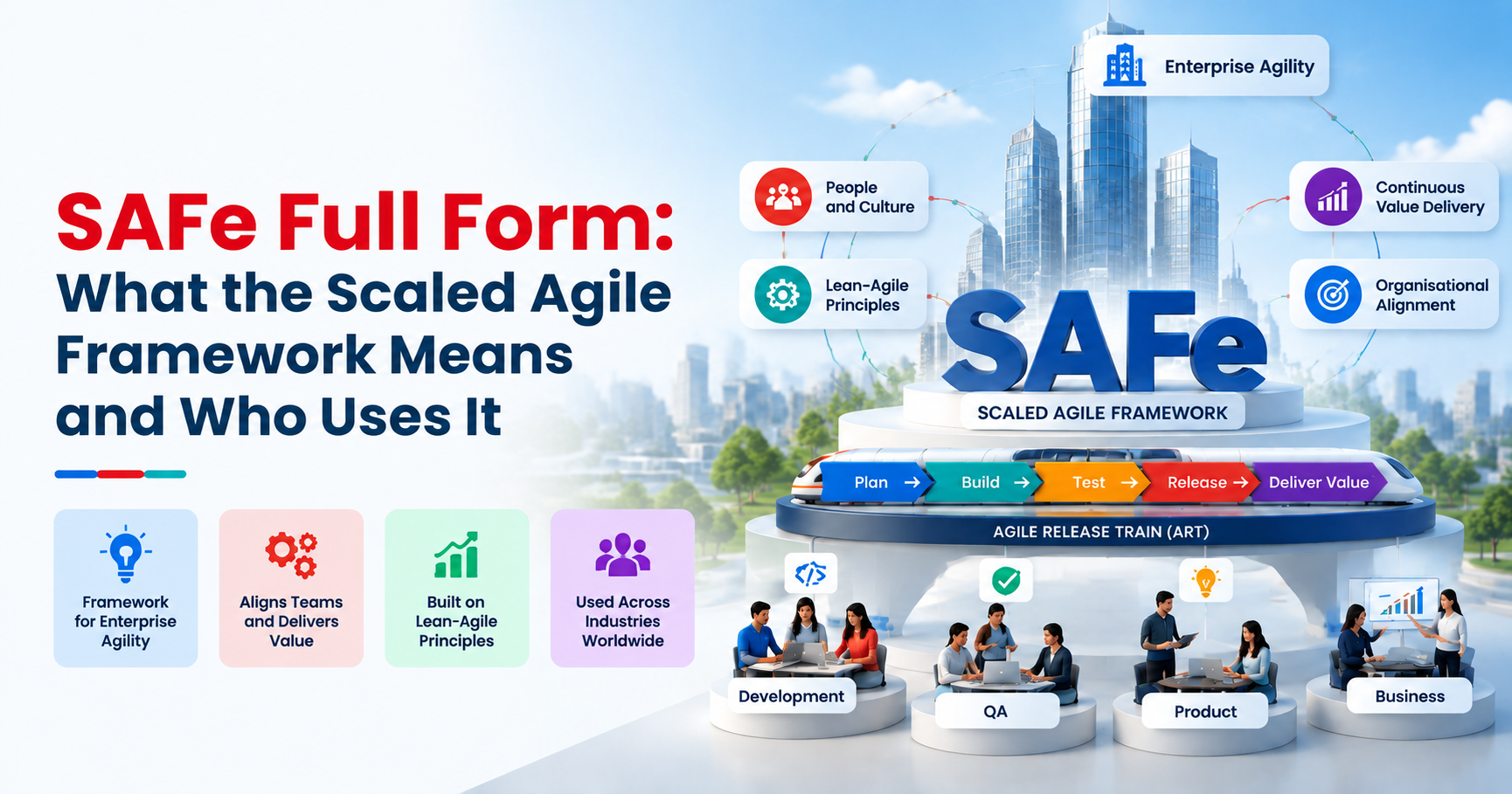
Bannner Image : Link: SAFe Full Form What the Scaled Agile Framework Means and Who Uses It.png
SAFe Full Form: What the Scaled Agile Framework Means and Who Uses It

Scaled Agile Framework (SAFe) helps organizations scale agile practices across multiple teams, align business and technology goals, manage dependencies and coordinate product delivery. Scrum is focused on team-level development, while SAFe is a more comprehensive framework for collaboration, planning and continuous improvement at an enterprise level.
In this blog, we will discuss SAFe, basics, Agile Release Trains, roles, industry applications, differences from Scrum, common misconceptions and certification options for newbies
Key Highlights of SAFe Full Form
- Main goal: Coordinate Agile development between teams and levels of the organization.
- Core foundation: Lean, Agile, systems thinking and continuous improvement.
- Delivery structure: The Agile Release Train (ART) – the Agile teams working together around a common mission.
- Typical customers: Large enterprises, technology companies, financial institutions, healthcare providers, manufacturers, government agencies.
- Relationship to Scrum: SAFe can include Scrum and other Agile practices as opposed to replacing them.
- Career relevance: SAFe certifications can help professionals understand enterprise-level Agile practices and prepare them for roles in Agile leadership, delivery coordination and product management.
Introduction
Think about a bank that builds a digital banking platform. It has a number of teams building mobile apps, payments, authentication, and fraud detection. Each team is Agile, but it can be difficult to manage dependencis and get everyone aligned for delivery.
And that’s where the Scaled Agile Framework (SAFe) comes in.SAFe stands for Scaled Agile Framework. For a deeper overview, see what is the Scaled Agile Framework. It enables organizations to synchronize multiple agile teams to provide value faster and bridge the gap between business goals and development efforts.
SAFe gives organizations a framework to manage dependencies, prioritize work and improve collaboration across multiple teams in a structured way on a digital transformation journey. This is particularly valid for large organizations developing complex products and services.
In this guide, we will learn the SAFe full form in Agile, its core components, principles, roles, industry applications, and differences from Scrum. We’ll also dispel common misconceptions and help beginners pick the right SAFe certification.
SAFe Full Form and Meaning
What’s SAFe? The Scaled Agile Framework (SAFe) is a framework for applying Lean and Agile principles at scale in large enterprises, particularly when many teams need to collaborate to develop and deliver complex products or solutions.
To get a handle on the SAFe meaning, it helps to break the term down into two parts:
Scaled: Extending Agile ways of working beyond a team so that multiple teams, departments and business functions can align their efforts.
Agile: Working in iterations, working with customers and stakeholders, ability to change direction, delivering value in small, manageable chunks.
These concepts describe a framework for helping organizations to retain the agility of Agile while addressing the coordination challenges of enterprise-scale development.
What Is SAFe in Agile?
When people ask “What is SAFe in Agile?”, they mean how an organization can implement Agile practices when a product needs to be contributed to by multiple teams.
Traditional Agile techniques such as Scrum are very good at helping individual teams plan, develop, review and improve their work. Big initiatives, however, bring additional challenges such as common tech dependencies, cross-team priorities, architectural decisions, regulatory requirements and business-level budgeting.
SAFe offers guidance for dealing with these issues through synchronized planning, clear roles, shared goals and continuous feedback.
For example, if an e-commerce company is creating a new shopping platform. Its teams may include:
- A customer experience team, managing the website and mobile app.
- A team building transaction and refund services for payments.
- A stock availability and inventory team.
- A logistics team combining shipping and delivery systems.
- A data team building analytics and personalization capabilities.
Each team can work independently on their features, but the customer only gets value when the pieces work together. SAFe helps the organization to align priorities, surface dependencies early and plan integrated delivery.
The framework does not dictate each technical decision, nor does it require every team to work in the same way. Instead, it provides a shared operating structure within which teams can use appropriate Agile practices.
What Does SAFe Mean for Organizations?
In reality, SAFe is more than coordinating software development. And that means linking teamwork to business strategy and to impact on the customer.
Typical reasons organizations implement SAFe are to improve:
- Alignment: Teams understand the business reason for the work.
- Transparency: Visibility into dependencies, risks, priorities and progress across teams.
- Predictability: Common planning and frequent integration help stakeholders to better predict delivery.
- Quality: Continuous integration testing and feedback make it less likely that you'll discover major problems late in the development cycle.
- Flexibility: The plans can be changed as customer needs, market conditions and technical requirements change.
- Collaboration: Common goals are met through collaboration between business, product, development, operations and other stakeholders.
These results are sensitive to implementation quality. Adopting SAFe is not a cure-all for reducing delays, increasing productivity or guaranteeing successful delivery. Organizations need to focus on leadership behavior, technical practices, team autonomy and organizational culture.
For a more detailed introduction, read what is SAFe.
Why Organizations Need a Scaling Framework
Part of the reason why Agile became popular was the contrast it provided to development approaches that relied heavily on extensive upfront planning and long delivery cycles. Agile teams can deliver smaller pieces and get feedback and make their work better instead of waiting for a whole project to be finished.
However, the challenges change when an organization moves from one Agile team to many.
A team of seven or eight people may be able to discuss priorities, dependencies and technical decisions directly. When 20, 50 or 100 teams contribute to a shared product, informal coordination becomes more difficult. The number of communication relationships can grow rapidly, and decisions made by one team may affect several others.
For example, a change to a shared customer database might affect mobile development, reporting, payment processing and compliance teams. If these teams are not coordinated, they could learn about the impact at different times and therefore may need to rework or delay releases.
Several common enterprise challenges contributed to the demand for scaling frameworks.
1. Lack of alignment between business and technology
Business leaders might be looking at keeping customers, growing revenue or getting products out faster. Development teams focus on getting done what’s in front of them. Teams can technically deliver sound features that don’t address the most important needs of the organization if the priorities are not clearly connected.
2. Cross-team dependencies
Large products often contain interconnected components. A delay in one service, platform or infrastructure change can affect several other teams. Coordinated planning makes these dependencies more visible and creates opportunities to resolve them earlier.
3. Inconsistent planning and delivery schedules
Different teams have different schedules and without a coordination mechanism, integration can be unpredictable. Having a regular planning cadence allows teams to align on goals, share constraints, and work towards aligned delivery milestones.
4. Limited visibility into progress
Senior stakeholders need to know that the investments are providing the intended results. Team-level reports alone may not provide sufficient detail on cross-team risks, delivery confidence, or to business objectives.
5. Difficulty balancing autonomy with governance
Large organizations often have to maintain security, regulatory compliance, architectural consistency and financial control. Agile teams need to have enough autonomy to make local decisions and respond to feedback at the same time. A scaling framework can help create common guardrails without centralizing every decision.
6. Delayed feedback and integration
If teams integrate work infrequently, problems can lurk until late in a release. SAFe promotes the practices of continuous integration, continuous feedback and synchronized delivery to help mitigate this risk.
One response to these challenges was SAFe. Dean Leffingwell and collaborators developed the framework to help organizations coordinate Lean-Agile product development at scale.
It is important to distinguish the problem from the solution: not every large organization needs SAFe. Some can coordinate effectively through a lightweight combination of Scrum, Kanban, product management and engineering practices. SAFe becomes worth considering when the complexity of cross-team coordination justifies its additional structures and ceremonies.
What SAFe Includes
SAFe is more than a collection of Agile meetings. It combines principles, organizational responsibilities, planning practices and delivery structures to help multiple teams operate as part of a coordinated system.
Its implementation can vary depending on the size of the organization, the complexity of its products and the number of teams involved. Nevertheless, several concepts form the foundation of the framework.
Core Competencies
SAFe organizes its approach around seven core competencies. Together, these competencies enable organizations to align business strategy with product development, technical execution and operational delivery.
1. Organizational Agility
Organizational Agility enables the business to react to changing market conditions, customer expectations and competitive pressures. It causes teams and business functions to alter their plans rather than sticking to fixed annual targets alone.
An online retailer could see an increase in demand for same-day delivery. An agile organization can re-prioritize, coordinate changes across inventory and logistics teams, and direct investment to capabilities that meet the new demand.
2. Continuous Learning Culture
A Continuous Learning Culture inspires staff, teams and leaders to improve through experimentation, feedback and knowledge sharing.
The organization doesn't use a failed experiment as a chance to point fingers, but instead looks at what actually happened and what lessons can be taken forward. Com
3. Lean-Agile Leadership
Lean-Agile Leadership is facilitating an environment where teams can deliver value effectively. Leaders model the behaviors they want to see, empower decision-making at the lowest level, remove organizational barriers, and pursue continuous improvement.
For example, instead of having to approve every little design decision, a leader could set out clear architectural principles and let teams make decisions within those parameters.
4. Lean Portfolio Management
Lean Portfolio Management is about aligning business strategy, investment decisions and execution. It helps organizations decide which projects are worthy of funding, how to distribute funds, and whether or not investments are still delivering value.
For example, a financial services company might be faced with the choice of improving its mobile-banking experience, upgrading legacy infrastructure, or creating new capabilities to prevent fraud. Lean Portfolio Management provides a way to assess those investments against strategic priorities, capacity and expected results.
5. Agile Product Delivery
Agile Product Delivery is about customer centricity, continuous delivery, product management and the ability to incrementally release valuable functionality.
Instead of taking months to build out a large set of features before getting feedback, a product team can launch a simple digital onboarding experience, monitor customer completion rate, and iterate based on real-world utilization.
6. Team and Technical Agility
Team and Technical Agility brings together effective Agile teams and sound engineering practices. It includes cross-functional collaboration, technical excellence, continuous integration, automated testing and the ability to maintain and improve software over time.
This competency matters because coordination alone cannot compensate for poor engineering. Teams must be able to build, test and integrate their work reliably.
7. Enterprise Solution Delivery
Enterprise Solution Delivery is the development and operation of large solutions that require multiple teams, systems or suppliers to work together. Such solutions may include software, hardware, infrastructure and special operational processes.
For example, in building a connected transportation system, software engineers, hardware specialists, infrastructure teams and regulatory specialists may collaborate.
The seven competencies provide a broader view of SAFe than simply looking at its planning meetings. They connect leadership, funding, product development, engineering and organizational learning into a common operating approach.
Lean-Agile Mindset and Principles
The Lean-Agile mindset is central to SAFe. It uses ideas from Lean thinking, Agile software development and systems thinking to aid organizations in delivering value and avoiding unnecessary delays and waste.
Lean aims to optimize the flow of value, to learn from results and to avoid activities that consume resources but don't yield meaningful benefits. Agile is all about collaboration, incremental delivery, customer input and adaptability.
Systems thinking encourages people to think about how the different parts of an organization affect each other.
SAFe is guided by ten principles. Each one is covered in our guide to SAFe principles.
1. Take an economic view
Decisions should take into account the overall economic impact of the work, including cost, time, risk and expected value. Teams need to be aware of the cost of delay to delivery and the cost of implementing a solution.
2. Apply systems thinking
A system of interconnected elements should be understood as a product or organization. If you optimize one team’s performance at the expense of the wider delivery process, you may create bottlenecks elsewhere.
3. Assume variability and preserve options
Uncertainty is normal in product development. It is prudent, when possible, to maintain multiple choices so that teams can learn before making an irreversible commitment.
4. Build incrementally with fast, integrated learning cycles
Smaller increments allow teams to validate assumptions, receive feedback and discover problems earlier. Integration and learning have to be continuous, not at the end.
5. Base milestones on objective evaluation of working systems
Progress must be measured against evidence (e.g. working functionality, integrated solutions and demonstrated outcomes) and not against documents or percentage complete estimates.
6. Make value flow without interruptions
Organizations should identify and reduce bottlenecks, excessive handoffs, queues and unnecessary work-in-progress. Improving the flow of value is often more useful than keeping every individual busy.
7. Apply cadence and synchronize with cross-domain planning
Regular planning and review cycles create a regular cadence. Synchronizing allows teams to see dependencies and make decisions in alignment across organizational boundaries.
8. Unlock the intrinsic motivation of knowledge workers
People do their best work when they have meaningful goals, the chance to make good choices and the opportunity to grow their skills. Leaders must create the conditions for ownership and collaborative work.
9. Decentralize decision-making
Generally, time-sensitive decisions should be made by the people closest to the work, and can be undone. Wider oversight may still be needed for strategic, high-impact or hard-to-reverse decisions.
10. Organize around value
Where practical, organizations should structure teams and responsibilities around the flow of customer value. That means less handoffs between departments and teams, which can take more ownership for outcomes.
The principles are designed to guide decision-making, not serve as a checklist. What matters is how consistently leaders and teams apply them to real-world delivery challenges.
For a deeper explanation, explore SAFe principles and SAFe core values.
Agile Release Trains
Teams of Agile teams work together inside an Agile Release Train (ART). It is a long-lived team of Agile teams that works towards a shared mission and delivers value in a coordinated way (Agile Release Train, SAFe Framework).
An ART commonly includes approximately 50–125 people, although the appropriate size depends on the work, organizational context and implementation. It is not simply a temporary project team assembled for a single release. It is designed to provide ongoing coordination around a product, solution or value stream.
Consider a telecommunications provider developing a new customer service platform. Its ART could include the teams responsible for the customer application, billing integration, identity management, network services and analytics.
Each team is responsible for its own work, but the teams coordinate around shared goals, dependencies and delivery dates.
A typical ART consists of these components:
- Every Planning Interval begins with PI Planning, where all teams align on objectives.
- Shared planning rhythm: Teams work in an agreed rhythm that makes coordination and integration more predictable.
- Shared mission: Teams understand the customer or business outcome they are collectively accountable for delivering.
- Continuous integration: Teams integrate and test their work frequently to find integration problems early.
- System demonstrations: Stakeholders may see integrated functionality and give feedback.
- Inspect and Adapt: Teams and stakeholders review outcomes and find problems and improvement actions.
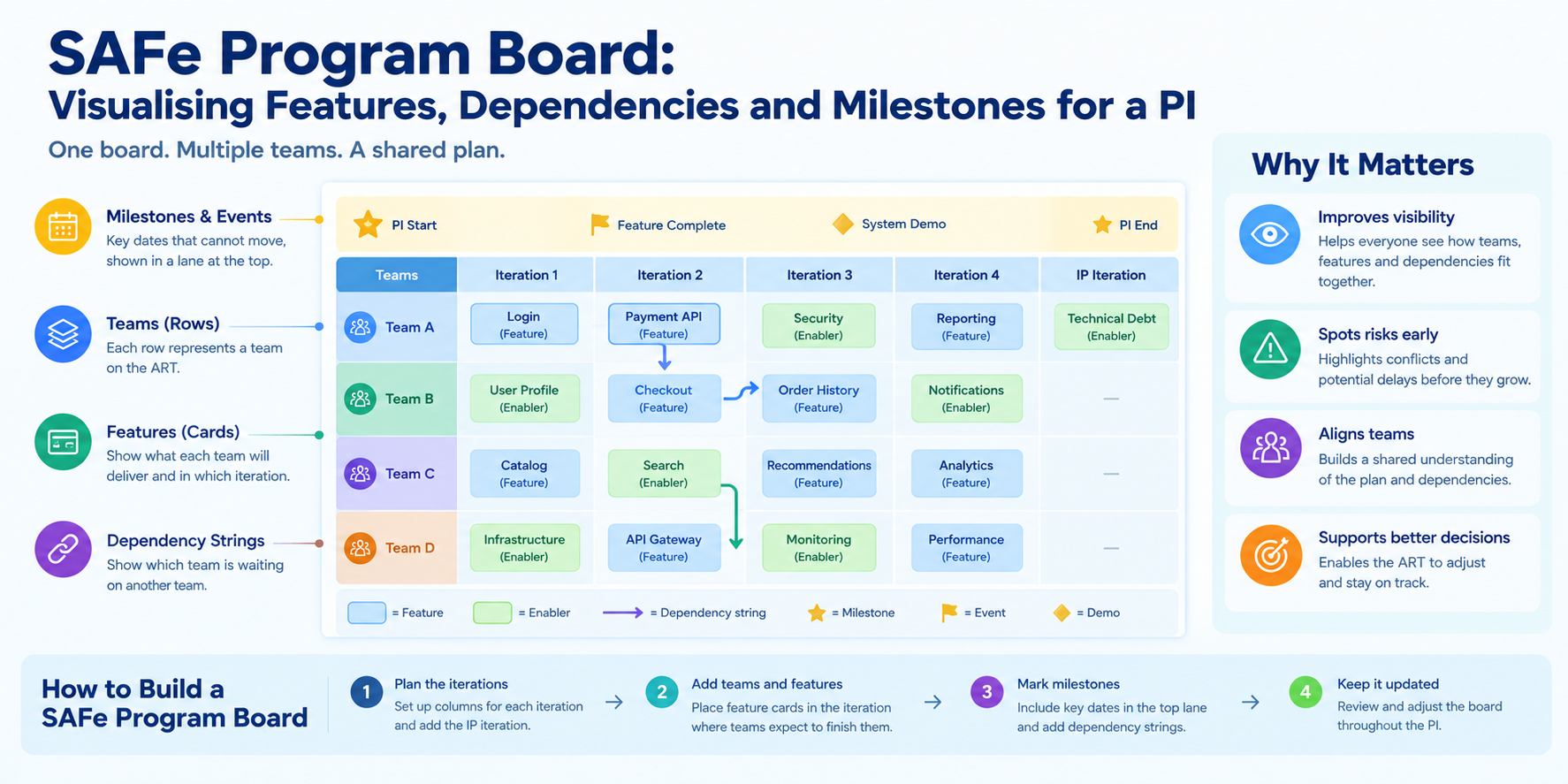
A Program Increment is generally eight to twelve weeks in length, though sometimes it can be longer or shorter (Planning Interval, SAFe Framework). Many organizations run PI Planning for a period of two days where teams discuss business context, identify risks, set objectives and align their plans.
Suppose an ART has six teams developing a new insurance claims platform. The claims submission team may depend on document processing, identity verification and payment services. During PI Planning, these dependencies are visible and teams can agree on sequence, responsibilities and realistic objectives.
The goal is not to ensure that every feature that we want will be shipped as planned. It is to improve shared understanding, to expose risks early and to make it easier to adjust when circumstances change.
SAFe vs Scrum in One View
It’s SAFe and Scrum are closely related but they have different coordination problems to solve.
Scrum, as defined in The Scrum Guide, is an Agile framework for developing and supporting complex products, using iterative work. SAFe gives you a larger framework to coordinate multiple teams and align their work with enterprise-level goals.
SAFe can use Scrum as one of its team-level delivery methods. It can also incorporate Kanban and other practices depending on the work being performed.See how they fit together in Scrum in SAFe vs Scrum.
The following table summarises the key differences.
| Aspect | Scrum | SAFe |
| Scale | Primarily designed for individual Scrum teams, although multiple teams can collaborate using Scrum principles | Designed to coordinate multiple Agile teams and broader organizational structures |
| Planning cadence | Sprint Planning takes place at the beginning of each Sprint; Sprints are one month or shorter | Includes team-level iterations and broader coordination through PI Planning, commonly every 8–12 weeks |
| Roles | Defines Product Owner, Scrum Master and Developers | Includes roles such as Product Manager, Release Train Engineer, System Architect and Business Owners, alongside team-level roles |
| Typical adopter | Individual product teams, startups and organizations seeking a lightweight Agile approach | Enterprises with multiple teams, shared dependencies and complex product or solution delivery needs |
Understanding the Difference in Practice
Imagine a company with one team developing an internal expense management application. The team has a Product Owner who prioritizes requirements, a Scrum Master who supports the team's effectiveness and Developers who build and test the product.
Scrum could provide the team with everything they need to plan Sprints, review progress and incorporate feedback.
Now imagine the same company rolls out the initiative to 15 teams responsible for expense management, accounting integrations, employee identity, compliance, analytics and mobile access.
Today the organization needs to coordinate dependencies between teams, manage shared architecture, align investment priorities and plan for integrated delivery. Scrum can still be used by individual teams, and SAFe can add structures for coordination across the enterprise.
The distinction is therefore not that one framework is inherently better than the other. It is that Scrum focuses primarily on team-level product development, whereas SAFe addresses the additional coordination needed when Agile work spans multiple teams and organizational levels.
SAFe also introduces more roles, events and governance structures. These can be helpful for complex environments but may create unnecessary overhead in an organization that has few teams and simple dependencies.
A sensible implementation starts from the problem to solve, and not from the assumption that every organization needs a large-scale framework.
Who Uses SAFe and in Which Industries
SAFe is used by organizations that need to coordinate product development and delivery across multiple teams, especially when technology, business operations, compliance and customer-facing services are tightly coupled.
It’s not just important for software companies. Enterprise Agile practices are valuable in a broad range of contexts because many traditional industries rely on software-intensive products, digital platforms and interconnected operational systems.
Examples of industries in which SAFe may be applied include:
1. Banking and financial services
Banks and other financial institutions run sophisticated systems for digital banking, payments, fraud prevention, customer identity, risk management and regulatory compliance.
To provide customers with a single digital experience, a bank will likely need several teams to coordinate changes to mobile apps, transaction services, authentication and data platforms. SAFe can help you align on delivery objectives, identify dependencies, and maintain appropriate governance.
A bank rolling out digital account opening could bring together customer experience, identity verification, compliance, document processing and core banking teams around a common delivery plan.
2. Healthcare and life sciences
Healthcare organizations use digital health platforms, electronic medical records, patient portals, clinical systems and connected medical technologies. Changes must often be coordinated across software, infrastructure, security and clinical workflows.
SAFe may help teams coordinate the development of these interconnected capabilities. However, it does not replace medical-device quality systems, privacy obligations or applicable regulatory requirements.
Example: For example, a healthcare technology provider building a patient portal might get the teams that handle appointment scheduling, medical records access, billing, identity management and notifications to work together.
3. Information technology and software development
Technology companies are natural candidates for scaled Agile practices since their products often encompass numerous applications, services, platforms, and engineering teams.
SAFe helps to align product management, software development, architecture, testing, security and operations to common business objectives.
Example: A software company building an enterprise resource planning platform could use coordinated planning to bring together teams working on finance, procurement, inventory, reporting and integration capabilities.
4. Telecommunications
Telecom providers run large technical ecosystems including network infrastructure, customer applications, billing platforms, service provisioning and customer support.
SAFe can help coordinate between software and infrastructure teams when changes need to be integrated into a larger service.
Example: A telecom operator rolling out a new customer self-service application might coordinate mobile app, billing, identity, network provisioning, and customer data teams.
5. Automotive and manufacturing
Modern vehicles and industrial products combine physical components, embedded software, cloud connectivity, data systems and manufacturing processes.
Coordinating these elements requires collaboration across disciplines and suppliers. This work might be supported by SAFe, especially if there is a need for the software and hardware development to align on common milestones.
Example: An automotive company developing connected vehicle features may orchestrate embedded software, mobile application, cloud platform, cybersecurity and testing teams.
6. Retail and e-commerce
Retailers need to keep investing in digital shopping experiences, payment services, inventory visibility, personalization and fulfillment systems.
SAFe can help coordinate changes across customer-facing applications and back-end services, especially in large platform modernization efforts.
Example: An e-commerce retailer launching a new checkout experience might coordinate product discovery, payment processing, fraud prevention, inventory and delivery estimates teams.
7. Government and public services
Government organizations often operate large digital services that span multiple departments, legacy systems, security requirements and formal accountability processes.
SAFe can offer a common way to coordinate delivery across teams while helping organizations stay on top of priorities and dependencies. Its structures have to be adapted to public sector procurement and governance requirements.
Example: A government department could use the online benefits application to orchestrate identity verification, eligibility rules, document processing, payments and citizen notifications.
Does Every Large Organization Need SAFe?
Not always, the size of an organization alone does not determine whether or not SAFe is appropriate.
A large company with several independent products and few cross-team dependencies may run successfully using Scrum, Kanban or a combination of lightweight approaches. Conversely, a smaller organization developing a highly interconnected product may benefit from selected SAFe practices.
SAFe is most useful when the complexity of coordination, shared delivery commitments and enterprise-level planning creates a genuine need for a common structure.
Organizations should assess their existing challenges, introduce only the structures that solve those challenges and evaluate whether the resulting benefits justify the additional effort.
SAFe Roles at a Glance
SAFe defines a set of responsibilities at various levels to enable organizations to link strategy, product development and delivery. The exact roles required depend on the specific SAFe configuration and the complexity of the work.
Knowing these duties gives an understanding of the decision-making process, how teams work together and who is responsible for different results.Learn who does what in our breakdown of roles in SAFe.
| Role | Primary Responsibility |
| Business Owners | Provide business context, validate outcomes, and help ensure the ART delivers value. |
| Release Train Engineer (RTE) | Facilitates ART events, manages impediments and supports coordination across teams |
| Product Management | Defines and prioritizes features based on customer needs and business objectives |
| System Architect | Guides architectural decisions and helps maintain technical alignment |
| Product Owner | Manages team-level priorities and maintains the Team Backlog |
| Scrum Master/Team Coach | Supports team effectiveness, facilitates improvement and helps remove impediments |
| Developers | Build, test, integrate and deliver working product increments |
| Lean Portfolio Management | Aligns portfolio strategy, investment funding and execution |
| System Team | Supports integration, testing and delivery activities where needed |
How These Roles Work Together
“Consider a company that’s developing a new digital insurance platform.
Business owners state business goals such as reducing claim processing time and improving customer satisfaction. Product Management translates those goals into product features and priorities. The System Architect is the technical lead and the RTE is responsible for planning and execution in the ART.
At the team level, Product Owners are responsible for prioritizing backlogs, Scrum Masters or Team Coaches support team effectiveness and Developers build and test the solution.
Lean Portfolio Management helps align the initiative with the larger investment priorities and strategic goals.
These responsibilities complement and are not interchangeable. For example, a Product Owner is primarily concerned with the needs and priorities of an Agile team, while Product Management is concerned with priorities across the broader product or ART context.
An RTE is not a project manager with a different name, either. The role is about letting the ART run well, enabling collaboration and supporting continuous improvement.
The SAFe framework means not every role needs to be implemented in every organization at the same time. What you want is clear responsibilities without creating additional layers of management.
Common Misunderstandings About SAFe
Although SAFe is widely discussed in enterprise Agile environments, several misconceptions can make it difficult to understand its purpose and limitations.
Misunderstanding 1: SAFe and Agile are the same thing
SAFe is not Agile. Agile is a set of values and principles that promote iterative development, customer collaboration and responsiveness to change. SAFe is one way to apply Lean-Agile practices across many teams and levels of an organization.
Organizations can adopt Agile practices without implementing SAFe.
Misunderstanding 2: SAFe replaces Scrum
SAFe doesn’t replace Scrum automatically. Scrum can stay the team-level framework in a SAFe implementation.
Teams can still work with Sprints, Product Backlogs, Sprint Reviews and Retrospectives, but they do so within the framework of broader planning and coordination activities.
Misunderstanding 3: SAFe is only about meetings and processes
System demos, PI Planning and other events are the visible parts of SAFe, but the framework also addresses leadership, technical excellence, investment decisions, organizational learning and flow of value.
If an organization adds more meetings, but doesn’t improve alignment, delivery, or decision-making, it may be adopting the mechanics without realizing the intended benefits.
Misunderstanding 4: SAFe guarantees faster delivery
No framework guarantees faster delivery. SAFe can help organizations identify dependencies, improve visibility and coordinate work more effectively but results depend on the quality of implementation.
Even teams that operate within a formal framework can be held back by poor engineering practices, too many sign-offs, unrealistic commitments and muddled priorities.
Myth 5: SAFe removes team autonomy
SAFe provides common goals and coordination processes, but teams need to maintain the autonomy to make the right decisions about how they execute their work.
The framework promotes decentralized decision-making as much as possible, especially for reversible decisions and those close to the work.
Misunderstanding 6: SAFe is only for software companies
SAFe is used by organizations building complex digital services, connected products and integrated solutions across industries. Possible applications include banking, healthcare, manufacturing, telecommunications and government services.
The question of importance is whether there are coordination problems in the organization that the framework can help to solve.
Misconception 7: SAFe certification means you are an Agilist
Certification gives you a roadmap of the learning and a way to demonstrate your knowledge of a framework, but experience is the best teacher.
They may improve their professional skills by planning sessions, resolving dependencies, coaching teams, improving delivery practices, and learning from real organizational problems.
The best way is to pair formal learning with hands-on practice and continuous improvement.
Which SAFe Certification to Start With
The right SAFe certification depends on your role, experience and career goals. A person seeking to understand enterprise Agile concepts may benefit from a different learning path than a Scrum Master, Product Owner or experienced Agile leader.
Before you choose a certification, consider whether you want a broad overview of SAFe, knowledge at the team level or specialized skills in product management, delivery leadership or portfolio management.
1. Leading SAFe / SAFe Agilist
The Leading SAFe course is commonly linked to the SAFe Agilist learning path. It explains the foundation, values, principles, roles and approach to alignment at the enterprise level of the framework.
It is a useful starting point for professionals who want to understand how Lean-Agile practices connect strategy, product development and delivery across an organization.
Suitable audiences may include:
- Project and program managers.
- Business analysts.
- Product managers.
- Agile practitioners moving into leadership roles.
- Managers and executives involved in organizational transformation.
- Professionals who want a broad understanding of SAFe before specializing.
For example, a project manager who oversees multiple technology teams may use this learning path to learn about PI Planning, Agile Release Trains and the responsibilities involved in coordinating enterprise delivery.
Find out more about the course and who it is for with Leading SAFe training.
2. SAFe Scrum Master
For those who coach Agile teams in a SAFe environment, a SAFe Scrum Master learning path is helpful.
It is focused on enabling team effectiveness, facilitating relevant events, identifying impediments, and helping teams collaborate in the larger ART.
It may be appropriate for Scrum Masters, team facilitators and those professionals moving into team-coaching roles.
3. SAFe Product Owner/Product Manager
This learning path is aimed at professionals who are responsible for product direction, prioritization and value delivery.
Product Owner is usually more focused on backlog priorities at the team level, whereas Product Management is more about product and feature priorities. Getting a handle on how these responsibilities fit together will lead teams to make better choices about what to build next.
This option may be useful for Product Owners, product managers, business analysts and professionals involved in requirements prioritization.
4. Advanced or Specialized SAFe Certifications
Professionals with relevant experience may consider specialized learning paths covering areas such as Release Train Engineering, Agile product management, Lean Portfolio Management, architecture or advanced Agile coaching.
These options are generally more useful once a professional understands the fundamentals and can identify the specific responsibilities they want to develop.
Certification names, eligibility requirements, course formats and examination policies can change. Always confirm the current details with the official certification provider before enrolling.
How to Choose the Right Starting Point
Use your current responsibilities as the starting point rather than choosing a certification solely because it is popular.
New to SAFe: Begin with foundational learning to understand the framework, its principles and its organizational structure.
Working as a Scrum Master or team facilitator: Explore the SAFe Scrum Master pathway.
Working in product management or requirements prioritization: Consider the SAFe Product Owner/Product Manager pathway.
Coordinating multiple teams or delivery trains: Investigate Release Train Engineer-focused learning.
Managing business strategy and investment decisions: Explore Lean Portfolio Management.
If you are new to the framework, the SAFe Agilist guide can help you understand the certification pathway and what to expect.
You can also review the reasons to get SAFe certified to assess whether certification aligns with your professional goals.
Remember that certification is a learning milestone, not a substitute for experience. The greatest value comes from applying the concepts to real delivery challenges and continuing to improve how teams work together.
Conclusion
The SAFe full form is Scaled Agile Framework. Align business goals and coordinates complex product delivery through practices such as Agile Release Trains and PI Planning and lean-agile practices across multiple teams.
SAFe, however, facilitates collaboration across teams and organizational levels, , whereas Scrum is mostly concerned with team-level development. But it is contingent upon the needs of the organization and its implementation.
Knowing the principles, roles and how SAFe differs from Scrum can assist beginners in choosing the right certification path. SAFe isn’t about adding more processes; it’s about improving coordination, adaptability and delivery of value.






 Lowest-Price Challenge












 Personalized Path



.webp)


 USA
 Canada
 India
 UK
 Australia
 Singapore


