


 Call Us



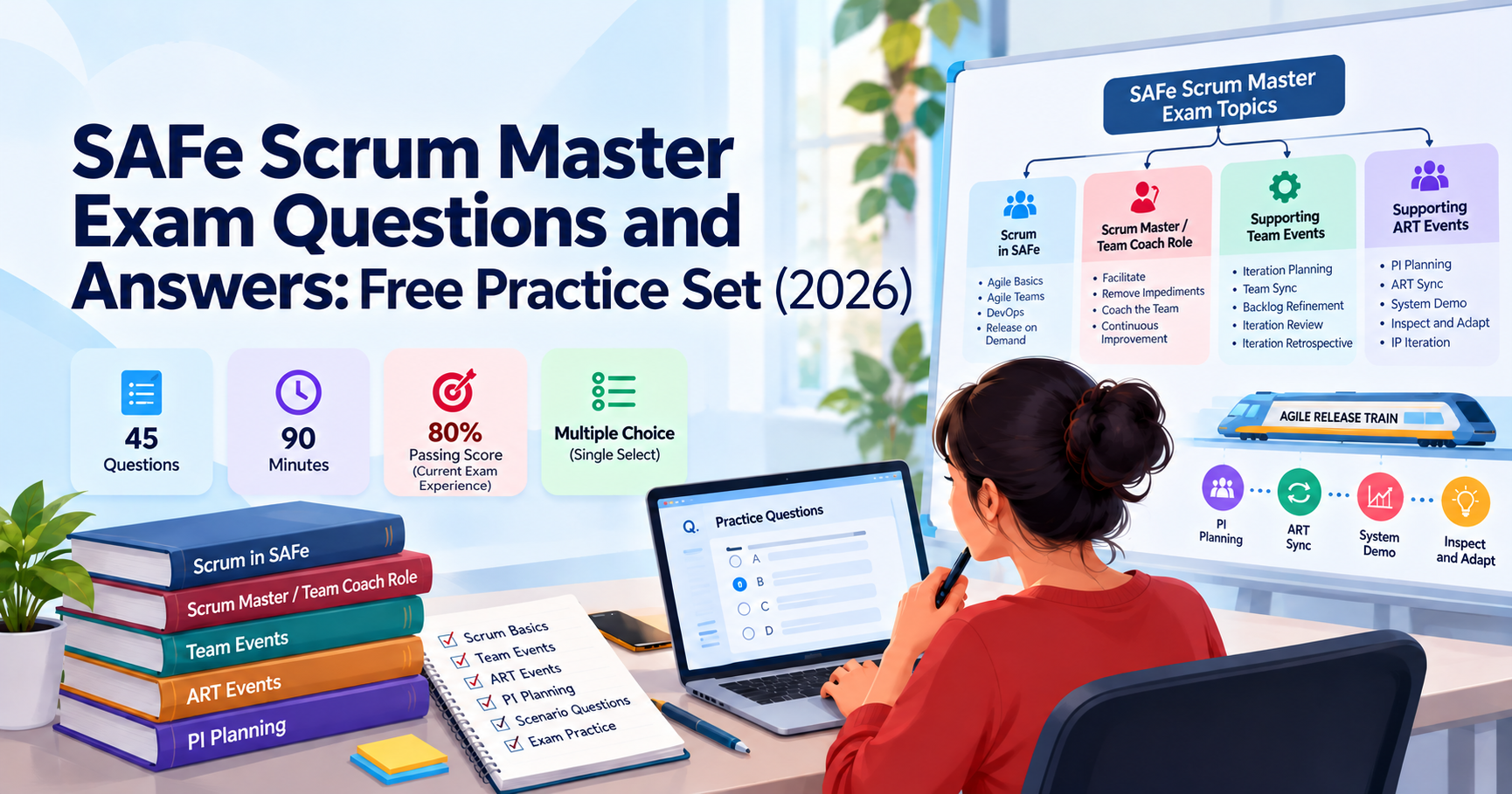
The SAFe Scrum Master exam checks how well you understand Scrum, the Scrum Master/Team Coach role, Agile Team events, and events that happen across the Agile Release Train.
For the SAFe Scrum Master 6.0 exam, the official study guide lists 45 questions and 90 minutes. The current certification page from Scaled Agile lists an 80% passing score for its current SSM exam experience.
The questions are not only about definitions. You may be given a situation involving a blocked team, a dependency during PI planning, a low confidence vote, or work that keeps moving from one iteration to the next. In such cases, you need to understand the Scrum Master role and choose the action that makes sense.
That is why practicing safe scrum master exam questions and answers can be useful when it is combined with proper study.
Key Highlights of safe scrum master exam questions and answers
- The SAFe Scrum Master 6.0 study guide lists 45 exam questions.
- The listed exam duration is 90 minutes.
- The current SSM certification page lists an 80% passing score for the current exam experience.
- The exam covers Scrum, the Scrum Master/Team Coach role, team events, and ART events.
- PI planning is an important area for preparation.
- ART Sync brings together Coach Sync and Product Owner Sync.
- A system demo looks at the integrated solution rather than one team's work alone.
- Inspect and Adapt takes place at the end of a Program Increment.
- Flow, WIP, built-in quality, and continuous improvement are useful areas to revise.
- Scenario questions are easier when you understand what each SAFe role is expected to do.
Introduction
The Scrum Master role looks familiar if you already know Scrum. If you are coming from Certified ScrumMaster (CSM) training, much of the team-level material will feel familiar. But working as a Scrum Master in an SAFe environment adds another layer.
You are still helping the team work well. You still facilitate team events and help deal with impediments. You still support the team in improving the way it works.
At the same time, the team is part of a larger Agile Release Train. Its work may depend on other teams. The team may also need to take part in PI Planning, ART Sync, System Demos, and Inspect and Adapt.
This is one reason people sometimes find the safe scrum master exam harder than expected. They know Scrum, but they are not sure how Scrum fits into a larger SAFe setup.
SAFe 6.0 also uses the term Scrum Master/Team Coach. The change reflects the broader coaching responsibilities connected with the role.
So, while preparing, do not study the Scrum Master as someone who simply runs meetings.
Think about what the person is trying to help the team achieve:
- Is the team blocked?
- Is work piling up?
- Are dependencies causing delays?
- Does the team need help during PI planning?
- Is there a problem that keeps coming back?
These situations are closer to the type of thinking you need for the certification.
If you are looking for a structured way to prepare, theSAFe Scrum Master Certification Training can be used along with your own revision.
SAFe Scrum Master Exam Format You Are Practicing For
Number of Questions, Duration, and Passing Score
The exact exam details depend on the version and certification exam you are taking.
For the SAFe Scrum Master 6.0 exam, the official study guide gives the following details:
- Questions: 45
- Time: 90 minutes
- Question format: Multiple choice, single select
- Passing score: 80%
- Exam delivery: Web-based
- Book access: Closed book
- Outside help: Not permitted
The study guide also states that unanswered questions are counted as incorrect and the exam is submitted automatically when the time ends.
There is an important point here for anyone preparing in 2026. Scaled Agile's current SSM certification page lists 80% as the passing score for its current certification experience.
This is also why using an old safe scrum master exam questions and answers PDF without checking its date can cause problems.
What the Exam Actually Tests
The SAFe 6.0 SSM study guide divides the exam into four broad areas:
- The first is introducing Scrum in SAFe. This covers Agile and Scrum basics, Agile Teams, high-performing teams, team events, DevOps, and Release on Demand.
- The second is the Scrum Master/Team Coach role. Here, you need to understand what the role involves and how a Scrum Master helps a team improve.
- The third area is Supporting Team Events. This includes iteration planning, Team Sync, backlog refinement, iteration review, and iteration retrospective.
- The fourth area is Supporting ART Events. This includes PI Planning, the IP Iteration, and Inspect and Adapt. TheSAFe Scrum Master course curriculummaps these areas module by module.
This gives you a useful idea of where to spend your study time.
Do not spend all your time memorizing terms while giving very little attention to the Scrum Master role. You should be comfortable with both.
How to Use These Practice Questions?
Practice by Topic First, Then Full-Length
If you have just started studying, taking a full safe scrum master mock test may not tell you much.
You will probably get several questions wrong simply because you have not covered the topics yet.
Start smaller.
Take five questions about Scrum and the Lean-Agile mindset. Check your answers. Then move on to the Scrum Master role.
After that, try questions about PI planning and ART events.
Once you have covered the main areas, take a full safe scrum master practice test without looking at your notes.
This gives you two different types of practice.
The first helps you learn.
The second tells you how much you actually remember.
You can also try theFree SAFe Scrum Master practice test as part of your revision.
Read the Explanation, Not Just the Answer
There is a simple mistake people make with practice questions.
They choose an answer, check whether it is right, and immediately move to the next question.
That is not enough.
Suppose you get a question about a Product Owner and a Scrum Master right. Ask yourself why.
What is the Product Owner responsible for?
What is the Scrum Master's role?
Would the answer change if the question was about the entire ART instead of one team?
These small questions help you understand the difference between roles.
The same applies to events.
If you know that Inspect and Adapt happens at the end of a PI, also understand why it exists. If you know what a system demo is, understand why the integrated solution matters.
When you practice safe scrum master exam questions and answers, spend more time on the questions you got wrong than the ones you got right.
That is where most of the learning happens.
Why Brain Dumps Fail You
You may find websites offering safe scrum master certification dumps. Some may claim that their questions are taken directly from the exam.
Relying on these is risky.
The questions may be old. The answers may be wrong. The material may relate to another version of SAFe. You also have no real way of knowing whether the questions are genuine.
There is another problem.
Suppose you memorize the answer to a question about PI Planning. If the exam gives you the same concept in a different situation, memorization will not help much.
Understanding will.
The official SAFe practice test is intended to help candidates become familiar with the question format and exam experience. Scaled Agile also points out that passing a practice test does not guarantee that you will pass the certification exam.
Use practice questions as a way to test yourself. Do not treat them as a shortcut around studying.
SAFe Scrum Master Exam Questions and Answers by Topic
The following questions are original practice questions based on important SAFe 6.0 concepts.
They are meant for study purposes. They are not actual questions from the certification exam.
SAFe Foundations and the Lean-Agile Mindset
Question 1. What forms the foundation of the SAFe House of Lean?
A) Value
B) Flow
C) Leadership
D) Innovation
Answer: C) Leadership
Lean-Agile leadership provides the foundation for applying Lean and Agile ideas across an organization. A Scrum Master also helps teams understand and apply Lean-Agile thinking in their daily work.
Question 2. The Lean-Agile Mindset is built on which two bodies of thinking?
A) Scrum and Kanban
B) The Agile Manifesto and Lean thinking
C) DevOps and ITIL
D) Waterfall and Agile
Answer: B) The Agile Manifesto and Lean thinking
The Lean-Agile Mindset is a mixture of ideas from Lean thinking and the Agile Manifesto. It is not just another name for Scrum.
Question 3. How many SAFe Core Values are there in SAFe 6.0?
A) 3
B) 4
C) 5
D) 10
Answer: B) 4
Alignment, Transparency, Respect for People, and Relentless Improvement are the four SAFe 6.0 Core Values.
It’s good to keep this in mind, since older SAFe study material might have different Core Values. If your study materials are not updated for SAFe 6.0, then make sure to verify the information before you memorize it.
Question 4. How many SAFe Lean-Agile Principles are there?
A) 4
B) 7
C) 9
D) 10
Answer: D) 10
SAFe adopts 10 Lean-Agile Principles. They help explain how to apply Lean and Agile ideas when you are working at scale.
Question 5. "Assume variability, preserve options" is an example of a:
A) SAFe Core Value
B) SAFe Lean-Agile Principle
C) Scrum event
D) DevOps practice
Answer: B) SAFe Lean-Agile Principle
It is Principle 3. The basic idea is simple. When there is uncertainty, do not make an important decision too early if keeping your options open can give you better information later.
The Scrum Master Role on an Agile Release Train
Question 6. In SAFe 6.0, the Scrum Master role is now titled:
A) Agile Coach
B) Scrum Master/Team Coach
C) Release Train Engineer
D) Team Lead
Answer: B) Scrum Master/Team Coach
SAFe 6.0 uses the title Scrum Master/Team Coach to show the broader coaching aspect of the role. Scaled Agile notes that organizations can use Scrum Master or Team Coach depending on their context.
Question 7. The SAFe Scrum Master is best described as a:
A) Project manager who assigns tasks
B) Servant leader and coach for the team
C) Line manager
D) Product Owner proxy
Answer: B) Servant leader and coach for the team
The Scrum Master helps the team rather than managing people. They enable, coach, remove barriers, and support improvement.
If the Scrum Master starts assigning every task to every person, the role is moving away from servant leadership.
Question 8. Which of these is NOT a Scrum Master responsibility in SAFe?
A) Facilitating team events
B) Helping remove impediments
C) Prioritising the team backlog
D) Coaching the Lean-Agile mindset
Answer: C) Prioritising the team backlog
The Product Owner is responsible for managing and prioritising the team's backlog.
The Scrum Master can help the Product Owner and team to do it effectively, but it should not take on the responsibility. SAFe POPM Certification Training covers the Product Owner side of this split.
Question 9. How does the Scrum Master coordinate with other teams on the ART?
A) Through the daily stand-up only
B) Through the Scrum of Scrums, part of ART Sync
C) Only at the System Demo
D) Through the retrospective
Answer: B) Through the Scrum of Scrums, part of ART Sync
The Coach Sync provides a place for coordination between teams and helps bring dependencies and impediments into view.
It is not simply an extended version of the team's daily meeting.
Question 10. Who is the servant leader for the entire Agile Release Train?
A) The Scrum Master
B) The Release Train Engineer
C) The Product Manager
D) The System Architect
Answer: B) The Release Train Engineer
The Scrum Master collaborates primarily with an Agile Team. The Release Train Engineer is at the ART level and facilitates coordination of the teams and ART events.
When answering the safe scrum master exam questions, it is important to distinguish between these two roles.
PI Planning and Program Increment Execution
Question 11. During PI Planning, the Scrum Master helps the team by:
A) Assigning stories to individuals
B) Facilitating estimation, capacity, dependencies, and draft objectives
C) Approving business value
D) Writing features
Answer: B) Facilitating estimation, capacity, dependencies, and draft objectives
The Scrum Master facilitates the team’s involvement in the planning process. This can include helping the team have discussions about their capacity, dependencies, and what work the team believes it can do.
The Scrum Master does not assign work to the individual developers.
Question 12. Where are cross-team dependencies captured during PI Planning?
A) The team board
B) The ART planning board
C) The Definition of Done
D) The retrospective
Answer: B) The ART planning board
The ART planning board displays important information across teams. This means you can discuss dependencies much earlier in development instead of finding out about them much later.
Question 13. Who assigns business value to the team's PI Objectives?
A) The Scrum Master
B) Business Owners
C) The developers
D) The RTE
Answer: B) Business Owners
Business Owners participate in PI Planning with the teams and assign business value to PI Objectives.
The Scrum Master can help the team through the process but does not decide the business value.
Question 14. When is the confidence vote taken?
A) Every day
B) At the end of PI Planning, on the committed objectives
C) At the System Demo
D) During the retrospective
Answer: B) At the close of PI Planning
The confidence vote gives everyone a chance to say whether they believe the plan is realistic.
It is not meant to be a formality. A low vote is a signal that something needs to be discussed.
Question 15. If the confidence vote is low, for example two fingers, the ART should:
A) Proceed anyway
B) Rework the plan until confidence is acceptable
C) Cancel the PI
D) Escalate to HR
Answer: B) Rework the plan until confidence is acceptable
A low vote should lead to discussion.
The team may need to make another change to the plan, change scope, look at dependencies, or adjust capacity. The point is to answer the concern, not ignore it.
Facilitating Iterations and ART Events
Question 16. The System Demo shows:
A) One team's work in isolation
B) The integrated work of all teams, ideally every iteration
C) Only the final PI
D) A status report
Answer: B) The integrated work of all teams
The System Demo provides a view of the solution developed by the Agile Release Train (ART) as a whole.
This is crucial because a team’s work may seem complete, but the end solution is still broken.
Question 17. ART Sync combines which two events?
A) Daily stand-up and retrospective
B) Coach Sync and Product Owner Sync
C) System Demo and Inspect and Adapt
D) PI Planning and I&A
Answer: B) Coach Sync and Product Owner Sync
ART Sync combines these two coordination activities.
Coach Sync is about team-level coordination, dependencies, and impediments. The Product Owner Sync gives a product-focused view of progress and upcoming work.
Question 18. Inspect and Adapt is held:
A) Every day
B) At the end of every PI
C) Every iteration only
D) Once a year
Answer: B) At the end of every PI
Inspect and Adapt is at the end of a Program Increment.
It allows the ART to take a step back and look at what happened and not go right on to the next PI.
Question 19. The three parts of Inspect and Adapt are:
A) Plan, do, check
B) The PI System Demo, quantitative and qualitative measurement, and the problem-solving workshop
C) Demo, retro, planning
D) Vision, roadmap, backlog
Answer: B) The PI System Demo, quantitative and qualitative measurement, and the problem-solving workshop
These are used by the ART to review their performance and identify issues to be addressed.
Question 20. The problem-solving workshop finds root causes using:
A) WSJF
B) Root cause analysis such as fishbone and the 5 Whys
C) Story mapping
D) Planning poker
Answer: B) Root cause analysis such as fishbone and the 5 Whys
The idea is to look beyond the immediate symptom.
For example, if stories are constantly rolling over, telling the team to go faster is not solving the real problem. The team needs to know why the work isn’t being done.
Improving Flow, Built-in Quality, and Metrics
Question 21. To improve flow, the team should:
A) Increase work in process
B) Limit work in process and reduce batch size
C) Add more meetings
D) Lengthen the iteration
Answer: B) Limit work in process and reduce batch size
Work is waiting on people, information, testing, or another team. Work is sitting waiting because of overloading.
Limiting WIP makes it more likely the team will finish work before starting new work.
Question 22. Built-in Quality means:
A) Testing only at the end
B) Building quality into every increment rather than inspecting it later
C) A separate QA phase
D) Quality owned only by managers
Answer: B) Building quality into every increment
Quality should not be treated as a final checkpoint.
The team should consider quality throughout development. Finding a problem earlier is usually easier than finding it after a large amount of work has already been completed.
Question 23. Which metric shows how work moves through the system over time?
A) Velocity only
B) The cumulative flow diagram
C) Business value
D) The confidence vote
Answer: B) The cumulative flow diagram
A cumulative flow diagram shows work across different stages over time.
It can help a team spot areas where work is building up. That makes it useful when talking about flow and bottlenecks.
Question 24. The iteration burndown mainly helps the team:
A) Assign business value
B) Track remaining work within the iteration
C) Plan the PI
D) Rank features
Answer: B) Track remaining work within the iteration
The burndown provides a simple picture of how much work remains.
It does not tell the team what its business priorities should be. It is mainly a view of progress against the work planned for the iteration.
Question 25. For the Scrum Master, the goal of relentless improvement is to:
A) Hit a fixed velocity
B) Continuously inspect and adapt to improve outcomes and flow
C) Reduce headcount
D) Add meetings
Answer: B) Continuously inspect and adapt to improve outcomes and flow
A Scrum Master should not push the team to chase a particular velocity number.
The bigger question is whether the team is getting better at delivering useful, quality work. Retrospectives, metrics, feedback, and regular problem solving can all help with that.
Sample Scenario Questions With Worked Explanations
The actual safe scrum master exam questions and answers you practice should not all be definition-based.
Scenario questions are worth spending time on because they make you think about what the Scrum Master should actually do.
Scenario 1
Two teams find a dependency during PI Planning. The dependency could put a committed objective at risk. What should the Scrum Master do first?
Answer:
The first step is to help the teams talk about the problem and make the dependency visible.
The teams can discuss who needs what, when it is needed, and what can be changed. The dependency can be shown on the ART planning board.
If the teams cannot solve it on their own, the Scrum Master can involve the RTE and other people who can help.
The important thing is not to hide the problem just because the plan has already been discussed.
Scenario 2
A team member has been blocked by another team for three days. What should the Scrum Master do?
Answer:
The Scrum Master should help remove the impediment.
They can contact the other team's Scrum Master, bring the issue into the appropriate coordination event, or involve the RTE when the problem needs ART-level help.
The Scrum Master should not simply tell the blocked person to keep waiting.
At the same time, removing an impediment does not mean taking over the work. The Scrum Master helps create the conditions for the team to move forward.
Scenario 3
The team's confidence vote at the end of PI Planning is low. What should happen next?
Answer:
The team should discuss why confidence is low.
Perhaps there is too much work. Maybe there are unresolved dependencies. There may be uncertainty around a feature or a capacity problem.
The Scrum Master can facilitate the conversation and help the team rework the plan.
After changes are made, another confidence vote can be taken.
A low vote is useful information. It should not simply be ignored.
Scenario 4
Velocity is unstable, and stories keep moving from one iteration to the next. What should the Scrum Master do?
Answer:
Start by looking at why the stories are not finishing.
Are they too large?
Are there too many items in progress?
Are dependencies holding them up?
Are the acceptance criteria unclear?
Is testing happening too late?
The Scrum Master can help the team look at these questions during the retrospective and make a small improvement rather than trying to fix everything at once.
The goal is not to force a higher velocity. It is to create a healthier flow of completed work.
Common Mistakes on the SAFe Scrum Master Exam
One mistake is trying to memorise every definition without understanding the role behind it.
You may remember that PI Planning happens at the start of a PI. But if a question gives you a problem during PI Planning, you still need to know what the Scrum Master should do.
Another common problem is using old SAFe material.
This can be particularly confusing with SAFe 6.0 Core Values and the Scrum Master/Team Coach role. Check the version of your study material before you start making notes.
Role confusion is another issue.
A Scrum Master is not the Product Owner.
A Scrum Master is not the RTE.
A Scrum Master does not decide business value for PI Objectives.
A Scrum Master does not simply assign tasks to developers.
If a question gives you several possible actions, first ask yourself which role owns the responsibility.
Some candidates also spend too little time on ART events.
PI Planning, ART Sync, System Demo, and Inspect and Adapt are important parts of working in a SAFe environment. Make sure you understand what each event is for and how the Scrum Master supports it.
Finally, do not measure your preparation only by how many questions you have completed.
Getting through 500 questions does not mean much if you cannot explain the answers.
SAFe Scrum Master Exam Preparation Plan
Official Courseware and Study Resources
Start with the material provided as part of your SAFe Scrum Master learning experience.
The official exam study guide is also worth reading because it gives you the exam structure and the areas covered.
Once you understand the basics, use practice questions.
You can read Expert tips to crack the SAFe Scrum Master examfor additional preparation guidance.
Before enrolling, it is also useful to check the SAFe Scrum Master certification prerequisites.
And if cost is part of your planning, see the latestSAFe Scrum Master certification cost.
A Simple Study Schedule
You do not need to make your study plan complicated.
Start with the basics:
- Day 1: Agile & Scrum basics review
- Day 2: Scrum Master/Team Coach focus
- Day 3: Team event updates & iteration activities.
- Day 4: PI Planning, ART Sync study
- Day 5: System Demo Review, Inspect and Adapt, flow and quality
- Day 6: Take a full practice test
- Day 7: Go through every mistake
If you have more time, spread this plan over two weeks rather than trying to finish it in seven days.
The main thing is to leave time between reading and testing yourself.
When You Are Ready to Book the Exam
There is no single practice-test score that can tell you that you are definitely ready.
Instead, look at your mistakes.
If you repeatedly get questions about PI Planning wrong, go back to PI Planning.
If you confuse the Scrum Master and Product Owner roles, revise those responsibilities.
If your answers are mostly right but you take too long, practise under a time limit.
You can also take a safe scrum master practice test without your notes. That gives you a better idea of how much information you can recall on your own.
Before booking, also check the exam information in your Learning Plan. This is particularly important because exam policies and passing requirements can change.
Free SAFe Scrum Master Practice Test vs Paid Question Banks
A free SAFe Scrum Master practice test can be useful when you are beginning your preparation.
You can use free questions to see whether you understand terms such as PI Planning, product backlog, WSJF, Scrum of Scrums, Agile Release Train, System Demo, and Inspect and Adapt.
They can also help you notice which topics need more attention.
Paid question banks can give you a larger set of questions. That can be useful later, especially when you want to practice under exam-like conditions.
But price is not the main thing to look at.
Check whether the questions are based on the right SAFe version. Look at whether explanations are included. Also check whether the questions test understanding rather than simply asking you to remember a definition.
Be careful with a safe scrum master exam questions and answers PDF downloaded from an unknown source. You may not know when it was created or whether the answers are correct.
The same applies to safe scrum master certification dumps. They can give you a false sense of preparation.
A smaller set of good questions can be more useful than a huge list of questionable ones.
Conclusion
The SAFe Scrum Master exam becomes easier to approach once you stop treating it as a memory test.
Yes, there are terms and concepts you need to know. But you also need to understand how those ideas fit together.
- Know what the Scrum Master does.
- Know what the Product Owner does.
- Understand the role of the RTE.
- Know what happens during PI planning.
- Understand why teams use ART Sync.
- Know what you should expect from a system demo.
- Know why inspect and adapt happens.
- And do not ignore flow or built-in quality.
When you work through safe scrum master exam questions and answers, take a few seconds to think about each question instead of rushing to the answer. If you get something wrong, find out why.
That approach is much more useful than memorising a list of answers.
It is also worth checking the latest exam information before you book. SAFe certification details can change, and older preparation material may not match the exam experience you are actually taking.






 Lowest-Price Challenge











 Personalized Path


.webp)


 USA
USA  Canada
 India
India UK
UK Australia
 Singapore


