


 Call Us




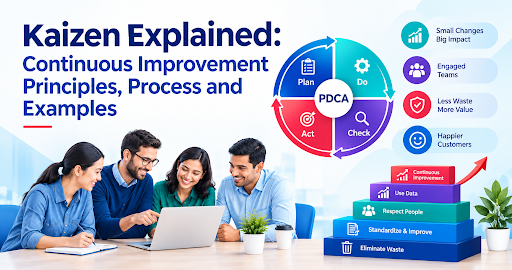
Kaizen is a Japanese approach for improving any business process. It uses the PDCA (Plan, Do, Check, Act) cycle to achieve incremental process improvement and build a work culture based on awareness and commitment for improving processes and solving daily problems.
It is common to come across processes, procedures and situations that may be improved in the workplace. However, not all of them are addressed and improved.
Key Highlights of Kaizen
- Kaizen is the practice of making continuous, small improvements to work processes. The idea is that the whole organization can improve and be improved, from the top to the bottom.
- The kaizen approach is based on a few principles. These include: continuous improvement, respect for people, transparency in pursuing continual improvement, making mistakes as a learning opportunity, and avoiding waste.
- To elaborate on the idea of continually improving and making mistakes as a learning opportunity, the PDCA cycle (Plan-Do-Check-Act) introduces a structured approach for teams to test and implement ideas at scale. The SDCA cycle then locks in the improvement.
- While there is much overlap with other improvement frameworks, there are several forms of Kaizen, including point, line, system, plane, and cube. Each requires a limited scope and executive sponsorship to be effective. Common examples include improved customer wait times, faster changeovers, and review times, and reduced claims rejections.
- Kaizen creates motivated and happy teams and customers. Some limits of the approach include apathy, adaptation fatigue, a lack of organization fit. These can be mitigated with strengthened commitment from leadership.
- Other ideas include a 5S event, mini PDCA cycle, and/or improved ways for employees to share their ideas. Furthermore, ongoing recognition helps inspire a commitment to Kaizen.
Introduction
The Kaizen process provides an effective means to address problems and situations that are detrimental to the business process. The essence of Kaizen is to empower all levels of an organization to look for ways to improve work processes and effect those improvements through a series of small changeover cycles.
This guide explains the history of Kaizen, its core concepts, and PDCA cycle. It explains the different types of Kaizen, Kaizen events, and provides practical case studies and examples from various industries. Lastly, the guide provides an implementation action plan for a Kaizen culture in your workplace.
What Is Kaizen? Meaning and Origin
The term Kaizen comes from two Japanese words. Kaizen means “ change for the better”.It focuses on continuous improvement (Kaizen – Lean Enterprise Institute).
In business, the term Kaizen refers to the effort by an organization’s entire workforce to improve their business’s products and services and how the business operates. All employees from top to bottom of an organization are involved in the process.
Kaizen in business takes many forms.It can be a major company-wide initiative or a small-scale business process improvement (BPI) project.
Origins of Kaizen
Kaizen became popular in Japan after World War II. The country’s economic, social, and industrial infrastructure was severely damaged. The country adopted many quality initiatives and business improvement projects to enhance industry and improve standards.
Japanese business leaders adopted many quality and improvement projects from the U.S. and other industrialized countries, including projects promoted by W. Edwards Deming. The U.S. quality management projects and initiatives gained popularity in Japan and other Asian countries.
Japan’s quest to continuously improve their products and services made kaizen part of the country’s business and industry focus. Other countries have also embraced Kaizen in many sectors and industries including government and education.
Core Kaizen Principles
Kaizen does not depend on completing an extensive, detailed plan of action. It encourages taking any positive step forward. That small step might seem insignificant. However, if a change leads to a more efficient method that saves just a few seconds or a couple of minutes on a repeated task, that change can really add up.
Respect for People
Toyota views the people performing a task as the experts. Management listens to and supports the ideas of front-line workers. This type of respect builds a relationship of trust. When workers see their ideas are appreciated and implemented, they are more willing to contribute additional ideas.
Treat mistakes as learning
Making mistakes is good, as long as improvement is the goal. In Kaizen, making a mistake means something is wrong with the process. It prompts the question "Why did this happen?" and points to the root of the problem.
Eliminate Waste
Waste is defined as any activity or process that does not add any value to the final product, or service, to a customer. Kaizen and Lean management focus on eliminating waste by detecting and understanding the underlying causes of inefficiencies.
Eight of the more common wasteful practices are described in detail in the Lean management guide, The Seven Wastes of Lean.
Standardize and then Improve
A process is improved by standardizing and locking in the best practices.
Data vs. Opinions
Some things can't be backed up with data. With Kaizen, you test ideas out by collecting data and comparing it to the previous data. You can use cycle time, how many times something has been done incorrectly, or how much time was wasted waiting to do the work.
Make Problems Visible
Most of the time, problems are undocumented and unsolved. With Kaizen, problems are often displayed using signs, boards, or other visual aids.
PDCA and the Kaizen Cycle
The Kaizen approach is meant to solve the same problem over and over again. This process is sometimes known as PDCA. It is also referred to as the Deming or Shewhart Cycle (PDCA Cycle – ASQ).
PDCA: The Four Steps
Plan:
Identify the problem. Break down the process to find the root cause. Set a goal or target. Test a possible solution.
Do:
Carry out the test. Keep it simple.
Check:
Look at the result. Compared to the goal. Did the solution help? Was there a negative effect?
Act:
If the solution worked, implement the change and tell others. If it did not solve the problem, repeat PDCA.
Why does the cycle matter?
The PDCA cycle allows teams to test and learn in a structured manner. Without it, teams opt to design and test solutions in an unstructured manner. PDCA provides the structure that facilitates the controlled design and test of ideas.
PDCA allows for the rapid removal of ideas that do not work. The cost of an idea that does not work is minimal.
PDCA in action
Consider a service support team that has a ticketing backlog due to a long average resolution time. The support team members search for the answer to the ticket across 5 folders. The support team, in the planning stage, determines that supporting team members should search for the answer to a ticket across 5 folders 30% less.
In the Do stage, the support team member creates a knowledge article for the top 20 of the most frequently asked questions and search items. The support team member measures search time for the 5 folders for a 2 week period in the check stage. Search time is reduced by 35%. The support team member updates the article and closed the case. The support team member then searches for and documents the next 20 most frequently asked questions and search items.
Types of Kaizen
SDCA (Standardize, Do, Check, Act) is another version of the improvement cycle. SDCA is employed to standardize the improvement and embed it to the organization.
1. Point Kaizen
Point kaizen focuses on the smallest, most immediate changes and can help to establish a daily improvement mindset. An example of point kaizen is modifying a workstation so an operator does not have to stretch as far to access a tool. Point kaizen is the most common type of kaizen, and for that reason, is the foundation of many improvement programs.
2. System Kaizen
System kaizen focuses on large systems or processes that require different departments or functions to interact and work together. For this reason, it typically requires management to lead the effort and can take a considerable amount of time and resources to implement.
An example of system kaizen is improving the order-to-cash process to reduce the time it takes for the business to receive payment after the sale, also known as the order-to-payment process.
3. Line Kaizen
Line kaizen focuses on processes and systems where the end product is created or produced and how the product or service flows through the system to the end customer. This type of kaizen focuses on the overall process, and each of the individual components of that process.
An example of line kaizen is balancing the overall production process to ensure no workstations are idle because they are waiting on other workstations to complete their work.
4. Plane and Cube Kaizen
Plane kaizen is focused on expanding an improvement in a similar way that Cube kaizen is focused on multiple areas of the business. An example of Plane kaizen is standardizing a method for reducing the time it takes for a process to changeover, across multiple lines in a manufacturing facility.
Cube kaizen is focused on standardizing an improvement across multiple facilities, and in multiple areas of the business. This takes the most coordination of all the different areas of the business and is typically led by a partner of the business such as the supplier.
How a Kaizen Event Works?
Daily practice is the basis of habit formation. Intense practice gives quick results. An intense practice session, a kaizen event, is a brief activity during which a cross-functional team improves a specific process. Traditionally, these activities last between three and five days.
Preparation and Scope
The best results are determined by the preparation work. This generally includes:
- Determining a negative business metric (i.e. long average lead times, high defect rates, etc.) and developing a case for improvement.
- Narrowing the focus of the improvement effort to a small part of a larger business unit (i.e. instead of improving the finance department, improve invoice processing).
- Setting quantifiable and realistic improvement targets (i.e. reduce average lead times by 40%).
- Identifying and inviting a management level person to sponsor the effort and serve as a barrier removal and decision authority for the improvements.
- Composing the core improvement team by inviting 6 to 10 employees from a variety of relevant departments and functions.
- Collecting and documenting key data and information pertaining to the negative business metric, process and employee complaints.
The most important constraint for an improvement effort is the scope.
The event week
The event week has a specific constraint, time. The structure and format of the improvement effort is generally the same. The following represents a typical format and schedule for such an effort.
- Day 1 - Train team members on the basics of improvement, particularly definition of value and process mapping. Walk the factory floor (i.e. gemba) and document the current process.
- Day 2 - Measure the current process and determine the root cause of the issues. Brainstorm potential alternatives.
- Day 3 - Prototype and test potential alternatives using the current process.
- Day 4: Prepare final drafts of new procedures. Install visual management and train staff on the new procedures.
- Day 5: Brief leadership on improvements and remaining opportunities.
Improvements during the workshop are the most powerful aspects and reinforce the idea that this approach can dramatically improve an organization.
Follow-up and Sustaining Improvements
What happens in the days following an event will determine the extent to which improvements are embedded and sustained in an organization. Without active management of improvements, they are often lost.
To manage improvements that were identified but not implemented during an event, the team should develop an action plan. Additionally, they should create a dashboard to visualize the key metrics and maintain a sense of urgency to assess the metrics.
Also, communicating the results and positive effect the improvement has on the business should be done to reinforce the idea that improvements are wanted and needed and to extend the drive and energy around process improvement.
Kaizen Tools and Techniques
Kaizen is a way of thinking and living but there are associated tools to assist. The tools should be used when relevant and relative to the situation being addressed.
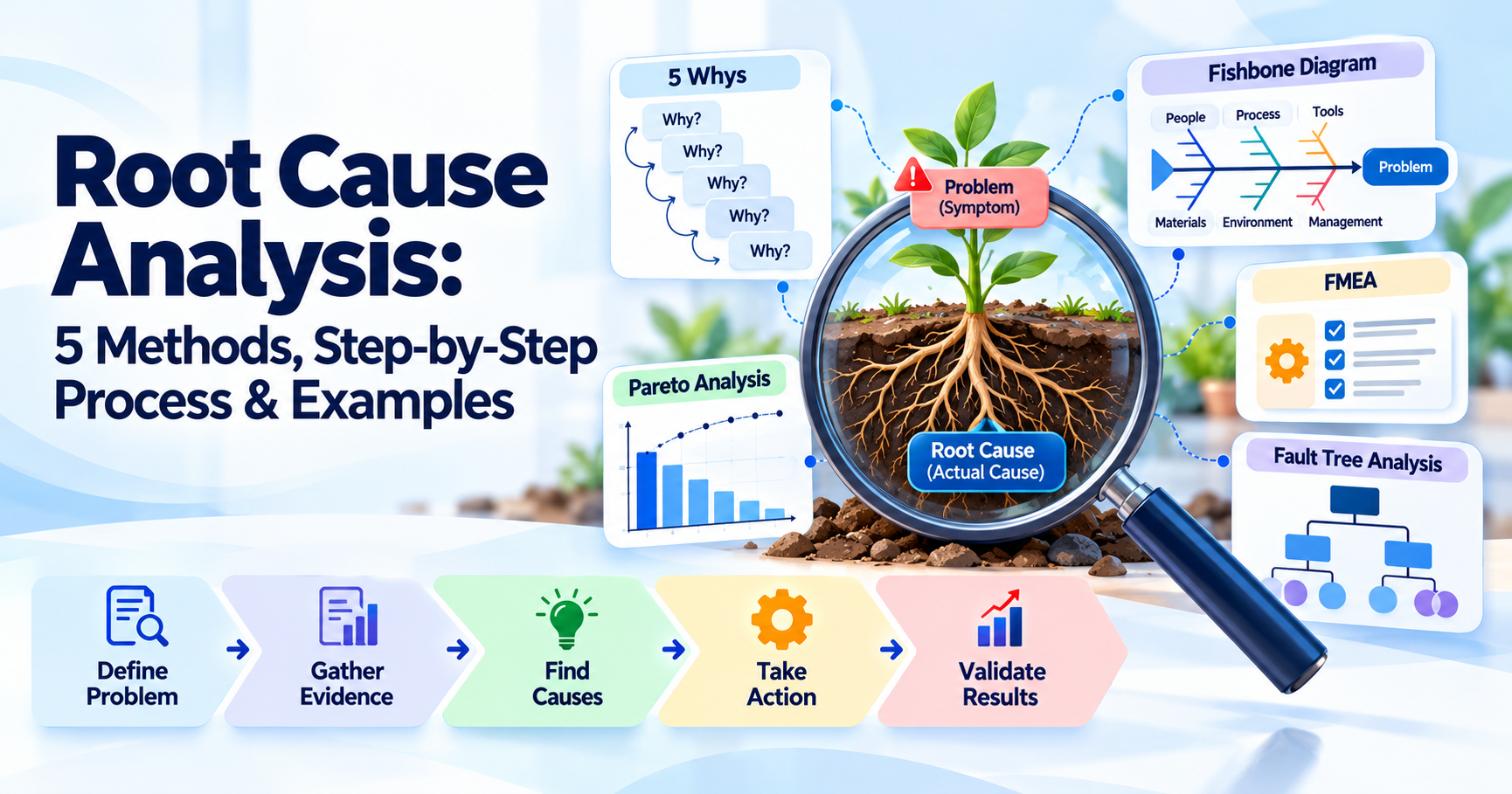
5 Whys: Repeatedly ask “why” to get to the root cause of a problem.
- Fishbone (Ishikawa) Diagram: Identify causes of an effect by considering people, method, machine, etc.
- Value Stream Mapping: Create a process flow to define the work to deliver a product or service.
- 5S: It is useful in designing an efficient workplace and serves as the foundation of other quality programs. It consists of five stages: Sort, Set in Order, Shine, Standardize, and Sustain. Learn more about 5S in Six Sigma.
- Visual Management: The use of various charts and colors, and add on signals to indicate work in process, errors, and conditions to be monitored.
- Standard Work: A written explanation describing the best way to perform a task to be used for improvement.
- Poka-Yoke: Devices, or procedural steps, that prevent an error from occurring.
- Pareto Analysis: Analysis that identifies and prioritizes problems based on effect (or impact).
- Suggestion Systems: Systems implemented to ensure that suggestions and recommendations made by employees are analyzed and acted upon.
- A3 Reports: Reports containing information pertaining to a problem, the analysis, the recommended solutions, and the actions to be taken to implement the solutions.
When dealing with business problems, it is best to use a combination of these tools and approaches.
Kaizen Examples From Manufacturing, Services and IT
Real world examples illustrate the principle of Kaizen. Below are examples from three different settings.
1. Manufacturing
Toyota Production System – Toyota Global is Toyota’s official explanation of jidoka and kaizen.
Workers are allowed to and in fact encouraged to stop the production line when a defect is detected. The cause of the defect is corrected and the process is evaluated and improved by the team.
There are many other great examples but one involves a parts manufacturing plant. There was significant downtime during the machine changeovers. A kaizen team broke the task down into what could be completed while the machine was running and what had to be completed while the machine was not running.
Finally, by pre-staging tools and materials and using a cart to further reduce the time required to get tools to the changeover location, additional time was saved.
2. Services
Kaizen can work very effectively in service industries as well. One example involves a hospital and the time a patient spends waiting to be evaluated and processed. One kaizen activity involves mapping the patient’s journey to and from the service and identifying all of the activities that the patient must complete and the many opportunities that exist for staff to eliminate or simplify the work that the patient must do.
Other activities include assuring the staff is scheduled to adequately cover the patient load, adjusting the layout of the work area to move staff closer to the patient, and improving the forms and processes to collect the patient’s information.
All kinds of businesses can use these ideas. For example, 30 percent of claims may be denied because of missing information. Simple checklists can be used to resolve this at intake. As a result, team members spend less time investigating reworks and more time answering customer requests.
3. Information Technology (IT)
Development teams use PDCA throughout the Agile process, especially in sprint retrospectives, to improve their work For example, teams agree to specific standards in order to improve the time required to perform code reviews. Automating low level deployment tasks is also considered kaizen.
Across the IT industry, there are countless opportunities for kaizen. These improvements may not seem large, but when many small changes are combined, a significant impact may be realized.
4. Routine Business Activities
Improving simple business procedures is also kaizen. A sample brief may be created to standardize proposals for advertising campaign approvals.
This small change can eliminate the need to request and review numerous emails to gather the required information. The same concept applies to HR by using a standardized checklist to simplify the onboarding process.
Kaizen vs Kaikaku vs Innovation
| Aspect | Kaizen | Kaikaku | Innovation |
| Size of change | Small, incremental steps | Large, radical redesign of a process or system | Can be large or breakthrough, often new to the market |
| Speed | Slow and steady, continuous | Fast and sudden, often as a one-time effort | Varies, often uncertain with long development cycles |
| Who drives it | Everyone, especially front line staff | Senior leaders and specialist teams | R&D, product teams, and leadership |
| Risk | Low, because changes are small and tested | High, because of disruption and cost | High, because success is not guaranteed |
Kaizen in Lean and Six Sigma
There is always overlap with Kaizen and other improvement strategies, and with Lean and Six Sigma especially.
Kaizen and Lean
With Lean, Kaizen is embedded throughout, and forms the basis of improvement. Lean strives to provide greater customer value and remove business waste. Improvement in Kaizen is defined in the context of Lean as removing waste.
With Lean improvement activities focused on defining value and removing waste from the process, flow, and service provided, improvement and optimization is pursued until perfection.
This perfection is continuously aspired through the establishment and practice of daily Kaizen habits. For a more macro context of the Lean methodology and tools, read this article on what is Lean process.
Kaizen and Six Sigma
The combination of both Kaizen and Six Sigma creates an improvement model that is incredibly holistic and powerful, as both embrace and redefine the notion of continual improvement through daily practice and engagement, and with deeper focus on process variation and defects.
The focus of Kaizen is well aligned to the aspiration of forming daily improvement habits and practices to enhance overall business process, and notably to engage employees and embrace variety, eliminate waste, and reduce and improve process defects.
The combined principles of Lean and Six Sigma attain the same. For further context, it is advised to learn more about Lean Six Sigma Principles.
Building Skills
Lean Six Sigma training is one option for structured learning that helps build the skills needed to lead continuous improvement activities. The Yellow Belt training is a foundational training that is appropriate for all team members,and the Green Belt training is appropriate for those who lead improvement projects
Benefits and Limitations of Kaizen
Kaizen is a systematic approach to improving quality and efficiency throughout a business. While each business will experience unique benefits as a result of their Kaizen efforts, some common benefits include:
- Cost of Quality (COQ) reduction through the elimination of waste.
- Increased customer satisfaction through the elimination of defects.
- Fewer delays and defects as a result of addressing root causes.
Limits and Risks of Kaizen
While the Kaizen methodology is extremely versatile and has the potential to improve a wide variety of business activities, there are some situations in which Kaizen may be inappropriate. Some situations in which Kaizen may not be sufficient include:
- If a business is operating in a market with significant competition, shifting consumer demands or preferences.
- If a business is operating with out-dated or legacy technology.
- Kaizen approach fatigue: if management supports Kaizen efforts, but doesn’t follow up with the work to support and maintain the new processes, employees may revert to old, ineffective processes.
- An improvement to one component of a system may negatively impact other components of the system.
- Too many initiatives at the same time means that people get overwhelmed and fatigued.
One of the main limitations of culture is that in some companies, employees can not speak their minds. Therefore, some good ideas remain unidentified.
Most of these constraints can be resolved. It requires management commitment and clarity on direction and goals. A fine balance of small and big changes can keep the initiative healthy.
How to Start a Kaizen Culture in Your Team?
A kaizen culture is formed over a period of time. The foundation is laid by following certain practices continuously.
In order to adopt a kaizen culture, management needs to communicate, and explain the reason for the necessity of improvement and the role of the employee in delivering that improvement.
Often, improvement activities are initiated with an aim to improve cost saving. This should be linked with the role of the employee in improving service/product delivered to the customer.
- Management commitment becomes evident with their visits to the working floor, and responding to employee suggestions.
- One of the simple yet effective improvement activities is 5S. It gives an improved workplace, and delivers quick results.
- Paint a picture of your process. When identifying waste and delays, represent them in a visual manner.
- Try a mini PDCA. Experiment with one change in two weeks. Change is equivalent to the removal of waste.
- Make it easy to express ideas. Use a suggestion board or suggest a change at a meeting. Be responsive to all ideas.
- Schedule and conduct a series of brief improvement meetings. Improving improvements works!
- Lead training on tools. Use small and often to introduce and build skill with tools such as 5 Whys and value stream mapping.
- Lead with recognition. Gratitude goes a long way.
Conclusion
Kaizen is a lean philosophy encouraging small improvements and positive change. The focus is on the incremental, not the end result. True to lean management principles, Kaizen incorporates practices such as the PDCA cycle, waste elimination, and definition of ‘standard’ work. Other concepts include ‘respect for people’ and ‘gemba’.
Kaizen is equally applicable to all types of work, including services, and Information Technology (IT). To implement it, start by identifying a process and taking a ‘gemba’ walk.
The lean management tools and the associated bodies of knowledge, e.g. ‘Lean Six Sigma’ are widely used to improve work processes across all industries. Simpliaxis offers trained facilitation, case tools and other aids to the Lean Six Sigma frameworks and methodologies.
Lean Six Sigma Yellow Belt training and Lean Six Sigma Green Belt training are foundational and advanced offerings, respectively, in the lean management tools body of knowledge. The training and associated tool kit help enhance your continuous improvement journey.







 Lowest-Price Challenge












 Personalized Path



.webp)


 USA
 Canada
 India
 UK
 Australia
 Singapore


