


 Call Us




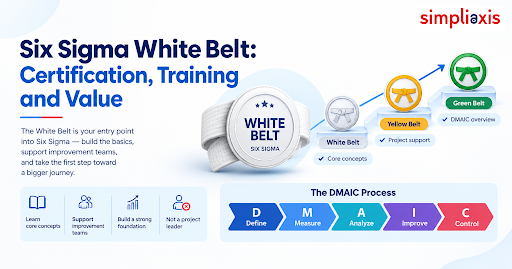
What is Six Sigma White Belt exactly? It is the first and most basic level of the Six Sigma belt system. The White Belt introduces core concepts, key project roles, and the DMAIC method in a few hours of study. It does not qualify you to lead projects. It prepares you to support improvement teams and progress to the Yellow and Green Belt levels.
Key Highlights of Six Sigma White Belt:
- The White Belt is the entry point of the Six Sigma belt path
- It covers basic concepts, project roles, and an introduction to DMAIC
- Formats range from a few hours of self-study to a one-day live class. There are no prerequisites for enrollment
- The CSSC White Belt certificate is valid for life
- White Belt holders support projects but do not lead them. It serves as a stepping stone to the Yellow Belt and Green Belt
Introduction:
Six Sigma is a process improvement methodology. Businesses that implement it boil it down to improving consistency, eliminating waste, and reducing defects. If you need more clarity, check out this guide on Six Sigma.
Six Sigma has a ranking system for its members like a martial art. Beginning with White and ending with Master Black Belt, the ranking system determines the level of knowledge and responsibility of members.
A Six Sigma White Belt requires very little time and financial commitment, therefore a lot of people begin their journey with Six Sigma here. White Belts learn the history of the progress of process improvement methods and the various aspects of the Six Sigma methodology.
What Is a Six Sigma White Belt?
A Six Sigma White Belt signifies an understanding of the fundamentals of Six Sigma and Lean. This knowledge is generally used to understand common terminology, and engage in general discussions surrounding process improvement. It does not grant an individual the ability to facilitate process improvement projects.
The Six Sigma White Belt is a basic, entry-level certificate that provides an overview of the Six Sigma methodology. Variations exist among the organizations that grant this credential. Some will award this recognition after a brief classroom training, while other organizations (such as CSSC) grant this recognition after the completion of an exam. This certification does not require previous training or work experience. The sponsoring organization intends for this training to be offered to all of the members of the organization.
The White Belt does not allow an individual to function at the project level. Holders of a White Belt work on teams to assist with data collection, documentation, and communication.
The belt system of the Six Sigma methodology is progressive. The understanding gained at each level of the certification allows individuals to function at a higher level to lead and manage complete process improvement projects.
Each level of the belt system builds on the one before it. The Lean Six Sigma certification levels progress from basic awareness to full project leadership. The White Belt is the doorway to that journey.
What the White Belt Covers?
The White Belt provides the basic elements of improvement projects. This is organized into the following categories:
- Defects
- Variation
- The Voice of the Customer
- Lean and Waste
The Six Sigma White Belt training guides the recognition of various types of waste. These include waiting waste, transport waste, and excess inventory. The training keeps the concepts very basic. The aim of this training is to raise awareness of various types of waste.These ideas come from the Lean process and its principles, which focus on removing waste.
Complex analysis, and statistical and computational tools, are not included at this level of training. Detailed Lean Six Sigma tools fall under the Yellow and Green Belt levels.
Roles on an Improvement Project
The second section of the training explains Six Sigma roles and responsibilities across the project team. These include Champions, Black, Green and Yellow Belts.
The extent of participation of a White Belt on a project team depends on the company policy. In many company policies, the primary role of a White Belt is limited to supporting a local project team with organizational and logistical tasks.
The primary purpose of White Belt training is to teach the basics of the language and framework of Six Sigma projects. This speeds up the overall project cycle time.
Introduction to DMAIC
DMAIC is the foundation of Six Sigma projects. See how each phase works in the stages of Six Sigma.White Belt training gives an overview of each of these phases.
- Set the goals and define the bounds of a project.
- Measure current status of a process.
- Analyze data to pinpoint root causes.
- Improve status and implementation of changes.
- Control eliminates changes made to root causes.
As a White Belt, you are introduced to the key elements of the DMAIC process. You’ll get a first look at the DMAIC Measure phase, including types of data and control charts.
Who Should Take the White Belt?
The White Belt is appropriate for individuals fresh out of school. Individuals that wish to determine interest or gain a competitive edge by adding training to their CV are candidates for the White Belt.
The White Belt is appropriate for managers looking to improve their ability to encourage and guide initiatives in the direction of the corporation. This is accomplished by helping managers identify clearer process boundaries.
Career switchers and students wanting to gauge interest in process improvement gain from lean six sigma training.
Free vs Paid White Belt Training
There are advantages and disadvantages to each method of earning your White Belt. It is best to look beyond cost to assess similarities and differences in the learning materials and the way the courses are structured and supported.
The Council for Six Sigma Certification (CSSC) offers a self-study White Belt option. After completing the self-study course, you can take the CSSC online assessment. CSSC offers a discount to examinees and waives the assessment fee for the self study course.
To identify ‘free’ opportunities, try a search for “White Belt Six Sigma free.” It is important to read the description to make sure the assessment and White Belt certificate are included.
Training resources are directed only to the self-study course and online assessment. There are no scheduled classes, and students have no opportunity to interact with the course instructor to clarify concepts.
There are paid training options that include continuing education credits and offer greater course instructor interaction. Depending on the training organization, format and course materials, prices may vary. To learn more, read our breakdown of Six Sigma certification cost.
Exam and Certificate Details
Although formats vary, the majority of credentialing entities use a short multiple-choice test to assess knowledge.
For example, the CSSC standard exam consists of 20 multiple-choice and true/false questions. The format is an open book. The duration of the exam is 30 minutes. A score of 56 or above is required to pass. Each candidate is allowed an unlimited number of attempts to achieve the passing score within 12 months from the assessment date.
In the case of CSSC, the certificate is awarded to candidates who have achieved the passing score of the exam; therefore, the CSSC certification is assessed. Although the CSSC White Belt certificate shows the candidate has knowledge of the basic concepts of Six Sigma, in most cases, the certificate does not demonstrate the candidate’s ability to perform or implement the concepts.
Prior to purchasing the credential, contact the entity that issues the certificate to gain clarity on its purpose and policy regarding assessment and recognition.
White Belt vs Yellow Belt vs Green Belt
| Belt | Depth | Typical Role | Next Step |
| White | Basic awareness of concepts and terms | Supports local problem-solving teams | Yellow Belt training |
| Yellow | Working knowledge of tools and metrics | Team member on improvement projects | Green Belt training |
| Green | Applied DMAIC and core statistical tools | Leads small to medium projects | Black Belt training |
Is the CSSC White Belt certificate worth the investment?
Earning the CSSC White Belt provides good value. There is a monetary and time savings benefit to the individual. From an employer’s perspective, this short training credential provides insight to the individual’s interest and passion for process improvement and can facilitate communication to address pain points.
The White Belt helps individuals adopt a more critical way of thinking that takes a key step in advancing to the next level of problem solving. This is especially helpful to fresh graduates and young professionals who are actively building and strengthening their skills and competencies required to gain a foothold in their chosen career.
With respect to a career, the white belt indicates on a resume that the individual has taken the initiative to participate in professional development courses. Although the education provided at the white belt level is only a very brief overview of the concepts related to process improvement, it still provides the individual with a basic fundamental understanding of some terminology and tools that may help structure and define a problem, and provide a pathway to the next step of professional development in the field of Six Sigma.
How to Move From White Belt to Green Belt?
The pathway to the Green Belt has a great deal of flexibility. Although some organizations may require you to first complete a Yellow Belt training, other organizations may allow you to move directly to the Green Belt training.
Using your White Belt knowledge, you can identify improvement opportunities.Try a small value stream mapping exercise on a process you know well to gain more understanding of areas beyond your current knowledge and what questions you may have. Continue on the pathway to Green Belt by developing and honing your Lean Six Sigma Yellow Belt training skills.
Conclusion
The main draw of the Six Sigma White Belt is that it’s a short credential that provides a basic understanding of improvement of processes. It’s also very affordable and time-efficient. For most, it will be the first step along a process improvement career path.
Consider it a sample of what’s to come. If it piques your interest, you should continue your process improvement journey. The Green Belt is when Six Sigma starts to become a career enabler. To sharpen your skills, enroll in the Simpliaxis Lean Six Sigma Green Belt training course.






 Lowest-Price Challenge












 Personalized Path



.webp)


 USA
 Canada
 India
 UK
 Australia
 Singapore


