


 Call Us



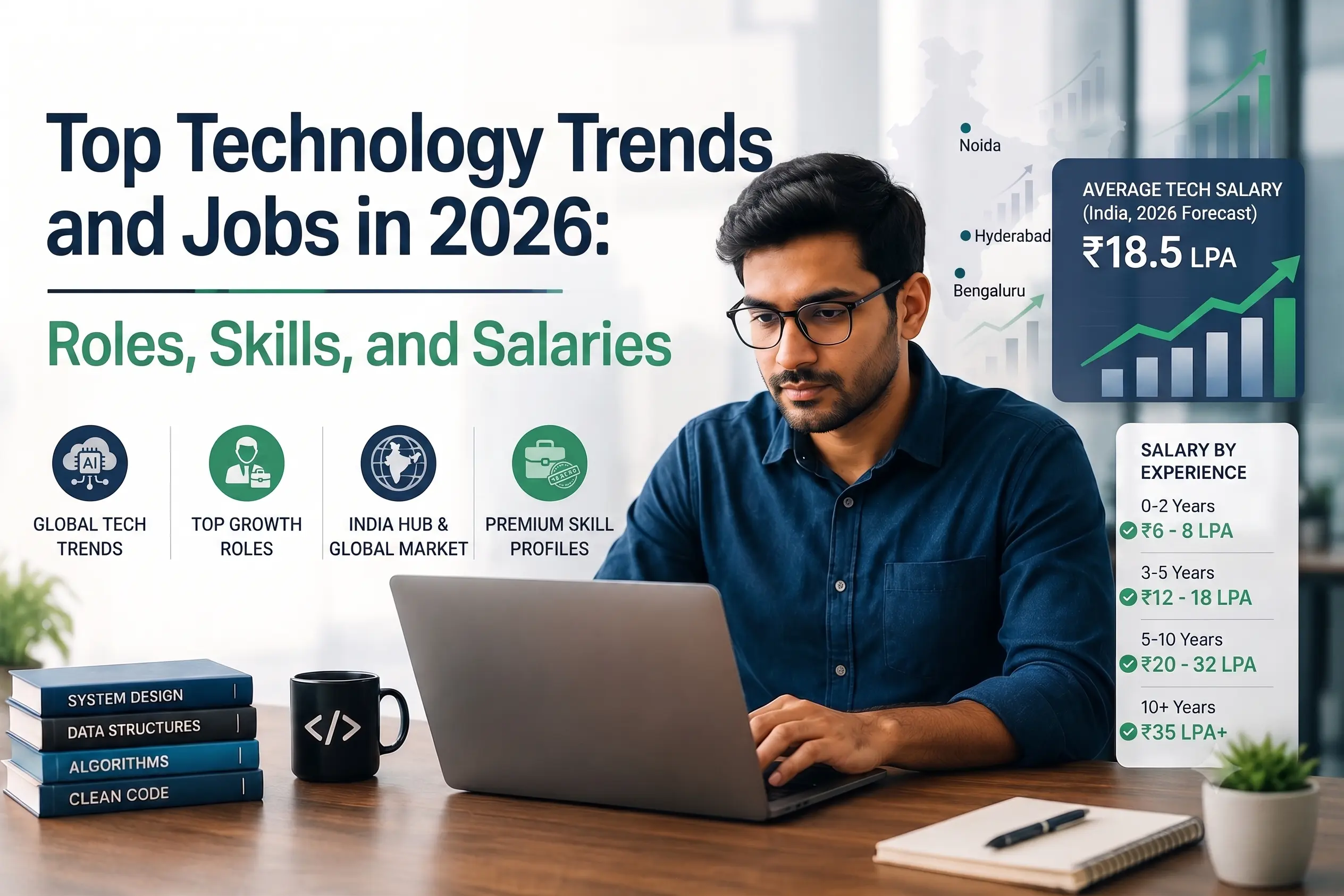
The technology trends creating the most jobs in 2026 are agentic and generative AI, cybersecurity, cloud computing, big data and data science, physical AI and robotics, quantum computing, AI-native software development, technical project management, and IoT with edge computing. Each trend maps to specific, hireable roles, from Agentic AI Engineer and Information Security Analyst to Cloud Architect and Technical Project Manager, most of which pay well above the national median wage and are growing far faster than the average occupation. The fastest path into any of these roles combines a foundational certification, a portfolio project, and continuous upskilling, since employers are hiring for demonstrated skills as much as degrees.
Key Highlights of Technology Trends and Jobs 2026
- Agentic AI job postings grew roughly 280 percent year over year, reaching an estimated 90,000 US postings in 2026, with average Agentic AI Engineer pay near 192,826 dollars a year.
- Information security analyst roles are projected to grow at least 19 percent from 2024 to 2034 according to the US Bureau of Labor Statistics, against a global cybersecurity workforce gap of about 4.8 million professionals.
- Data scientist employment is projected to grow 34 percent from 2024 to 2034, adding roughly 82,500 jobs, with a 2024 median wage of 112,590 dollars.
- Cloud computing and information technology occupations overall are projected to grow much faster than average through 2034, with cloud architects earning a reported median in the 150,000 dollar range and senior architects well above 200,000 dollars.
- The World Economic Forum's Future of Jobs Report 2025 lists Big Data Specialists, FinTech Engineers, and AI and Machine Learning Specialists as the three fastest-growing job categories globally through 2030.
- Gartner's Top Strategic Technology Trends for 2026 are organized around three themes, building resilient digital foundations, orchestrating intelligent systems such as multiagent AI, and protecting enterprise value through security-first design.
1. Agentic AI and Multiagent Systems
Agentic AI, systems of AI agents that can plan, act, and coordinate with other agents to complete multi-step work with limited human supervision, is the single fastest-moving trend in the 2026 technology landscape. Gartner's 2026 strategic trends report places Multiagent Systems under its "Synthesist" theme, describing modular AI agents that collaborate on complex tasks to improve automation and scalability across the enterprise. Demand caught up with the hype quickly: postings mentioning agentic systems went from roughly 151 in 2024 to more than 16,500 in 2025, one of the sharpest skill-demand shifts tracked in recent AI labor market research, and agentic AI postings overall grew about 280 percent year over year to reach an estimated 90,000 US postings in 2026.
Job roles: Agentic AI Engineer, AI Agent Developer, AI Orchestration Engineer, AI Consultant and Strategist, Multiagent Systems Architect.
Required skills: large language model APIs, retrieval-augmented generation, agent frameworks and tool-calling, prompt and context engineering, evaluation and guardrails for autonomous systems, and enough software engineering fundamentals to productionize agent workflows.
Realistic salary ranges: the average Agentic AI Engineer salary in the United States is reported around 192,826 dollars a year, with a typical range between roughly 152,000 dollars at the 25th percentile and 247,000 dollars at the 75th percentile. Broader AI and ML engineer roles are benchmarked by Robert Half's 2026 Salary Guide at 134,000 to 193,250 dollars, with a reported midpoint near 170,750 dollars, and specialists at frontier AI labs can earn considerably more in total compensation. On LinkedIn's 2026 Jobs on the Rise list, AI engineers and AI consultants and strategists took the top two spots among the fastest-growing roles in the country.
How to break in: most people entering agentic AI roles come from software engineering, data science, or machine learning backgrounds and add agent-specific skills on top, since the discipline is too new for most universities to offer dedicated degree programs. Building two or three working agent projects, ideally tied to a real business workflow such as customer support triage or data pipeline automation, is currently a stronger signal to hiring managers than credentials alone.
Certifications that help: a structured, hands-on program such as Simpliaxis's Applied Agentic AI Certification Training builds the practical skills of designing agents that plan, use tools, and execute tasks with large language models and retrieval-augmented generation. Pairing that with a broader foundation from the Artificial Intelligence Course helps candidates speak fluently about the underlying model concepts that interviewers probe for.
2. Generative AI and Domain-Specific Language Models
Alongside agentic systems, Gartner's 2026 outlook highlights Domain-Specific Language Models, smaller, fine-tuned models trained on industry data that deliver higher accuracy and better regulatory compliance than general-purpose models for use cases in healthcare, finance, and legal work. AI-native development platforms that embed generative AI directly into the coding and design process are cited as a related trend reshaping how software teams work. This is a distinct hiring lane from agentic AI: it is more about building and fine-tuning models and integrating them safely into products than about autonomous multi-step execution.
Job roles: Generative AI Engineer, Machine Learning Engineer, AI Solutions Architect, Prompt Engineer, MLOps Engineer.
Required skills: model fine-tuning and evaluation, vector databases and retrieval pipelines, Python and ML frameworks such as PyTorch, responsible AI and bias testing, and cloud-native deployment of inference services.
Realistic salary ranges:generative AI and machine learning engineering roles largely track the broader AI/ML engineer band cited above, roughly 134,000 to 193,250 dollars nationally, with senior fine-tuning and MLOps specialists pushing higher in competitive metro markets. The World Economic Forum's Future of Jobs Report 2025 places AI and Machine Learning Specialists among the three fastest-growing job categories worldwide, with projected growth of about 82 percent through 2030.
How to break in: a data science or software engineering foundation is the most common entry point, followed by hands-on practice fine-tuning open models and shipping at least one retrieval-augmented application. Contributing to open-source AI tooling is an increasingly credible way to get noticed, mirroring the pattern GitHub's Octoverse 2025 report describes, where AI repositories nearly doubled to 4.3 million and grew contributor bases roughly three times faster than typical open-source projects.
Certifications that help: Simpliaxis's Mastering Generative AI Tools course and Introduction to AI and Machine Learning program both give a structured route into this trend for professionals moving over from adjacent IT or data roles.
3. Cybersecurity and AI Security
Security is not a niche trend inside the AI wave, it is the trend that determines whether the AI wave is safe to deploy at all. The global cybersecurity workforce gap now stands at approximately 4.8 million unfilled positions according to the ISC2 Cybersecurity Workforce Study, a gap that grew 19 percent year over year, with the United States alone facing an estimated deficit of about 522,000 professionals. US cybersecurity job postings reached 514,359 over a recent 12-month period, up nearly 12 percent year over year, and 67 percent of organizations report active staffing shortages on their security teams. Among current skills priorities, AI security ranks highest at 41 percent, followed by cloud security at 36 percent, reflecting how closely this trend is now tied to the AI buildout described above.
Job roles: Information Security Analyst, Security Engineer, Cloud Security Engineer, AI Security Specialist, Security Operations Center Analyst, Chief Information Security Officer.
Required skills: threat detection and incident response, cloud security architecture, identity and access management, security frameworks and compliance (NIST, ISO 27001), and, increasingly, the ability to secure AI pipelines and model endpoints against prompt injection and data leakage.
Realistic salary ranges: the US Bureau of Labor Statistics reports a 2024 median annual wage of 124,910 dollars for information security analysts, with employment projected to grow at least 19 percent from 2024 to 2034, several times faster than the average occupation. The World Economic Forum separately projects Security Management Specialist roles to grow about 53 percent globally through 2030.
How to break in: most security analysts start in general IT support, networking, or system administration and move laterally once they hold a foundational security certification, since employers weigh verified security knowledge heavily for roles that carry compliance responsibility.
Certifications that help: Simpliaxis offers both the CISSP Certification Training, aligned to the internationally recognized (ISC)² credential, and the Certified Information Security Manager (CISM) course for professionals aiming at governance and leadership tracks such as Information Security Manager or CISO.
4. Cloud Computing and FinOps
Cloud platforms have moved from experimental environments to core infrastructure, and cost management has become as important as capability. The US Bureau of Labor Statistics projects computer and information technology occupations broadly, including cloud-adjacent roles such as network architects and systems managers, to grow much faster than the average for all occupations through 2034, with commonly cited projections in the 12 to 15 percent range for cloud-specific roles. Multi-cloud FinOps, the discipline of managing cost, governance, and performance across AWS, Azure, and Google Cloud simultaneously, has emerged as its own specialization as organizations try to control spend across increasingly complex, multi-vendor cloud estates.
Job roles: Cloud Architect, Cloud Engineer, DevOps Engineer, Site Reliability Engineer, FinOps Analyst, Cloud Security Engineer.
Required skills: infrastructure as code, containerization and orchestration (Docker, Kubernetes), one or more major cloud platforms, cost governance and tagging discipline, and CI/CD pipeline design.
Realistic salary ranges: reported figures for cloud architects range widely by source and seniority, from a national median in the neighborhood of 150,000 dollars to averages above 200,000 dollars for senior and principal architects at large employers, while cloud engineers typically start between 82,000 and 101,000 dollars and reach 125,000 to 153,000 dollars at the senior level. These figures come from compensation aggregators rather than a single government survey, so they should be treated as directional rather than exact.
How to break in: a vendor-neutral fundamentals certification followed by a platform-specific associate certification (AWS, Azure, or Google Cloud) is the standard on-ramp, usually paired with a home lab or sandbox project that demonstrates you can deploy, secure, and monitor a real workload end to end.
Certifications that help: Simpliaxis's AWS Cloud Computing Certification Training and AWS Cloud Practitioner Certification both build this foundation, and the Multi-Cloud FinOps course is a direct match for the cost-governance specialization now in demand.
5. Big Data and Data Science
Big Data Specialists top the World Economic Forum's Future of Jobs Report 2025 list of fastest-growing roles worldwide, with projected growth of about 113 percent by 2030, ahead of every other occupation the report tracks including FinTech Engineers at roughly 93 percent and AI and Machine Learning Specialists at roughly 82 percent. In the United States specifically, the Bureau of Labor Statistics projects data scientist employment to grow 34 percent from 2024 to 2034, adding an estimated 82,500 jobs and about 23,400 annual openings, taking total employment from roughly 245,900 to 328,300.
Job roles: Data Scientist, Big Data Engineer, Data Analyst, Business Intelligence Developer, Analytics Manager.
Required skills: statistics and applied machine learning, SQL and distributed data tools such as Spark, data visualization, and increasingly the ability to integrate generative AI into analytics workflows rather than treat it as a separate discipline.
Realistic salary ranges: the Bureau of Labor Statistics reports a 2024 median annual wage of 112,590 dollars for data scientists, comfortably above the 105,990 dollar median for the broader computer and information technology occupational group and more than double the median wage across all US occupations.
How to break in: data analyst or business intelligence roles remain the most common stepping stone into data science, since they build the SQL, visualization, and stakeholder communication skills that pure machine learning coursework often skips.
Certifications that help: Simpliaxis's Data Science with Python course and broader Data Science Certification programs cover the analysis, visualization, and machine learning skills this trend rewards.
6. Physical AI and Robotics
Gartner's 2026 trends report names Physical AI, intelligence embedded directly into robots, drones, and smart equipment for real-world operational impact, as one of the year's defining shifts, and hiring data backs up the acceleration. Postings for "Robot Learning Engineer," a role focused on teaching robots using machine learning rather than hand-coded rules, grew about 340 percent between January 2024 and January 2026, the fastest growth of any robotics specialization tracked. The global robotics technology market is projected to grow from roughly 94.54 billion dollars in 2026 to about 372.59 billion dollars by 2034, a compound annual growth rate near 14.7 percent.
Job roles: Robotics Engineer, Robot Learning Engineer, AI Robotics Engineer, Computer Vision Engineer for robotics.
Required skills: classical robotics and controls fundamentals combined with modern machine learning, computer vision, and increasingly vision-language and foundation models applied to physical systems.
Realistic salary ranges: general robotics engineer salaries are reported in the 87,298 to 128,296 dollar range with a median near 106,310 dollars, while AI-focused robotics engineers average around 105,605 dollars a year, and specialists who combine robotics with software engineering can earn considerably more depending on employer and location.
How to break in: mechanical, electrical, or computer engineering remains the most common academic path, but professionals from software and AI backgrounds are increasingly moving in laterally by learning robotics-specific tooling such as ROS and simulation environments.
Certifications that help: because robotics leans heavily on AI foundations today, Simpliaxis's Artificial Intelligence Course and Introduction to AI and Machine Learning program are practical starting points for professionals moving toward physical AI roles from a software background.
7. Quantum Computing
Quantum computing has moved from theoretical research toward early commercial deployment. IBM has stated a target of delivering quantum advantage by the end of 2026 and fault-tolerant quantum computing by 2029 through its Quantum Starling architecture, aiming for roughly 200 logical qubits built from around 10,000 physical qubits, while Google's Willow processor progressed from a 3x3 surface code demonstration in late 2024 to a 7x7 code in early 2026, with each step in code distance roughly halving the logical error rate as surface-code theory predicts. Commercially, cloud-based quantum computing services are projected to reach about 2.4 billion dollars in revenue in 2026, growing at roughly 78 percent compound annual growth as enterprises shift from experimentation to production use. The talent pipeline has not kept pace with this momentum: industry estimates put roughly 15,000 open quantum computing positions globally against only about 3,000 qualified graduates entering the field each year.
Job roles: Quantum Software Engineer, Quantum Research Scientist, Quantum Algorithm Developer, Quantum Hardware Engineer.
Required skills: linear algebra and quantum mechanics fundamentals, quantum programming frameworks such as Qiskit or Cirq, classical software engineering to integrate quantum and classical workflows, and increasingly cloud platform experience since most quantum access today runs through cloud services.
Realistic salary ranges: reliable, broad salary benchmarks for this occupation are still limited given how small and new the field is; publicly reported figures vary widely by employer, seniority, and whether the role is research-focused or applied, so specific salary claims for quantum roles should be treated as unverified until confirmed against a primary compensation survey.
How to break in: this is currently the most credential-dependent trend on this list, physics, computer science, or engineering graduate study remains the most common path in, though software engineers with strong math backgrounds are increasingly able to move into quantum software roles through specialized bootcamps and vendor certification tracks.
Certifications that help: Simpliaxis does not currently offer a dedicated quantum computing certification; professionals exploring this trend are better served starting with a strong Data Science Certification or Artificial Intelligence Course to build the mathematical and programming base the field requires before pursuing vendor-specific quantum training.
8. AI-Native Software Development
Software development itself is being restructured around AI-assisted coding. GitHub's Octoverse 2025 report found the platform added 36 million new developers over the year, bringing its total population to 180 million with more than one new developer joining every second, and that nearly 80 percent of those new developers adopted GitHub Copilot within their first week, a sign that AI-assisted coding is now a baseline expectation rather than an optional add-on. AI repositories on the platform nearly doubled to 4.3 million, LLM SDK adoption grew 178 percent year over year, and the Copilot coding agent alone authored more than 1 million pull requests in five months. TypeScript became the most-used language on GitHub for the first time in August 2025, while Python, with about 2.6 million contributors, a 48 percent increase, continues to dominate wherever AI and data science intersect. The Bureau of Labor Statistics separately projects software developer employment to grow about 15 percent from 2024 to 2034, with a 2024 median annual wage of 133,080 dollars, and the World Economic Forum projects Software and Applications Developer roles to grow roughly 57 percent globally through 2030.
Job roles: Software Developer, Full-Stack Developer, AI-Native Development Engineer, Developer Experience Engineer.
Required skills: strong fundamentals in at least one modern language (JavaScript/TypeScript, Python, or similar), effective use of AI coding assistants without over-relying on them, cloud-native architecture, and testing discipline that keeps AI-generated code reliable in production.
Realistic salary ranges: the Bureau of Labor Statistics puts the 2024 median annual wage for software developers at 133,080 dollars, well above the broader technology occupation median, with senior and specialized developers earning considerably more depending on stack and location.
How to break in: a portfolio of shipped projects, ideally including at least one that shows fluent, responsible use of AI coding tools rather than blind acceptance of generated code, now carries as much weight with hiring teams as a computer science degree.
Certifications that help: Simpliaxis's resource on what vibe coding is and its Mastering Generative AI Tools course both address how to code faster and debug smarter using modern AI-assisted workflows.
9. Technical and AI-Enabled Project Management
As every trend above lands inside real organizations, someone has to plan, sequence, and de-risk the rollout, and that job is increasingly held by technical project managers who understand both delivery methodology and the underlying technology. AI is changing this discipline directly: forecasting, sprint planning, and risk mitigation are being augmented by AI tooling, and professionals who can operate that tooling are commanding a premium over generalist project managers. Demand for Technical Project Managers spans IT, healthcare, finance, and manufacturing, and is also expanding into fintech, renewable energy, and infrastructure development as those sectors digitize.
Job roles: Technical Project Manager, AI-Enabled Project Manager, Program Manager, Scrum Master, Agile Delivery Lead.
Required skills: core project management methodology (predictive, agile, and hybrid), stakeholder and risk management, enough technical fluency to challenge estimates and scope credibly, and growing comfort with AI-assisted forecasting and reporting tools.
Realistic salary ranges: project management compensation varies significantly by industry, certification, and geography; Simpliaxis's own Project Management Job Trends analysis and Technical Project Manager Skills resource cover the specific skill and demand patterns for this role in more depth than is appropriate to restate here.
How to break in: most technical project managers move up from a hands-on delivery role, such as developer, business analyst, or QA lead, rather than entering the discipline directly, since credibility with technical teams is built on having done the work yourself.
Certifications that help: the PMP Certification Training from Simpliaxis remains the most widely recognized credential for this career path, and Simpliaxis's AI in Project Management resource is a useful next step for PMs who want to specialize in AI-augmented delivery.
10. IoT and Edge Computing
The number of connected IoT devices worldwide grew about 13 percent year over year to reach roughly 21.1 billion by the end of 2025, and industry forecasts expect that figure to approach 39 billion by 2030, more than double the 2024 total. That volume of devices is pushing computation out of centralized data centers and toward the edge: more than half of enterprise-generated data is now estimated to be processed outside centralized data centers rather than sent back to the cloud for every decision, which is what makes edge computing, running AI models directly on local devices for low-latency responses, one of the fastest-growing segments within the broader IoT trend.
Job roles: IoT Architect, Edge Computing Engineer, IoT Solutions Engineer, Embedded Systems Engineer.
Required skills: embedded systems and networking fundamentals, edge AI model optimization for constrained hardware, security for distributed device fleets, and familiarity with major cloud IoT platforms for device management at scale.
Realistic salary ranges: because IoT and edge computing span so many industries, from manufacturing to healthcare to smart cities, compensation varies more by industry and seniority than for more standardized roles like cloud engineer; professionals should benchmark against the specific industry they are targeting rather than a single national figure.
How to break in: a background in electrical, computer, or software engineering combined with a hands-on IoT project, such as a sensor network or edge inference pipeline, is the most direct route in, and student-level project experience is taken seriously by hiring managers in this space.
Certifications that help: Simpliaxis's IoT project ideas resource is a useful starting point for hands-on practice, and its Cloud-Native Security resource covers the DevSecOps practices increasingly required to secure distributed edge and IoT deployments.
How to Choose Which Trend to Pursue
Most professionals do better picking one trend that extends their current skill set rather than starting from zero in an unrelated field. A software developer is closer to agentic AI and AI-native development than to quantum computing. A network or systems administrator is closer to cloud computing and cybersecurity than to robotics. A project manager already working in IT or manufacturing is closer to technical and AI-enabled project management than to data science. Matching the trend to existing strengths shortens the time to a first job offer and gives interviewers a coherent story about why you are qualified, rather than asking them to take a leap of faith on a completely new direction.
Key Takeaways
- Agentic AI is currently the fastest-moving trend by job posting growth, but generative AI, data science, and software development remain the broadest and most accessible entry points.
- Cybersecurity demand is growing alongside AI adoption rather than shrinking because of it, with a global workforce gap of roughly 4.8 million professionals.
- Cloud computing and big data roles remain among the highest-paying and fastest-growing technology occupations tracked by the US Bureau of Labor Statistics and the World Economic Forum.
- Physical AI, robotics, and quantum computing are real and growing trends, but they currently require more specialized backgrounds than AI, cloud, or cybersecurity roles.
- Technical and AI-enabled project management is the connective role across every other trend on this list, since organizations need someone who can plan and de-risk the adoption of all this new technology.
- The most efficient career strategy is to pick a trend adjacent to your current skills, add a focused certification, and build at least one real project before applying.
Frequently Asked Questions
1. Which technology trend has the fastest job growth in 2026?
By percentage growth, agentic AI is expanding the fastest, with postings up roughly 280 percent year over year, while the World Economic Forum's Future of Jobs Report 2025 ranks Big Data Specialist as the single fastest-growing occupation globally through 2030 at about 113 percent projected growth.
2. Do I need a computer science degree to get an AI or cloud job in 2026?
Not necessarily. Many employers now hire on demonstrated skills, certifications, and portfolio projects, especially for roles like cloud engineer, data analyst, or generative AI practitioner, though research-heavy roles such as quantum computing scientist still lean heavily on advanced degrees.
3. What is the highest-paying technology role covered here?
Reported figures put senior cloud architects and specialized agentic AI engineers at the top of the range, with some senior agentic AI and cloud architecture roles reported above 200,000 dollars a year in the United States, though exact figures vary widely by employer, location, and how compensation surveys define the role.
4. Is cybersecurity still a good career choice given how much AI can automate?
Yes. The global cybersecurity workforce gap actually grew, reaching about 4.8 million unfilled positions, and AI security itself is now the top-cited skills priority for security teams, meaning AI is creating new security work rather than eliminating the need for people.
5. How long does it typically take to move into one of these roles from an adjacent job?
Most career-changers report six to eighteen months when they combine a structured certification with a portfolio project and continued on-the-job practice, though this varies significantly by how close the starting role is to the target trend.
6. Are quantum computing jobs realistic for most professionals right now?
Not yet for most career-changers. The field is small, with an estimated 15,000 open positions globally against only about 3,000 qualified graduates a year, and most current openings still favor physics, engineering, or computer science graduate training over lateral moves.
7. Which certification gives the broadest coverage across multiple trends?
A general artificial intelligence and machine learning foundation, such as Simpliaxis's Artificial Intelligence Course, is the most broadly useful starting point since it underpins agentic AI, generative AI, data science, and increasingly robotics and IoT roles as well.
8. Do these trends apply outside the United States?
The underlying trends are global, agentic AI, cybersecurity, cloud computing, and data science demand are rising in most major economies, but the specific salary and job growth figures cited here are largely US-focused (BLS, US job postings data) unless otherwise noted, and professionals outside the US should benchmark against local labor market data where available.







 Lowest-Price Challenge











 Personalized Path


.webp)


 USA
USA  Canada
  India
India  UK
UK  Australia
  Singapore


