


 Call Us




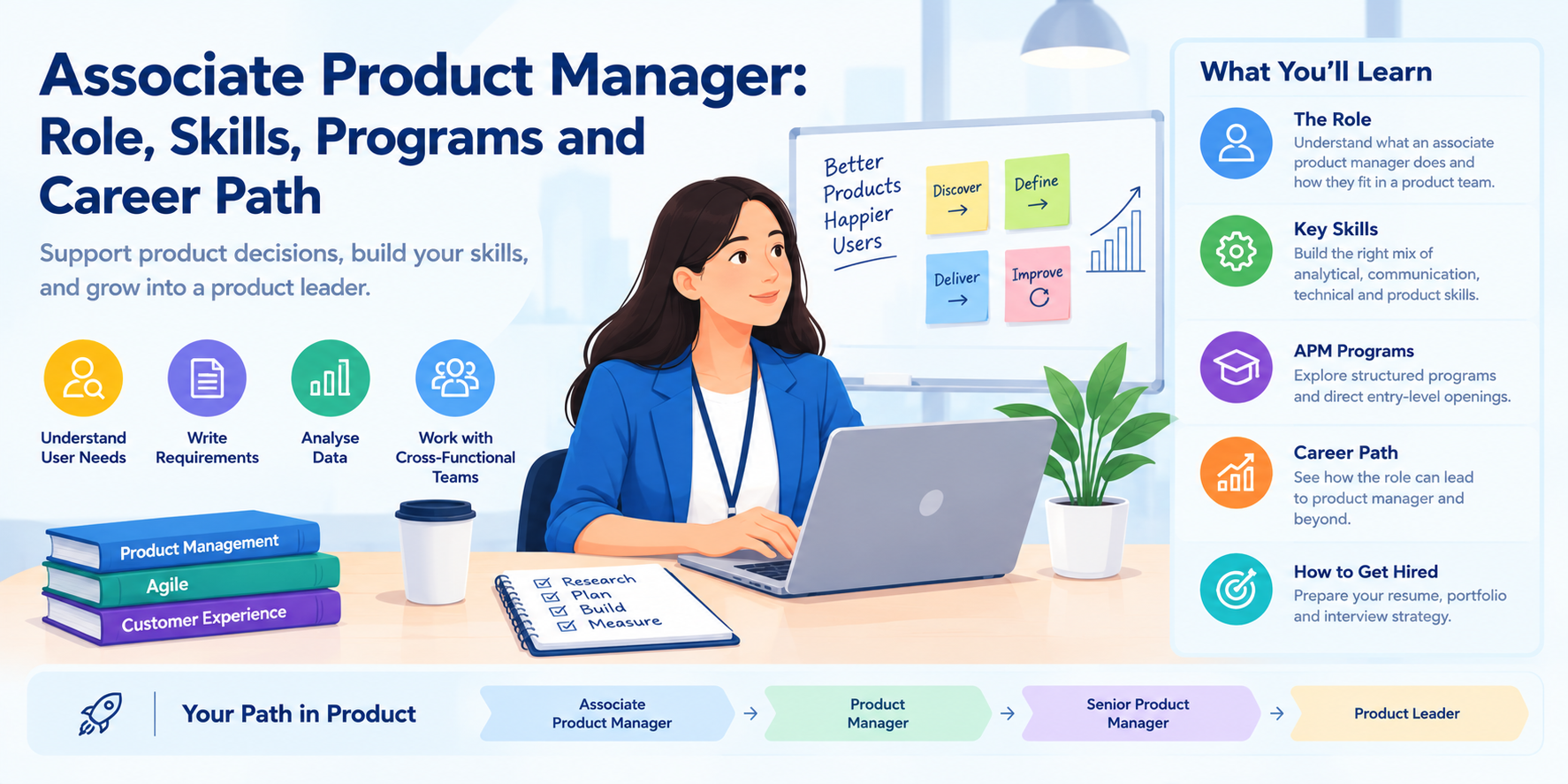
An associate product manager (APM) is an early-career product professional who supports product decisions while learning to own them. Working with experienced product managers, designers, engineers, and stakeholders, an APM researches user needs, writes requirements, analyses data, and drives defined features or initiatives. Associate product management is a common entry route into product management, with ownership growing as the APM proves judgment and delivers results.
Key Highlights of Associate Product Manager
- An associate product manager supports discovery, requirements, delivery, and measurement under the guidance of senior product people.
- Core associate product manager roles include user research, writing user stories, aligning engineering and design, and tracking outcomes.
- The most valuable product management skills are analysis, communication, customer empathy, prioritisation, and technical fluency.
- Associate product management programs, including rotational schemes, offer structured mentorship, while direct entry-level openings also exist.
- A small portfolio, a focused resume, and structured case practice matter more than any single credential.
- Progression to product manager depends on demonstrated ownership and outcomes, not on a fixed timeline.
Introduction
Every app on your phone began as someone’s decision about what to build, for whom, and why. The associate product manager is often the person learning to make that decision well.
If you are exploring this career, you probably have three questions. What does the role involve in practice? Which skills and experience help you get in? And where can the role lead? This guide answers all three, drawing on how associate product management works across technology companies, startups, and enterprise teams.
Unlike a typical entry-level product manager role, an APM is expected to learn quickly, back recommendations with evidence, and take ownership of small but real parts of a product. The APM works closely with the people described in our explainer on who is a product manager, so understanding that senior role helps you see what the APM is growing towards.
You will see where the APM sits in a product team, how the role differs from a product owner, which skills to build, how APM programs and associate product manager jobs are structured, how to prepare for interviews, and what a realistic product manager career path looks like. Titles and expectations vary by company, so treat the descriptions here as typical patterns rather than universal rules.
What Is an Associate Product Manager?
An associate product manager is an early-career member of a product team who helps shape what gets built and why, while learning product judgment from more experienced colleagues. Associate product manager roles typically cover a defined feature, a narrow product area, or a research-and-analysis workstream rather than an entire product. Decisions are made with guidance, and scope grows as the APM builds credibility. Some companies use the title junior product manager for a similar position.
Infographic : Associate Product Manager
Product management centres on discovering what customers need and making sure the team builds solutions that are valuable, usable, feasible, and viable. SVPG’s description of the product manager frames the job around those same product risks, which is a useful lens for understanding what an APM is learning to handle.
Where the APM Sits in a Product Team
An APM usually reports to a product manager, senior product manager, or group product manager. Day to day, the APM works with a small group: engineers who build the product, designers who shape the experience, analysts who help interpret data, and stakeholders from marketing, sales, support, or operations.
In a small company, the APM may report to a head of product and cover a lot of ground, from customer calls to release notes. Whereas in a large organisation, the APM may support one product manager and own a specific slice of the roadmap. In both cases, the APM is the person who keeps context organised, asks good questions and follows work through to a result.
APM vs Product Owner
The two titles are often confused. A product owner is an accountability defined in Scrum, centred on maximising product value and keeping the Product Backlog clear and ordered. A product manager role is broader, covering strategy, discovery, prioritisation and outcomes. Some companies combine the two, others keep them separate, and an APM may handle product owner tasks such as refining backlog items without being a Scrum product owner.
A fourth title also causes confusion. An associate product marketing manager focuses on positioning, messaging, launches, and go-to-market work, not on deciding what the product should do. The table below compares the four roles.
| Role | Typical focus | Scope of responsibility | How the role differs |
| Associate Product Manager | Learning and supporting product decisions | Defined features, research, analysis, or initiatives | Works with guidance while building ownership |
| Product Manager | Product direction and outcomes | Product goals, prioritisation, roadmap and delivery alignment | Broader decision-making responsibility |
| Product Owner | Product value and backlog management in Scrum | Product Backlog ordering and clarity | Accountabilities depend on the Scrum context and organisation |
| Associate Product Marketing Manager | Product positioning and market adoption | Messaging, launches, market and customer insights | More focused on go-to-market work |
These are typical distinctions, not universal job descriptions. Always read the responsibilities in a job advert rather than relying on the title alone.
Associate Product Manager Roles and Responsibilities
The responsibilities of an associate product manager follow the product lifecycle: understand a problem, define a solution, build it with the team, and check whether it worked. Scope varies by company, industry, and product maturity. A startup APM might touch everything from customer interviews to launch notes, while an APM at a large firm may specialise in one part of the journey. The table maps each core responsibility to the kind of output an APM typically produces.
| Responsibility | Example activity | Possible output |
| Discovery | Review user feedback and research findings | Synthesised user needs |
| Requirements | Draft a user story and acceptance criteria | Clear, testable requirements |
| Collaboration | Clarify scope with engineering and design | Shared understanding of a feature |
| Measurement | Review agreed product metrics | Findings and recommended next steps |
Check out more: Product Manager Certification Beginner’s Guide: Best Certification, Cost, Skills, Eligibility
Discovery and User Research
APMs help the team understand who the users are and what they struggle with. Typical tasks include:
- Reviewing support tickets, app store reviews, and survey responses
- Sitting in on, and later running, user interviews with a senior colleague
- Synthesising findings into themes and a clear problem statement
- Benchmarking how competitors solve the same problem
Good discovery separates what users say from what they actually do, and treats every idea as a hypothesis to test.
Writing Requirements and User Stories
Once a problem is understood, the APM documents it so the team can act. Writing user stories is a core craft. These user story templates and examples show the format in practice. For example: “As a returning customer, I want to reorder a previous purchase in one tap so that I save time.” The acceptance criteria might state that the reorder button appears on past orders and that unavailable items are flagged before payment.
- Drafting user stories, edge cases, and acceptance criteria
- Refining the backlog with the product manager
- Keeping requirement documents current as decisions change
Where a team runs Scrum, this work overlaps heavily with product owner responsibilities.
Working With Engineering and Design
An APM has no authority over engineers or designers, so influence comes from clarity and trust. Practical habits include:
- Explaining the user problem and context before proposing a solution
- Clarifying trade-offs between scope, time, and quality
- Joining sprint planning, stand-ups, and reviews, and answering questions quickly
- Bringing designers and engineers into discovery early
Collaboration is easier when you understand how systems fit together. APMs who enjoy that side of the work may later explore a technical product manager path.
Measuring Outcomes
Shipping a feature is not the goal; changing user behaviour or business results is. An APM typically:
- Agrees success metrics with the team before launch
- Builds or requests dashboards that track those metrics
- Reviews results, often with an analyst, and separates signal from noise
- Recommends whether to iterate, expand, or stop
Atlassian’s product management guide offers a clear overview of how these activities fit together in agile teams.
A Simple Example Workflow
Let us imagine an e-commerce app where many shoppers abandon checkout. The APM reviews support tickets and finds repeated complaints about re-entering address details (discovery). She writes a user story for saved addresses with acceptance criteria (requirements), walks engineers and the designer through the problem and agrees on a smaller first release (collaboration), and after launch compares checkout completion before and after (measurement). This hypothetical shows how the four responsibilities connect into one loop.
Skills Every Associate Product Manager Needs
Product management skills fall into three clusters: analytical, communication, and technical. Prioritisation, customer empathy, structured problem-solving and adaptability run through all three. Recruiters rarely expect mastery from an APM, but they do look for evidence. The table links each skill to why it matters and what a candidate can show.
| Skill | Why it matters | Example evidence |
| Data analysis | Helps evaluate problems and outcomes | A simple analysis of product or user data |
| Communication | Keeps teams aligned | A concise product brief |
| User research | Connects decisions to customer needs | A synthesised research summary |
| Technical fluency | Supports productive engineering discussions | A clear explanation of a feature or integration |
| Prioritisation | Helps compare competing needs | A reasoned feature-priority decision |
Analytical and Data Skills
APMs interpret metrics, ask testable questions and distinguish observations from assumptions. You do not need advanced statistics, but you should be comfortable with funnels, retention, conversion and basic experiments. Beginners can build these skills by:
- Learning SQL basics and practising on public datasets
- Analysing a product you use and proposing one measurable improvement
- Reading experiment write-ups and noting what the team concluded and why
A product management framework such as RICE prioritization or a value-versus-effort grid helps structure prioritisation, but the reasoning behind the score matters more than the number.
Communication and Stakeholder Skills
Most of the job is communication: concise writing, careful listening, explaining trade-offs and aligning people with different goals. To develop these skills:
- Write one-page briefs with a problem, evidence, recommendation, and risks
- Practise saying no with a reason, and offering an alternative
- Summarise meetings in writing with decisions and owners
Strong APMs make their thinking visible, so others can challenge it early rather than late.
Technical Fluency
Technical fluency means understanding the product architecture at a useful level, such as how APIs and integrations work and how engineering decisions affect users, not writing production code. Many APM positions do not require coding, although some, especially in developer-facing or platform products, expect more. To build fluency, ask engineers to explain recent trade-offs, read product documentation, and learn how a request moves through your product.
If you prefer structured learning, our product manager certification guide compares credentials and explains where each one fits.
Associate Product Management Programs
Associate product management programs are structured early-career schemes that develop new product people through mentorship, training, and varied assignments. They differ from ordinary entry-level product manager openings in three ways: they usually recruit in cohorts, include formal mentoring, and often rotate participants between teams. Many companies run an APM program, but names, eligibility, and application windows change, so always confirm details on the official page. The table lists well-known examples and what to verify.
| Program | Official source | What to verify |
| Google APM | Google Careers APM program | Current availability, eligibility, location, application window |
| Atlassian APM | Atlassian graduate APM program | Current intake, role expectations and location |
| Other relevant programs | Official employer pages | Program structure, eligibility and application requirements |
Not every program is rotational, and not every program runs every year, so avoid assuming.
How Rotational APM Programs Work
In a rotational product manager program, participants move between product teams, often every six to twelve months, so they see different products, users, and leadership styles. Typical features include a formal mentor, shared training sessions with the cohort, and projects of increasing scope. The benefit is breadth and a network inside the company. The trade-off is that you may change teams before seeing a project through from start to finish, so ask how rotation length and project ownership are handled.
What Programs Look For
Selection criteria differ, but programs commonly look for:
- Evidence of structured problem-solving and analytical reasoning
- Curiosity about users and products, shown through projects or side work
- Collaboration, leadership, and communication through internships, clubs, or teams
- Relevant technical or business grounding, depending on the program
The Google associate product manager program is one of the most searched examples. Google’s official page is the right source for its current eligibility, locations, and application timeline, because those details are updated by the company and can change between cycles. Treat third-party summaries as background only.
When evaluating any program, ask:
- Is there a formal mentor, and how often do you meet?
- What rotations are available, and how are projects assigned?
- How long is the program, and what happens afterwards?
- What does success look like at the end?
Before committing years to this route, it helps to confirm that it suits your goals. Our article on is product management a good career weighs the rewards and challenges honestly.
How to Become an Associate Product Manager
There is no single route into associate product manager jobs. Candidates arrive from computer science, business, design, analytics, consulting, operations, and customer-facing roles. The practical sequence below applies whether you are targeting an APM program or open associate product manager positions. The table summarises each step and the evidence that shows you are ready.
| Step | Action | Evidence of readiness |
| Learn the role | Review product responsibilities and examples | Can explain the product lifecycle |
| Build skills | Practise analysis and problem framing | Can support decisions with evidence |
| Create a portfolio | Document a product case study | Shows reasoning and trade-offs |
| Prepare applications | Tailor resume and examples to the role | Demonstrates relevant experience |
| Apply and practise | Track suitable jobs and rehearse interviews | Can communicate decisions clearly |
Learn the role and map your transferable skills: If you come from project delivery, note that managing a schedule differs from deciding what to build; our comparison of project management vs product management explains the shift in mindset. Analysts, designers and engineers bring different strengths, and every background has gaps to fill.
Build experience: Seek opportunities to work on product-adjacent tasks in your current job: analysing customer feedback, writing a feature brief, or coordinating a small launch. Internships and side projects count too.
Prepare a focused product manager resume: Lead with outcomes, not duties. Check that your resume:
- Quantifies results where honest numbers exist
- Shows decisions you influenced and the evidence you used
- Highlights cross-functional work with engineers and designers
- Matches the language of the job description without copying it
Search and apply: Look at official APM program pages, company career sites and job boards, and treat each application as a chance to learn. Entry requirements for associate product manager positions vary, so apply to roles that match your evidence, not only your ideal title.
Building a Product Portfolio
With limited formal experience, a portfolio lets you demonstrate thinking. A strong case study shows the problem, the research, the decision, the trade-offs, and the intended outcome. Project ideas include:
- A teardown of a product you use, with a prioritised list of improvements
- A small prototype or no-code tool that solves a real problem for real users
- A written case study of a feature you helped ship, with metrics
- A research summary based on five to ten user conversations
Keep each case study to a page or two, and be clear about your own contribution.
Certifications That Help
No certification is compulsory for associate product manager roles, but a recognised credential can structure your learning and signal commitment. Options include Scrum-based product owner certifications and broader product management certification programs. Choose one for the skills it teaches, such as backlog management and stakeholder communication, rather than as a shortcut to a job. We return to this in the training section later in this guide.
Associate Product Manager Interview Preparation
Interviews for associate product manager roles test how you think more than what you already know. Whether you apply through an APM program or to open associate product manager jobs, expect a mix of product sense, analytical, prioritisation, behavioural and execution questions. The table shows what each type may assess and how to prepare.
| Interview type | What it may assess | Preparation approach |
| Product sense | Understanding users and defining problems | Practise framing a problem before proposing solutions |
| Analytical | Reasoning with metrics and evidence | Explain assumptions and interpret results |
| Prioritisation | Trade-offs and decision-making | Compare options using explicit criteria |
| Behavioural | Collaboration, ownership, learning | Prepare truthful examples with outcomes |
| Execution | Planning and measuring delivery | Explain dependencies, risks and success metrics |
Interviewers are rarely looking for one correct answer. They want to see a clear structure, sensible assumptions, user empathy, and the willingness to adjust when new information appears.
A Sample Case and How to Approach It
Try this prompt: “How would you help new users of a food-delivery app place their first order?” A structured response might run as follows:
- Clarify the goal and context: Ask what success means, such as first-order conversion, and which users are in scope.
- Segment the users: Separate, for example, students, busy professionals, and families, and choose one to focus on, explaining why.
- Identify pain points: Consider discovery, trust, pricing, delivery time, and payment friction.
- Propose two or three solutions: For instance, a guided first-order flow, a first-order incentive, or curated popular dishes.
- Prioritise: Compare options by user impact, effort, and risk, and state your reasoning.
- Define success: Name a primary metric, a guardrail metric such as order cancellations, and how you would test the change.
Speak your thinking aloud, check in with the interviewer, and finish with a short recommendation.
Preparation Checklist
- Practise three to five product sense cases aloud, ideally with a partner who gives feedback
- Prepare four or five behavioural stories covering conflict, failure, influence, and learning
- Study the company’s products and identify one improvement you would propose
- Refresh basic metrics such as conversion, retention, churn and activation
- Rehearse a concise two-minute introduction that links your background to product work
Our guide to product manager interview questions includes example questions and answer approaches you can practise with.
For Google-specific preparation, separate official information from community advice. Google’s own APM program page describes what it publishes about eligibility and the application process, while interview write-ups from candidates reflect individual experiences and may be out of date. Use them to understand question styles, not to predict exact rounds.
Career Path After the APM Role
The product manager career path is not a fixed escalator. Progression depends on demonstrated ownership, product outcomes, organisational structure, and available openings. Many APMs become product managers within a couple of years, while others take longer or move sideways into specialisms. No company guarantees promotion after a set period, so focus on building evidence of impact.
Career Ladder Table
The table below is an illustrative ladder. Job titles and expectations vary widely between organisations.
| Career stage | Typical focus | Evidence of progression |
| Associate Product Manager | Supporting defined product initiatives | Reliable analysis and execution |
| Product Manager | Owning a product area or outcomes | Sound prioritisation and measurable results |
| Senior Product Manager | Handling broader or more complex problems | Strategic decisions and cross-team influence |
| Product leadership | Guiding teams, portfolios or product strategy | Organisational impact and leadership |
Beyond this core ladder, many people specialise as technical product managers, growth product managers, or in areas such as data and AI products. Others move into strategy, founding startups, or adjacent roles.
Salary Expectations by Level
Pay for associate product management roles depends on geography, company size, industry, the level of the role, and whether the position sits within a structured program. Compensation usually rises with scope and impact, and at senior levels a larger share may come from bonuses or equity. Because currencies, markets, and definitions differ, compare figures only when they come from the same country, the same level, and a recent source. For a closer look at how pay differs between product ownership and product management, read our comparison of product owner vs product manager salary.
How Product Owner Training Accelerates an APM Career
Product management and product ownership overlap but are not identical. Product management covers discovery, strategy and outcomes; product ownership, in Scrum, is an accountability for maximising the value of the product and managing the Product Backlog. Scrum.org’s explanation of the Product Owner sets out that accountability clearly. Not every APM role is a product owner role, but many APMs perform product owner tasks, so the training is relevant.
Structured product owner training can help an aspiring APM practise skills that are hard to learn alone, such as refining backlog items, prioritising with a clear rationale, writing user stories and communicating with stakeholders. It can also give you a shared vocabulary for agile teams. A certification supports learning and signals commitment, but it does not guarantee a job or replace real experience.
When choosing a course, look for these learning outcomes:
- Writing and refining user stories
- Prioritising work using a clear rationale
- Communicating product goals and backlog decisions
- Working with stakeholders and delivery teams
- Evaluating outcomes and incorporating feedback
Do you want hands-on practice with the above skills? If so, our CSPO certification training covers them through a Scrum-aligned curriculum.
Moreover, for the credential itself, the Scrum Alliance CSPO page is the official source for current requirements. Pair any certification with a portfolio case study so employers see applied skills, not just a certificate.
Conclusion
The associate product manager role is a realistic entry point into product management for people who combine user-focused thinking, clear communication, analytical skill, and practical evidence of their work. Choose between APM programs and direct openings, build a small portfolio, practise structured interviews, and verify details with official sources.
Now that the path from your first user story to product leadership is clear, what is the first step you will take this week? A sensible next move is to read our guide on who a product manager is or explore product owner training to start building proof of your skills.









 Lowest-Price Challenge












 Personalized Path



.webp)


 USA
 Canada
 India
 UK
 Australia
 Singapore


