


 Call Us



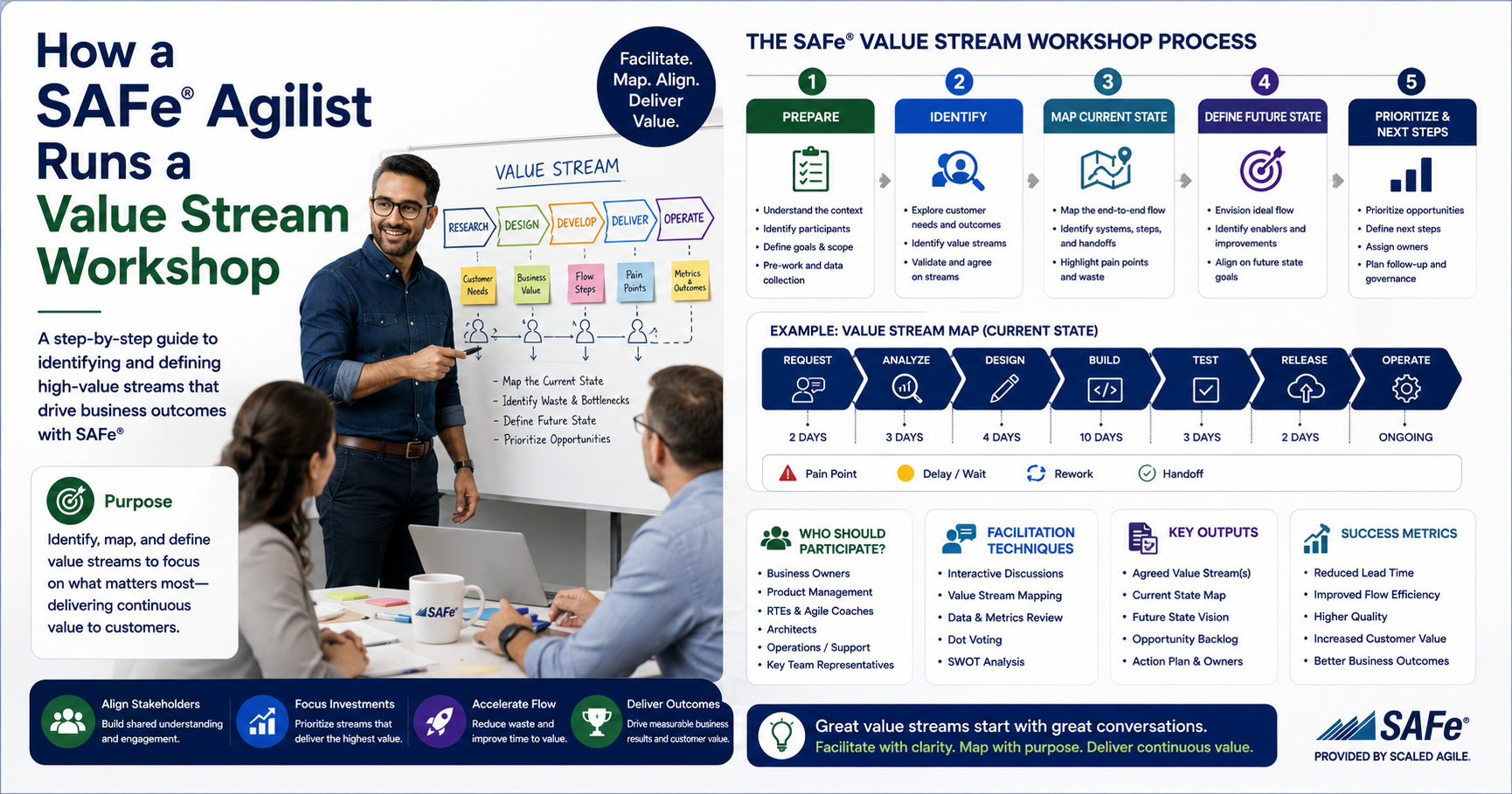
Value stream identification is the activity of working out what an organisation's development value streams are and which operational value streams they support. Running that workshop well is the single highest-leverage thing a SAFe Agilist does before an adoption starts, because every Agile Release Train drawn afterwards inherits whatever the workshop concluded. Get it wrong and you spend the next two years managing dependencies that should never have existed.
Key Highlights
- Scaled Agile defines value stream identification as identifying development value streams and the operational value streams they support.
- An operational value stream is the sequence of activities that delivers a product or service to a customer. A development value stream converts a business hypothesis into a digitally-enabled solution that delivers customer value.
- Value stream mapping is a different activity: identifying the individual steps in a workflow and the delays between them.
- Trains are organised around development value streams, so an error in the workshop becomes a structural error in the organisation.
- The most common workshop failure is starting from the organisation chart, which produces value streams that mirror departments and trains that depend on everything.
- Operational value streams should be identified before development ones, because the second exists to serve the first.
Identification against mapping
Two activities with similar names doing different jobs, and conflating them wastes a workshop.
Value stream identification asks what our value streams are. It is a discovery activity, run once at the start of an adoption and revisited when the business changes, and its output is a set of named value streams and the trains that will serve them.
Value stream mapping asks how work actually flows through one of them. Scaled Agile describes it as identifying the individual steps in a workflow and the delays between the steps. It is an improvement activity, run repeatedly, and its output is a picture of where time is lost.
The sequence is identification first, then mapping. You cannot map a value stream you have not identified, and organisations that jump to mapping usually end up mapping a department's internal process, which produces local optimisation and no structural change.
This article covers identification, since that is the one that determines how the organisation gets organised.
Operational before development
The ordering that most workshops get wrong.
An operational value stream is the sequence of activities that delivers a product or service to a customer. Processing an insurance claim. Opening an account. Getting a vehicle from order to delivery. These exist whether or not anyone has drawn them, and they are how the business actually makes money.
A development value stream converts a business hypothesis into a digitally-enabled solution that delivers customer value. These build and support the systems the operational streams run on.
The relationship is directional: development value streams exist to serve operational ones. Starting a workshop by asking what our development value streams are, without establishing the operational ones first, means the group has no criterion for judging their answers. They fall back on what they know, which is the organisation structure.
Starting with operational value streams gives the workshop an anchor outside the org chart, and it is usually the moment the room realises that three departments are all serving one customer journey badly.
Who needs to be in the room
The workshop fails on attendance more often than on facilitation.
You need people who know how the business actually delivers value to customers, which is usually operations and business leadership rather than technology. This is the constraint that determines whether the workshop can run at all, and it is worth delaying the session to get the right people rather than proceeding with the available ones. You need people who know what systems exist and how they connect, which is architecture. You need budget authority, because the output implies reorganisation and funding change. And you need enough seniority that decisions taken in the room hold afterwards.
What you do not need is every stakeholder. A workshop of forty people produces a diagram nobody owns.
The attendance failure that recurs is running it entirely within technology. A group of engineering leaders can describe the systems accurately and cannot describe the operational value streams, because those are business processes. The result is a set of development value streams organised around system boundaries, which is the org chart in a different costume.
Running the workshop
A sequence that works, and it takes longer than people schedule for.
Establish the customer. Not the internal stakeholder. The person or organisation that receives value and pays for it. Groups routinely name an internal department as the customer, and every subsequent step inherits that error.
Map the operational value streams. How does value reach that customer today, end to end, across whatever departments it crosses. Budget considerably more time for this than seems reasonable. Most organisations have never drawn it explicitly, so the drawing itself is contested, and the disagreements that surface about where a process actually starts and ends are usually the most valuable output of the day.
Identify the systems each one depends on. Which applications, platforms and services have to work for that operational stream to function. Architecture usually holds this and it is worth having prepared, since deriving it live consumes hours. Our guide to what an Agile Release Train is covers how these groupings eventually become trains.
Group the systems into development value streams. Where a set of systems is consistently needed by the same operational stream, and changes to them have to be coordinated, that is a candidate development value stream.
Size them into trains. A train should be able to deliver something end to end for its value stream without constant dependency on another train. Where a candidate value stream is too large for one train, it becomes a candidate for multiple trains with a coordination construct above them.
Test each one. Can this train deliver a meaningful change to a customer without a dependency on a train outside it. If not, the boundary is wrong.
That last test is the whole workshop compressed into one question, and it is worth applying repeatedly rather than once at the end.
The failure modes
Starting from the org chart. The dominant one. The group draws value streams that map to existing departments because that is the structure everyone already holds in their head. The output looks like a value stream diagram and behaves like a reorganisation of nothing.
Confusing systems with value streams. A large platform is not a value stream. It is a system that one or more value streams depend on. Organising a train around a platform produces a team that serves many masters and prioritises for none.
Too many value streams. Where the group produces fifteen, they have usually identified components rather than streams. Most organisations of any given size have far fewer than they first think.
Too few. The opposite error, producing one enormous value stream that cannot be served by a single train and does not decompose cleanly. Usually a sign the customer was defined too broadly.
Deciding it in a room without the business. Covered above, and worth repeating because it is the most common and the most expensive.
Treating the output as permanent. Value streams change when the business changes. Reviewing them every year or so is reasonable; treating the first workshop as settled forever is not.
Designing for the organisation you want rather than the one you have. A subtler failure and a common one in ambitious rooms. Value streams drawn against a future target operating model produce trains that cannot be staffed, because the people are still organised the old way. The workshop should describe how value reaches customers now, and the reorganisation follows from it rather than being assumed into it.
What good output looks like
Concrete tests you can apply to the result.
Each development value stream can be described in one sentence that a business person would recognise, without naming a system or a department.
Each has an identifiable operational value stream it serves.
Each can be served by one train, or by a defined set of trains with a coordination mechanism between them.
The number of value streams is small enough that a leadership group can hold all of them in mind at once. If the list needs a reference document to navigate, it is a component inventory rather than a set of value streams, and the trains drawn from it will inherit that fragmentation.
A change to a customer-facing capability can be delivered inside one value stream in most cases. Some cross-stream work is normal; constant cross-stream work means the boundaries are wrong.
Someone senior owns each one and can fund it.
If the output fails the last test, the workshop has produced a diagram rather than a structure, and the adoption will proceed with old funding through new shapes. That is the point at which the SAFe Implementation Roadmap stops being followed regardless of what the plan says.
Preparing for the workshop
Preparation determines the outcome more than facilitation does, and it is usually skipped.
Gather the customer-facing processes in advance. Not the org chart. However the organisation already describes its customer journeys, service catalogue or product lines. Walking into the room with these saves half a day of contested drawing.
List the major systems and who owns them. Architecture usually has this. It becomes the raw material for grouping into development value streams.
Find out where the money currently sits. Which budgets fund which work, and who approves what. This determines whether the output is implementable, and discovering it during the workshop derails the session.
Identify the sceptics and talk to them first. Value stream identification implies reorganisation, and the people whose teams would move will resist in the room unless they have been engaged beforehand. This is the single most useful piece of preparation and the one most often neglected.
Agree what happens with the output. A workshop with no decision path afterwards produces a diagram. Establishing in advance who takes the decision, and when, changes how seriously people participate.
Common questions the room will raise
Anticipating these keeps the session moving, since each can consume an hour if unprepared.
What about shared platforms? A platform used by several value streams is not itself a value stream. It is either a shared service supporting them, or a value stream in its own right where its consumers are internal. Both models exist and the choice depends on whether the platform has a distinguishable customer.
What about the people who work across several streams? They exist and their number should be minimised rather than accommodated. A person split across three value streams is a dependency in human form, and the framework's stable-team assumption assumes they are the exception.
What about work that does not fit any stream? Usually a sign the customer definition is too narrow, or that the work genuinely should not be happening. Both are useful findings.
Do we have to reorganise? Eventually, in most cases. Not immediately. A first train can be formed as a virtual structure while reporting lines catch up, and pretending otherwise loses the room.
How is this different from what we did last time? In organisations with a history of failed reorganisations this question is asked with justified scepticism. The honest answer is that the difference is whether funding follows the structure, and if it does not, this will indeed be the same as last time.
That last exchange is worth preparing for properly, because it is the moment the room decides whether to engage seriously, and the SAFe implementation roadmap sequences leadership commitment before this workshop precisely so the answer can be yes.
Why this is a leadership activity
It is tempting to treat this as an architecture exercise. It is not, and the reason is what the output implies.
Identifying value streams properly usually reveals that the current organisation is arranged around functions while value flows across them. Acting on that means changing reporting lines, budgets, or both. That is a leadership decision with real cost, and it cannot be taken by the people running the workshop unless they hold that authority.
This is why the roadmap sequences leadership commitment before value stream identification rather than after. A workshop run without that commitment produces an accurate picture that nobody can act on, and the organisation proceeds to draw trains around the org chart anyway, having spent two days confirming why it should not.
The connection between this activity and the leadership work is the substance of what Leading SAFe certification training covers in its later modules, and it is the part attendees most often say changed how they saw their own organisation.
After the workshop
The output is a decision, not a diagram, and what happens next determines whether the two days were worth anything.
Name an owner for each value stream. Someone senior who can fund it and is accountable for the value it produces. A value stream with no owner will not get funded differently, which means it will operate as a renamed department.
Decide which one goes first. Not all of them. The first Agile Release Train exists to surface wrong assumptions before they get replicated, and choosing the one with the clearest customer and the most contained dependencies gives the best chance of learning something usable.
Publish the map. People outside the room will be affected and will hear about it regardless. Controlling that communication is cheaper than correcting it later.
Set a review date. Six to twelve months. Value streams shift as the business does, and a map treated as permanent becomes wrong quietly.
Check the funding follows. This is the one that matters. If a value stream has been identified, given an owner, and is still funded through the same annual project cycle as before, nothing structural has changed. That is the point at which an adoption is decided, and it is usually decided by inaction rather than by a conscious choice.
How this connects to the exam
Value stream identification appears within the Lean Portfolio Management domain, which carries 25 to 28 percent of the SAFe Agilist paper and is jointly the largest.
The examinable content is the definitional part: the distinction between operational and development value streams, that trains are organised around development value streams, and that identification precedes train design. The workshop facilitation covered in this article is practice rather than syllabus.
That weighting is worth knowing, because candidates from a delivery background consistently under-revise portfolio material and it is a quarter of the exam. The free Leading SAFe practice test will show you quickly whether the value stream vocabulary is solid, and Leading SAFe certification training covers it alongside the rest of the portfolio content across the two days. Current certification costs are listed separately.
The one thing to get right
If a workshop achieves nothing else, it should establish who the customer is and how value reaches them today, across whatever departments that crosses.
Everything downstream follows from that. Development value streams are derived from operational ones. Trains are sized against development value streams. Dependencies between trains are determined by how well the boundaries were drawn. An error at the first step propagates through all of it and shows up two years later as a coordination problem nobody can solve, because the structure itself is generating it.
That is why this workshop is worth doing slowly and with the right people in the room, and why it belongs before the adoption rather than during it.
For the wider context of where this sits in an implementation, Leading SAFe certification training covers value stream identification alongside the rest of the framework across two days, and the free Leading SAFe practice test is a quick way to check how well you already hold the underlying vocabulary.






 Lowest-Price Challenge











 Personalized Path


.webp)


 USA
USA  Canada
  India
India  UK
UK  Australia
  Singapore


