


 Call Us



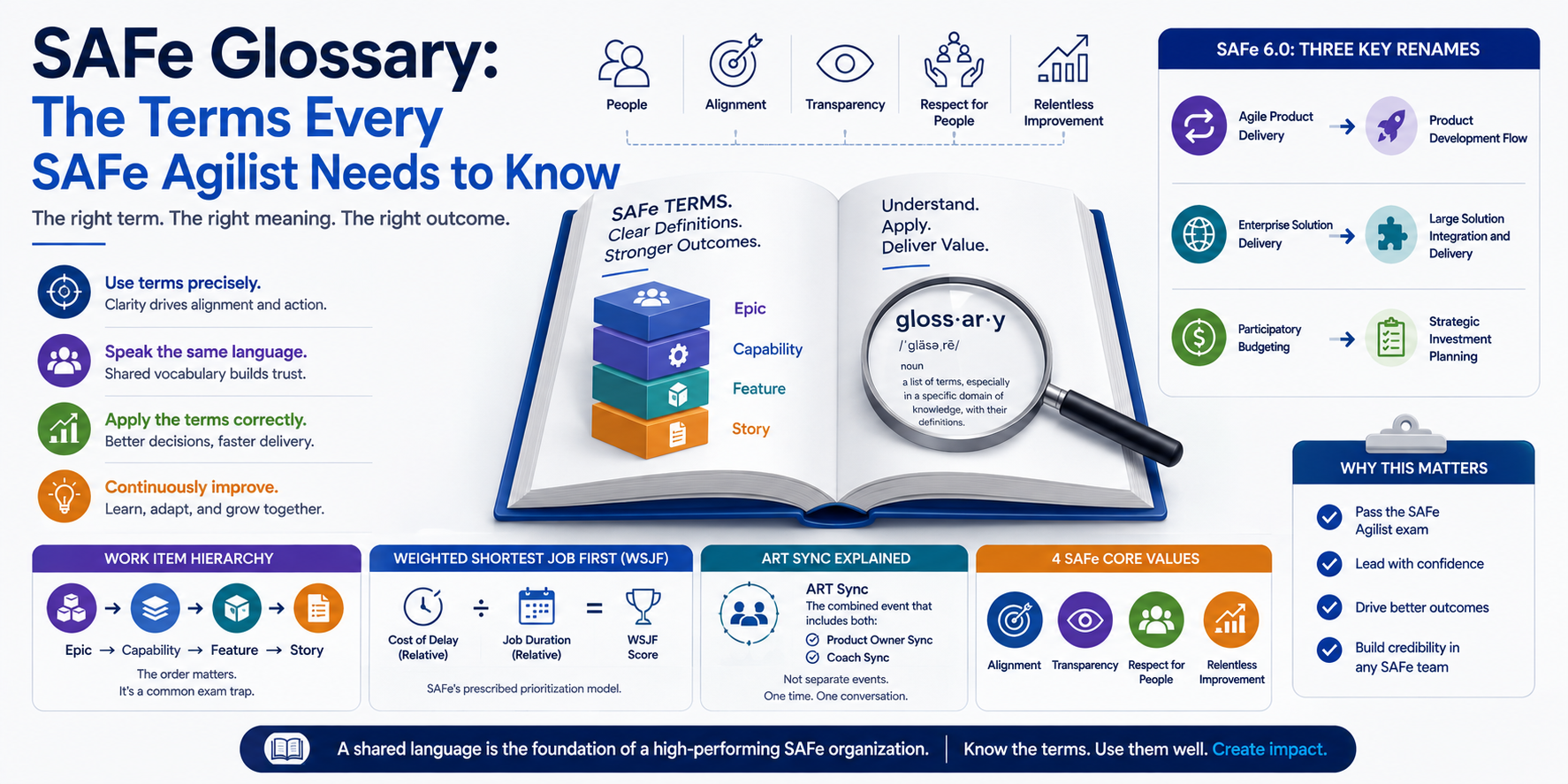
A SAFe Agilist needs roughly forty terms to follow any conversation in a SAFe organisation, and about a dozen of those carry a precise meaning that differs from how the same word gets used in ordinary Agile practice. Feature, capability, value stream and enabler are all ordinary English words with specific definitions inside the framework, and using them loosely is the fastest way to lose credibility in a room of practitioners. This glossary covers the terms that matter for the Leading SAFe course and the SAFe Agilist exam, grouped the way they actually come up.
Key Highlights
- Scaled Agile defines a Feature as functionality sized to be delivered by a single Agile Release Train within one Program Increment, while a Capability spans multiple ARTs and is still sized for one PI.
- The work item hierarchy runs Epic, then Capability, then Feature, then Story. Getting this order wrong is one of the most common errors on the SAFe Agilist exam.
- SAFe 6.0 renamed three significant terms: Agile Product Delivery became Product Development Flow, Enterprise Solution Delivery became Large Solution Integration and Delivery, and Participatory Budgeting became Strategic Investment Planning.
- The four SAFe Core Values are alignment, transparency, respect for people, and relentless improvement.
- Weighted Shortest Job First is calculated as relative cost of delay divided by relative job duration, and it is the only prioritisation model SAFe prescribes by name.
- ART Sync is the combined event that contains both the Product Owner Sync and the Coach Sync, which are frequently mistaken for separate calendar items.
Why the vocabulary carries more weight than it looks
Most frameworks tolerate loose language. SAFe does not, for a practical reason: the whole model depends on many teams agreeing what size a thing is before they commit to it. When a Feature means one thing to a product manager and something else to an architect, PI Planning produces a plan nobody can execute.
This is also why the SAFe Agilist exam leans on definitional precision. The questions rarely ask whether you like a practice. They ask whether you can tell a Capability from a Feature, or name which event produces which output. If you are preparing, our free Leading SAFe practice test is built around exactly this kind of distinction and takes a few minutes.
There is a second reason the vocabulary is worth learning properly rather than skimming. A large part of what a SAFe Agilist does after certification is translate between groups who do not share language: executives who talk in budgets and quarters, product people who talk in outcomes, and engineering teams who talk in capacity. The framework's terms are the shared middle. That translation work is most of the job, and it is the part Leading SAFe certification training spends its second day on.
What changed in SAFe 6.0
Start here, because a good deal of the material circulating online still uses the older names and it causes genuine confusion in interviews.
Scaled Agile renamed Agile Product Delivery to Product Development Flow. The concept did not change much, but the emphasis moved toward continuous flow of value rather than a delivery function.
Enterprise Solution Delivery became Large Solution Integration and Delivery. Again the substance is similar, covering the practices needed when a solution is too large for a single Agile Release Train.
Participatory Budgeting became Strategic Investment Planning. This is the collaborative process for allocating portfolio budget across value streams.
The framework also restructured how the core competencies of Business Agility are presented, consolidating and renaming several. Scaled Agile currently names Lean Portfolio Management, Team and Technical Agility, Product Development Flow, Large Solution Integration and Delivery, and Leadership and Culture. If you learned the older seven-competency model, expect the newer grouping in current course material. Worth confirming against the framework site immediately before an exam, since Scaled Agile revises this periodically.
How SAFe organises the work
Agile Release Train (ART). A long-lived team of Agile teams that develops, delivers and often operates one or more solutions within a development value stream. The ART is the central organising unit of SAFe, and most of the framework only makes sense once you understand it. Our guide to what an Agile Release Train is covers how one is formed and sized.
Program Increment (PI). A cadence-based timebox in which Agile Release Trains deliver value aligned to PI Objectives. Treat the PI as the planning heartbeat of the ART.
Value Stream. The full sequence of activities, along with the people, systems, information and materials, required to deliver value to a customer. SAFe distinguishes operational value streams, which deliver value to the end customer, from development value streams, which build the solutions the operational streams depend on. Leaders confuse these two constantly.
Solution Train. The construct used when a solution needs multiple ARTs working together.
SAFe configurations. The framework is presented in configurations of increasing scope, from Essential through Large Solution and Portfolio to Full SAFe. Essential is the minimum viable version and the one most organisations start with. Each configuration adds constructs rather than replacing them, so Large Solution adds the Solution Train and Portfolio adds Lean Portfolio Management on top of what Essential already defines.
The roles you will hear named
SAFe Agilist (SA). The credential earned by completing Leading SAFe. It signals that the holder understands the framework at the level needed to lead or participate in a transformation, rather than to run a single team.
Release Train Engineer (RTE). The servant leader and coach for the ART, responsible for facilitating ART events and processes and helping teams deliver value. The RTE is a distinct role with its own certification, covered in our SAFe RTE certification programme.
Product Management. Owns the ART Backlog and is accountable for what the train builds. Distinct from Product Owner, who works at team level.
System Architect. Defines the overall architecture and the enablers required to support it.
Business Owners. A small group of stakeholders with primary business and technical responsibility for the value delivered by the ART. They assign business value to PI Objectives during PI Planning, which is the single most misunderstood responsibility in the framework.
Epic Owner. Shepherds an Epic through the portfolio Kanban, from definition to implementation.
The events on the calendar
PI Planning. A cadence-based event for the entire ART that aligns teams and stakeholders to a shared mission and vision. It is the anchor event of SAFe, and if an organisation runs nothing else properly, it usually still runs this. Our PI Planning guide covers the two-day agenda in detail.
ART Sync. The event combining Product Owner Sync and Coach Sync. Candidates routinely list these as three separate events on the exam. They are not.
System Demo. Gives stakeholders an integrated view of the new Features delivered by all teams on the ART for the most recent iteration. The word integrated is doing real work in that sentence, since a System Demo is not a series of team demos played back to back.
Inspect and Adapt (I&A). Held at the end of each PI, where the current state of the solution is demonstrated and evaluated, and teams identify improvement backlog items. It has three parts: the PI System Demo, a quantitative and qualitative measurement review, and a problem-solving workshop that produces improvement items for the next PI backlog. Skipping the third part is what turns I&A into a status meeting.
Innovation and Planning (IP) Iteration. A dedicated iteration each PI that provides an estimating buffer for meeting PI Objectives, plus time for innovation, continuing education and planning. It is not a sprint for clearing carryover work, though a great many organisations quietly use it that way.
The work items, and the sizing that separates them
This is where precision matters most, and where the exam concentrates.
| Term | What it is | How it is sized |
| Epic | A significant solution development initiative | Requires a business case, tracked in a portfolio Kanban |
| Capability | Large solution functionality | Spans multiple ARTs, sized to fit within one PI |
| Feature | Functionality delivering business value and meeting a stakeholder need | Sized for a single ART within one PI |
| Story | A short description of small desired functionality from the user's perspective | Sized for one team within one iteration |
| Enabler | Work extending the architectural runway or improving the development value stream | Exists at every level above |
The hierarchy runs Epic, Capability, Feature, Story. An Enabler is not a fifth level. It is a type that can exist as an Epic, a Capability, a Feature or a Story, which is why exam questions about it trip people up.
Architectural Runway. The existing code, components and technical infrastructure needed to implement near-term Features with minimal redesign and delay. Enablers are how the runway gets extended, and runway is consumed as Features are built on it. That consumption and replenishment relationship is a favourite exam topic.
PI Objectives. The business summary of what each team and the train intend to deliver in the PI, with business value assigned by Business Owners. SAFe also distinguishes committed objectives, which the team is confident of delivering, from uncommitted objectives, which are included in the plan but excluded from the predictability measure. That distinction exists so teams can stretch without being punished for it.
The concepts a SAFe Agilist is expected to lead with
Business Agility. The ability to compete and thrive in the digital age by responding quickly to market changes and emerging opportunities with innovative, digitally enabled business solutions. This is the outcome the whole framework exists to produce, and it is the framing device for most of the Leading SAFe course.
Lean-Agile Mindset. The combination of beliefs, assumptions, attitudes and actions of leaders and practitioners who embrace Lean thinking and the Agile Manifesto. SAFe treats this as a leadership obligation rather than a team one, on the argument that teams cannot adopt behaviours their management structure penalises.
SAFe Core Values. Alignment, transparency, respect for people, and relentless improvement. Four, not five, and the order does not matter but the count does.
SAFe Principles. Ten principles underpin the framework, and they are the part of the syllabus most likely to appear as scenario questions rather than recall questions. Our breakdown of the SAFe Lean-Agile principles works through each with an example.
Weighted Shortest Job First (WSJF). The prioritisation model SAFe prescribes, calculated as relative cost of delay divided by relative job duration. Cost of delay is itself composed of user and business value, time criticality, and risk reduction or opportunity enablement. Our WSJF explainer covers the arithmetic and where teams misapply it.
Continuous Delivery Pipeline. The workflows, activities and automation that carry new functionality from ideation to on-demand release.
Lean Portfolio Management (LPM). Aligns strategy and execution by applying Lean and systems thinking to strategy and investment funding, portfolio operations, and governance.
Lean-Agile Leadership. Scaled Agile defines this as how leaders drive and sustain organisational change and operational excellence by empowering individuals and teams to reach their highest potential. It is the argument for why leaders have to change their own behaviour rather than instruct teams to change theirs, and Leading SAFe spends real time on it.
Built-in Quality. The principle that quality is designed into the increment as it is built rather than inspected in afterwards. In practice this covers flow, architecture, code and release quality, and it is the reason SAFe treats a definition of done as non-negotiable rather than aspirational.
Cadence and Synchronization. Two terms that always travel together and are frequently split apart in error. Cadence gives events a predictable rhythm. Synchronization makes multiple teams operate on that rhythm at the same time so their work can be integrated. Cadence without synchronization produces trains that plan regularly and still cannot integrate.
How SAFe measures progress
The measurement vocabulary changed materially in recent versions and it is worth knowing, because leaders are the audience for most of these numbers.
Scaled Agile organises measurement into three domains. Outcomes asks whether the solutions meet customer and business needs. Flow asks how efficiently the organisation delivers value. Competency asks how proficient the organisation is in the practices that enable agility.
Within the flow domain, SAFe names six flow metrics: flow distribution, flow velocity, flow time, flow load, flow efficiency and flow predictability. Flow load in particular is the one leaders under-use, since it measures work in progress and is usually the fastest explanation for why a train that looks busy is delivering slowly.
Lean Budgets. Funding value streams rather than projects, so money follows the flow of value instead of a fixed scope. Guardrails are the spending policies that keep that funding governed without reverting to project-level approval.
The reason a SAFe Agilist is expected to know these is that they are the language of the conversation with executives. Team-level metrics do not travel upward well, and the Leading SAFe certification training course covers how to frame delivery in terms leaders already use.
Two further terms worth pinning down, since both appear constantly and neither means what the ordinary English word suggests.
Enabler. Work that extends the architectural runway or improves the development value stream. It is a type rather than a level, and it exists at Epic, Capability, Feature and Story scale.
Guardrails. The spending policies that accompany lean budgets. Not approval gates. The distinction is that a guardrail defines what can be decided without asking, which is precisely the opposite of a gate.
Terms people routinely get wrong
Six that come up again and again, in interviews and on the exam.
PI is not a sprint. A Program Increment contains multiple iterations. It is a planning timebox, not a longer sprint.
Business Owners do not assign business value after the fact. They do it during PI Planning, and they do it with the teams present.
A System Demo is not a sprint review. It shows integrated functionality across the whole ART.
Capability is not just a big Feature. The distinction is that a Capability spans multiple ARTs. Size alone does not make something a Capability.
Enabler is a type, not a level. See the table above.
The IP Iteration is not a buffer for unfinished work. It is an estimating buffer plus dedicated innovation time, and using it to absorb carryover is the most common anti-pattern in the framework.
Cadence is not the same as synchronization. Cadence is the rhythm. Synchronization is multiple teams moving on that rhythm together. A train can have perfect cadence and no synchronization, and it will still fail to integrate.
Value stream is two different things. Operational value streams deliver value to the end customer. Development value streams build the solutions those operational streams run on. Asking which type someone means is usually the fastest way to unpick a confused conversation about value stream mapping.
How much of this the exam actually tests
The SAFe Agilist exam concentrates on the framework's structure and the leader's role within it, rather than on team-level mechanics. Expect definitional precision on the work item hierarchy, the events and their outputs, the roles and their accountabilities, and the principles applied to scenarios.
If you want to know where your gaps are before you book, the Leading SAFe practice test is the quickest diagnostic. For the exam format itself and how to prepare, our guide on how to pass the SAFe Agilist exam goes further.
Where to go next
Vocabulary is the entry fee rather than the qualification. What the Leading SAFe class adds is the reasoning behind the terms: why a Feature is sized to an ART and a PI, why Business Owners assign value in the room, and why the framework insists on cadence at all.
If you are working toward the credential, Leading SAFe certification training covers the full syllabus across two days and includes the SAFe Agilist exam attempt. The modules run from business agility and Lean-Agile leadership through team and technical agility, product development flow and portfolio management, closing on leading the change. You can check current Leading SAFe certification costs before booking. If you are still deciding whether the credential fits where you are heading, our comparison of SAFe Agilist and SAFe Scrum Master is the better place to start.





 Lowest-Price Challenge










 Personalized Path


.webp)


 USA
USA  Canada
  India
India  UK
UK  Australia
  Singapore


