


 Call Us



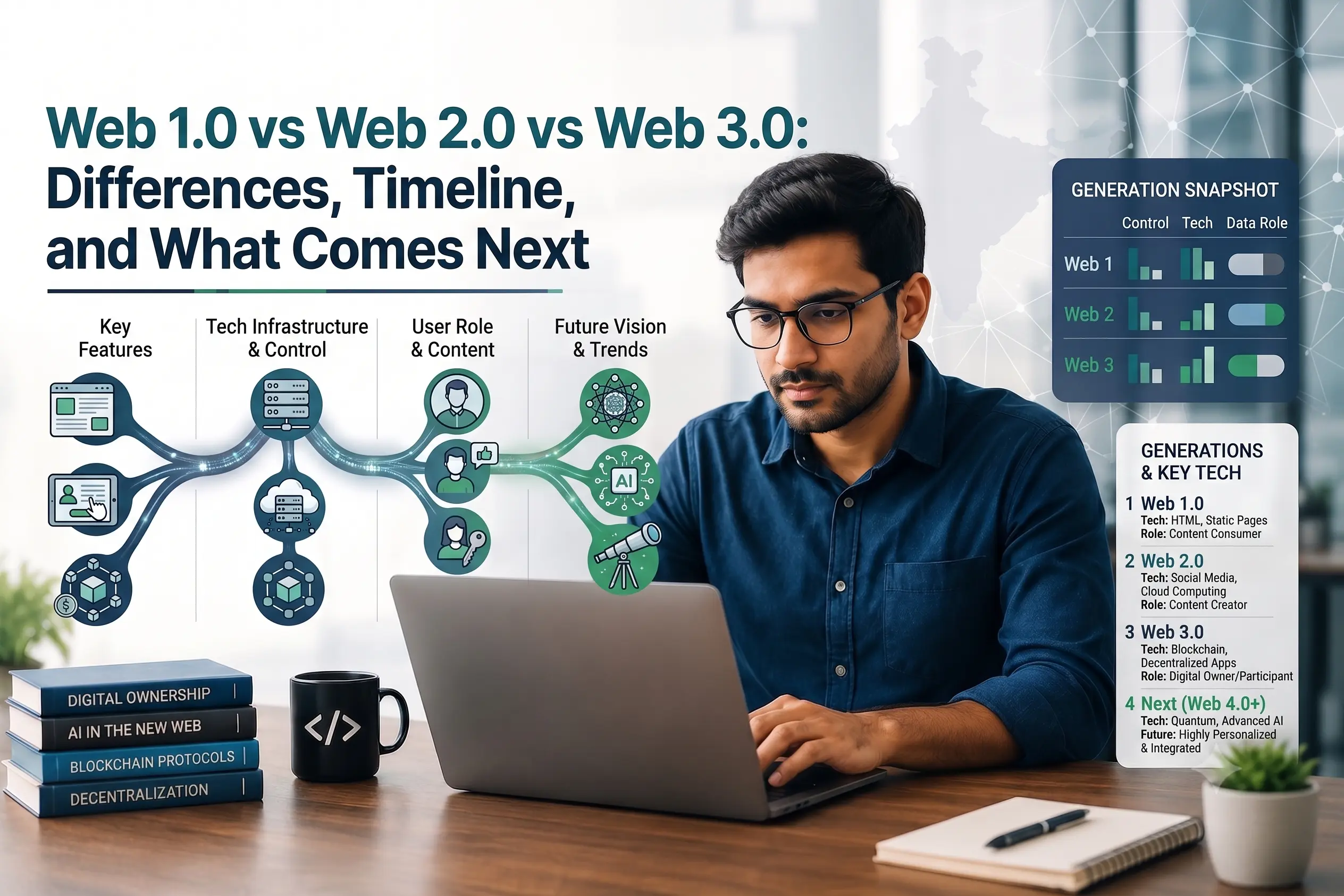
Web 1.0 (roughly 1991 to 2004) was a read-only web of static pages published by a small number of creators. Web 2.0 (2004 onward) turned the web into a read-write, participatory platform built on social media, blogs, and interactive apps powered by technologies like AJAX. Web 3.0, a term coined by Ethereum co-founder Gavin Wood in 2014, describes a proposed read-write-own web built on blockchain, decentralization, and token-based ownership, though it remains an evolving vision with limited mainstream adoption rather than a fully realized standard.
Key Highlights of Web 1.0 vs Web 2.0 vs Web 3.0
- Web 1.0 was static and read-only, built on basic HTML pages with little to no user interaction, dominant from roughly 1991 to the early 2000s.
- Web 2.0 introduced user-generated content, social networking, and dynamic interfaces, popularized after the term was coined during a 2004 O'Reilly Media brainstorming session.
- Web 3.0 (Web3) envisions a decentralized internet built on blockchain, smart contracts, and token ownership, a term first proposed by Gavin Wood in 2014.
- A separate, older concept called the Semantic Web, described by Tim Berners-Lee in 2001, is sometimes also referred to as "Web 3.0" but is a distinct idea focused on machine-readable data rather than blockchain.
- Global cryptocurrency ownership reached roughly 700 to 800 million people by 2025, yet daily active Web3 application users remain a small fraction of that number, showing a real gap between ownership and everyday use.
- Careers spanning blockchain development, smart contract security, decentralized application design, and Web3 product roles are growing, but they require a distinct skill set from traditional web development.
What Is Web 1.0
Web 1.0 refers to the earliest phase of the World Wide Web, spanning roughly from its public launch in 1991 through the early 2000s. It is often called the "read-only" web because the flow of information ran almost entirely in one direction: organizations, universities, and early businesses published static HTML pages, and visitors could only view or download that content. There were no comment sections, no user logins in the modern sense, and no way for an average visitor to publish their own content without knowing how to code a page and find server space.
Pages in this era were built with plain HTML and simple hyperlinks, often hosted on personal or institutional servers, framed with tables for layout, and updated infrequently because updating a page required manually editing and re-uploading files. Early directories and portals, personal home pages, and simple online brochures for businesses are the clearest examples of Web 1.0 in practice. Search was primitive by later standards, relying on keyword indexes rather than the ranking algorithms that came afterward.
The defining limitation of Web 1.0 was not the technology alone but the absence of a participation layer. Content creation was expensive and technical, so the web behaved like a digital library or catalog rather than a social space.
What Is Web 2.0
Web 2.0 describes the shift of the internet from a static publishing medium to an interactive, participatory platform. The term was popularized starting in 2004 after Dale Dougherty of O'Reilly Media raised it during a conference brainstorming session with MediaLive International, which led to the first Web 2.0 Conference later that year. Tim O'Reilly went on to formalize the concept, describing "the web as a platform" where value came from user participation and network effects rather than from static content alone.
The technical enabler most associated with this shift is AJAX (Asynchronous JavaScript and XML), a technique popularized in a widely read 2005 essay by Jesse James Garrett that allowed pages to update parts of themselves without a full page reload. This made web applications feel closer to desktop software, which in turn made richer, more interactive experiences practical at scale.
Concrete examples of the Web 2.0 era include:
- Social networking platforms such as MySpace (2003), Facebook (2004), YouTube (2005), and Twitter (2006), which turned users into publishers.
- Blogging platforms and wikis that let anyone contribute, edit, and comment on content.
- Web-based applications delivered through the browser, supported by RSS feeds, APIs, and "mashups" combining data from multiple sources.
- Rich interface technologies of the time, including AJAX, Adobe Flash, and later JavaScript frameworks, that made pages feel dynamic rather than static.
Web 2.0 also introduced a structural trade-off that later shaped the Web3 conversation: the platforms enabling participation, such as large social networks and search engines, became centralized gatekeepers that owned and monetized the data users generated.
What Is Web 3.0
"Web 3.0" is used in two related but distinct ways, and conflating them is one of the most common sources of confusion in explainer content on this topic.
The first and older use comes from Tim Berners-Lee, inventor of the World Wide Web, who described a "Semantic Web" in a 2001 Scientific American article co-authored with James Hendler and Ora Lassila. That vision imagined a web where data carried machine-readable meaning, so software agents could interpret and act on information across sites without human intervention, using standards such as RDF and OWL. This version of "Web 3.0" is about making data smarter and more structured, not about decentralization or blockchain.
The second and now more commonly referenced use is Web3, a term coined by Gavin Wood, co-founder of Ethereum and later founder of Polkadot, in an April 2014 blog post titled "DApps: What Web 3.0 Looks Like." Wood's Web3 describes an internet built on blockchain infrastructure, cryptographic verification, and peer-to-peer consensus rather than centralized servers controlled by a handful of large technology companies. In this framing, users hold and control their own identity, data, and digital assets through cryptographic keys instead of a corporate login.
Key technologies associated with this Web3 vision include:
- Public blockchains such as Ethereum, which host programmable smart contracts.
- Decentralized applications (dApps) that run on blockchain networks instead of a single company's servers.
- Cryptocurrencies and tokens used for payments, governance, and incentive design.
- Decentralized finance (DeFi) protocols that replicate lending, trading, and insurance without a central intermediary.
- Decentralized storage and identity systems intended to reduce reliance on centralized cloud providers and logins.
- Artificial intelligence and machine learning layered on top of these systems, which some proponents describe as making the web more contextually aware.
In practice, most current usage of "Web 3.0" or "Web3" in marketing and media refers to Wood's blockchain-centric vision, while the Berners-Lee semantic web idea continues on a separate, largely academic and standards-driven track.
Web 1.0 vs Web 2.0 vs Web 3.0 Comparison Table
| Attribute | Web 1.0 | Web 2.0 | Web 3.0 |
| Approximate era | Early 1990s to early 2000s | Mid-2000s to present | Emerging since 2014, still developing |
| Core model | Read-only | Read-write | Read-write-own |
| Content creation | By site owners only | By all users | By users, verified and owned via cryptography |
| Data control | Held by site owner | Centralized in platform companies | Distributed among users via blockchain, in theory |
| Underlying technology | Static HTML, basic hyperlinks | AJAX, JavaScript frameworks, APIs, databases | Blockchain, smart contracts, cryptographic wallets |
| Representative examples | Early personal home pages, static company brochures, early portals | Facebook, YouTube, Wikipedia, blogging platforms | Ethereum dApps, DeFi protocols, NFT marketplaces, DAOs |
| Monetization model | Minimal, mostly informational | Advertising and data monetization by platforms | Tokens, transaction fees, protocol-level incentives |
| Primary criticism | Limited interactivity and access to publishing | Data centralization and privacy concerns | Scalability, usability, speculation, and unclear real-world utility |
Timeline and History of the Web Generations
- 1989 to 1991: Tim Berners-Lee proposes and then implements the World Wide Web at CERN, laying the technical foundation for all later generations.
- Early to mid-1990s: The Web 1.0 era begins in earnest with static HTML pages, early browsers, and the first wave of commercial websites.
- 1999: Designer Darcy DiNucci uses the phrase that would later evolve into "Web 2.0" in an article discussing the web's coming interactive shift.
- 2001: Tim Berners-Lee, James Hendler, and Ora Lassila publish "The Semantic Web" in Scientific American, describing a machine-readable future web, an idea some later also labeled "Web 3.0."
- 2004: Dale Dougherty and Tim O'Reilly popularize "Web 2.0" at a conference brainstorming session, and the first official Web 2.0 Conference is held in San Francisco.
- 2003 to 2006: Major social platforms launch in quick succession, including MySpace, Facebook, YouTube, and Twitter, cementing the participatory Web 2.0 model.
- 2005: Jesse James Garrett publishes his influential essay naming and describing AJAX, the technical backbone of many Web 2.0 applications.
- 2008 to 2009: Bitcoin's whitepaper and network launch introduce blockchain to a wider audience, setting the stage for later Web3 development.
- 2014: Gavin Wood publishes "DApps: What Web 3.0 Looks Like," coining the modern blockchain-based definition of Web 3.0 / Web3.
- 2015: Ethereum launches, providing the programmable smart contract platform on which most Web3 applications are later built.
- 2020 to 2022: Interest in Web3, NFTs, and DeFi surges, accompanied by major venture capital investment and mainstream media attention.
- 2022 to present: A market correction and increased regulatory scrutiny prompt renewed debate about how much of Web3 reflects genuine technical progress versus speculative hype, alongside continued protocol development.
Current State of Web3 Adoption
Ownership of crypto assets, which is the closest available proxy for Web3 reach, has grown substantially. Industry tracking estimates put global cryptocurrency ownership at somewhere in the range of 560 million to over 700 million people by 2025, representing a meaningful share of the global internet population. Total value locked across decentralized finance protocols has also grown into the hundreds of billions of dollars at various points, reflecting real capital moving through these systems.
That said, ownership does not equal active usage of decentralized applications. Estimates of global monthly active wallet-connected dApp users are far smaller than the number of people who simply hold a cryptocurrency balance, often cited in the single-digit millions range. This gap between wallet ownership and habitual, wallet-connected application use is one of the clearest signals that Web3, as an everyday computing paradigm, is still early rather than mainstream. Most people who own crypto assets today are doing so as an investment or speculative holding, not as a replacement for their everyday web-browsing, social, or productivity habits.
Enterprises have continued to experiment with blockchain for supply chain tracking, digital identity, and tokenized assets, and interest in combining Web3 infrastructure with artificial intelligence has picked up as both fields mature. Whether this results in a full transition to a "Web3 internet" or a narrower set of blockchain-powered features bolted onto the existing Web 2.0 web remains an open question among researchers and technologists.
Criticisms and Skepticism Around Web3
Web3 has attracted substantial skepticism alongside its enthusiasm, including from some of the very people credited with earlier web transitions. Tim O'Reilly, who popularized the Web 2.0 term, has publicly described much of the Web3 hype as naive, arguing that decentralization claims often do not hold up once a project is examined closely.
Common criticisms raised by researchers, technologists, and journalists include:
- Questionable decentralization: Many applications marketed as decentralized still depend on centralized infrastructure providers, exchanges, or a small number of validator nodes, undermining the core promise.
- Scalability limits: Public blockchains have historically struggled to match the transaction throughput and low latency of centralized systems at consumer scale.
- Usability barriers: Managing private keys, gas fees, and wallet security remains far more complex for an average user than a simple username and password login.
- Speculation and scams: A significant share of Web3 activity, particularly around NFTs and low-quality tokens, has been characterized by industry commentators as speculative or fraudulent rather than genuinely utility-driven.
- Environmental concerns: Earlier proof-of-work blockchain models drew criticism for high energy consumption, though many networks have since shifted to less energy-intensive consensus mechanisms.
None of this means blockchain technology lacks legitimate use cases. It means the gap between the Web3 vision and its current, everyday reality is still wide, and treating every blockchain claim as settled fact is not a defensible reading of the evidence.
Career and Skills Angle
Regardless of where the Web3 hype cycle eventually settles, the underlying technical skills tied to each web generation remain commercially relevant. Professionals coming from a traditional web background can build on existing strengths while adding targeted skills for the areas seeing real hiring demand:
- Foundational web and digital skills: HTML, CSS, and JavaScript fundamentals from the Web 1.0 and Web 2.0 eras remain the baseline for almost every technical and marketing role built around the web.
- Web 2.0-era skills: Front-end frameworks, API integration, content and social media strategy, and digital marketing remain core, in-demand professional skill sets, with strong overlap into generative AI applications that are now layered on top of existing platforms.
- Web3-era skills: Smart contract development, blockchain architecture, cryptography, and security auditing are the most sought-after technical skills in the Web3 job market, alongside product and community roles specific to decentralized projects. A practical starting point for professionals new to this space is a structured introduction to blockchain technology course that covers core concepts before moving into specialized development work.
- Security skills across all eras: As more sensitive data and financial value move onto both centralized and decentralized systems, credentials such as CISSP certification training remain relevant for professionals responsible for securing systems that bridge Web 2.0 infrastructure with emerging Web3 components.
For most professionals, the pragmatic approach is not choosing one web generation over another but building layered skills, since Web 2.0 platforms and Web3 protocols are increasingly expected to interoperate rather than replace one another wholesale in the near term.
Frequently Asked Questions
1. What is the simplest way to describe the difference between Web 1.0, Web 2.0, and Web 3.0?
Web 1.0 is read-only, Web 2.0 is read-write, and Web 3.0 aims to add ownership, often summarized as read-write-own, though Web 3.0 remains a developing vision rather than a finished standard.
2. Who actually coined the term Web 3.0?
The modern, blockchain-based definition was coined by Gavin Wood, co-founder of Ethereum, in an April 2014 blog post. A separate, earlier concept called the Semantic Web was described by Tim Berners-Lee in 2001 and is sometimes also referred to as an early version of Web 3.0, though it is a different idea focused on machine-readable data rather than blockchain.
3. Is Web 3.0 the same thing as the metaverse?
No. Web3 refers specifically to decentralized, blockchain-based internet infrastructure, while the metaverse refers to immersive, often 3D virtual environments. The two concepts are frequently discussed together and can overlap in specific products, but they describe different things.
4. Are we currently using Web 2.0 or Web 3.0?
The vast majority of everyday internet use today, including social media, search, and streaming, still runs on Web 2.0 infrastructure. Web3 applications exist and have real users, but they remain a small fraction of overall internet activity as of 2026.
5. What made Web 2.0 possible from a technical standpoint?
The widespread adoption of AJAX, described in Jesse James Garrett's 2005 essay, along with maturing JavaScript, APIs, and database-backed content management systems, allowed pages to update dynamically and support user-generated content at scale.
6. Why are some technologists skeptical of Web3?
Critics, including Web 2.0 pioneer Tim O'Reilly, point to inconsistent decentralization, high complexity for average users, scalability limitations, and a history of speculative or fraudulent projects as reasons to treat Web3 claims with caution rather than accept them uncritically.
7. Do I need to learn blockchain to have a relevant tech career in 2026?
Not necessarily. Traditional web, cloud, security, and AI skills remain in high demand on their own. Blockchain and Web3 skills are valuable additions for specific roles and industries rather than a universal requirement.
8. What comes after Web 3.0?
Some commentators speculate about a "Web 4.0" or "Web 5.0" combining AI, spatial computing, and decentralization, but these remain informal, contested labels rather than established industry standards.
Key Takeaways
- Web 1.0, Web 2.0, and Web 3.0 describe distinct phases in how the web has handled content creation, interactivity, and data ownership, not strict version numbers with fixed start and end dates.
- Web 1.0 was a static, read-only web of the 1990s and early 2000s built on plain HTML pages.
- Web 2.0, popularized from 2004 onward, introduced user-generated content, social platforms, and interactive applications powered by AJAX and related technologies.
- The term Web 3.0 has two distinct meanings: Tim Berners-Lee's 2001 Semantic Web concept and Gavin Wood's 2014 blockchain-based Web3 vision, and most current usage refers to the latter.
- Global crypto ownership has grown into the hundreds of millions of people, but active, everyday use of decentralized applications remains far smaller, showing Web3 is still an early-stage transition rather than a completed one.
- Serious, well-documented criticisms around decentralization, usability, scalability, and speculation mean Web3 claims deserve scrutiny rather than uncritical acceptance.
- Professionals benefit most from layering skills across generations, combining foundational web and digital skills with targeted blockchain, security, or AI capabilities depending on career goals.








 Lowest-Price Challenge











 Personalized Path


.webp)


 USA
USA  Canada
  India
India  UK
UK  Australia
  Singapore


