


 Call Us



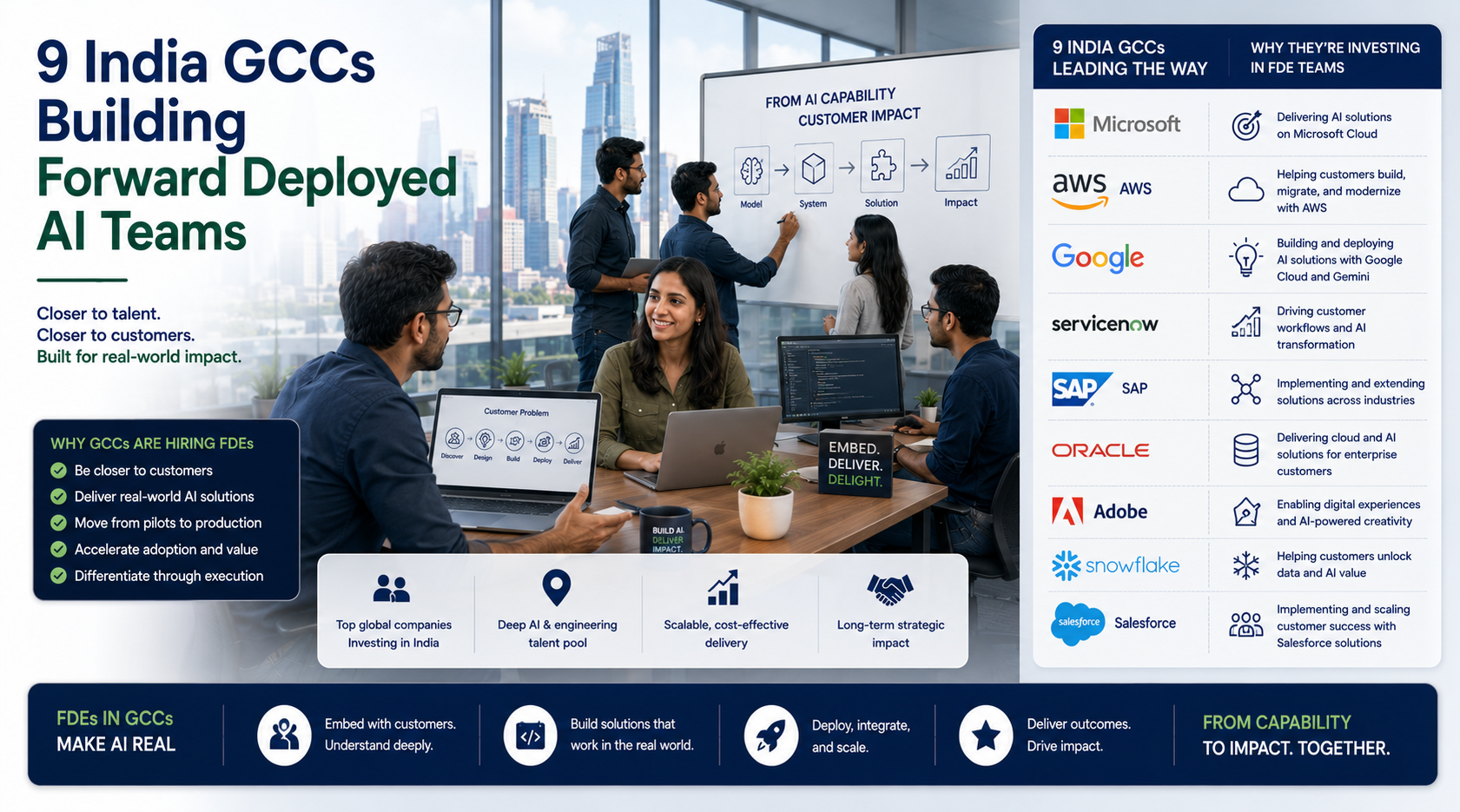
The fastest-growing source of forward deployed work in India is one that most job seekers overlook: the global capability centre. As large global enterprises race to deploy AI across their worldwide operations, their India-based centres have become engines of exactly the kind of embedded, make-it-work-in-the-real-environment engineering that defines forward deployed work, even when the roles are not always labelled that way. This piece explains why India GCCs are building forward-deployed-style AI teams, which centres and parent companies are leading, and why this route deserves the attention of any India-based engineer thinking about the role.
The GCC route matters because it represents a large, growing, and underappreciated pool of forward deployed opportunity situated in India, with the stability of established global enterprises. Building the capability this work requires, through the Forward Deployed Engineering Program, positions you for a source of opportunity that is expanding rapidly as GCCs turn AI-first.
Key Highlights
- India GCCs, the local centres global enterprises run to build technology for their worldwide business, are increasingly building AI deployment teams.
- The vast majority of new GCCs and GCC roles now carry an AI-first mandate, making them a large and growing source of AI engineering work.
- The work of deploying AI across a large enterprise's real operations is forward deployed work in substance, even when not titled that way.
- Bengaluru and Hyderabad dominate GCC activity, with Hyderabad rising fast, and Pune, Chennai, and Gurugram also significant.
- The GCC route offers forward-deployed-style work with the stability of an established global enterprise, situated in India.
Why GCCs are becoming forward deployed engines
To understand the opportunity, start with what a global capability centre is: an India-based operation that a global enterprise runs to build and manage technology for its worldwide business, rather than outsourcing that work to a vendor. These centres have grown from cost-focused back offices into strategic engineering hubs, and the latest wave of that evolution is a decisive turn toward AI. As enterprises everywhere try to deploy AI across their operations, their GCCs have become the places where much of that deployment work actually happens.
This turns GCCs into forward deployed engines, because deploying AI across a large, complex enterprise's real operations is forward deployed work in substance. The engineer in a GCC who takes a capable AI tool and makes it work inside the company's messy, specific, global infrastructure is doing exactly what a forward deployed engineer does, embedding with the real environment, understanding how the organisation actually works, and bridging the gap between AI capability and real deployment. The main difference is that the customer is internal, the enterprise itself, rather than an external client, but the nature of the work is the same. This is why GCCs are quietly becoming one of the largest sources of forward-deployed-style work in India, a shift that mirrors the broader reason enterprise AI pilots stall and need someone to bridge the gap.
The scale of the AI-first shift
The turn toward AI in India's GCCs is not a marginal trend but a dominant one, which is what makes the opportunity so large. The great majority of new GCC roles being created now require AI, data science, or intelligent automation skills, and the overwhelming majority of GCCs newly launched carry an AI-first mandate, meaning AI is central to their purpose rather than a side project. This represents an enormous and rapid redirection of India's GCC engineering capacity toward AI.
For an engineer, this scale matters because it means AI deployment work in GCCs is not a niche but a mainstream and growing category. India's GCC sector employs a vast and rising number of people, and as the mandate turns AI-first, a large and increasing share of that capacity is directed toward exactly the kind of AI deployment work that defines the forward deployed role. Engineers with production-system experience in AI and machine learning are among the most competed-for profiles in this hiring, which reflects how central real deployment capability has become. The sheer scale of the AI-first shift in India's GCCs makes this one of the largest pools of forward-deployed-style opportunity anywhere, which is why it deserves the attention of India-based engineers considering the role and connects to the broader industries hiring for the work.
Bengaluru and Hyderabad: the leading hubs
GCC activity in India concentrates in particular cities, and understanding the geography helps an engineer target the opportunity. Bengaluru remains the dominant hub, accounting for the largest share of GCC hiring and continuing to grow, cementing its position as the centre of India's GCC ecosystem. Its deep talent pool, established ecosystem, and concentration of technology companies make it the natural home for many of the AI-focused GCCs, and it remains the first place to look for GCC forward deployed work.
Hyderabad has risen rapidly to become the second major hub, recently outpacing Bengaluru in the number of new GCC setups even as Bengaluru leads in total hiring. Hyderabad's growth reflects deliberate investment and a strong emerging ecosystem, and it has attracted major AI-focused GCC expansions. For an engineer, this means Hyderabad is a fast-growing source of new opportunity, often with the energy of a rising hub. Together, Bengaluru and Hyderabad dominate India's GCC landscape, and an engineer pursuing GCC forward deployed work will find the greatest concentration of opportunity in these two cities, which host the AI-focused centres of many global enterprises and continue to attract new ones.
Pune, Chennai, and Gurugram: the growing centres
Beyond the two leading hubs, several other Indian cities host significant and growing GCC activity, broadening the geography of the opportunity. Pune has a strong and established GCC presence, with many global enterprises running centres there, and it offers a substantial base of technology and engineering work including the growing AI deployment category. Its combination of talent, established ecosystem, and quality of life makes it an attractive location for both enterprises and engineers.
Chennai hosts a meaningful GCC presence with particular strengths in certain industries, and it participates in the broader AI-first shift as its centres adopt AI mandates. Gurugram, in the National Capital Region, is another significant hub, hosting the GCCs of many global enterprises, particularly in finance and consulting, which are increasingly building AI deployment capability. For an engineer, these cities broaden the geography of GCC opportunity beyond Bengaluru and Hyderabad, offering forward-deployed-style work in additional locations that may suit different circumstances. While the two leading hubs concentrate the most opportunity, the presence of significant GCC activity in Pune, Chennai, and Gurugram means the GCC route is available across several major Indian cities, which widens the practical opportunity for engineers based in different parts of the country.
The enterprises building these teams
Specific global enterprises are leading the way in building AI deployment teams in their India GCCs, and knowing them helps an engineer target the opportunity. Global retailers such as Walmart and Target run large India GCCs that hire engineers to deploy AI across their vast global retail and supply-chain operations, which is substantial forward-deployed-style work given the scale and complexity of those operations. Their GCCs are significant employers of AI and engineering talent in India.
Global financial institutions such as Goldman Sachs and UBS run major India GCCs that are increasingly building AI capability, deploying AI across their global financial operations, with UBS notably expanding its Hyderabad presence with a large hiring plan spanning technology and AI-led capabilities. Beyond these, a broad range of global enterprises across industries, from technology to manufacturing to consulting, run India GCCs that are turning toward AI deployment. For an engineer, these enterprises represent concrete targets: large, established global companies building real AI deployment teams in India, offering forward-deployed-style work with the stability and scale of a major enterprise. The companion guide on India companies hiring for the role covers the broader set of employers, of which these GCCs are a large and growing part.
Why the GCC route suits many engineers
The GCC route has characteristics that make it particularly well suited to many India-based engineers, and understanding them helps you judge whether it fits you. First, it offers forward-deployed-style work with the stability of an established global enterprise, which appeals to engineers who want the substance of the role without the volatility of a startup or the fierce competition of a global remote role. Second, it is situated in India, at a major enterprise's India centre, which suits engineers who want to build a career in India rather than compete in a global pool or relocate.
Third, the internal-customer nature of GCC work, deploying AI within the enterprise rather than for external clients, means somewhat less of the heavy external travel that characterises client-facing forward deployed roles, which suits engineers for whom travel is a constraint. And fourth, the sheer scale and growth of the AI-first GCC shift means there is a large and increasing volume of this work, which improves the odds for a capable engineer. These characteristics make the GCC route a strong fit for many, particularly those who value stability, an India base, and lighter travel, while still doing genuine AI deployment work. It is a different proposition from the client-facing external role, and for many engineers a more accessible and sustainable one, while still building the same core capability that the Forward Deployed Engineering Program develops.
How to break into GCC forward deployed work
Given the scale of the opportunity, a practical question is how an engineer actually breaks into GCC forward deployed work, and the approach differs somewhat from pursuing a client-facing external role. The first step is to identify the GCCs that fit, which means looking at the large global enterprises running AI-focused centres in the cities accessible to you, and understanding which ones are actively building AI deployment capability. Because the work is often not titled forward deployed engineer, you have to look past titles at the substance, seeking roles that involve deploying AI across the enterprise's real operations, whatever they are called.
The second step is building the genuine capability these roles require, which is the same core forward deployed skill set, understanding a complex environment, integrating AI into it, and making it deliver, applied to the enterprise as the internal customer. GCCs increasingly compete for engineers with real production AI experience, so demonstrable capability matters. The third is targeting deliberately, since GCC roles, like other forward deployed roles in India, are often reached through networks and targeted applications rather than mass job boards. An engineer who identifies the right AI-focused GCCs, builds the real capability, and targets them deliberately is well positioned for a large and growing pool of opportunity, and the broader set of India employers hiring for the role provides the wider context for where GCCs fit. The capability itself is what the Forward Deployed Engineering Programdevelops, applied here to the internal-customer setting of the GCC.
Why GCC experience is valuable beyond the GCC
A point worth understanding is that experience doing forward deployed work in a GCC is valuable well beyond the GCC itself, which makes the route attractive even for engineers who do not intend to stay in one. The core capability built in a GCC, deploying AI into a large, complex, real enterprise environment and making it deliver, is exactly the capability that the whole forward deployed market values, so it transfers readily to client-facing roles, startups, and the many other destinations the role leads to. An engineer who builds genuine deployment capability in a GCC has built something portable, not something confined to that setting.
This matters because it means the GCC route is not a lesser or dead-end version of forward deployed work but a legitimate way to build the core capability, with the added benefits of stability, an India base, and often lighter travel. An engineer can enter through a GCC, build real skill deploying AI at enterprise scale, and then choose to stay, move to a client-facing role, join a startup, or pursue any of the many paths the capability opens, exactly as the broader exit paths of the role describe. The GCC is a strong place to build the capability, and the capability is what carries you wherever you want to go next, which makes the route valuable both for its own sake and as a foundation. This portability is a strong reason for India-based engineers to take the GCC route seriously rather than dismissing it as somehow lesser than the client-facing version.
The GCC opportunity at a glance
To help you target, here is how the India GCC forward-deployed opportunity maps.
| Dimension | The GCC opportunity |
| Leading hubs | Bengaluru and Hyderabad, with Hyderabad rising fast |
| Other centres | Pune, Chennai, Gurugram |
| Leading enterprises | Walmart, Target, Goldman Sachs, UBS, and many more |
| Nature of the work | Deploying AI across the enterprise's real global operations |
| The customer | Internal, the enterprise itself, rather than external |
| Travel | Often lighter than client-facing roles |
| Best for | Engineers wanting stable, India-based deployment work |
Read the table as a guide to a large and underappreciated source of forward deployed opportunity. The GCC route offers the substance of the role, deploying AI into a large enterprise's real environment, with the stability of an established company, an India base, and often lighter travel, which makes it a strong fit for many engineers who might not pursue the client-facing external version.
The bottom line
India's global capability centres are becoming one of the largest sources of forward deployed work in the country, as global enterprises turn their India centres toward deploying AI across their worldwide operations. The overwhelming majority of new GCCs and GCC roles now carry an AI-first mandate, making this a mainstream and rapidly growing category rather than a niche. Deploying AI across a large enterprise's real, complex operations is forward deployed work in substance, even when the roles are not labelled that way, with the main difference being that the customer is internal.
The opportunity concentrates in Bengaluru and Hyderabad, with Hyderabad rising fast, and extends to Pune, Chennai, and Gurugram, and it is led by enterprises like Walmart, Target, Goldman Sachs, and UBS building real AI deployment teams. For many India-based engineers, the GCC route offers a particularly well-suited version of the role: genuine deployment work with the stability of an established enterprise, an India base, and often lighter travel than client-facing roles. Building the capability this work requires, through the Forward Deployed Engineering Program grounded in agentic AI foundations, positions you for one of the fastest-growing sources of forward deployed opportunity in India.
For India-based engineers weighing their options, the GCC route deserves a serious place on the list precisely because it combines genuine forward deployed work with the practical advantages of stability, an India base, and lighter travel, at a moment when the AI-first shift is creating an unusually large volume of the work. The core capability it builds is portable and valuable everywhere, developed through the agentic AI practitioner path and hands-on engineering with agents, which means an engineer loses nothing by entering through a GCC and gains a strong, stable platform. As the GCC sector continues its rapid turn toward AI, this route is likely to become one of the defining ways that India-based engineers enter and build careers in forward deployed work.
For India-based engineers, the GCC route is one of the clearest and most accessible ways into genuine forward deployed work, and it is growing faster than almost any other, which makes it well worth pursuing deliberately with real capability behind you.
The engineers who recognise this shift early, and build the deployment capability that GCCs increasingly compete for, put themselves ahead of a wave that is still building rather than chasing it once it has crested.








 Lowest-Price Challenge











 Personalized Path


.webp)


 USA
USA  Canada
 India
India UK
UK Australia
 Singapore


