

Explore Categories
Lean Six Sigma Green Belt Certification Training Program in Frankfurt
Lean Six Sigma Green Belt Certification Training Program in Frankfurt
Lead DMAIC projects successfully with Lean Six Sigma Green Belt certification course.

3K+ Enrolled
Accredited by

Accredited by
Lean Six Sigma Green Belt Certification Training Program in Frankfurt
Lean Six Sigma Green Belt Certification Training Program in Frankfurt in Frankfurt
Lead DMAIC projects successfully with Lean Six Sigma Green Belt certification course.
Credential issued by

Guaranteed to Run Workshops
Expert-Led Study Sessions
Networking Opportunities
Flexible Monthly Payment Plans
Real-World Case Studies
Hands-On Project Experience

Need guidance? Talk to an expert
Contact Course Advisor
450K+
Professionals trained
250+
Workshops every month
30+
Trainers
3K+ Enrolled

5% OFF
Coupon code "POP5"
Expires Next Tuesday
450K+
Professionals trained
250+
Workshops every month
20+
Trainers
Course Overview
The Lean Six Sigma Green Belt Certification program delivered by Simpliaxis is designed to help professionals with practical skills to analyze, improve, and control business processes using Lean and Six Sigma techniques. The certification covers the DMAIC methodology, process mapping, root cause analysis, and performance measurement tools. Participants learn how to apply data-driven approaches to reduce inefficiencies and improve quality. Upon completion of the course, certified Green Belts contribute to or lead process improvement projects within their functional areas.
The Lean Six Sigma Green Belt (LSSGB) certification is a strategic career investment that helps professionals with the ability to solve complex business problems and drive operational excellence. It combines Lean techniques to eliminate waste with Six Sigma methods for reducing process variation and defects. Green Belt professionals apply the DMAIC framework to analyze current processes, identify root causes of inefficiencies, and implement data-driven improvements.
Our Lean Six Sigma Green Belt certification course focuses on developing practical problem-solving skills through real business scenarios. The program covers comprehensive principles of Lean and Six Sigma, with a strong focus on the DMAIC framework. Participants receive in-depth training on process mapping, root cause analysis, data collection, and statistical analysis using industry-relevant tools. At the same time, real-world case studies and project simulations help them effectively translate theory into practice and pass the Lean Six Sigma Green Belt certification exam.
The Lean Six Sigma Green Belt training helps participants develop the following skills:
The Lean Six Sigma Green Belt course includes a comprehensive set of DMAIC, Lean, and advanced statistical tools, such as
At Simpliaxis, we offer the Lean Six Sigma Green Belt certification through live, instructor-led virtual classes, flexible, self-paced online learning, and customized corporate group training. Each mode embeds structured instruction with practical project guidance to help participants apply the key concepts of Lean Six Sigma effectively in real business environments.
SSGB Training Highlights
24 Hours of live instructor-led training sessions
Complete the sessions with our expert trainer and earn up to 25 PDUs.
End-to-end exam preparation support and guidance
Practical experience with industry case studies
Lifetime access to the course learning material
Hands-on learning with real-world projects.
Career upliftment
By the end of the Lean Six Sigma Green Belt course, participants will be able to:
Unsure about your prep?
Benefits focused on Individuals and corporate

Strong Process Improvement Expertise: Lean Six Sigma Green Belt training builds a solid understanding of process improvement methodologies and allows professionals to identify inefficiencies and support data-driven decision-making.
Enhanced Analytical and Problem-Solving Skills: The Lean Six Sigma Green Belt certification strengthens analytical thinking by teaching structured problem-solving techniques, root-cause analysis, and statistical tools for effectively addressing complex operational challenges.
Career Advancement Opportunities: Lean Six Sigma Green Belt certification enhances professional credibility and opens opportunities in quality management, operations, and continuous improvement across multiple industries.
Improved Cross-Functional Collaboration: The Lean Six Sigma Green Belt certification improves collaboration skills by promoting structured communication with stakeholders, teams, and leadership during improvement projects.
Foundation for Advanced Six Sigma Certifications: Lean Six Sigma Green Belt certification establishes a strong foundation for pursuing advanced certifications such as Lean Six Sigma Black Belt and supports long-term professional development.
Reduced Process Variability and Defects: Lean Six Sigma Green Belt-certified professionals help organizations identify root causes of defects, implement corrective actions, and realize improved quality and reduced rework costs.
Cost Reduction and Resource Optimization: By eliminating inefficiencies and non-value-adding activities, organizations minimize operational costs and optimize the use of available resources.
Faster Problem Resolution: Trained Lean Six Sigma Green Belts use structured methodologies to analyze and resolve process issues efficiently, minimize downtime, and accelerate problem resolution across departments.
Scalable Continuous Improvement Capability: Lean Six Sigma Green Belt training helps organizations build internal capability for continuous improvement and allows process optimization efforts to scale across teams and functions.
Enhanced Customer Satisfaction: Improved process consistency and quality directly impact customer experience and lead to higher satisfaction, better service delivery, and stronger long-term customer relationships.
Common attendees
The Lean Six Sigma Green Belt training program is suitable for professionals involved in improving business processes, quality, and operational performance. It is especially relevant for individuals such as
Quality and process improvement professionals
Operations and production team members
Business analysts and data analysts
Project managers and team leads
Engineers and technical professionals
Lean Six Sigma Yellow Belt–certified professionals
Professionals involved in continuous improvement initiatives
Prerequisites for SSGB certification training
The Lean Six Sigma Green Belt certification typically requires prior foundational knowledge and practical exposure to process improvement concepts. It includes the following eligibility considerations:

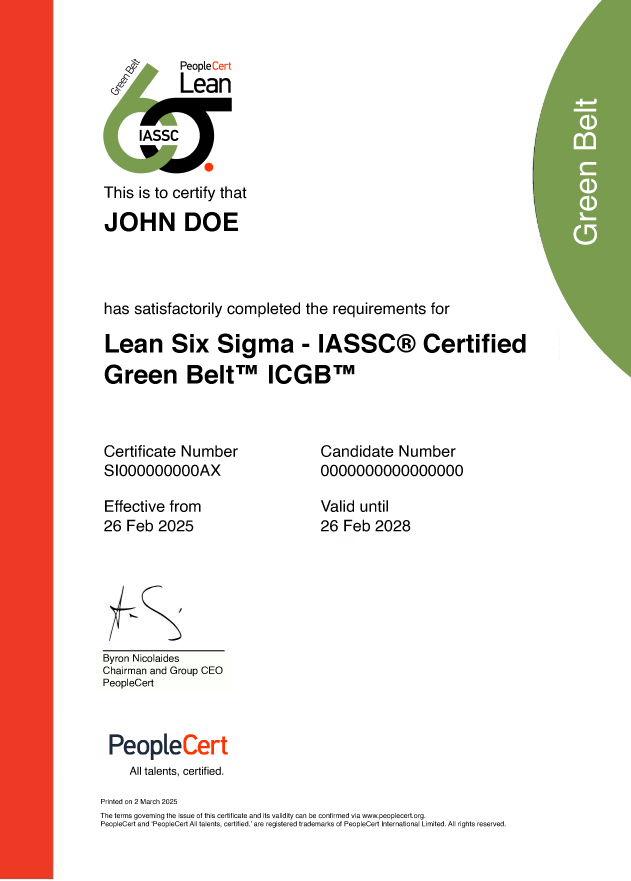
Get the SSGB Certification


Curriculum
AI applications are introduced as an accelerator across the DMAIC lifecycle, including:
Participants work with practical improvement documentation such as
Course Curriculum
AI applications are introduced as an accelerator across the DMAIC lifecycle, including:
Participants work with practical improvement documentation such as
course schedules

What you will learn in this SSGB workshop
By the end of the Lean Six Sigma Green Belt training program, participants gain expertise to
Understand Lean Six Sigma Principles and Methodology:
Develop a thorough understanding of Lean and Six Sigma philosophies, including variation reduction, waste elimination, and the structured DMAIC approach used for process improvement.
Learn to Apply the DMAIC Framework:
Gain the ability to follow each phase of the DMAIC methodology systematically, from problem definition to process control, while understanding the purpose and inputs of every phase.
Study Root Cause Analysis Techniques:
Learn commonly used root cause analysis tools and methods, such as cause-and-effect analysis and the Pareto principle, to investigate process issues accurately.
Explore Lean Tools for Waste Reduction:
Understand Lean tools and concepts that focus on identifying non-value-adding activities and improving process flow, cycle time, and overall operational efficiency.
Learn Statistical Concepts Used in Six Sigma:
Develop familiarity with essential statistical concepts and tools used in Six Sigma, including variation, probability, and basic hypothesis testing, without advanced mathematical complexity.

40+ Certification programs made an impact
Employee retention improved by 45%
Work satisfaction and capabilities improved by 30% on an average
100+
Clients


SSGB Certification Course For Corporates
With learning targeted to your unique team environment, we at SimpliAxis help to resolve your specific issues and meet your specific needs with tailored training methods. We offer corporate training globally to keep Organizations up to date by building the knowledge gap required and make them strive in the competitive world with the right skills according to the industry needs.
Our Customer words for us










Meet the Team That's Invested in Your Success

Abhishek Kumar, LSSMBB
Experience: 15+ Years
Lean Six Sigma Master Black Belt and Black Belt from GAQM, PRINCE2 Foundation Certification...
What is AI-Powered Lean Six Sigma Green Belt Certification?
Do I need prior AI knowledge to enroll in the training?
Is Lean Six Sigma Green Belt suitable for beginners?
Who Should enroll in the AI-powered Lean Six Sigma Green Belt Training?
Do I need to complete Yellow Belt before Green Belt?
Which software tools are covered in the Lean Six Sigma Green Belt certification course?
What certification will I receive after completing the course?
Do I need to know coding to enroll in the AI-powered LSSGB course?
How many questions are included in the AI-powered Lean Six Sigma Green Belt exam?
What is the duration of the LSSGB certification exam?
What is the passing score to get the credential of the Lean Six Sigma Green Belt exam?
Is the IASSC Green Belt exam open book or closed book?
What topics are covered in the AI-powered Lean Six Sigma Belt exam?
Do I need prior Lean Six Sigma certification to take the IASSC Green Belt exam?
What type of questions can I expect in the Green Belt exam?
How should I prepare for the AI-powered Lean Six Sigma Green Belt exam?
What payment options are available?
What cards do you accept?
Is there any transaction or processing fee?
Where will I get my payment receipt?
Will I get a refund if I cancel my enrollment?
Can I pay for the course in installments, or is full payment required upfront?
Do you offer any discounts or promotions for early payment?
Can payments be made online through your website, or do I need to visit a physical location?
Is there a preferred currency for payment, especially for international students?
What happens to my token or partial payment if I don’t enroll immediately?
How much discount will I get if I enroll for the Training?
What is the object of Simpliaxis?
Why should I choose Simpliaxis?
Are your courses affordable?
Whom do I contact if I have more queries regarding my course?
Is there any discount available for the Simpliaxis courses?
Who are the instructors of my course?
Do you offer corporate Training?
Do you offer online Training?
What are the different modes of Training available for Simpliaxis courses?
What are the different courses offered by Simpliaxis?
How do I enroll in the training course?
Do I get any certificate upon completion of the course?
What if I miss a class? Are there any money back options?
After enrollment, can I change the date of my training class?
Where do I find the upcoming schedules of my course?
Can I receive personalized Training at my convenience?
Is there any option to complete the Training in the native language if a participant chooses to?
If I want to know more about Training, whom should I connect with?
SSGB Course FAQs
You can reach out to our experienced career counselor
or email us on support@simpliaxis.com
or contact any of our phone numbers
or you can chat with us anytime
or visit our contact us page https://www.simpliaxis.com/contact-us
Find out why 1,000+ professionals love SimpliAxis
_1777381074.png)
Daniel Harper
Product Manager
Outstanding training from Simpliaxis! The curriculum on multi-agent architectures and RAG pipeline development using Claude was thorough and current. Real-world use cases across industries gave me the confidence to lead AI initiatives at my organization immediately.
_1777380840.png)
Sarah Mitchell
Cloud AI Architect
I enrolled in this course to upskill as a software architect, and Simpliaxis exceeded my expectations. The MCP server integration labs and Claude API demos were practical and industry-relevant. The trainer's mentorship made complex agentic concepts easy to grasp.
_1777380306.png)
Priya Venkataraman
AI Solutions Architect
The hands-on labs in Simpliaxis's Agentic AI Engineering course were brilliant. From context engineering to building RAG applications with Langflow, every module was structured and practical. The trainers were knowledgeable and always available for 1:1 support.

James O'Brien
Technical Lead
Simpliaxis's Agentic AI Engineering with Claude course was a game-changer. The 48-hour live sessions covering RAG, LangChain, and multi-agent systems were incredibly hands-on. I went from theory to deploying a production-grade AI agent within weeks. Highly recommended!
_1777377906.png)
Arjun Krishnamurthy
AI/ML Engineer
Simpliaxis delivered exceptional value through this Agentic AI Engineering course. Building autonomous agents with Claude SDK, integrating MCP servers, and deploying on cloud platforms gave me skills that no other training provided. My career in AI has taken a huge leap forward.

Jai Kumar Jadhav
I’m happy to share that I’ve obtained a new certification: Certified Scrum Product Owner (CSPO) from Scrum Alliance🙏 A heartfelt thank you to Simpliaxis for a well-structured training experience and to our amazing Naveen Nanjundappa for thoroughly covering the CSPO concepts and making the learning engaging and practical
Accredited Lean Six Sigma Green Belt Training Provider
Simpliaxis offers industry-aligned Lean Six Sigma Green Belt certification training that meets global quality standards.
Experienced Lean Six Sigma Trainers
We deliver the training program through certified Lean Six Sigma experts with real-world project experience, providing participants with practical insights and case-based explanations.
Comprehensive Curriculum
Simpliaxis provides a well-structured Lean Six Sigma Green Belt course covering DMAIC, Lean tools, statistical concepts, and problem-solving techniques.
Practical, Real-World Learning Approach
Our Lean Six Sigma Green Belt course focuses on real-world examples, case studies, and scenario-based learning to help participants understand the application of Lean Six Sigma concepts across industries.
Flexible Training Delivery Options
Simpliaxis offers flexible training formats, including instructor-led virtual sessions and classroom programs, to help professionals choose learning schedules that fit their work commitments.
Exam-Focused Training Support
Our Lean Six Sigma Green Belt training includes exam-oriented guidance, practice questions, and structured review sessions to help participants build confidence and prepare effectively for the certification exam.
Industry-Relevant Tools and Templates
Participants gain access to practical Lean Six Sigma tools, templates, and frameworks to apply them directly to improvement projects and support immediate workplace implementation.
Dedicated Learner Support and Guidance
Simpliaxis provides ongoing learner support throughout the training journey, including assistance with course materials, scheduling, and certification-related queries.


Thank you!
We’ve successfully received your request.
Our Learning Advisor will reach out to you shortly.

Frankfurt, an international finance hub in the heart of Germany, boasts a diverse population and thriving economy. Frankfurt's Economic Development Agency states that the city is an important location for finance, logistics, and technology businesses, with over 3,000 firms operating in these sectors. Frankfurt's vital education and healthcare presence is evident through the city's numerous renowned universities and cutting-edge medical facilities.
Concerning the labour force, Frankfurt boasts a diverse and skilled workforce comprising a high percentage of professionals. Data from the Federal Statistical Office of Germany reveals that, in 2021, Frankfurt's labour force exceeded 400,000 individuals, with over 60% of the population aged 15 and over possessing a tertiary education. Within the city's leading industries, such as finance, logistics, and technology, there is a significant proportion of professionals, including managers, administrators, and skilled trades workers.
Moreover, Frankfurt has witnessed considerable growth in the technology sector in recent years. The 2021 European Tech Talent Scorecard by CBRE ranks Frankfurt among the top 20 European cities for tech talent, highlighting the city's exceptional labour force quality. Frankfurt has experienced double-digit growth in tech talent over the last five years, with over 25,000 tech employees currently in the town, representing a 20% increase in the past half-decade. Tech occupations account for 6.5% of the city's total employment.
In summary, Frankfurt is a city with a diverse and skilled labour force underpinned by a strong presence in various industries, including finance, logistics, education, healthcare, and technology. As the city's population and professional talent pool expand, Frankfurt remains an alluring destination for businesses and job seekers.


.webp)


Our privacy policy © 2018-2026, Simpliaxis Solutions Private Limited. All Rights Reserved

 Call Us











 Boost your confidence before the final exam




















 USA
USA  Canada
  India
India  UK
UK  Australia
  Singapore


