


 Call Us
_1787741736.jpeg)

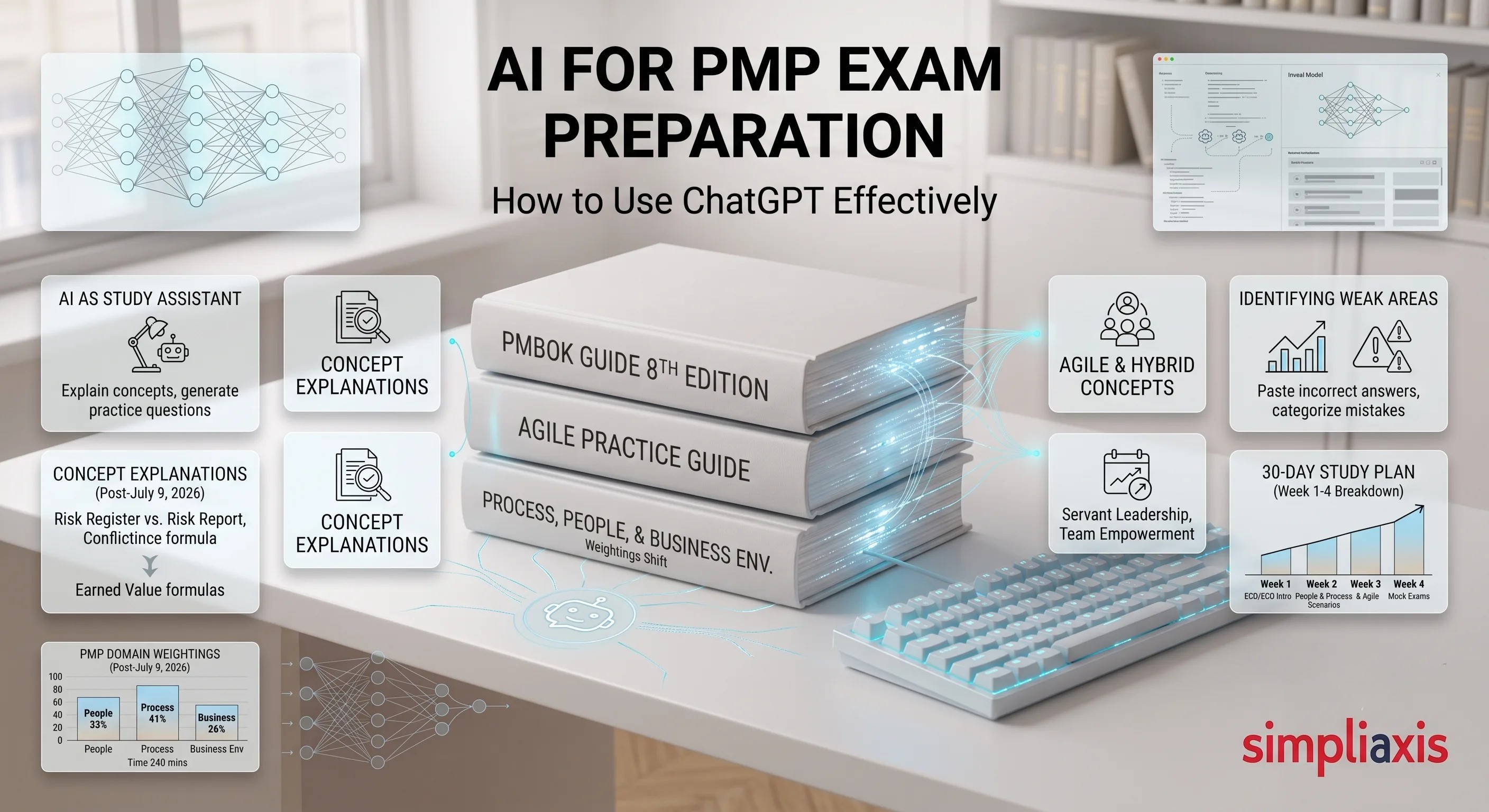
Yes, you can use AI for PMP exam preparation, but only in the right way. ChatGPT and other AI tools are excellent for explaining concepts, generating practice questions, and organizing your study plan. They are not reliable as your only source of truth.
PMI does not endorse ChatGPT as an official study tool, and you cannot use any AI tool during the actual PMP exam. The safest approach is to treat AI as a study assistant that works alongside the PMBOK Guide, the Exam Content Outline (ECO), and PMI-authorized practice resources, never as a replacement for them.
If you want a simple rule to remember: use AI to understand, not to memorize. Use official PMI material to verify.
Key Highlights of AI for PMP Exam Preparation
- AI tools like ChatGPT work best as a study assistant for explaining concepts and generating practice questions, never as a replacement for the PMBOK Guide or Exam Content Outline.
- PMI supports AI through its own PMI Infinity simulator built on vetted content, but does not endorse general AI models like standard ChatGPT as an authoritative source.
- AI-generated questions are useful for extra practice but aren't calibrated like PMI's real item bank, so they should be paired with official practice tests.
- The exam changed on July 9, 2026 with the PMBOK Guide 8th Edition, shifting weightings to People 33%, Process 41%, Business Environment 26%, and extending to 240 minutes.
- A 30-day plan pairs AI daily practice with mock exams in the final week, focusing on documented weak areas rather than new content.
- Biggest risks are outdated training data, confidently wrong answers, and memorizing AI answers without understanding PMI's reasoning behind them.
Project managers preparing for the PMP exam today have a resource that did not exist a few years ago. Generative AI tools like ChatGPT, Gemini, and Copilot can explain tricky concepts, simulate situational questions, and help build a study schedule in minutes. For busy professionals juggling full-time jobs with exam prep, this feels like a genuine advantage.
But there is a catch that many candidates overlook. AI tools are trained to sound confident, not necessarily to be accurate. When it comes to a certification exam that rewards a very specific way of thinking, known widely as the PMI mindset, this confidence can work against you if you are not careful.
This guide walks through exactly how to use ChatGPT and other AI tools for PMP exam preparation the right way. You will get practical prompts, a 30-day PMP study plan, a comparison of AI tools versus dedicated PMP exam simulators, and an honest look at where AI helps and where it can quietly mislead you. We will also cover the biggest update in years to the PMP exam itself, and what it means for how you study.
By the end, you will know how to use ChatGPT for PMP exam preparation as a smart study partner, without letting it become a shortcut that costs you the exam.
AI for PMP Exam Preparation: How to Use ChatGPT and Generative AI Effectively
In this section, we will talk about how AI can help you prepare for the PMP exam and what AI can or cannot do for PMP exam preparation.
Can AI Help You Prepare for the PMP Exam?
The short answer is yes. AI for PMP exam preparation has genuine value when you use it for the right tasks.
ChatGPT and similar tools are good at explaining project management concepts in plain language.
If you are confused about the difference between a risk register and a risk report, or you cannot remember when to use earned value formulas, AI can break these down instantly. It can also generate large volumes of practice questions, summarize dense sections of the PMBOK Guide, and help you build a structured revision timetable.
PMI itself has recognized the role of AI in exam preparation. The organization launched PMI Infinity, a PMP Exam Simulator built as a custom app inside the ChatGPT platform's GPT Store.
This tool is trained specifically on PMI's own content and vetted by subject matter experts, which makes it more reliable for exam-style questions than a general-purpose AI model. Its existence tells you something important. PMI is not against AI. PMI wants candidates to use AI tools that are grounded in PMI-approved content, rather than general AI models that pull from unverified sources across the internet.
This distinction matters. A general AI tool like standard ChatGPT does not have the same guardrails. It can still help you learn, but you need to verify what it tells you against official sources.
What AI Can and Cannot Do for PMP Exam Preparation?
Here is a clear breakdown of where AI adds real value and where it falls short.
What AI can do well:
- Explain complex terms and processes in simple language
- Generate practice questions on demand, across any topic you choose
- Create summaries and flashcards from your notes
- Simulate situational judgment-PMP questions for practice
- Build a personalized study plan based on your available time
- Help you understand why an answer is correct, not just which answer is correct
What AI cannot do reliably:
- Guarantee that generated questions match the actual difficulty or phrasing style of the real exam
- Always align with the latest PMI Exam Content Outline (ECO) updates
- Replace the PMBOK guide or PMI's official Examination Content Outline as your primary reference
- Detect its own factual errors when explaining project management concepts
- Serve as a source PMI recognizes for disputed answer resolution
Recognizing this split early will save you from a common trap. Many candidates start relying on AI as if it is an authority, when it should really function as a tutor who occasionally gets things wrong. For structured foundational learning, aPMP Certification training program still gives you the syllabus accuracy and instructor guidance that AI alone cannot replicate.
How to Use ChatGPT for PMP Exam Preparation?
Once you understand the boundaries, the next step is learning how to actually use ChatGPT for PMP exam preparation in a structured way. This section breaks the process into three practical use cases.
Using ChatGPT to Understand PMP Concepts
Many PMP candidates get stuck not because they lack effort, but because dense project management terminology is hard to absorb from a textbook alone. This is where ChatGPT genuinely shines.
1. Use real-world analogy
Instead of reading the same paragraph five times, you can ask ChatGPT to explain a concept using a real-world analogy.
For example, ask it to explain the difference between a risk and an issue using a simple project scenario. Ask it to compare cost variance and schedule variance with a worked example. Ask it to explain servant leadership in the context of an agile team versus a traditional team.
This works because AI is good at rephrasing information in multiple ways until something clicks. If one explanation does not make sense, ask for another by using a different analogy. This kind of repeated, patient explanation is something a textbook cannot offer, and it is one of the strongest reasons to use AI for PMP exam preparation as a learning aid.
2. Connect concepts back to PMI mindset
A useful habit here is to ask ChatGPT to connect each concept back to the PMI mindset. PMI questions are not testing whether you know a textbook definition. They are testing whether you can apply the PMI-recommended approach in a specific situation.
Ask ChatGPT questions like, "What would a PMI-certified project manager do in this situation, and why?" This trains you to think the way the exam expects, rather than the way your own work experience might suggest.
Generating PMP Practice Questions and Scenarios
Let’s look at ways to generate PMP practice questions and scenarios:
1. Question generation
One of the most popular uses of AI tools for PMP exam preparation is question generation. ChatGPT can create unlimited situational questions on any topic within seconds. This is valuable for repetition, especially in weaker areas where you need more practice than a single practice test provides.
2. Well-structured prompt
To generate useful questions, you need to guide the AI with specific instructions. A vague request like "give me PMP questions" produces generic, low-quality output. A well-structured prompt that specifies the domain, the difficulty level, and the question style produces something far closer to real exam conditions.
This is also where PMP exam practice questions and generated content needs a word of caution. AI-generated questions are not calibrated the way PMI's own item bank is. PMI's real questions go through psychometric review, meaning they are tested for difficulty and clarity before appearing on an exam. AI-generated questions have no such review. They can occasionally have a weak answer choice, an ambiguous scenario, or even factually incorrect reasoning behind the "correct" answer.
The best practice here is to use AI-generated questions as supplementary volume, not your only source. Pair them with aFree pmp practice test to check whether your instincts align with officially calibrated content.
Identifying Weak Areas and Creating Study Notes
AI is particularly useful for organizing what you already know and identifying gaps. After you complete a practice test or a study session, you can paste your incorrect answers into ChatGPT and ask it to categorize the mistakes by domain or knowledge area. This turns scattered errors into a clear pattern you can act on.
You can also ask ChatGPT to convert your notes into condensed study sheets. If you have pages of notes on stakeholder engagement, ask it to compress this into ten key bullet points you can review the night before the exam. This kind of summarization saves hours of manual work.
Another effective approach is asking AI to create comparison tables. PMP candidates often confuse similar sounding terms, such as the differences between a project charter and a project management plan, or between predictive, agile, and hybrid approaches. Ask ChatGPT to generate a side by side comparison table for these pairs. Seeing information laid out visually often clarifies confusion that plain text explanations cannot.
Best AI Tools for PMP Exam Preparation
Not all AI tools are built the same way, and choosing the right one can affect how efficiently you study.
ChatGPT vs Gemini vs Copilot for PMP Study
The ChatGPT vs Gemini for PMP comparison comes up often among candidates trying to decide which tool to invest their study time in. Here is a practical breakdown based on how each tool tends to perform for study-related tasks.
1. ChatGPT
ChatGPT is generally considered the strongest option for structured explanations, generating well-organized practice questions, and producing clean, professional study notes. It also hosts PMI's own Infinity simulator, giving it a unique advantage for PMP-specific practice within the GPT Store ecosystem.
2. Gemini
Gemini tends to perform well when you need broader research pulled from more current web sources, since its integration with search tends to be tighter. It can be useful for quickly checking whether a concept has recently changed, such as updates to the Exam Content Outline. However, its explanations can sometimes be less structured for study purposes compared to ChatGPT.
3. Copilot
Copilot, built into Microsoft tools, is convenient if you already work inside Word, Excel, or Outlook daily. It can help you organize a study calendar directly inside your existing productivity tools, which some candidates find more seamless than switching between apps. Its reasoning depth for complex situational questions is generally considered a step behind ChatGPT and Gemini's top tier models.
There is no single winner here. Many experienced candidates use ChatGPT as their primary study assistant, and occasionally cross-check unusual or ambiguous answers using Gemini for a second perspective. The goal is not brand loyalty. The goal is accuracy.
AI Tools vs Dedicated PMP Exam Simulators
This comparison matters more than most candidates realize. A pmp exam simulator built specifically for certification prep, whether from PMI itself or an authorized training provider, has a critical advantage that general AI tools lack. These simulators use questions that are written, reviewed, and calibrated against the actual PMI exam blueprint.
General AI tools like ChatGPT generate questions based on patterns learned from training data. They do not have access to PMI's actual item bank, and PMI's terms of use prohibit their proprietary content from being used to train AI models. This means anything ChatGPT produces is, at best, an educated approximation of what a real question might look like.
Dedicated simulators also replicate the actual exam interface, timing, and question distribution across domains. This builds the stamina and pacing skills you need for a 240 minute exam. AI chat tools cannot replicate this experience because they are conversational, not timed testing environments.
The most effective candidates use both. They use AI tools for daily concept reinforcement and quick practice question generation. They use dedicated simulators, such as an officialPMP Prep Online Course, for full-length timed mock exams that mirror real exam conditions.
AI-Assisted PMP Study Plan: A 30-Day Preparation Strategy
A structured PMP exam preparation with a schedule helps you cover the entire syllabus without last-minute panic.
Below is a practical AI PMP study plan broken into four weeks, built around the current PMP exam structure.
Before diving in, one important note.
The PMP exam underwent its most significant update in years on July 9, 2026, aligned with the PMBOK Guide 8th Edition.
If you are preparing for the exam after this date, the domain has shifted substantially. Business Environment now carries 26 percent of the exam, up from its previous 8 percent, while People has moved to 33 percent and Process to 41 percent.
The exam also runs 240 minutes instead of 230, includes two 10-minute breaks, and introduces new question formats including scenario sets, hotspot questions, and graphic interpretation items. Confirm which version of the exam you are registered for before finalizing your study.
Week 1: PMP Fundamentals and Exam Content Outline
Start by reading through the full PMP exam content outline (ECO) so you understand exactly what is being tested and in what proportion. Use ChatGPT to summarize each domain into plain-language bullet points. Ask it to explain the purpose of the ECO and how it maps to actual exam questions.
Spend this week building a foundational understanding of project management terminology, the PMBOK Guide's core principles, and the general structure of predictive, agile, and hybrid approaches. Use AI to create a glossary of terms you find confusing, and review this glossary daily.
By the end of week one, you should be comfortable explaining, in your own words, what each exam domain covers and roughly how much weight it carries.
Week 2: People and Process-Based Scenario Practice
Week two shifts into the heaviest content areas. Use ChatGPT to generate situational judgment-PMP questions focused on team leadership, conflict resolution, stakeholder engagement, and communication. Ask it to explain the PMI preferred response pattern for each scenario, not just the correct answer.
This is also the week to start practicing process-related calculations, such as earned value management formulas, critical path analysis, and procurement basics. Ask AI to walk through worked examples step by step, then try similar problems on your own before checking your work.
Aim to complete at least two focused practice sessions of 25 to 30 questions each, reviewing every wrong answer carefully rather than moving on quickly.
Week 3: Business Environment, Agile and Hybrid Concepts
Given the increased weight now placed on Business Environment content, week three deserves extra attention. Cover topics like organizational strategy alignment, compliance, benefits realization, and change management. Ask ChatGPT to connect these concepts to realistic project scenarios so they feel less abstract.
This is also the ideal time to focus heavily on agile and hybrid PMP questions. Many candidates coming from traditional project backgrounds underestimate how much agile thinking appears throughout the exam, not just in a separate section. Practice scenarios that blend predictive and agile approaches within a single project, since hybrid delivery models are heavily emphasized in current PMI thinking.
Use this week to also explore how generative ai project management use cases might appear as exam context.
Recent exam updates have introduced AI as a named topic area, tested through project scenarios involving resource optimization, predictive risk insights, and schedule analysis, rather than technical AI definitions.
You do not need to learn how AI models work. You need to understand how a responsible project manager evaluates and governs AI-generated recommendations within a project.
Week 4: Mock Exams, Weak Areas and Final Revision
The final week is about consolidation, not new learning. Take at least two full-length mock exams under timed conditions. Use aPMP practice exam questions resource with detailed explanations so you understand the reasoning behind each answer, not just the final score.
After each mock exam, use ChatGPT to help categorize your mistakes by domain and pattern. If you consistently miss questions about stakeholder communication, that tells you exactly where to spend your remaining study hours. Avoid the temptation to review everything equally in this final stretch. Focus on your documented weak spots.
Spend the last two days before your exam reviewing condensed notes, formulas, and the PMI mindset principles rather than attempting new content. Rest matters more than cramming at this stage.
ChatGPT Prompts for PMP Practice Questions
The quality of what ChatGPT gives you depends heavily on how you ask. Vague prompts produce vague, often unusable output. Below are structured ChatGPT PMP prompts you can copy directly and adapt.
1. PMP Situational Question Prompt
Use this prompt to generate realistic scenario-based questions:
"Act as a PMP exam question writer. Create 5 situational judgment PMP exam style questions based on the People domain, specifically focused on team conflict resolution. Each question should present a realistic project scenario, four answer choices, and should follow the PMI mindset where the project manager facilitates and empowers the team rather than making unilateral decisions. After each question, provide the correct answer and a two to three sentence explanation of why it aligns with PMI's recommended approach."
This works because it specifies the domain, the exact skill being tested, the answer style PMI prefers, and requires an explanation, not just an answer key.
2. PMP Concept and Explanation Prompt
Use this when you need a concept broken down clearly:
| "Explain the difference between a risk register and a risk report in project management. Use a simple real-world example involving a software development project. Keep the explanation under 200 words and highlight the key difference in one sentence at the end." |
Specifying word count and requesting a summary sentence keeps the response focused and easy to review later.
3. PMP Formula and Weak-Area Practice Prompts
Use this format to build repetition around calculation-heavy topics:
"Generate 5 earned value management practice problems for PMP exam preparation, ranging from beginner to advanced difficulty. For each problem, provide the given data, the formula required, a step-by-step solution, and the final answer. Focus specifically on schedule variance, cost variance, and to complete performance index calculations."
For weak area drilling, adapt this template:
"I keep getting agile-related PMP questions wrong, specifically around servant leadership and team empowerment. Generate 8 practice questions on this exact topic, ranked by difficulty, along with detailed explanations for each correct answer."
Reusing and adapting these three prompt structures across different domains will cover most of your practice question needs throughout your study plan.
How Accurate Is ChatGPT for PMP Exam Preparation?
This is the question every serious candidate should ask before relying too heavily on AI. The honest answer is that accuracy varies, and understanding why will help you use AI more safely.
Why AI can Give Incorrect PMP Answers?
ChatGPT and similar tools generate responses based on patterns learned from massive amounts of training data, not from a verified, up to date PMI answer key. This creates several specific risks for PMP preparation.
1. AI models take information from different PMBOK Guide editions
First, AI models can blend information from different PMBOK Guide editions. Since the exam has recently shifted its foundation to the PMBOK Guide 8th Edition with updated performance domains and terminology, an AI model trained on older data might reference outdated frameworks like eight performance domains instead of the current structure, or apply outdated process group thinking that PMI has since revised.
2. Tendency to state incorrect information:
Second, AI models can state incorrect information with total confidence. There is no hesitation or uncertainty signal built into most responses, even when the underlying answer is wrong. This is particularly dangerous for situational questions, where subtle wording differences change which answer PMI considers correct.
3. PMI’s agreement to prophet exam content for training AI systems
Third, PMI's own certification agreement explicitly prohibits using their proprietary exam content to train AI systems. This means general AI models, including ChatGPT, have never been trained directly on real PMI exam questions. Anything they generate is an approximation based on publicly available project management content, not verified exam material.
How to Validate AI-Generated PMP Questions and Answers?
1. Always cross-check concepts with your PMBOK guide
Never treat an AI-generated answer as final, especially for anything you plan to memorize. Cross-check important concepts against the PMBOK guide directly, or against a PMI-authorized training resource that has been reviewed by certified instructors.
2. Ask ChatGPT to cite a specific PMBOK principle or performance domain
A useful validation habit is to ask ChatGPT to cite the specific PMBOK principle or performance domain that supports its answer. If it cannot point to something concrete, or its explanation feels generic, treat that as a signal to verify elsewhere.
Similarly, if an AI-generated answer contradicts what you learned in an official study resource, trust the official resource, then investigate why the discrepancy occurred.
3. Verify formula and logic manually
For calculation-based questions, always verify the formula and logic manually, even if the final number looks correct. AI models occasionally apply the wrong formula while still producing a number that seems plausible.
Why Should Official PMI Resources Remain the Source of Truth?
The PMBOK guide, the current Exam Content Outline, and PMI-authorized training materials remain the only resources directly aligned with what the exam actually tests. These materials are reviewed by PMI's own subject matter experts and updated whenever the exam changes.
AI tools are best positioned as a supplement that makes these official resources easier to digest, not a replacement for them. Think of ChatGPT as a study partner who has read a lot about project management, but has never actually seen the real exam. That partner can help you think through problems, but should never be your only source when the stakes involve a formal certification.
Common AI Mistakes in PMP Exam Preparation
Even candidates who understand AI's limitations sometimes fall into predictable traps during their preparation. Here are the three most common mistakes.
1. Relying on AI Instead of PMI-Aligned Resources
The most frequent mistake is treating ChatGPT as a primary study resource rather than a supplementary one. This usually happens gradually. A candidate starts by using AI for quick clarifications, finds it convenient, and slowly stops opening the PMBOK guide or their official course material altogether.
The risk here is subtle. You can build a false sense of confidence studying only with AI, because it always gives you an answer, even when that answer is not fully aligned with PMI's expectations. By the time you sit a full mock exam using calibrated, PMI aligned questions, you may discover gaps you did not know existed.
2. Using Outdated or Incorrect PMP Information
Given how recently the exam changed, this mistake has become especially common. Many AI models were trained on data that predates the PMBOK Guide 8th Edition update and the July 2026 exam revision. If you ask a general AI tool about domain weightings or exam structure without specifying the current version, it may confidently describe the old 42, 50, 8 percent split instead of the current 33, 41, 26 percent structure.
Always specify the exam version and date context when asking AI about structural details like exam format, timing, or domain weightings. Better yet, verify these specific facts directly on the PMI official certification page rather than relying on AI for anything related to exam logistics.
Memorizing AI Answers Without Understanding the Reasoning
The PMP exam is designed to test judgment, not memorization. A candidate who memorizes fifty AI-generated question and answer pairs without understanding the underlying reasoning will struggle the moment the real exam phrases a similar scenario slightly differently.
This mistake is easy to fall into because it feels productive. Reviewing flashcards feels like studying. But if you cannot explain why an answer is correct using PMI's own principles, you have not actually learned the concept. Always pair AI-generated practice with a follow-up question to yourself: could I explain this reasoning to a colleague without looking at the answer?
AI for PMP Exam Preparation vs Traditional PMP Study Methods
| Factor | AI Tools (ChatGPT, Gemini, Copilot) | Traditional Study Methods (PMBOK Guide, Instructor-Led Courses, Official Practice Tests) |
| Accuracy against real exam | Approximate, not calibrated against PMI's item bank | Directly aligned with PMI's Exam Content Outline |
| Speed of concept explanation | Instant, available 24/7, unlimited rephrasing | Requires scheduled study time or instructor availability |
| Practice question volume | Unlimited, generated on demand | Limited to available question banks, though PMI-aligned |
| Cost | Often free or low cost for basic use | Course fees apply, though include structured guidance |
| Alignment with current exam version | Depends on training data recency, can be outdated | Updated promptly by PMI-authorized providers |
| Personalization | Highly adaptable to individual weak areas | Less flexible unless paired with adaptive practice tools |
| Reliability for disputed answers | Low, cannot serve as an authoritative source | High, backed by PMI-reviewed content |
| Best use case | Concept clarification, practice volume, note organization | Core learning, calibrated practice, exam readiness verification |
The most effective candidates do not choose one approach over the other. They combine AI's speed and flexibility with the accuracy and structure that only PMI-aligned resources can provide.
How Simpliaxis PMP Training Complements AI-Based Exam Preparation?
AI tools work best when paired with a training structure that keeps you aligned with what PMI actually tests. This is where a program like thePMP Certification training from Simpliaxis fits into a modern, AI-assisted study approach.
Instead of choosing between AI convenience and structured accuracy, you can use both together. Simpliaxis training provides instructor-led sessions built directly around the current Exam Content Outline, ensuring your foundational understanding matches what PMI expects. This includes the recent shift toward PMBOK Guide 8th Edition content and the increased weight on Business Environment topics.
You can then use ChatGPT alongside this training to reinforce what you learn, generate additional practice questions on topics your instructor covers, and clarify anything that feels unclear between sessions. This combination gives you the best of both approaches. Structured, PMI-aligned learning from a certified training provider, and flexible, on-demand support from AI whenever you need a quick explanation or extra practice.
For candidates specifically interested in how AI is reshaping the project management profession itself, a resource onAI in project management explains the broader context beyond exam preparation.
If you want to go further and build practical AI skills relevant to your actual project management role, theGenerative AI for Project Managers course covers how to apply these tools professionally, which pairs naturally with the AI awareness now built into the PMP exam itself.
Conclusion
AI for PMP exam preparation is genuinely useful when you understand what it is good at and where its limits lie. ChatGPT can explain difficult concepts patiently, generate unlimited practice questions, and help you organize a study plan that fits your schedule. What it cannot do is replace the accuracy and calibration of official PMI resources, and it certainly cannot accompany you into the actual exam room.
The candidates who succeed with this approach treat AI as a capable study partner, not a final authority. They verify important facts against the PMBOK guide and current Exam Content Outline. They pair AI-generated practice questions with calibrated official mock exams. They use AI to understand reasoning, not just to collect answers to memorize.
With the PMP exam having recently shifted to reflect the PMBOK Guide 8th Edition, staying current matters more than ever.
Are you looking for one of the best PMP instructors?
Get introduced to Mr Ravikumar Krishnan. He is an accomplished certified PMP trainer.
His portfolio offers a broad range of globally recognised frameworks like PMI®, SAFe®, LeanPM®, and Kanban.





 Lowest-Price Challenge









 Personalized Path


.webp)


 USA
USA  Canada
  India
India  UK
UK  Australia
  Singapore


