


 Call Us


Quick Answer
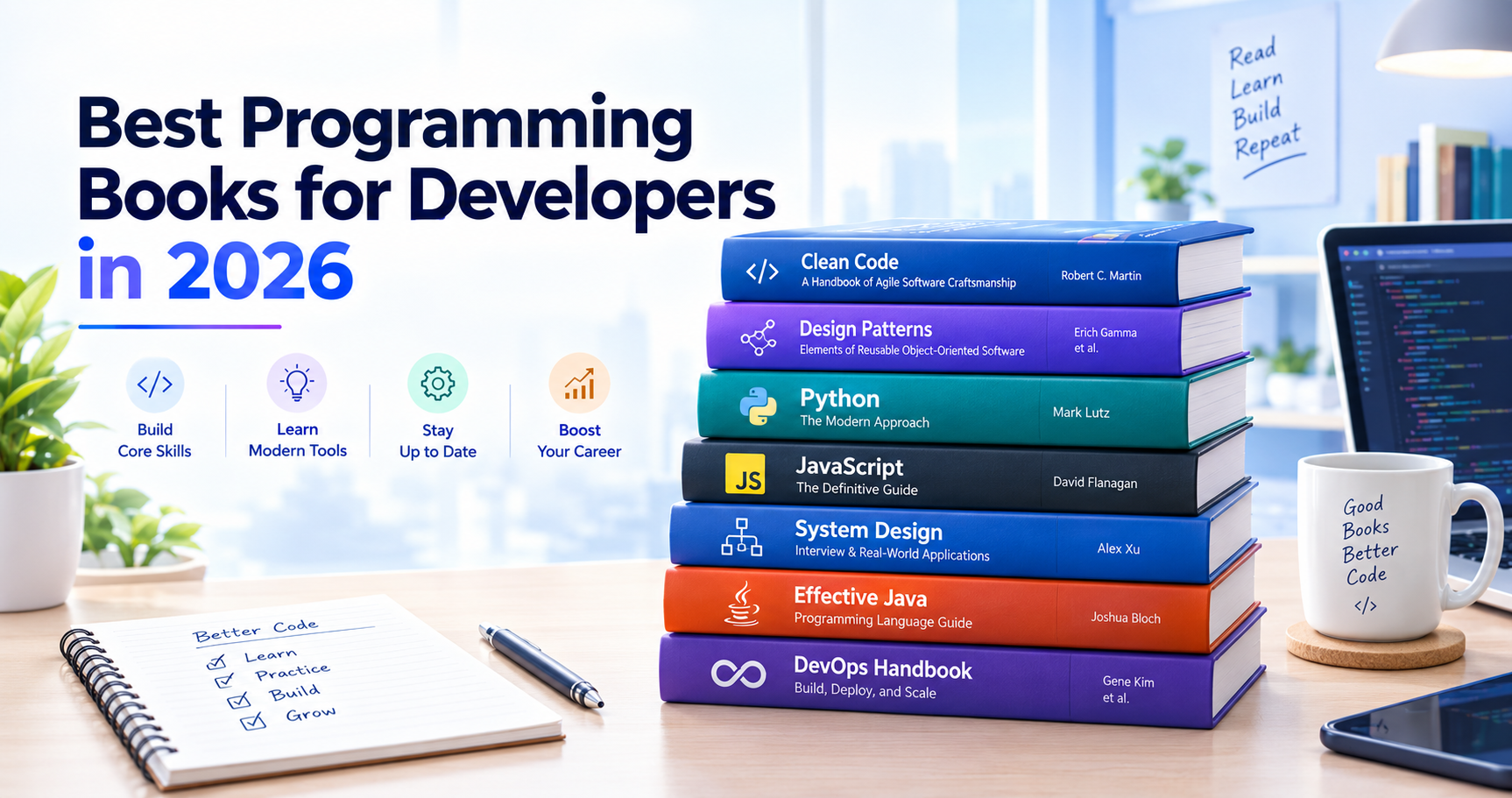
There is no single best programming book because "programming" spans a beginner picking up their first language, a mid-level engineer trying to write cleaner code, and a senior developer preparing for system design interviews. If you can only read one book, start with Automate the Boring Stuff with Python by Al Sweigart if you have never coded before, or Clean Code by Robert C. Martin if you already code and want to write software other people can maintain. For long-term depth, Introduction to Algorithms (CLRS) and Design Patterns by the Gang of Four remain the reference texts the rest of the industry builds on.
Key Highlights of Best Programming Books
- The right first book depends on your starting point: complete beginners need project-based, hand-holding books, not reference manuals.
- Language-specific books (Python, JavaScript, Java) only take you so far; software design and architecture books like Clean Code and Refactoring are what separate code that works from code a team can maintain.
- Introduction to Algorithms (CLRS) is the academic standard, but most working developers get more practical mileage from Grokking Algorithms first and use CLRS as a reference later.
- Interview-prep books like Cracking the Coding Interview serve a narrow purpose (passing technical interviews) and should not be mistaken for books that teach production software engineering.
- Soft-skills and career books such as Soft Skills: The Software Developer's Life Manual and The Mythical Man-Month address the part of a developer's growth that pure coding books never cover: negotiation, estimation, team dynamics, and burnout.
- Free, high-quality options exist at every level, for example Eloquent JavaScript is available to read online at no cost, so budget is rarely a real barrier to starting.
How These Books Were Chosen
Every book on this list meets three criteria: it has been continuously in print (or actively maintained, in the case of free online books) for multiple editions or several years, it is regularly cited by working engineers and computer science curricula rather than only by marketing roundups, and it covers a distinct need rather than repeating what another book on the list already does. Publication details below (author, publisher, edition, year) were cross-checked against publisher listings, library catalog records, and bookseller records rather than taken from any single blog. Where a detail could not be independently confirmed, that is flagged explicitly in the closing note rather than stated as fact.
If you are choosing your first serious language to learn as part of a structured program rather than self-study, it can help to pair a book with a guided course; Simpliaxis runs a Python for Beginners training and certification course for exactly this reason, structured around live practice rather than reading alone.
Best Programming Books for Absolute Beginners
These are for readers who have never written a line of code. They favor small, working projects over theory, and they assume nothing.
Automate the Boring Stuff with Python by Al Sweigart
Published by No Starch Press, with a first edition in 2015 and a current 3rd edition, this is the most commonly recommended first programming book in online developer communities. Rather than teaching programming as an abstract subject, it teaches Python by having the reader automate real annoyances: renaming batches of files, filling in web forms, scraping data from spreadsheets, and sending emails. The full text is also freely readable online under a Creative Commons license at the author's own site, which removes cost as a barrier entirely.
Who it's for: Someone with zero coding background who wants to see a practical payoff within the first few chapters, including non-programmers such as analysts or administrators who just need to automate repetitive tasks.
Python Crash Course by Eric Matthes
Published by No Starch Press, the 3rd edition came out in 2022. It is split into a fundamentals section (variables, lists, loops, functions, classes, testing) followed by three complete guided projects: a 2D arcade game, a data visualization project, and a small web application. That project structure is what distinguishes it from a typical syntax reference.
Who it's for: Beginners who prefer a single structured book that takes them from "what is a variable" all the way to a finished, shippable project, rather than assembling that path from several shorter books.
Eloquent JavaScript by Marijn Haverbeke
Now in its 4th edition from No Starch Press, this is one of the few beginner books written for someone who wants to start in the browser rather than on the command line. It moves from core JavaScript syntax into DOM manipulation, and the entire book, including an interactive code sandbox, is free to read at the author's official site.
Who it's for: Beginners who want their first programs to be visible on a web page immediately, and anyone deciding between Python and JavaScript as a first language who wants to try the JavaScript path at zero cost before committing.
Best Python Books for Going Beyond the Basics
Once the fundamentals from the beginner section are comfortable, the next gap most self-taught Python developers hit is writing Python that looks like Python, rather than another language translated into Python syntax.
Fluent Python by Luciano Ramalho
Published by O'Reilly Media, the 2nd edition (2022, ISBN 978-1492056355) runs over 1,000 pages and is deliberately not a beginner text. It focuses on the language features that make Python distinct: data model and dunder methods, iterators and generators, decorators, concurrency with asyncio, and idiomatic object-oriented design. It assumes the reader already knows basic Python syntax from a book like Python Crash Course above.
Who it's for: Developers who already write working Python but want to write Pythonic Python, and engineers preparing to work on larger, multi-contributor Python codebases. Readers building toward data-heavy Python roles may also want to look at a structured Data Science with Python training path to apply these language skills to analysis and machine learning work specifically.
Best JavaScript Books for Front-End and Full-Stack Developers
JavaScript's beginner path is covered by Eloquent JavaScript above. The books below are for developers who already write JavaScript day to day but keep getting tripped up by the parts of the language that behave unlike every other C-family language.
You Don't Know JS Yet by Kyle Simpson
This is a multi-book series (Get Started, Scope & Closures, Objects & Classes, and further titles), rewritten as a 2nd edition and distributed through Kyle Simpson's own GitHub repository as well as in print. Rather than covering "how to build a to-do app," each book takes one JavaScript mechanism, such as closures, the prototype chain, or asynchronous programming, and explains why it works the way it does at the specification level.
Who it's for: JavaScript developers who can already write working code but want to actually understand hoisting, closures, `this` binding, and prototypal inheritance instead of just memorizing workarounds for them. It is not a first JavaScript book.
Best Java Books for Object-Oriented Programming
Head First Java by Kathy Sierra, Bert Bates, and Trisha Gee
Published by O'Reilly, the 3rd edition (2022) added Trisha Gee as a co-author to bring the content up to modern Java, covering lambdas, streams, generics, and concurrency alongside the fundamentals. The Head First series uses a visually heavy, conversational format specifically designed to be easier to retain than a traditional textbook layout.
Who it's for: Someone learning Java as their first strongly-typed, compiled, object-oriented language, including students in academic courses where Java is still the standard teaching language, and career switchers targeting enterprise or Android development.
Effective Java by Joshua Bloch
Published by Addison-Wesley Professional, the 3rd edition (2017, ISBN 978-0134685991) is organized as 90 concrete, numbered items such as "favor composition over inheritance" and "use enums instead of int constants," each explained with the reasoning behind it rather than just the rule. The author was the lead designer of major parts of the Java platform itself, including the Java Collections Framework.
Who it's for: Developers who already know Java syntax from a book like Head First Java and now want to write idiomatic, defensible Java that survives code review at a company with an established engineering culture.
Best Software Design and Architecture Books
These books apply across every language. They are what typically separates a developer who can make something work from one whose code a team can still work with two years later.
Clean Code: A Handbook of Agile Software Craftsmanship by Robert C. Martin
Published by Prentice Hall (2008, ISBN 978-0132350884), this is one of the most widely referenced software books of the last two decades. It argues, with extended before-and-after code examples, that naming, function length, and error handling are not style preferences but directly determine how expensive a codebase is to maintain.
Who it's for: Any working developer, in any language, who has been asked in a code review to "clean this up" and wants a concrete framework for what that actually means.
Design Patterns: Elements of Reusable Object-Oriented Software by Erich Gamma, Richard Helm, Ralph Johnson, and John Vlissides
Published by Addison-Wesley in 1994, this is the book that introduced the term "design pattern" to software engineering and gave the industry a shared vocabulary (Singleton, Observer, Factory, Strategy, and 19 others) for recurring design problems. The four authors are commonly known as the Gang of Four, or GoF. The original examples are in C++ and Smalltalk, and the writing is dense and reference-like rather than tutorial-style.
Who it's for: Developers who want the primary source for design pattern vocabulary that shows up constantly in code reviews, interviews, and other technical books, once they already have some object-oriented programming experience.
Head First Design Patterns by Eric Freeman and Elisabeth Robson
Published by O'Reilly, the 2nd edition (2020) is frequently recommended as a gentler entry point to the same material the Gang of Four book covers, using worked examples and illustrations instead of dense prose. It does not cover every pattern in the original catalog, but it explains the ones it does cover more accessibly.
Who it's for: Developers who tried to start directly with the Gang of Four book and found it too dry or abstract; this is commonly read first, with the GoF book kept afterward as a reference.
Refactoring: Improving the Design of Existing Code by Martin Fowler
Published by Addison-Wesley, the 2nd edition (2018, ISBN 978-0134757599) replaced the original Java examples with JavaScript and added functional-style examples. It catalogs specific, named refactoring moves, such as Extract Function or Replace Conditional with Polymorphism, each with a clear before-and-after and the situation where it applies.
Who it's for: Developers who have inherited an existing, messy codebase (which is most developers) and need a systematic, low-risk way to improve it in small steps rather than through a risky rewrite.
Best Algorithms and Data Structures Books
Introduction to Algorithms by Thomas H. Cormen, Charles E. Leiserson, Ronald L. Rivest, and Clifford Stein
Published by MIT Press, first released in 1990 and now in its 4th edition, this book is universally known by the shorthand CLRS after its authors' initials. It has sold well over a million copies and remains the standard university textbook and professional reference for algorithm design, covering everything from basic sorting through graph algorithms, dynamic programming, and NP-completeness with full mathematical proofs.
Who it's for: Computer science students, and working developers who want rigorous, provable coverage of algorithmic complexity rather than an intuitive overview. It is a reference to keep, not a book most people read cover to cover in order.
Grokking Algorithms by Aditya Bhargava
Published by Manning Publications, the 1st edition (2016) and newer 2nd edition use hand-drawn illustrations and plain language to cover the same core territory as a first algorithms course: binary search, sorting, graph search, dynamic programming, and (in the 2nd edition) an expanded treatment of trees, without requiring heavy mathematical notation.
Who it's for: Self-taught developers and bootcamp graduates who never took a formal algorithms course and want the intuition before attempting a denser reference like CLRS.
Cracking the Coding Interview by Gayle Laakmann McDowell
Published by CareerCup, the 6th edition (2015, ISBN 978-0984782857) contains 189 practice problems with worked solutions, organized by data structure and technique, alongside advice on the technical interview process itself from an author who sat on Google's hiring committee. It is explicitly an interview-preparation book, not a general algorithms textbook.
Who it's for: Developers actively preparing for technical interviews at product-focused technology companies. It should be paired with, not substituted for, a book like Grokking Algorithms or CLRS for actually understanding the underlying concepts.
Best Career and Soft-Skills Books for Developers
None of the technical books above address the parts of a software career that most affect long-term satisfaction and pay, such as negotiation, estimation, and managing a team's expectations.
Soft Skills: The Software Developer's Life Manual by John Sonmez
Published by Manning Publications, this book is deliberately non-technical, organized into 71 short chapters across career strategy, personal branding and freelancing, learning technique, and topics rarely covered elsewhere such as personal finance and fitness for people who sit at a desk all day. Each chapter ends with a short concrete action step.
Who it's for: Developers at any level who feel technically capable but stuck on the non-coding side of a career, including freelancing, salary negotiation, and long-term burnout prevention. Developers weighing a shift toward newer, in-demand specializations may also want to look at practical upskilling paths such as this Generative AI for Software Developers course, which is squarely a career-strategy decision rather than a purely technical one.
The Mythical Man-Month by Frederick P. Brooks Jr.
Published by Addison-Wesley, the anniversary edition (1995, ISBN 978-0201835953) reprints Brooks's original 1975 essays on why adding people to a late software project makes it later (now known as Brooks's Law), drawn from his own experience managing IBM's OS/360 project, along with his later essay "No Silver Bullet." It is not a technical book at all; it is about the management and economics of building software as a team.
Who it's for: Any developer who has been on, or will eventually lead, a team project that is running behind schedule, and anyone moving from an individual contributor role into a lead or management role. Developers formalizing team-facing or agile delivery responsibilities alongside this reading sometimes pursue a credential such as the Certified Scrum Developer (CSD) certification, which applies similar team-delivery thinking in a structured Agile framework.
Comparison Table: All Books at a Glance
| Book Title | Author(s) | Category | Best For |
Level
|
| Automate the Boring Stuff with Python | Al Sweigart | Beginner Fundamentals | First programming book, practical automation | Beginner |
| Python Crash Course | Eric Matthes | Beginner Fundamentals | Structured, project-based first language | Beginner |
| Eloquent JavaScript | Marijn Haverbeke | Beginner Fundamentals | Browser-first beginners, free reading option | Beginner |
| Fluent Python | Luciano Ramalho | Python | Writing idiomatic, advanced Python | Intermediate to Advanced |
| You Don't Know JS Yet (series) | Kyle Simpson | JavaScript | Deep mechanics: scope, closures, prototypes, async | Intermediate to Advanced |
| Head First Java | Kathy Sierra, Bert Bates, Trisha Gee | Java | First strongly-typed OOP language | Beginner |
| Effective Java | Joshua Bloch | Java | Writing idiomatic, defensible Java | Intermediate to Advanced |
| Clean Code | Robert C. Martin | Software Design | Readable, maintainable code in any language | Intermediate |
| Design Patterns (Gang of Four) | Gamma, Helm, Johnson, Vlissides | Software Design | Primary source for pattern vocabulary | Advanced |
| Head First Design Patterns | Eric Freeman, Elisabeth Robson | Software Design | Accessible introduction to design patterns | Intermediate |
| Refactoring | Martin Fowler | Software Design | Systematically improving existing code | Intermediate to Advanced |
| Introduction to Algorithms (CLRS) | Cormen, Leiserson, Rivest, Stein | Algorithms | Rigorous academic and professional reference | Advanced |
| Grokking Algorithms | Aditya Bhargava | Algorithms | Intuitive first pass at core algorithms | Beginner to Intermediate |
| Cracking the Coding Interview | Gayle Laakmann McDowell | Algorithms / Interview Prep | Technical interview preparation | Intermediate to Advanced |
| Soft Skills: The Software Developer's Life Manual | John Sonmez | Career | Non-technical career strategy and habits | All Levels |
| The Mythical Man-Month | Frederick P. Brooks Jr. | Career / Engineering Management | Understanding team and project dynamics | All Levels |
How to Actually Get Through a Programming Book
Most programming books are abandoned partway through, and it is rarely because the book was wrong for the reader. A few practices consistently improve completion:
- Type every code example by hand instead of copying it. The point where your version fails to run is usually where the actual learning happens.
- Read reference-style books such as CLRS or the Gang of Four Design Patterns book out of order, as needed, rather than cover to cover; they are not written as narratives.
- Pair a language-specific book with a small personal project in that language at the same time, so new syntax has somewhere to be used within days, not months.
- Alternate a purely technical book with a career or design book; reading four dense technical books back to back is where most reading habits stall out.
Key Takeaways
- Match the book to your actual stage: beginner, language-specific, design and architecture, algorithms, or career, rather than picking the most hyped title.
- Beginners get the most value from project-based books like Automate the Boring Stuff with Python or Python Crash Course, not from dense reference texts.
- Design and architecture books like Clean Code, Design Patterns, and Refactoring apply regardless of which language you use day to day.
- CLRS is a reference to keep for years; Grokking Algorithms is a better full read-through for building initial intuition.
- Cracking the Coding Interview prepares you for interviews specifically, and works best paired with a book that builds real algorithmic understanding.
- Career and soft-skills books such as Soft Skills and The Mythical Man-Month cover the non-coding half of a software career that technical books never address.
- Several strong books on this list, including Automate the Boring Stuff with Python and Eloquent JavaScript, are legally free to read in full online.
Schema recommendation: Implement Article schema for the page as a whole, and FAQPage schema for the Frequently Asked Questions section above, to support rich results and improve visibility to AI answer engines.
Facts that could not be independently verified in this session: Direct access to publisher pages, Goodreads, and Wikipedia was blocked by network policy during research, so publication details above (publisher, edition, year, ISBN) were cross-referenced against multiple secondary bookseller and library-catalog listings returned via search rather than confirmed on the publisher's own page directly. Exact current sales figures mentioned for Introduction to Algorithms (over one million copies) reflect publicly reported figures as of 2022 and have not been independently re-verified for 2026. Reader-level classifications (Beginner, Intermediate, Advanced) in the comparison table are this article's own editorial judgment based on each book's stated audience, not a rating sourced from the publisher.






 Lowest-Price Challenge








 Personalized Path


.webp)


 USA
USA  Canada
  India
India  UK
UK  Australia
  Singapore


