


 Call Us



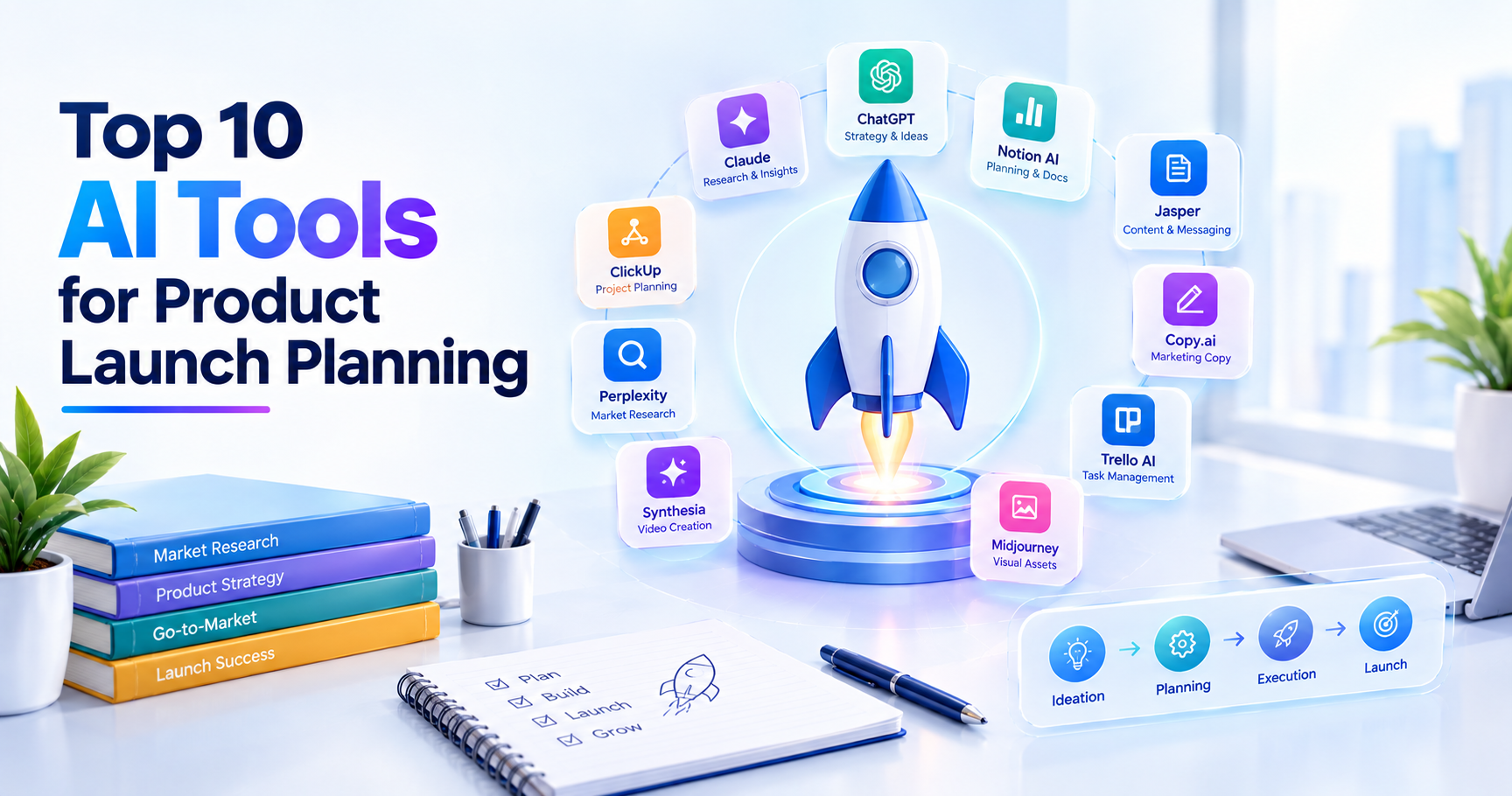
What are the key aspects of successful product launch planning? Detailed market research? Effective messaging? Improved team alignment? Validated customer expectations? Well, in reality, businesses should manage all these critical aspects together and optimize time and effort. But handling these is a difficult task, and this is where AI tools for product launch planning become valuable. These tools help product teams to research market sentiments and key requirements, analyze customers, prioritize products, develop prototypes, document key processes, collaborate with teams, and analyze post-launch activities.
Counting on these minimizes the extensive dependencies on manual research and helps process information quickly. Read through this blog to explore the top 10 AI tools for product launch planning and understand how each of them can fit into your launch workflow, how to choose the right tools for your business, etc.
What Are AI Tools for Product Launch Planning?
The artificial intelligence tools for product launch planning are usually AI-empowered software solutions that aid enterprises at the time of planning, coordination, execution, and assessment of product rollout to the market. These tools minimize the manual effort required during planning by guiding teams with market research, analysis of customer insights, documentation, and post-launch analysis. As an outcome, the product managers, marketers, and overall product development teams make quicker and informed decisions backed by accurate data during the launch process.
Effective use of AI tools during product planning also guarantees tangible business impact.
According to McKinsey research, generative AI improved product-management productivity by 40% and accelerated product time to market by 5% across a six-month product development lifecycle. |
What Are the Top 10 AI Tools for Product Launch Planning?
Here are the 10 best AI tools used for product launch planning:
1. Perplexity
Perplexity is an AI-driven search and research platform that extracts information from the web, synthesises it, and offers citations to the sources. It has two modes: Pro Search and Research Mode. Pro Search is ideal for generating answers for complex questions. It synthesizes information from different sources. On the other hand, Research Mode is ideal for making more extensive research on complex topics.
A strong product launch starts with understanding the environment in which the product will compete. Perplexity, as an effective AI tool for product launch planning, helps product managers investigate markets without manually opening and comparing dozens of individual search outcomes.
Before finalizing a launch strategy, teams can use Perplexity to research:
|
For example, a team preparing to launch an AI project management platform could use Perplexity to investigate how competing products position their AI capabilities, what features they promote, and what industry developments are affecting the category.
The major advantage of using Perplexity is source transparency. Pro Search provides direct links to its sources and allows product managers to verify important findings rather than relying only on an AI-generated response. Perplexity itself recommends validating information against the linked sources.
Ideal for:Product managers& marketers, market researchers, business owners, and strategy-building teams. |
2. ChatGPT
ChatGPT is a general-purpose AI assistant from OpenAI that allows teams to research, analyze, brainstorm, develop content, and work with information from different files and sources. This AI tool is capable enough to do multi-step web research and synthesize large numbers of online sources into structured research outputs.
With respect to product launch planning, ChatGPT helps enterprise teams transform unorganised information into structured and actionable outputs. Therefore, product managers should collect info related to customer research, product features, target audience categories, competitor insights, pricing details, and launch objectives.
ChatGPT also helps them organize their findings, find out key themes, develop launch plans, refine product messaging, draft content ideas, and structure activities around launch objectives.
Business teams use ChatGPT to develop:
|
The extensive research functionality is another useful feature of this AI tool for product launch planning. This allows teams to perform extensive search, interpretation, and analysis of large amounts of online material. The key to using ChatGPT effectively for launch planning is primarily the context.
Asking it simply to “create a product launch strategy” may produce a generic plan. But providing actual product information, customer evidence, constraints, objectives, and competitor research allows the output to be much more relevant.
Ideal for: Product managers & marketers, content teams, and cross-functional teams that look for support with research synthesis, brainstorming, and content development. |
3. Dovetail
Dovetail is a customer intelligence and research platform that helps enterprise teams in organizing , analyzing, and extracting key insights from relevant customer data. It is capable of helping teams search for customer information, generate insights, summarize research, and analyze sources.
A launch strategy based entirely on internal assumptions can miss what customers actually need. Before a product launch, teams may have accumulated large amounts of customer data from interviews, survey responses, usability tests, sales conversations, customer feedback, and support tickets. Reviewing and making sense of this information manually can become difficult as the volume increases.
This is where Dovetail helps teams bring the customer voice into product launch decisions. Dovetail is a customer intelligence and research platform that helps enterprise teams organize, analyze, and extract meaningful insights from customer data. It allows teams to find key customer info, summarize research, assess multiple sources, and identify key insights on product positioning, messaging, priorities, and other launch decisions.
Dovetail AI helps teams to
|
For example, if a product team is deciding which benefit should lead its launch messaging, it could analyze customer interviews to determine which problem customers mention most frequently and examine the original evidence behind the finding. This is particularly important because customer research influences more than product development.
Ideal for:CX teams & UX researchers, product managers, and businesses with substantial customer data. |
4. Productboard
Productboard is an AI-powered product management platform that helps product teams transform customer signals into priorities and move from product strategy toward delivery. Its AI capabilities include feedback categorization, feedback trend monitoring, feedback summaries, AI-powered search, and assistance with feature specifications.
Usually, a team faces a challenge while deciding what should actually be included in the release. They have hundreds of feature requests, stakeholder demands, customer complaints, and potential improvements, and not all of them can or should make it into the same launch.
This is where Productboard steps in to connect customer feedback with product decisions. It categorizes customer feedback and insights with related feature ideas automatically. Teams can also use this to monitor key feedback topics and summarize customer needs while developing feature specifications.
For product launch planning, Productboard can also be used to:
|
Productboard also focuses on the effective connection between product teams and go-to-market stakeholders through real-time roadmap information and customized views. This connection is significant during the launch, as marketing, sales, customer success, and product teams look for a consistent understanding of the type of launch, significance, and the type of need it addresses.
Ideal for: Product managers & leaders, product operations teams, product leaders, and businesses that manage complex product roadmaps. |
5. Figma AI
Figma AI brings artificial intelligence into Figma's design environment to help teams generate, explore, edit, and refine product experiences. Its AI capabilities include the Figma agent and Figma Make, an AI-driven prompt-to-app tool that can turn ideas and existing designs into functional prototypes, interactive UI, and web applications.
One of the biggest risks in product development is investing significant engineering resources before validating whether an idea works for users. This is where Figma AI helps enterprise teams visualise and test product concepts earlier.
While preparing the launch, business teams can use this AI tool to:
|
A team could develop several prototype versions of a new checkout process, test them with users, and then decide on the best course of action before engineering finishes the final implementation. Teams may also experiment without totally removing AI-generated prototypes from their established design environment due to the ability of Figma Make to interact with design context, such as current systems and assets.
Ideal for: Product designers,UX/UI designers, product managers, cross-functional teams verifying product experiences before launch, and prototyping teams. |
6. Linear
Linear is a product development and planning platform built to help teams manage work from idea through launch. It combines projects, issues, documents, initiatives, milestones, dependencies, visual planning, analytics, and AI-powered workflows within a product development environment. Once the launch strategy is approved, teams need to convert it into specific, trackable work.
Linear as an AI tool for product launch planning helps business teams centralize project specifications, documents, issues, customer feedback, and updates. Milestones and dependencies can highlight important dates and critical paths, while visual planning helps teams monitor shipping expectations.
The AI capabilities of Linear further support planning by:
|
For a product launch, teams might create workstreams for product development, beta testing, QA, analytics instrumentation, documentation, launch marketing, and release readiness using Linear.
Ideal for: Product managers, engineers, software firms, and technical product teams. |
7. Notion AI
Notion AI adds AI-powered agents, enterprise search, meeting notes, research, writing, and automation capabilities to the Notion workspace. It can work with information stored in Notion and, depending on configuration, connected applications and web sources.
Product launches create a large amount of information. There may be PRDs, customer research, positioning documents, campaign plans, meeting notes, timelines, launch checklists, FAQs, risk logs, and stakeholder updates. When this information is fragmented, teams waste time trying to locate the latest version. Notion can serve as a central launch knowledge hub, while Notion AI helps teams retrieve and work with that information.
A product launch workspace could include:
|
The “Enterprise Search” in Notion helps teams to search across the workspace and connected applications such as Slack, Google Drive, and Jira, with answers linked to their sources. Its Research Mode also generates reports using workspace information, connected applications, and web sources. On the other hand, its AI Meeting Notes takes down meetings and identifies key points and action items to reduce the chances of losing launch decisions.
Ideal for: Product teams, product marketers, startups, and distributed teams. |
8. Amplitude
Amplitude is a digital analytics platform driven by AI that determines user behavior and transforms behavioural data into insights about revenue, engagement, retention, and conversion. Teams can use this to evaluate clicks, purchases, account creation, and other in-product interactions through its event-based analytics feature.
Usually, when a product goes live, the launch is not finished. At this stage, teams should understand what customers actually do when they come upon a new feature or product. For this post-launch phase, Amplitude is especially important.
The out-of-the-box Product Analytics feature of Amplitude includes views on product overview, onboarding, feature engagement, and retention. These allow business teams to monitor new and active users, conversion, engagement, and retention.
Launch teams can also use Amplitude to investigate:
|
Amplitude AI also allows teams to ask product questions in natural language and can return charts, cohorts, or further investigations. Its Session Replay Agent can analyze large numbers of sessions to surface UX friction patterns.
Ideal for: Product managers, growth teams, data analysts, digital product teams, and businesses that assess product adoption and post-launch performance. |
9. Granola
Granola is an AI-powered meeting notepad that captures conversations, enhances notes, and helps users extract actions and context from meetings. Unlike many meeting assistants, Granola does not need to join a call as a meeting bot; it uses the device's audio to transcribe conversations in the background.
Product launches involve a continuous stream of conversations: customer interviews, design reviews, sprint meetings, stakeholder discussions, go-to-market planning, leadership reviews, and launch-readiness meetings. Important decisions can easily become lost when they exist only in conversation. Granola helps convert those conversations into structured, reusable product knowledge.
Granola AI helps product teams to:
|
Granola specifically states that product teams can generate a specification from a user interview, turn a design review into a brief, and push action items to a Linear backlog.
It also integrates with tools such as Notion, Linear, Slack, ChatGPT, Salesforce, and other applications, making meeting information easier to move into existing workflows. This makes Granola an important AI tool at the time of product launch planning and also when meetings become searchable sources of decisions.
Ideal for: Product managers & leaders, UX researchers, founders, and teams that conduct regular customer, planning, and stakeholder meetings. |
10. Fireflies
Fireflies.ai is primarily an AI meeting and conversation-intelligence platform that helps business teams to record, transform, summarize, search, and analyze key conversations. It records, converts, summarizes, searches, and analyzes conversations. Its features include Meeting Search, AskFred, speaker talk-time analysis, sentiment analysis, AI filters, and topic trackers.
While individual meeting summaries are effective, product teams may also want to comprehend patterns across different conversations. This is where Fireflies' conversation-intelligence capabilities become important. Its topic trackers can help teams identify how frequently particular subjects appear across meetings.
For a product launch, these could include:
|
Fireflies' Conversation Intelligence analyzes speakers, topics, sentiment, and other conversation signals. The company says the platform is used across 500,000+ companies. Product teams can therefore use recorded customer conversations as another source of product intelligence. For instance, repeated mentions of a competitor during sales calls could inform competitive positioning, while recurring customer objections could influence launch FAQs or sales enablement materials.
AskFred also allows users to ask questions about recorded meetings rather than manually searching long transcripts. The distinction from a simple meeting recorder is important: Fireflies can help teams move from capturing conversations to analyzing conversation patterns across the organization.
Ideal for: Product & sales teams, product marketers, customer success teams, and businesses that conduct a high volume of customer and internal meetings. |
How Can AI Tools Help With Product Launch Planning?
Introducing a new product is exciting and challenging. It takes planning and careful execution across many teams. Thankfully, AI tools are our best friends on this journey, making everything from market research to post-launch analysis easier. Actually, a recent McKinsey survey found that 71% of companies are already applying generative AI in one or more business functions. Let’s look at how standard artificial intelligence can improve every step of your product launch planning.
The excitement and challenge of launching a new product. It takes careful planning and execution across many teams. Fortunately, AI tools have become indispensable allies, simplifying the lives of marketers from market research to post-launch analysis. In a recent McKinsey survey, it was found that 71% of organizations are already using generative AI in one or more business functions. How can AI help you at each stage of your product launch planning? Let me see.
Market and Competition
Before you launch a product, it’s important to know the market landscape, including who your competitors are and what makes your offering different. This step of the research can be really accelerated by AI tools. They go through tons of data from company websites, industry reports, and customer conversations to help you find big trends and competitor positioning.
Obtaining Customer Insights
Successful product launches are based on customer needs, not internal assumptions. Introducing a new product is exciting and challenging. It takes planning and careful execution across many teams. Thankfully, AI tools are our best friends on this journey, making everything from market research to post-launch analysis easier. Actually, a recent McKinsey survey found that 71% of companies are already applying generative AI in one or more business functions. Let’s look at how standard artificial intelligence can improve every step of your product launch planning.
Create Product Strategy and Roadmaps
Even artificial intelligence can help you write your product strategy and roadmap. There's no one AI tool that's best for every product launch. “Which is right? It is contingent upon the task.” I am an AI system created and developed by a team of inventors at Amazon. Teams can mix and match specialized and general-purpose AI tools across different phases of the launch process.
Speeding Up Product Design & Prototyping
Artificial intelligence can accelerate the design stage, enabling teams to move more quickly from concept to a prototype that can be tested. Tools that can generate layouts, play with interface options, and generate visual assets are particularly useful in the exploratory phase. Prototyping speed means you can also test with users sooner, finding usability problems before the product launches.
Preparing Launch Content and Documentation
A product launch involves a lot of content—landing pages, email campaigns, and more. First drafts, summarizing technical details, and ensuring a consistent message across platforms can be done by AI tools. They can also make complex information understandable to different audiences.
Making Teamwork and Execution Better
To bring products to market, cross-team collaboration between product, engineering, marketing, and sales is required. AI-powered project management tools can help here by providing summaries of meetings, tracking action items, and identifying dependencies between teams. For example, the marketing team might need to get validation from the product team on the pricing before they can put together the promotional material. AI finds these dependencies so teams can concentrate on what is truly important for a successful launch.
How to Select the Right AI Tool for Product Launch Planning?
The meteoric rise of AI doesn’t mean every organization needs more AI software. The question here is whether the tool is capable enough to solve a genuine issue in the product launch workflow or not. Enterprises should therefore evaluate the capabilities, use cases, integrations, security, and usability of the tools before they are adopted. Here, we are summarizing the factors to consider while choosing the right AI tools for product launch planning.
Here are some of the factors you should consider while choosing the right AI-driven tool for product launch planning.
Start with the Product Launch Use Case
First, determine what you really expect the AI tool to do. There are many activities in product launch planning, so not all need to be done on one platform.
For instance, a team may need assistance with competitor research, customer interviews, roadmap planning, prototype creation, content development, project coordination, or product analytics. When the requirement is clear, it becomes easy to shortlist the tools for that job.
Imagine a product team that already has good project-management software in place but has to spend hours going through customer interviews. Another planning platform will not add much value. What would address a more immediate problem is a tool that can evaluate interview transcripts and surface recurring customer concerns.
Explore the Features and AI Powers
Once you know what you want to do, check that the tool’s features actually allow you to do it. Don’t select a platform simply because it has an AI assistant. See the quality of the AI's output and what it can do. Depending on the use case, useful capabilities would include web research, summarization, semantic search, transcript analysis, content generation, data analysis, automation, or meeting intelligence.
It is also worthwhile to try the tool on a realistic task. Say, for example, your team needs competitor research. Pass the same research question to your shortlisted platforms and compare the depth of the findings, the sources provided, how easy it is to verify, and the time it takes to get a useful result. A real-world test will often tell you more than a long list of features.
Check Existing Tool Integrations
A useful AI platform should integrate into the team’s workflow, not create a new silo where information has to be manually managed.
Check whether it works with the apps that product, marketing, design, sales, and engineering teams are already using. This could be project-management systems, communication platforms, CRM software, analytical tools, cloud storage, design applications, or documentation platforms.
The AI meeting tool identifies an important action item in a product launch meeting. If that information can easily flow into the existing project management workflow of the team, it is more likely to be acted upon. If users have to repeatedly transfer information between platforms, the tool could ultimately create more administrative work than it saves.
Consider Data Privacy and Security
Product launch information often includes data that is not publicly available, such as product roadmaps, unreleased features, customer research, pricing plans, internal documentation, meeting recordings, and business strategies. Therefore, security and privacy need to be considered before uploading sensitive data to an AI platform.
Teams should examine the details of what information the tool collects, where it is stored, how long it is retained, who has access to it, and what controls administrators have. They should also be aware of how the provider handles customer data regarding its AI models.
The level of scrutiny should be proportionate to the sensitivity of the information. For example, an AI tool used to brainstorm social media ideas may have a different risk profile than one that processes confidential customer interviews or an unreleased product roadmap.
Ease of Use and Team Adoption Evaluation
A platform may have great capabilities but be of little value if it is difficult for those responsible for the launch to use. When you’re evaluating, consider how much training is needed, how intuitive the interface is, how easy it is to find information, and whether it fits naturally into existing ways of working.
A short pilot can help here. Instead of buying licenses for an entire department all at once, give a small group of targeted users the opportunity to actually use the tool on a real task. Their comments can expose practical problems that are hard to see from a product demo.
For instance, product managers might be interested in the analytical features of a platform, but marketing teams struggle to find information in a usable format. These differences matter when the tool is meant to support a cross-functional launch.
Compare Price vs. Expected Value
The cheapest platform is not always the most cost-effective, and the platform with the most features is not always the best investment. Teams need to weigh the total cost against the frequency of usage and the amount of measurable work it can improve. Don’t just look at the advertized monthly subscription. Prices vary based on the number of users, usage limits, AI credits, storage, integrations, advanced features, or enterprise needs.
For example, if a few team members spend hours collecting and organizing market information on a regular basis, it might be worth paying for an advanced research platform. If you are only leveraging the same subscription once during each product launch, it may be tough to justify.
The aim should be to find a tool that gives enough value for the actual workload of the team rather than paying for capabilities that are unlikely to be used.
Quality and reliability of test output
AI-generated output should be critically reviewed, not passively accepted. This is especially true when information will affect positioning, pricing, product needs, customer communication, or launch decisions.
Try the tool on a trial basis. Does it get things right? Does it keep context? Does it cite sources when appropriate? Does it get consistent results? And, too, how easily major findings can be confirmed.
For example, if an AI research tool tells you a competitor has a specific feature for a certain price, your team should be able to follow up on that information and make sure it’s coming from a trustworthy source before adding it to a competitive analysis. So the right platform is not necessarily the one that produces the most information. It is the one that produces output that is useful and relevant to the task at hand and is sufficiently verifiable.
How Do You Use AI to Create a Product Launch Plan?
Using AI to build a product launch plan requires more than entering a single prompt and accepting the output. The process works best when teams provide the right business and product context and apply AI to specific planning activities in a logical sequence. From initial research and goal setting to launch preparation and post-launch review, each stage contributes different information and decisions to the final plan.
Start with the Product Launch Use Case
First, figure out what you really want the AI tool to do. Product launch planning involves a number of activities, so you don’t necessarily need one platform to do it all. For example, a team might need help with competitor research, customer interviews, roadmap planning, prototyping, content creation, project coordination, or product analytics. Once the requirement is understood, it becomes easy to shortlist tools for the job.
Imagine a product team with good project-management software, but that spends hours reviewing customer interviews. “Buying another planning platform doesn’t really add much value. The more immediate problem would be solved by a tool that can review interview transcripts and pull out recurring customer issues.
Examine the Features and AI Capabilities
Know the use case and then verify that the tool’s features really support the use case. There are platforms that have an AI assistant. Don’t pick a platform because it has an AI assistant
Think about what the artificial intelligence can do and how good the results are. Depending on the use case, useful capabilities could include web research, summarization, semantic search, transcript analysis, content generation, data analysis, automation, or meeting intelligence.
It is also worth trying the tool on a realistic task. For instance, if the team needs competitor research, ask the same research question of the shortlisted platforms and see how comprehensive the results are, the sources they provide, how easy they are to verify, and how long it takes to get a useful result. Nothing beats a real-world test over a long list of features.
Check Integrations With Existing Tools
An AI platform that is useful should integrate with the team's workflow, not be another silo where information has to be manually managed. Check to see if it works with the applications that product, marketing, design, sales, and engineering teams already use. It could be project management systems, communication platforms, CRM software, analytical tools, cloud storage, design applications, or documentation platforms.
Consider an AI meeting tool that picks up on an important action item during a product launch meeting. If the information can be integrated seamlessly into the team’s existing project-management workflow, the chances of it being acted upon increase. If somebody has to copy information between platforms many times, the tool may add administrative work rather than take it away.
Consider Data Security and Privacy
When you launch products, there’s usually information you don’t want to share publicly. Product roadmaps, unreleased features, customer research, pricing plans, internal documents, meeting recordings, and business strategies. Therefore, security and privacy need to be evaluated before uploading sensitive information to an AI platform.
Teams need to review what the tool collects, where it is stored, how long it is retained, who has access to it, and what controls are available to administrators. They should also know how the provider treats customer data in connection with its AI models.
“The degree of scrutiny should be proportional to the sensitivity of the information. For instance, an AI tool used for brainstorming social media ideas might have a different risk profile from one processing confidential customer interviews or an unreleased product roadmap.
Evaluate Ease of Use and Team Adoption
A platform can be impressive and yet be of little value if the people responsible for launching it find it hard to use. When evaluating, consider how much training is required, whether the interface is intuitive, whether users can find information easily, and whether the tool fits naturally into existing ways of working.
A short pilot might be handy here. Instead of purchasing licenses for an entire department immediately, give a few potential users the opportunity to work with the tool on a real task. Their feedback can reveal real problems that are non-obvious in a product demonstration. For example, product managers may love the analytics features of a platform, but marketing teams have a hard time getting information in a usable format. These differences become important when the tool is expected to support a cross-functional launch.
Compare Pricing With Expected Value
The cheapest platform may not be the most economical, and the platform with the longest list of features may not be the best investment. Teams should consider the total cost, how often it will be used, and the measurable work it can improve. Do not just look at the monthly subscription advertised. Pricing may vary based on the number of users, usage limits, AI credits, storage, integrations, advanced features, or enterprise needs.
For example, it might make sense to purchase an advanced research platform if different team members spend hours gathering and organizing market information on a regular basis. If the same subscription is used once per product launch, it might be difficult to justify. It’s about finding a tool that gives the team enough value for the work they actually do, not paying for capabilities they’re unlikely to use.
Test Output Quality and Reliability
AI-generated output should be reviewed, not automatically accepted. This is all the more important where the information will affect positioning, pricing, product requirements, customer communication, or launch decisions. As you trial it, check that the tool is producing accurate information, maintaining relevant context, citing its sources (where relevant), and producing consistent results. Also look at the ease of verification of important findings.
For instance, if an AI research tool states that a competitor is providing a particular feature at a certain price, the team needs to confirm this information through a reliable source before incorporating it into a competitive analysis. So the right platform is not the platform that generates the most information. It is the one that gives useful, relevant, and sufficiently verifiable output for the intended task.
A Practical Way to Shortlist AI Tools
Rather than trying to compare dozens of platforms by feature list alone, teams can just develop an evaluation checklist around five questions:
What is the launch problem we're trying to solve?
Will the tool work?
Does it integrate with our existing systems and workflow?
Can we make it safe with the information we have?
Does the cost justify the time or value you get?
What Are the Challenges of Using AI for Product Launch Planning?
The uptake of AI is accelerating, but simply adopting AI doesn’t create business value. By 2025, McKinsey found that 71% of organizations surveyed were regularly using generative AI for at least one function — a sign of broad acceptance, but also a sign of the organizational changes you need to capture value.
It also means it is important to learn about the limitations of AI as well as its capabilities.
Inaccurate or Outdated Information
Generative AI can produce incorrect, incomplete, or outdated information while presenting it confidently.
This creates particular risk when researching:
Competitors • Pricing • Market statistics • Regulations • Product specifications • Customer trends
Rule to follow: Use AI to accelerate research—not as the final source of truth.
Important claims should be checked against current primary or authoritative sources.
Data Privacy and Security
A simple prompt can become a security issue if it contains confidential customer data, an unreleased roadmap, proprietary code, pricing strategy, or other sensitive information.
The previously mentioned IBM research found data privacy was cited by 57% of surveyed IT professionals at organizations not exploring or implementing generative AI as an inhibitor to adoption.
Organizations therefore need clear policies governing what employees can and cannot enter into AI systems.
Lack of Product Context
An AI model does not automatically know your product's strategy, customers, organizational constraints, technical limitations, competitive environment, or previous decisions.
Compare:
Weak prompt:
"Create a product launch strategy."
with:
Context-rich request:
"Using our target audience, customer research, product differentiators, pricing, competitors, launch objectives, and constraints, identify possible components of our launch strategy."
More relevant context can produce more useful outputs—but teams must still evaluate them.
Over-Reliance on AI
AI can generate ideas quickly, but speed should not be confused with strategic judgment.
Product launches involve trade-offs, uncertainty, customer empathy, organizational knowledge, creativity, accountability, and decision-making.
A useful principle is that AI can recommend. Data can inform. People remain accountable for the decision.
Integration and Adoption Issues
Finally, buying an AI platform does not guarantee that employees will use it effectively.
Organizations may encounter fragmented systems, incompatible workflows, implementation complexity, inadequate skills, or resistance to new processes. IBM's research identified limited AI skills (33%), data complexity (25%), integration and scaling difficulty (22%), and high price (21%) among reported barriers to successful enterprise AI adoption.
This reinforces an important point for product teams: choosing an AI tool is only the beginning; integrating it into the way people actually work determines whether it becomes useful. AI tools can support product research, planning, prioritization, and decision-making, but using them effectively also requires a strong understanding of product ownership and Agile ways of working. Professionals who want to strengthen these capabilities can explore theAI-Empowered SAFe Product Owner/Product Manager (POPM) Certification Training and work on product ownership, Lean-Agile principles, and product management within a SAFe environment.



_1738228533.jpg)




 Lowest-Price Challenge











 Personalized Path


.webp)


 USA
USA  Canada
  India
India  UK
UK  Australia
  Singapore


