


 Call Us



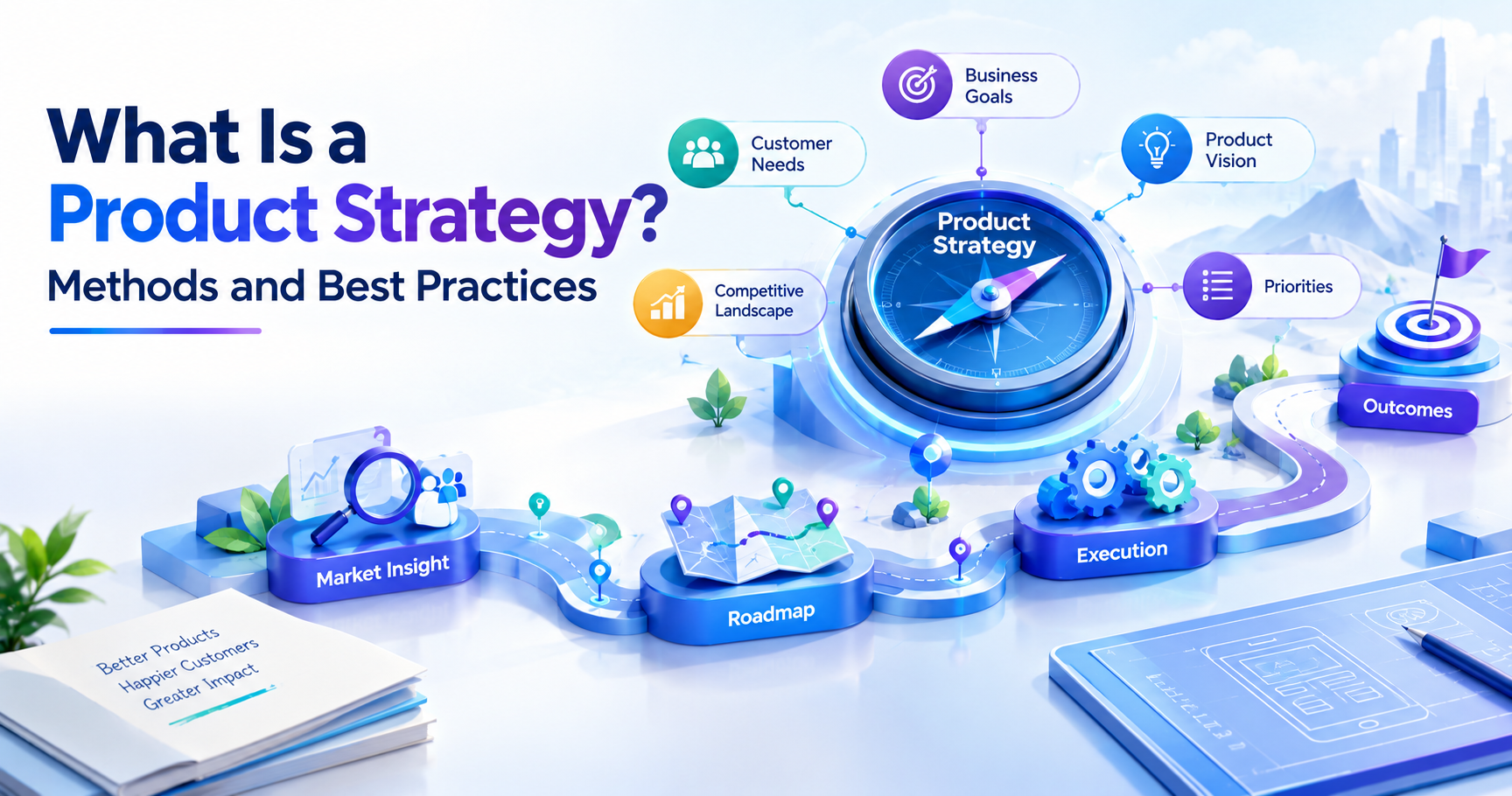
A high-level plan that defines the product’s vision, long-term business goals, and target audience is known as a product strategy. Some of its key elements include measurable goals and prioritised initiatives that are based on customer needs. To ensure a strategy remains relevant, continuous monitoring and adaptation are important.
Key Highlights:
- A product strategy encompasses various elements, such as product vision, target customers and their needs, competitive differentiators, organizational goals and strategies, and other elements.
- To develop a sound product strategy, it is essential to have a deep understanding of your customers, analyze your competitors and the market, set and prioritize goals, and be nimble.
- Various frameworks are available to help product managers think through their strategies. A few of these frameworks are Lean Canvas, SWOT, OKRs, Jobs-to-be-Done, Design Thinking, GEM and DHM, Three Horizons, and GLEe.
- Product mix strategy helps businesses manage their range of products. This strategy is used to reach a wider market or to reduce the range of products offered.
- Improving the skills needed for managing product development and roadmapping can be developed through on-the-job training and educational programs.
Introduction
A product strategy offers clarity and direction, which ensures the key stakeholders involved in the product development process work on the same objectives. It looks after prioritizing your product’s most critical aspects throughout the development process.
We are all well aware that project strategy goes into delivering successful products. However, implementing the product strategy is challenging. Misaligned priorities and failure to adapt to growing customers’ needs might lead to product failure.76% of product professionals believe that spending money on a product strategy is one of the best investments a team can make. Hence, product investments cannot be underestimated.
This article will guide you through the essential elements of crafting an effective product strategy, from understanding your target market to setting clear product goals and using the right product management tools for long-term success.
What is a product strategy?
A product strategy serves as a roadmap for product development, helping teams and stakeholders to be on the same page with a common objective. When you take a product from development to launch, you are coordinating with different stakeholders by taking their inputs into consideration. Here, product development software will help teams in navigating the challenges of the product development process.
Roman Pichler, a renowned product strategist, defines a product strategy as “A high-level plan that helps you realise your vision or overarching goal”. He states that a product strategy will describe who the product is for and why anyone would want to purchase and use it.
A product strategy will give clarity on what you like to achieve and the ways to plan to achieve it. The “why” behind the product is defined here. Prior to strategizing, you should get into the detailed work of developing your product roadmap and creating new features.

Where does a product strategy fit?
| Layer | Core Question | Primary Focus | Typical Timeframe |
| Business strategy | Why | Company-wide purpose and market ambition | Long-term, multi-year |
| Product strategy | What and where | Customer needs, positioning, competitive differentiation | Long-term, product lifecycle |
| Product roadmap and execution | How | Feature sequencing, resourcing, delivery | Short to medium term |
| Go-to-market strategy | Who and through what channel | Market entry, pricing, distribution, sales | Short to medium term, launch focused |
1. Business strategy
Business strategy lays the foundation for a company and defines its overarching goals, including its purpose and the markets in which it will compete. This strategy also sets the company’s objectives regarding revenue, market share, and other competitive goals.
Business strategy establishes the rules and objectives within which a company makes product and feature decisions.
2. Product Strategy: The What and Where
A product strategy defines the product or service offering and establishes the competitive boundaries within which a company will operate. This strategy also identifies the customers a company will serve and the value a company’s product or service will realize for the customer.
A product strategy also outlines how the company’s product or service will be differentiated from its competition. Additionally, a product strategy outlines the geographic markets and other markets within which the company will compete.
Within a product strategy, product roadmapping outlines the features and functions of a product, the business case for the product, and the overall product strategy. A product roadmap also outlines how the product will provide value to the customer.
The goal of a product strategy is to identify how a product will fulfil the purpose defined by the business-level strategy and to provide an edge over the competition.
Product Strategy requires consideration of the following elements.
- Untapped market opportunities must be clearly understood. Setting goals and defining strategies to develop a product or service and bring it to the market is important
- Understanding the target market and key competition is essential. User personas are good tools for effective product development.
- A competitive analysis helps in understanding the level of distinction a product or service may have against competition.
Product strategy focuses on several elements of a business. It is different and more strategic than a product development roadmap. Product strategy serves as a product business plan and sets direction for the overall product line.
When you talk about product vision vs product strategy, the vision is the future of a product in terms of value or change that a product wishes to create for a customer.
Strategy, on the other hand, describes the route to the destination, which consists of analysis of the market, competition and segmentation, as well as the decisions made concerning the elements of a competitive strategy.
3. Product Development, Roadmap and Execution - The How
Once a product strategy is defined, the next level of strategy is to define what will be built and when. It requires integrating several elements of a business and focusing on the tactics of product development.
4. Go-to-Market Strategy: A Parallel Path
Product strategy and go-to-market strategy are related but distinct areas. Go-to-market strategy does not fall under product strategy. Product strategy is mainly focused on the product, whereas go-to-market strategy is mainly focused on the business environment.
Let’s look at the differences between product strategy and go-to-market strategy in brief
- Product strategy focuses on product development and differentiation. Go-to-market strategy focuses on the means to make the product or service accessible to the target market.
This includes elements of the commercialization strategy such as price and distribution. It also includes the definition of the market or customer segments for the purpose of marketing and sales.
- The product strategy would define the target customer and product positioning. The go-to-market strategy would define the product and the company’s first-mover positioning in the market (i.e., initial sales and distribution channels).
Go-to-market strategy could also define other elements of the commercial launch marketing strategy (i.e. campaign, promotional activities, and product pricing).
Why is product strategy important?
With the help of a product strategy, you can align your project’s trajectory with customer and internal expectations. A quality product strategy will do the following:
1. Defines your product’s niche:
A well-researched product strategy will give you clarity on your product’s niche. This awareness helps teams in making decisions during development.
When an organization skips defining their product’s niche, they might produce a product that’s technically capable but loses strategically, appealing to customers broadly without creating a sense of urgency.
On the other hand, when you define the product’s niche, trade-offs become justifiable, resource allocation sharpens, the positioning becomes concrete, and the competitive position strengthens.
2. Aligns teams and reduces waste:
Many startups have cross-functional teams who perform various activities - engineering, marketing, design, and support. The lack of a shared strategy will put each group in a different direction. As a solution, a coherent strategy will align teams across research, design, marketing, and more.
As per the 2024 State of Product Management Report, 58% to 76% of people believe that product strategy and roadmapping are primarily the key investments. With clarity at the strategic level, the team can decide what to work on and what to defer. When you understand what a product strategy is, you tend to visualise a static document which keeps key stakeholders on the same page.
3. Avoids common failure modes:
According to a report by CB Insights, 40% of startups fail due to a lack of market need for what they were building. There are other reasons, like poor product quality and getting outcompeted. These issues create a missing or weak strategy.
If you aren’t having a defined problem and a target audience, you tend to develop risky features that aren’t valued. Also, if your product doesn’t have a unique selling proposition, your competitors are bound to overtake you.
To stay competitive in a growing market, having a clear strategy is important. It ensures that the roadmap addresses real problems, so your solutions can be presented better.
4. Managing change and enabling agility
According to a survey conducted by Productplan, 46% of product strategies are actually driven by internal inputs from sales feedback, compared to 48% that lean more on external inputs like competitive analysis and customer feedback. The teams who focused on external inputs rated their effectiveness on a larger scale (4.25 vs 4.03 on a six‑point scale). From this data, we believe that anchoring strategy in market insights will make teams more agile.
As a suitable measure, teams should balance quantitative metrics with qualitative user conversations, helping them understand why things work the way they do. A product strategy gives you a roadmap to decide the type of changes to implement and which ones to leave.
What are the best product strategy examples?
Some of the best product strategy examples include the following
1. Amazon: Work Backwards From Customers
Amazon’s customer obsession says that leaders must begin with a customer focus, and work backwards to also consider competitors. Ultimately, trust and loyalty of customers are of the utmost importance.
The lesson in this is to outline the experience you want your customers to have before deciding on the operational or technical means to accomplish that. This can be used to shape a variety of business documentation from product descriptions to how-to-build guides to service blueprints and schedules of work.
While the value added by customer obsession is undeniable, outlining systems that promote the use of customer data to make decisions is even more valuable.
2. Netflix: Evolve in Phases
Gibson Biddle provides several product strategy frameworks with examples from Netflix.
- The first was the strategy to move from the traditional video business to dominance in the streaming and global video business.
- The second was an explicit test of strategic bets focused on the development of high-value, hard-to-copy, and highly profitable services.
- The last framework was the strategic clarity of the triad of Growth, Engagement and Monetization.
Continuous strategic change was the most difficult and important element from the Netflix case study. Each element provided great flexibility to define the business strategy, meeting the interests and needs of customers.
3. Apple: Build an Integrated Ecosystem
Apple's business model has been strengthened by an ecosystem in which hardware, software, the App Store, and services work together to create and capture customer value. Harvard Business School describes this ecosystem as central to Apple's business model.
The strategic lesson is that differentiation can exist across a system rather than in one feature. Consistent design, integration, shared services, developer participation, and brand reinforce one another. This system-level advantage is more difficult to copy than an isolated product capability.
What are the key components of a product strategy?
An excellent product strategy has numerous intertwined elements; where each one needs to be looked at keenly. If you’re still clueless about what is a product strategy, understanding these components will help you notice how vision becomes a reality.
1. Product vision and goals:
The product vision represents the essence of a product. They are written as aspirational statements that articulate what the organization looks to achieve.
Moving forward, you’ll need to have high-level strategic goals. Examples of product goals are:
- In the next 6 months, there should be an increase in the free-trial downloads by 50%.
- Within 12 months, generate $3MM in revenue.
The best approach during goal setting for your product strategy is to use SMARTgoals. Similar to product roadmaps, your goals need to be specific, measurable, attainable, relevant, and time-bound.
2. Market research and target audience
The product design process begins with research to empathise with users, clarify business goals, and explore the market. Some of the activities include surveys, interviews, and market research, helping to uncover trends and opportunities. By taking these activities into consideration, teams can create personas that help in capturing goals, attitudes, and behaviors. To help you decide who to delight, a well-defined target audience will be useful.
3. Competitive analysis
Competitive analysis is one of the key components of a product strategy. It involves identifying opportunities, threats, strengths, and weaknesses. Teams are advised to map competitors based on price vs simplicity rather than “feature lists.”
4. Product roadmap and development
A successful strategy depends on how well it is executed. With a roadmap, your strategy will translate into planned releases, initiatives, and themes. Alongside strategy, teams view roadmapping as a crucial investment.
5. Continuous insight and management
As part of your product strategy, the importance of ongoing customer support and feedback integration cannot be underestimated.
As per a survey conducted by ProductPlan, 73% of companies add product managers to their user research. However, only 14% make good use of product managers, tech leads, and designers. If you are looking at a UX researcher taking the place of a product designer, the number increases to 16%.
This data suggests that many firms still operate in silos. Consider the use of cross-functional discovery so as to avoid blind spots. Having a well-balanced strategy will help in building processes that collect both types of insight and actively manage the portfolio.
6. Pricing strategy and monetization
Your pricing strategy will communicate value and define your revenue model, too. Remember, your strategy needs to have monetization and pricing that outline per-client costs and revenue channels as well. Both customer perception of value and business sustainability get aligned via effective pricing strategies.
Let’s look at the two pricing strategies
(a) Usage-based pricing will benefit infrastructure products, where value gets a boost with volume.
(b) For SaaS companies that target various company sizes, tiered pricing is the perfect option.
If you are looking at becoming a product manager, check some of the best product manager interview questions and answers.
How Do You Create a Product Strategy?
Creating product strategies is part of an ongoing process of research and validation. There are general steps that must be followed, and once completed, further steps are taken based on the information and results gathered.

New assumptions must be made, and more customer and market evidence must be validated. The following steps will generally be in this order.
1. Define the product vision
The product vision is the focal point that describes the change that a company aspires to create through its products and services. An effective product vision is clear, inspires employees to take action, and resolves an ethical dilemma.
Consider the following when creating a vision:
- What change does the product need to create?
- Who are the primary beneficiaries of the product?
- What does the product change with respect to speed, cost, safety, or quality?
- Is there an opportunity for the company to create this product in the market?
- Will this vision inspire employees to make trade-offs?
If the statement provides enough direction to create a product, then the statement is too restrictive. A broad product vision statement inspires employees to take action and frames the boundaries within which employees must operate.
If a stated feature can be aligned to the product vision, then the product vision is too broad. A broad vision must inspire and focus employees to create a new product or service that meets the stated vision.
2. Understand Customers and the Market
Starting a strategy with a customer and a significant job-to-be-done in mind allows you to consider both qualitative and quantitative evidence in your strategy development.
Qualitative evidence may come from a variety of sources including customer interviews, observations, journals, and support calls. It may also come from product usage data, customer surveys, and retention data, to name a few.
When product teams, for instance, are trying to gauge the level of frustration customers have regarding a given job, they have to determine the job itself. They must study the current process to understand the underserved job and the customer’s definition of progress. They may also observe customers and study the context surrounding why the customer is not solving a particular job, including why the customer may be satisfied doing nothing.
Along with understanding the job, product teams have to evaluate the context surrounding the job, including the market, competition, and changes in business regulations and technology.
When product teams study the job to be done and the market, they may uncover both the stated and the not-so-stated needs of a customer. In some cases, customers may not be able to articulate the desired outcome. In those cases, product teams should generate and test potential solutions.
3. Analyse competitors
A competitive analysis is an assessment of the choices available to customers. Relevant competition includes direct competitors, substitute products, alternate solutions (manual workarounds, homegrown apps, outside services, no solution).
According to April Dunford (globally recognized expert in product positioning), the analysis consists of 4 important factors.
1. Determining the competitive alternatives
2. Identifying the differentiating capabilities and the value those capabilities create
3. Customer segments that represent the best fit
4. The market (category and segment) that represents the best opportunity.
Competitor matrices should include:
- Customer segments and use cases
- Inclusive value proposition
- Operational and/or functional differences
- Pricing and/or delivery variations
- Means of distribution
- Relative strengths and weaknesses
- Threats and opportunities
- Unmet customer needs
- Critical, sustainable competitive advantages
The goal of the analysis is to develop strategic alternatives, not mimic a competitor’s strategies.
Understanding the competitive landscape should help answer what parts of the market are too competitive, and what parts of the market are not competitive enough, as well as identify the company’s defensible competitive advantages.
4. Set Goals and Priorities
Product goals demonstrate progress toward the vision. Impactful goals are defined by what is to be achieved, the metric, the starting point, target, and time limit.
Examples of possible goals include shortening the time to first value, improving the gross margin, or lessening the average support caseload.
Objectives and Key Results (OKRs) define an objective and the results associated with achieving that objective. A good objective can be further broken down into several key results. Key results should be written in a way that quantifies the outcome.
An example of a SaaS objective could be:
Objective: To provide a rapid and confidence-building experience during the onboarding process for operations teams.
Key Results:
- Increase the percentage of new accounts completing the setup process within 7 days from 42% to 65%.
- Reduce the median amount of time to complete the first workflow within the system.
- Increase the 30-day account retention rate from 70% to 78%.
Not all opportunities should be prioritized based on the most demanding customer. Priorities should be determined based upon the greatest customer value and strategic fit.
Some of the factors that should be taken into consideration when evaluating opportunities should include the expected business impact, effort and risk involved. The RICE methodology is one way to structurally and systematically prioritize opportunities.
When using the RICE methodology to prioritize opportunities, the scores should be evaluated to determine why a particular opportunity scored the way it did. The focus should be on initiatives that allow the organization to differentiate itself from its competition and improve its competitive edge. Initiatives should not be implemented to improve vanity metrics.
5. Create Strategic Initiatives
Strategic initiatives are the broad set of activities required to achieve product goals. Strategic initiatives are further broken down into features. To achieve a strategic initiative, the organization may need to implement a variety of features.
Improving the activation rate of a B2B product may require the following strategic initiatives:
- Improve the reliability of data import.
- Simplify the account setup process.
- Role-based Onboarding.
- Build and launch an implementation partner program.
Some use cases are so time-sensitive that it will be beneficial to provide templates that describe or assist in constructing portions of the strategy.
Each of the templates listed below should be provided to capture details of work being performed. The team justifying the work should describe how the work impacts the team's goal. Keeping the focus on the goal should help alleviate the feeling that additional, unnecessary work is being done.
6. Measure and adapt the strategy
A product or business strategy is made up of a series of hypotheses. These hypotheses should be validated or disproven as rapidly as possible.
Each hypothesis should be evaluated using evidence that is relevant to the product strategy, including, but not limited to, customer usage data, market data, and competitor actions.
Create a set of product strategy measures, including:
- Customer Measures: Time to achieve a product goal, Customer Satisfaction, Customer Churn.
- Business Measures:Average Order Value, Margin, Customer Acquisition Cost.
- Product Measures: Availability, Reliability, Response Time, Support Case Volume.
What Are the Benefits of Having a Product Strategy?
Product strategy helps make faster and better decisions. Establishing a common framework and standard for evaluation allows different functions of the company to evaluate ideas and proposals in the context of customer and business needs.
Product strategy provides:
- Visualizes the customer and the challenges they face to the team. Team members are given the endpoint in a quest to solve an underlying business problem.
- Provides a framework for prioritizing opportunities.
- Promotes transparency in the company by showing the interrelationships of company goals, strategies, and activities.
- Empowers teams to make decisions.
- Allows a company to focus on their unique value proposition and competitive edge.
- Helps avoid squandering company resources in areas that do not create business value.
- Encourages the company to test and validate its assumptions about new opportunities.
- Helps align the company to achieve business outcomes rather than just delivering a long feature backlog.
- Helps the company achieve strategic alignment in all areas from product, pricing, and promotion to post-purchase support.
- Allows a company to pursue a single strategic path while allowing a good degree of flexibility and manoeuvrability to achieve the path.
What are Product Mix Strategies?
The full assortment of goods and services offered by a firm for sale is called product mix. This can be measured by width, length, depth and consistency. Width measures the number of product lines; length measures the number of products. Depth is the number of variations in a product or a line. Consistency is how similar the different product lines are in terms of production, distribution and marketing.
Examples of strategies are:
- When a new product line or new product is introduced, this is known as an expansion strategy.
- A contraction strategy refers to the removal of a product from a product line. This is typically done if the product is not meeting the objectives of the firm.
- When a new, improved product is introduced, this is known as product improvement.
- Different products can be differentiated by the way they are packaged or labeled.
- If a firm decides to sell more than one product at a given price, this is called product line skipping.
- Product bundling is when a firm sells two or more related products for a single price.
A product mix can be extended to cover a larger market; however, this does not always benefit the firm. Before extending the product mix of a firm, there are various factors that must be taken into consideration. Some of these factors are operational costs, demand, cannibalization, strategic value and the firm’s objectives.
How Do Marketers Use Data to Develop Product Strategies?
Marketers provide customer, market, channel, and product-related evidence. Marketers use both forms of data to determine the most appropriate segments to target based on their needs and wants, as well as the most effective ways to reach them.
Further, data analysis helps marketers identify potential obstacles to trade, including the competition. Lastly, product data allows marketers to identify the optimal ways to reach target segments.
Some sources of product data include:
- How, when, and where users interact with a company’s product.
- Customers’ opinions expressed through interviews, surveys, focus groups, or online communities.
- Data collected and analyzed by the sales and marketing departments
- Competitors’ product offerings, pricing, and messaging.
- Users’ purchasing behavior and experience.
- The results of product and service tests, including A/B tests.
- Company data relating to revenue and expansion.
What are the best product strategy business models?
| Business model | How it works | Best suited to | Strategic questions |
| Subscription | Customers pay a recurring monthly or annual fee for access | SaaS, media, memberships, connected services | Is recurring value strong enough to support retention? Which unit or tier should determine price? |
| Usage-based | Price increases with consumption, such as transactions, storage, calls, or compute | APIs, cloud infrastructure, communications, financial technology | Does customer value rise with usage? Can customers predict and control spending? |
| Freemium | A free tier drives adoption while premium capabilities, scale, or governance require payment | Products with low serving cost and strong self-service adoption | Does the free product create a qualified path to paid use, or only support costly free users? |
| Transactional | Revenue comes from each purchase or transaction | Ecommerce, payments, ticketing, delivery | What drives purchase frequency, basket value, and contribution margin? |
| Marketplace | A platform connects two or more participant groups and charges fees or commissions | Labour, travel, retail, financial, and service marketplaces | How will the product create liquidity, trust, quality, and balanced value for every side? |
| Licensing | Customers pay for rights to use technology, content, intellectual property, or software | Enterprise software, media, patents, specialised tools | How will usage rights, updates, support, and compliance be structured? |
| Advertising | Users receive a free or subsidised product while advertisers pay for access to attention or targeting | Media, search, social, and content platforms | Can the product balance advertiser value, user trust, relevance, privacy, and experience? |
| Product plus service | A core product is combined with implementation, consulting, support, or managed operations | Complex B2B, industrial, healthcare, and transformation products | Which service elements accelerate value, and which prevent the model from scaling? |
| Razor and blade | An initial product drives repeat purchase of consumables, accessories, or services | Printers, coffee systems, medical devices, gaming hardware | Does the installed base produce durable repeat economics without harming trust? |
| Hybrid | Two or more models are combined | Platforms and mature product portfolios | Does the combination improve customer fit, or create pricing and operational confusion? |
What are the best product strategy methods?
Various methods make up product strategy. Let’s look at them in detail

Source: Product Strategy Canvas
1. Product Strategy Canvas
Melissa Perri, a product strategy professor and consultant, created the Product Strategy Canvas to capture a team’s product strategy. It comprises four components, which are challenge, vision, current state and target condition.
- Vision: A team’s direction and goals for the future.
- Challenge: The obstacle a business has identified and has committed to solving.
- Target condition: A goal, which, when achieved, solves the challenge.
- Current state: The evidence-based position of the business.
A business should complete the canvas only if it has a vision and needs to define the next important challenge. It should encourage a team to define the performance gap and evaluate business trade-offs.
2. Lean Canvas
Ash Maurya’s Lean Canvas is a modification of the Business Model Canvas to capture product strategy and product innovation. It comprises nine components.
- Problem
- Solution
- Key metrics
- Unfair advantage
- Unique value proposition
- Channels
- Customer segments
- Cost structure
- Revenue streams
Unlike the Business Model Canvas, which is generally used to capture the strategy of an organization, the Lean Canvas is appropriate to capture the strategy of a new product.
Maurya says a Lean Canvas should capture a few customer problems and a handful of product solution trade-offs. Product solutions, however, should be supported by multiple product outcomes.
3. SWOT analysis:
A SWOT analysis is an assessment of the strengths, weaknesses, opportunities, and threats a business is facing.
Strengths and weaknesses are found within a business, while opportunities and threats are found outside. For product strategy, the best SWOT analyses are specific and supported by data. An analysis that states a product strategy is supported by a “strong brand” is not beneficial.
Generally, SWOT analyses are used to evaluate a product strategy. A full product strategy requires other analyses in addition to SWOT.
4. OKRs and Prioritization Frameworks
OKRs help connect organizational strategies and goals. OKRs consist of a set of objectives and a set of key results. Key results help describe and measure progress toward an objective. It is important to note that key results are assessed by the outcome, not the activity.
Initiative prioritization helps answer the question “which idea should we implement first?” with a number of frameworks.
A couple of these frameworks include:
- RICE: Reach, impact, confidence, and effort.
- ICE: Impact, confidence, and ease.
Some other prioritization frameworks focus on value and effort. These concepts help anchor an initial discussion on which idea should be implemented first. When using these frameworks, it is important to find the right balance, based on your organizational strategy and goals.
Arbitrary debate is reduced when a framework is provided and clear directions are given. These frameworks help focus and develop business strategies, but do not always validate the strategies.
What are the modern product strategy frameworks?

Some of the modern product strategy frameworks include the following:
1. Jobs-to-be-done:
"Jobs-to-be-Done" (JTBD) identifies what consumers need in a given circumstance. It's broader than product attributes and user/buyer demographics.
JTBD takes into account the user's emotional and social needs. The theory states that users “hire” a product to achieve a specific function, or progress, in their life.
Alternatively, staff members can look at situations in which a product is being evaluated, and purchase has not been made, to gain a deeper understanding of users. These staff members must research and understand the consumer’s state of mind with regard to the purchase and their reservations about changing their status quo.
2. Design Thinking
This theory is based upon understanding the consumer and creating a product or service that meets the consumer’s needs while considering what the company is financially and technologically able to produce.
With design thinking, research is employed to gain a thorough understanding of the consumer, and from that research, ideas are created and shown in a physical form (i.e. a prototype). The goal is to create a product that meets the user’s needs.
In design thinking, there is a focus on iteration, and several solutions are created; from those many options, the most valuable are determined.
3. GEM Model: Growth, Engagement, Monetization
The GEM Model states that product teams can focus on growth, engagement and monetization of the product. However, the model does not ignore the other two focus areas.
The main purpose of the model is to clarify product team alignment in case trade-offs are required.
- If a product team focuses on growth of a product, it means the product team is focusing on product expansion to include new customers.
- Engagement of a product means the product team focuses on product features that enable customers to get value that leads to product retention.
- Monetization means the product team focuses on features of the product that enable the product team to achieve a positive return on investment.
4. DHM Strategy: Delight, Hard-to-Copy, Margin-Enhancing
In regard to strategy, the DHM model focuses on product features and how they help a company achieve two of the three focus areas of the GEM model. How a product helps a customer and how that helps a company achieve trade-offs in economics of the company.
- Delight: Does the decision lead to a better experience or customer value?
- Hard to Copy: Does the decision lead to a competitive edge through economics, structure or organizational capabilities?
- Margin: Does the decision impact the economy to protect or strengthen the ability to create future customer value?
There are trade-offs. Some choices may positively impact economics and customer value, but may negatively impact employee trust.
A positive trust-economics trade-off may occur with the addition of a new, competing feature in the marketplace. Generally, the strongest choices impact all three areas.
5. Three Horizons Framework
The Three Horizons Framework was first introduced by McKinsey’s consultants Mehrdad Baghai, Stephen Coley, and David White in their book "The Alchemy of Growth.
With McKinsey’s Three Horizons Framework, companies can strategise to optimize short-term and long-term performance.
- The first horizon represents the company’s core business and largely comprises the company’s profit and cash flows.
- The second horizon encompasses business opportunities which, with effort, may be developed to largely comprise the company’s profit and cash flows.
- The third horizon encompasses research and other activities which, with effort and time, may lead to company growth opportunities.
This framework describes strategies based on horizons.
- Horizon 1 describes strategies related to improving, protecting and extending the current product line.
- Horizon 2 describes strategies related to surrounding the core product.
- Horizon 3 describes strategies related to speculating about the future by identifying, understanding, and commercially exploiting customer needs, problems and wants.
Strategies must be formulated and implemented simultaneously. This is particularly true when the industry is evolving rapidly, competition is strong, and the company is resource constrained.
The risk with this framework is that a company can become too focused on optimizing its core product, or become too speculative about the future. In either case, the company can eventually find itself struggling to remain competitive.
What are the differences between a Product Strategy and a Product Roadmap?
The differences between product Strategy and a product roadmap include the following
| Dimension | Product strategy | Product roadmap |
| Core question | Where will the product compete, why will it win, and how will it create value? | Which outcomes and initiatives will move the strategy forward, and in what broad sequence? |
| Purpose | Establish choices and decision guardrails | Communicate priorities and guide coordinated execution |
| Typical content | Vision, customers, needs, market, alternatives, differentiation, business goals, strategic hypotheses, and measures | Goals, initiatives, themes, releases, broad time horizons, dependencies, status, and success metrics |
| Time horizon | Usually medium to long term, with regular validation | Usually near to medium term and updated more frequently |
| Level of detail | High-level direction and choices | More specific than strategy but less granular than a backlog |
| Stability | Changes when important assumptions, market conditions, or business direction change | Changes as teams learn, capacity shifts, dependencies move, and goals evolve |
| Main audience | Executives, product leaders, and cross-functional decision-makers | Product, engineering, design, marketing, sales, support, leadership, and sometimes customers |
| Output | A coherent explanation of what the team will and will not pursue | A prioritised view of intended outcomes and major work |
| Main risk | Becoming vague, generic, or unsupported by evidence | Becoming a fixed feature calendar or stakeholder wish list |
| Relationship | Provides the rationale and constraints | Operationalises and communicates the strategy |
What are the Best Practices for Product Strategy?
Product strategy is a collaboration in which the leadership team makes a series of choices, communicates these choices to the organization, and adopts a testing discipline regarding the choices.
1. Start With a Specific Customer
Once a segment has been identified, the product development team must reach a collective understanding of the job the customer is trying to accomplish, the context in which the customer is buying, and the customer's definition of value. It is best if the first segment is kept relatively narrow. If a position in the market has not been clearly defined, the segment can be expanded later.
2. Solution Separation
It is important to write down the definitions of the customer's job, the desired outcome, and the customer's evidence before defining the solution. This encourages the development of various potential solutions.
3. Implicit Value Trade-Offs
Value is defined by the customer. If a product is valued by a segment of the market, it does not guarantee that the product will be economically successful. The definition of a strategy's implicit value provides focus for the product team.
4. Customer Value / Business Value
The product must integrate customer and business value in order to be successful. The integration may be in the form of a customer's willingness to pay, customer value that allows for efficient product development, or learning strategies that differentiate the business.
5. Strategic Bet Testing
There must be a clear definition of the strategy's biggest unknown. The definition may be in the form of customer acceptance of the product, the legality of the product, the product's distribution, or the economics of the product.
The definition should be tested using the lowest possible resource commitment. Depending on the evidence, product development may continue, change direction, or cease.
6. Outcomes Over Outputs
Outputs are easy to define and measure, and unfortunately, many business decisions are made using outputs. Delivering a product with ten features is an output.
So is shipping a product at all. But increasing the percentage of customers taking an action that is essential to the business is a better way to measure the value the team delivers.
7. Different Types of Data
Although data is easy to collect and can be done at scale, it does not always explain the why behind a customer’s actions. One-on-ones and observations can help explain customers’ fears and goals. Product teams should find ways to integrate data, surveys and interviews into their product development process.
8. Changing the North Star
When a new strategy is defined, the associated North Star is also updated. To keep the strategy and associated metrics focused, define the new metrics and baseline. Metrics should be clearly defined to help align the team.
9. Adopting the New Strategy
As early as possible, teams who are impacted by the new business strategy should be notified to help remove barriers and obstacles and gain commitment. Most constraints can be removed, but not all. Product managers should be able to rely on others and make key decisions.
10. Communicating the Strategic Logic
You must convey the rationale for the strategic choices made and the overall logic of the strategy. The name and the chosen colors are important elements of the strategy but, more broadly, the reasoning and evidence for the choices made, the assumptions taken, the bets made, the risks taken, the objectives, the initiatives and the cadence of review are also important.
11. Treating the Roadmap as a Working Hypothesis
When communicating the roadmap to stakeholders, set the appropriate expectations for each bet and outline the potential outcome and the evidence that will be collected to support, dismiss or modify the outcome.
12. Setting a Review Schedule
There are a number of metrics and performance indicators that are useful in assessing the effectiveness of the organization and helping shape the direction of the strategy. These metrics should be tracked regularly and strategically. Change the strategy only when the environment demands it.
13. Maintaining Consistency
There are a number of areas where strategies and choices for the business should be aligned, including how the company interacts with and provides for its customer base. Conflict in choices results in a focus on too many areas.
What are the common product strategy mistakes?
Some of the common product strategy mistakes include the following:
1. Passing off a roadmap as a strategy: An effective strategy communicates the reasons why a product will win, not the features or when the work will be completed.
2. Taking a market position of strategic equivalence: Without definition, the market becomes too big to effectively target with research, price, or position the product.
3. Building a solution around a technology: A product strategy can incorporate a new technology, but it will not be effective against competitive differentiation unless it addresses a significant customer need.
4. Blindly following competition: Mimicking a competitor can lead to equal outcomes, but not necessarily the best results against a product’s overall strategy.
5. Assuming a product request equals a product need: It is important to understand the customer’s true need rather than assuming a product request equals a product need.
6. Nonspecific Strategic Objectives: A goal to improve product engagement provides little to no actionable information to the stakeholders.
7. Misplacing strategy and reprioritizing product output: More product output does not guarantee improved strategy.
8. Failing to assess strategic impacts on product economics: It is possible to invest too much in a product, creating a delightful customer experience, but adversely affecting the business’ bottom line.
How does Simpliaxis help professionals learn about creating a product Strategy?
When learning product strategy, people are more inclined to retain information when examples are provided.
Simpliaxis provides several options for professional development through webinars and certification programs in various domains such as Agile, Scrum, SAFe, product management, project management and more.
Some of the courses provided by the edtech company include the Certified Scrum Product Owner course, SAFe Product Owner/Product Manager course, as well as courses on Agile Product Management and other product ownership courses.
The Certified Scrum Product Owner course provides participants with the skills necessary to effectively manage a product backlog and engage with stakeholders to implement and test the product. It provides ample opportunities for participants to engage in case studies and upskill through practice tests, helping you become a successful Scrum Product Owner.
The SAFe Product Owner/Product Manager course provides participants with the skills to effectively manage and engage with stakeholders in an enterprise Agile environment to facilitate the delivery and attainment of strategic outcomes.
These learning paths help you in the following ways:
- Turning theory into decisions:
Learners develop their skills in constructing and communicating product visions, prioritization, and backlog management and have opportunities to practice having conversations with stakeholders in a safe and realistic environment. - Connecting strategy and delivery:
Through training, learners gain the skills necessary to define and construct a product backlog at various levels of a product and/or business strategy. - Improving prioritisation:
Through a series of activities, learners prioritize product backlogs based on user stories, affinity, and agreement, rather than on personal opinion. - Strengthening stakeholder alignment:
Through role-plays and other inter-participant activities, learners practice explaining product backlog prioritization and rationale to stakeholders. - Building an Agile feedback loop:
Participants learn to structure strategies to suit the objectives of a product and to be flexible and responsive to changes in the strategic direction. - Product ownership at various levels:
Scrum trains participants in product ownership at a team level, whereas SAFe trains participants in product ownership at an enterprise level.








 Lowest-Price Challenge











 Personalized Path


.webp)


 USA
USA  Canada
  India
India  UK
UK  Australia
  Singapore


