


 Call Us



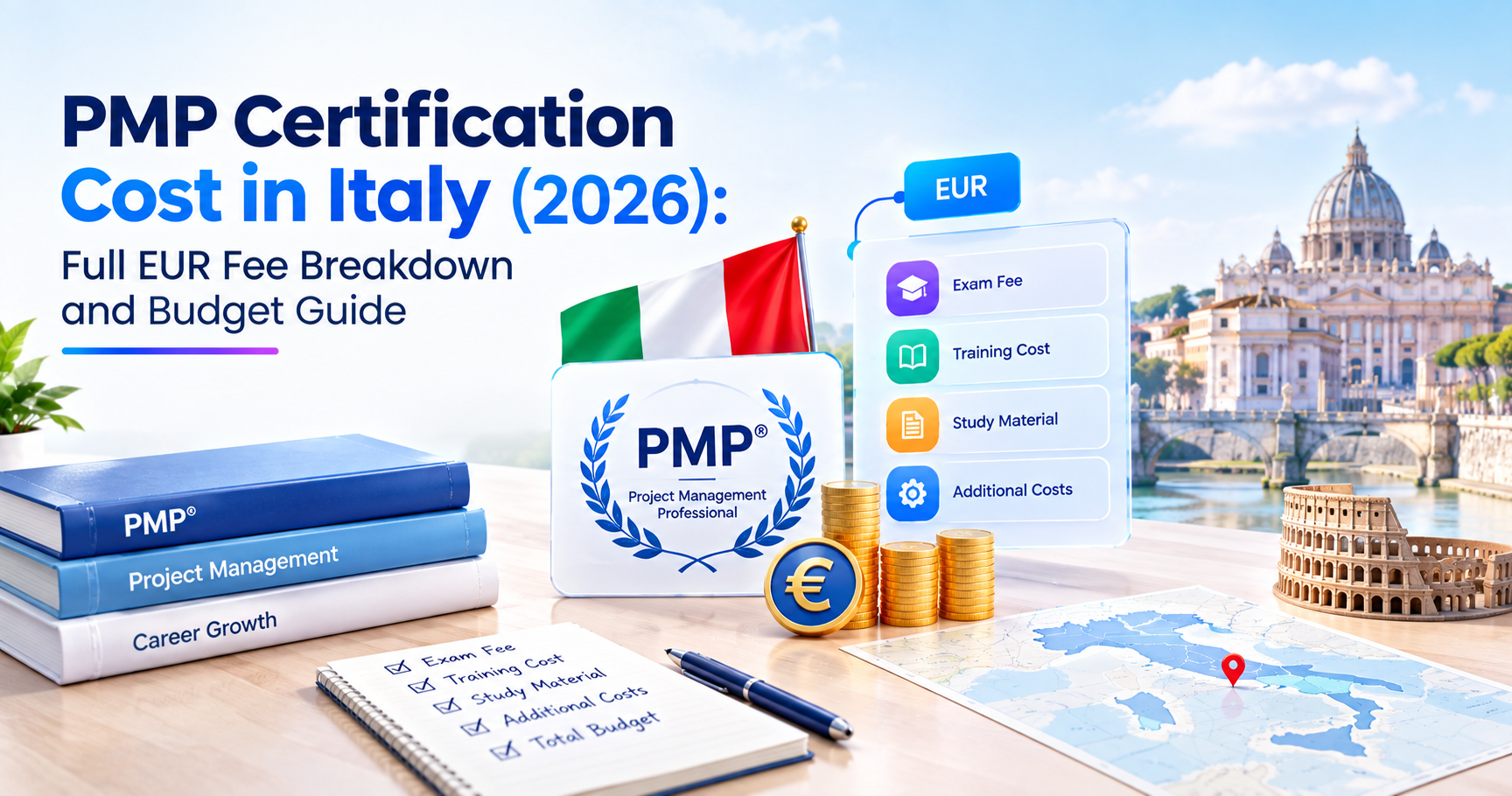
PMP certification in Italy typically costs between EUR 900 and EUR 3,000 in total once you add PMI's exam fee, optional PMI membership, a training course that meets the 35-contact-hour requirement, and basic study materials. The exam fee itself is set by PMI in US dollars: $425 for members and $675 for non-members, following the fee increase that took effect on 6 August 2026, and Italian candidates see a euro-equivalent amount plus VAT at checkout on pmi.org. Training delivered by a PMI Authorized Training Partner in Italy generally ranges from around EUR 1,090 for live online formats to well over EUR 5,000 for premium classroom bootcamps in cities such as Milan or Rome. Renewing the credential every three years adds a further EUR 55 to EUR 140, depending on membership status, plus whatever it costs to earn 60 PDUs.
Key Highlights of PMP Certification Cost in Italy
- PMI's PMP exam fee rose on 6 August 2026 to $425 for members and $675 for non-members, with Italian candidates paying a PMI-set euro equivalent plus VAT at checkout rather than a fixed published EUR rate.
- Total first-year PMP cost in Italy typically lands between roughly EUR 950 (lean, self-paced route) and EUR 3,500+ (classroom or bootcamp training with full materials).
- PMI membership costs roughly EUR 110-140 a year and immediately cuts the exam fee by around $250, so it usually covers most or all of its own annual dues.
- Live online PMP training in Italy commonly costs 30-50% less than in-person classroom courses covering identical content, according to several training providers.
- Renewal every three years under PMI's Continuing Certification Requirements (CCR) programme costs $60 for members and $150 for non-members, plus the cost of earning 60 PDUs.
- Italian employers can redirect part of their mandatory INPS training contribution through a Fondo Interprofessionale, such as Fondimpresa, to fund employee PMP training at no direct cost to the training budget.
- The PMBOK Guide 8th Edition and a revised Examination Content Outline reshaped the 2026 PMP exam, which changes what candidates should budget for study materials even though it did not change the exam fee itself.
The Complete PMP Certification Cost Breakdown in Italy (2026 Snapshot)
Becoming PMP certified in Italy involves five separate cost items, and the total for most first-time candidates falls between EUR 900 and EUR 3,000 depending on how much of the process is self-directed versus delivered through a training provider. The table below sets out each component as it stood in September 2026, drawn from PMI's published fee structure and current Italian training market rates, though individual providers and PMI's own euro conversion at checkout will move the exact figure.
Two things are worth flagging before setting a budget. First, PMI prices the exam fee in US dollars everywhere and then displays a euro-equivalent figure, inclusive of VAT, once a candidate logs into a pmi.org account and reaches checkout, so the euro figures above are informed estimates rather than a fixed PMI-published rate. Second, training cost is the single biggest swing factor in the whole budget: a self-paced course and a multi-day classroom bootcamp in Milan can differ by more than EUR 5,000 for essentially the same exam content.
How Much Is the PMP Exam Fee in Italy in 2026?
Italian candidates pay PMI's standard global exam fee rather than a discounted or Italy-specific rate, and that fee rose on 6 August 2026 to $425 for PMI members and $675 for non-members, up from the previous $425/$675 structure. Before that increase, industry fee trackers cited PMI's euro-facing price for EU candidates at roughly EUR 340 for members and EUR 465 for non-members; since the underlying dollar fee has since risen, the current euro equivalents sit somewhat higher, in the region of EUR 360-375 and EUR 570-585 respectively at a representative September 2026 exchange rate, though the only figure that matters is the one PMI itself shows in euros, including Italian VAT, at the moment of application. Italy is not on PMI's list of countries eligible for geolocation-adjusted reduced pricing, which applies mainly to lower-income economies, so candidates should not expect a discount tied to residency. For a closer look at how the fee structure and the August 2026 increase work in practice, Simpliaxis's PMP exam fee guidewalks through the payment steps and schedule options in detail.
| Cost Component | Typical Range (EUR) | Paid To | Notes |
| PMP exam fee, PMI member | ~EUR 360-375 | PMI (via Pearson VUE) | Approximate euro equivalent of the $425 fee set after PMI's 6 August 2026 increase |
| PMP exam fee, non-member | ~EUR 570-585 | PMI | Approximate euro equivalent of the $675 fee |
| PMI annual membership | EUR 110-140 + one-time EUR 9 application fee | PMI | Optional, but reduces the exam fee by roughly $250 |
| PMI-authorised training course | EUR 250-6,300 | Training provider | Self-paced e-learning through to classroom or university-affiliated bootcamps |
| Study materials and practice exams | EUR 0-250 | Various publishers/providers | Often bundled into a training course fee |
| Retake fee (if needed) | Lower than the full fee | PMI | PMI charges a reduced rate for a second attempt in the same eligibility window; confirm the current amount at pmi.org since it moved with the August 2026 increase |
| Renewal, per 3-year CCR cycle | $60 member / $150 non-member | PMI | Plus the cost of earning 60 PDUs, which can be close to free |
Is PMI Membership Worth It for Candidates in Italy?
For most Italian candidates, joining PMI before applying for the exam is worth it purely on the arithmetic: annual membership costs somewhere between $129 and $159 depending on which 2026 tracker is consulted (with more recent figures citing around $154), plus a one-time $10 application fee, roughly EUR 110-140 in total, yet it immediately unlocks a reduction of about $250 on the exam fee. That discount alone typically covers most or all of the first year's dues before counting the other perks membership brings. Members also get free digital access to the PMBOK Guide (now in its 8th Edition), discounted rates at local PMI chapter events, and a cheaper renewal fee three years later. Candidates who only plan to sit the exam once and never renew membership can, in principle, skip membership and simply pay the higher non-member exam fee; the maths only favours non-membership if the exam is a genuine one-off and no PMBOK or chapter resources are needed along the way.
PMP Training Costs in Italy: Self-Paced vs Live Online vs Classroom vs Corporate
Training is the largest and most variable line item in the Italian PMP budget, ranging from a few hundred euros for a self-paced course to several thousand for a premium classroom programme. The table below groups the main delivery formats available to candidates based in Italy.
| Training Format | Typical Cost (EUR) | Delivery | Best Suited For |
| Self-paced e-learning | EUR 250-700 | On-demand video, own pace | Independent learners with prior project management exposure |
| Live online (virtual instructor-led) | EUR 1,090-1,500 | Scheduled live sessions with a real instructor | Most Italian candidates balancing work and study |
| Classroom/in-person | EUR 1,800-3,500 | Multi-day sessions in Milan, Rome or other cities | Candidates who want structured, in-person learning |
| University or business-school-affiliated | EUR 2,100-6,300 | Extended programmes carrying an academic brand | Candidates prioritising institutional branding or a wider network |
| Corporate/group training | Custom quote, typically lower per head | Delivered privately to a team of employees | Organisations upskilling several project managers at once |
Live online training generally costs 30-50% less than in-person classroom courses while covering identical exam content, which is why it has become the default choice for most working professionals in Italy. Simpliaxis runs a PMP certification training programme that includes the 35 contact hours PMI requires plus PDUs, and its owncomparison of leading PMP training providers is a useful reference point before committing to a specific format or price bracket, since course inclusions (practice exams, recordings, one-to-one support) vary as much as headline price.
How to Reduce Your PMP Certification Cost in Italy?
- Join PMI before you apply: pay the annual membership fee first so the exam application automatically qualifies for the member rate, rather than paying the non-member fee and joining afterwards.
- Choose live online over classroom: unless in-person networking is a priority, a live virtual course covers the same syllabus for a fraction of the classroom price.
- Bundle training and materials: many providers include practice exams and the current-edition study guide in the course fee, which usually works out cheaper than buying them separately.
- Apply and sit the exam within one eligibility window: PMI's reduced retake fee only applies to a second attempt within the same one-year eligibility period, so a lapsed application forfeits that discount.
- Ask about employer or fund-based support: many Italian companies can route training costs through a Fondo Interprofessionale or an internal learning and development budget rather than the candidate paying out of pocket.
What Do PMP Study Materials and Exam Prep Cost in Italy?
Study materials for the PMP exam in Italy typically add anywhere from nothing, if a training course already includes them, to around EUR 250 for a standalone bundle of a current-edition prep book, flashcards and a practice-exam simulator. PMI members receive free digital access to the PMBOK Guide, which moved to its 8th Edition in November 2025, as part of their membership benefits, removing one of the larger standalone material costs. Because the PMP exam released on 9 July 2026 is aligned to a revised Examination Content Outline rather than the older one, candidates should check that any book, question bank or course they buy is written for the current outline; older, discounted materials pegged to the previous outline can be poor value even at a lower price if they under-cover topics that now carry more exam weight.
PMP Certification Renewal Cost in Italy: The Three-Year CCR Cycle
Renewing a PMP certification costs $60 for PMI members and $150 for non-members every three years, on top of whatever it costs to earn the required 60 Professional Development Units (PDUs) during that Continuing Certification Requirements (CCR) cycle. At least 35 of those 60 PDUs must come from education, with minimums of 8 PDUs each in Ways of Working, Power Skills and Business Acumen, while the remaining "Giving Back" category is optional and capped at 25 PDUs. PDUs themselves can often be earned at no cost through free webinars, PMI chapter events, volunteering or reading, so the real out-of-pocket renewal cost for many members is close to just the $60 fee, roughly EUR 50-55 at typical conversion rates. Non-members who let membership lapse pay $150, and since maintaining membership saves $90 on that renewal fee alone, most candidates who plan to stay certified long-term find it cheaper to keep membership active. Simpliaxis'sPMP certification renewal fee guidebreaks down the PDU categories and reporting process in more detail.
PMI Chapters Serving Italy: Rome, Milan and the Northern Italy Chapter
Italy is served by several PMI-chartered chapters rather than a single national body, and joining one adds a modest local due on top of global PMI membership while opening access to low-cost or free PDU events. The PMI Northern Italy Chapter, based in Milan and chartered in 2001, is the largest, with more than 2,700 members and over 100 volunteers running more than 30 events a year, according to the chapter's own PMI-hosted profile. A Central Italy Chapter serves the Rome area, and a Southern Italy Chapter covers the rest of the peninsula; the three chapters have a standing agreement to cooperate on national-level project management initiatives. For candidates budgeting the full cost of certification, chapter membership is optional but often pays for itself quickly through discounted study group sessions and free PDU-earning events ahead of renewal. Full chapter details, including current dues, are published on the PMI Northern Italy Chapter page.
Can Italian Employers Fund PMP Certification Training?
Yes: Italian employers can redirect the training portion of their mandatory INPS social security contribution, 0.30% of payroll under Legge 388/2000, into a Fondo Interprofessionale, an employer- and union-backed training fund, and use that funding to cover PMP exam preparation and training for employees at little or no direct cost to the company's own training budget. Funds such as Fondimpresa manage the full cycle of a funded training plan, from identifying skills gaps through to running and reporting on the course, and PMP-aligned project management training fits within the categories of professional upskilling these funds are designed to support. For organisations that want to run this as a structured group programme rather than sending individual employees into public cohorts, Simpliaxis's corporate and group training option lets an L&D team commission a private PMP cohort scheduled around the organisation's own calendar, which pairs naturally with Fondo Interprofessionale funding since the entire cost can be invoiced to the employer rather than reimbursed individually. Further detail on how the interprofessional fund mechanism works is available directly from Fondimpresa.
Three PMP Budget Scenarios for Italy: Lean, Standard and Premium
Because the exam fee is fixed but training cost is not, the honest answer to "how much will my PMP cost" depends heavily on which of three realistic paths a candidate in Italy follows. The scenarios below combine the cost components covered earlier into rounded, representative totals.
| Scenario | Exam Fee Path | Training | Materials | Approx. Total (EUR) |
| Lean | Non-member exam fee, no PMI membership | Self-paced e-learning | Free or low-cost bundled resources | EUR 950-1,150 |
| Standard | Member exam fee plus annual membership | Live online instructor-led course | Moderate, mostly bundled | EUR 1,650-2,100 |
| Premium | Member exam fee plus annual membership | Classroom or business-school affiliated bootcamp | Full materials, practice-exam simulator | EUR 2,900-3,600+ |
Most working professionals in Italy land in the standard scenario, where the combination of membership, a live online course and bundled materials keeps quality high without paying classroom prices. Anyone leaning towards the premium end is usually paying for either an in-person cohort in a city such as Milan or Rome, or an academic institution's brand and network; checking a current, independent comparison of training providers before committing to that tier helps confirm whether the extra cost is buying meaningfully more support or mostly a name.
Is the PMP Worth the Cost in Italy? Salary and ROI
PMP certification tends to pay for itself well within the first year for most Italian project managers, since certified professionals sit at the upper end of a wide national salary range. The average gross salary for a project manager in Italy was around EUR 72,120 as of July 2026, according to SalaryExpert, with entry-level professionals (1-3 years) averaging roughly EUR 51,680 and senior professionals (8+ years) averaging roughly EUR 81,286. PMP-certified project managers specifically report a wider spread, from about EUR 39,000 to EUR 141,000 based on a Payscale sample of 92 respondents, reflecting how much industry, seniority and city affect pay. City-level data from Glassdoor puts average project manager pay at roughly EUR 47,500 in Rome and EUR 46,500 in Milan. Set against a typical all-in certification cost of EUR 950 to EUR 3,600 depending on the chosen path, even a modest salary uplift or improved job prospects after certification generally recovers the outlay quickly. Simpliaxis's PMP certification salary guide covers how certification typically affects earnings across different markets in more depth.
How the PMBOK 8th Edition and 2026 Exam Update Affect Your Budget
The PMBOK Guide 8th Edition, released in November 2025, and a revised Examination Content Outline that took effect with the new PMP exam version on 9 July 2026 do not change PMI's exam fee, but they do change what candidates should budget for study materials, since courses and books written for the previous outline no longer match current domain weightings. The 8th Edition restructures guidance around six core principles and seven performance domains, adds new non-prescriptive "Focus Areas," and, according to several exam-prep specialists tracking the change, shifts the Business Environment domain's weighting from around 8% to roughly 26% of the exam, alongside new emphasis on AI use in project delivery and sustainability. Practically, this means a candidate who bought PMP materials before mid-2026 should confirm those materials have been updated for the current outline before relying on them, since the content weighting shift is large enough to affect study time allocation even though it changes nothing about PMI's fee schedule. Official details on the current outline sit on PMI's PMP certification page.
Conclusion
The honest answer to what PMP certification costs in Italy is "it depends on the path chosen," but the range is predictable: a lean, self-paced route can land near EUR 950-1,150, a standard live-online path with PMI membership typically runs EUR 1,650-2,100, and a premium classroom or academic-affiliated programme can reach EUR 2,900-3,600 or more. The exam fee itself, set globally by PMI in US dollars and shown in euros with VAT at Italian checkout, rose in August 2026 and is not something training providers or candidates can negotiate, but every other line item- membership, training format, materials and even who pays- is a genuine choice. For employed candidates, checking whether an employer can route the cost through a Fondo Interprofessionale or a corporate training arrangement is often the single biggest lever on the final bill, ahead of choosing between training formats. Whatever combination is chosen, treating PMI's own fee page as the source of truth for the exam fee, and a current, 8th-Edition-aligned course for training, keeps the budget both accurate and aligned with the exam actually being sat in 2026.







 Lowest-Price Challenge











 Personalized Path


.webp)


 USA
USA  Canada
  India
India  UK
UK  Australia
  Singapore


