


 Call Us
_1788343714.jpeg)


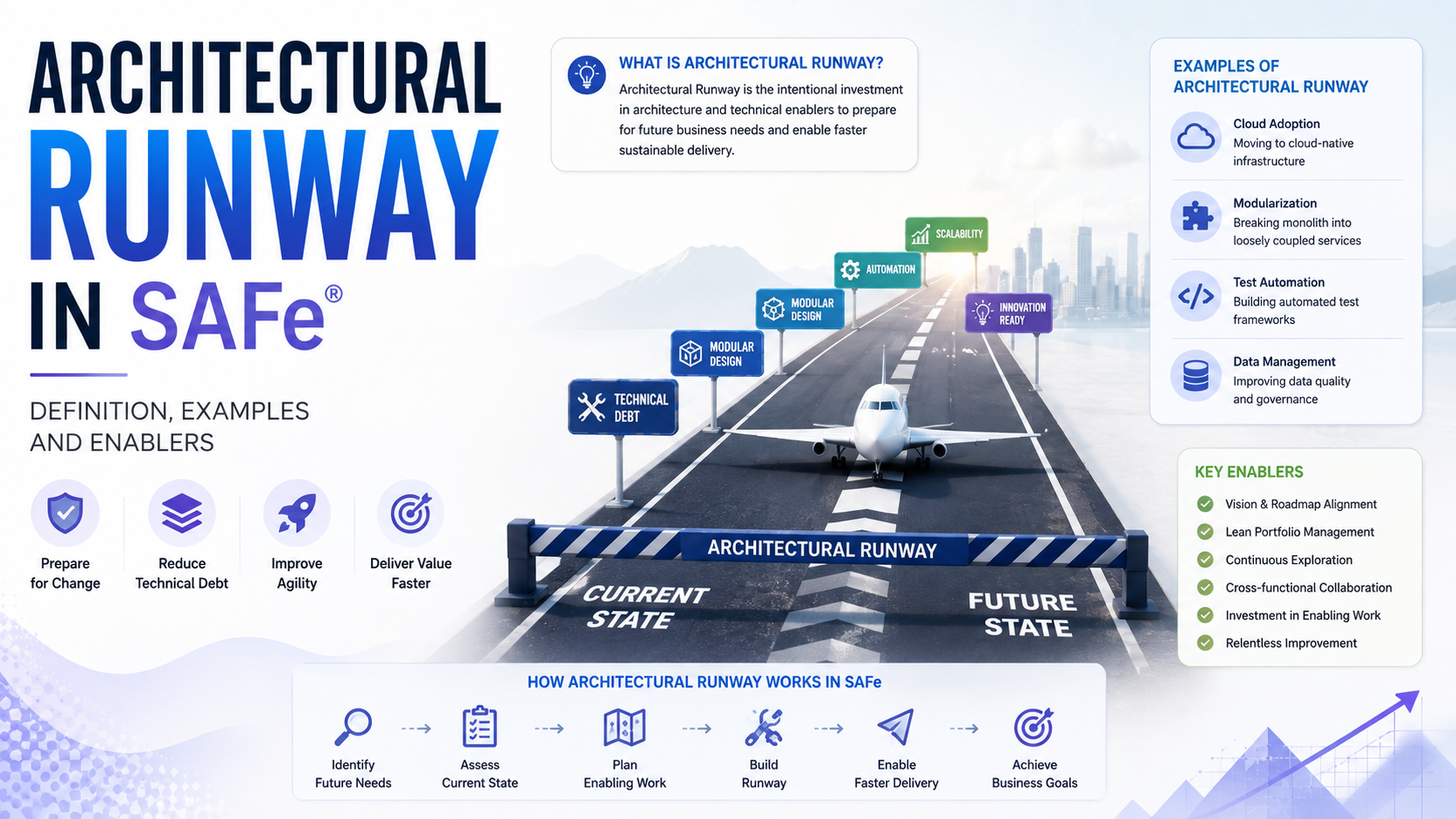
The pre-existing technical infrastructure that’s required for developing new features at a rapid pace is known as Architectural Runway in SAFe. Understanding this concept is crucial for people who take active participation in SAFe projects. Here, the primary goal is to enable continuous delivery and continuous deployment with respect to maintaining system quality and reducing technical debt.
Key Highlights of Architectural Runway in SAFe
- Architectural runway is the existing code, components, and technical infrastructure (cloud platforms, security frameworks, reusable APIs) that lets Agile Release Trains build near-term business features without redesign or delay, unlike traditional planning it's built just far enough ahead, not end to end.
- It exists to serve two goals: facilitating agile development by enabling rapid, reliable feature delivery, and supporting flexibility by giving teams a stable foundation for continuous deployment while reducing technical debt.
- Enablers, the backlog items that extend the runway, come in four types: infrastructure (CI/CD pipelines), architecture (payment gateway PoCs), compliance and security (audits, V&V), and exploration (prototyping unknowns), and they compete for priority alongside business features rather than being sidelined.
- Architectural runway is often confused with technical debt, but the two are opposites: runway is a proactive, intentional investment that adds value, while debt is a reactive byproduct of shortcuts that slows teams down and, if unmanaged, quietly erodes the runway itself.
- SAFe balances intentional architecture with emergent design (incremental decisions that evolve as teams learn), with System Architects, Solution Architects, Product Management, and Agile teams all sharing responsibility for building and maintaining the runway, especially during PI Planning.
To give better clarity on what is an architectural runway in SAFe, let’s take the example of railway tracks. When you remove the railway tracks, the train doesn’t have a proper direction. Hence, we need to build a path that helps the train seamlessly move from point A to point Z.
Traditionally, we create the railway tracks from point A to point Z. However, in SAFe, it works differently. Point Z may not be the end point; we might look at reaching point H. So, accordingly, we lay tracks from point A to point B. Later, we move the train along those tracks.
Architectural Runway in SAFe: What It Means?
The existing code, components, and technical infrastructure which helps in implementing near-term features without redesign or delay defines architectural runway in SAFe. Teams can now swiftly deliver features and also maintain the system’s scalability and flexibility. The architectural runway offers a stable base in which new features are safely developed.
It comprises of a technical foundation that includes the following
- Hardware and software platforms.
- Code infrastructure.
- Development and operational toolchains.
- Network and deployment infrastructure.
Consider the example of a SAFe train that’s working on creating a mobile app or a website.
- Base infrastructure: The SAFe train (ART) develops an exceptional base infrastructure. This includes servers, scalable cloud services, and databases that are apt for the rapid deployment of application features.
- Security framework: This is an integrated security framework that protects user data and transactions that’s important for websites and mobile applications.
- Reusable APIs and Services: By using reusable APIs and services, you will be able to facilitate the addition of new features without major overhaul.
Why Does SAFe Need an Architectural Runway?
The top two reasons what SAFe need an architectural runway include the following
1. Facilitating agile development
The architectural runway plays an important role in SAFe because it helps in reliable and rapid development of new features. Without implementing this, teams may need to face delays in project management. There’s the tendency to rebuild or revise the current architecture in order to accommodate new user requirements and business challenges.
2. Supporting flexibility and maintenance
One of the main characteristics of an architectural runway is that it offers a solid foundation for continuous deployment. It ensures that there’s already the required infrastructure needed to deploy future features; helping in minimizing the risk of having unexpected technical issues. Teams can remain agile and responsive with respect to the growing demands of the business.
The Architectural Runway Metaphor Explained
Architectural runway looks into how far your product strategy can be used without having to face any struggles. Teams are left stranded when roadmaps stop, the reason being that architecture isn’t able to support what the business needs next. When you talk about architectural runway, it’s not about predicting a future requirement; it’s more about undertaking technical investments that ensure that options are open with respect to ensuring steady delivery.
In comparison to ART level, the runway supports near-term features and PI objectives. In Solution level, the runway supports capabilities spanning across ARTs. This task is synchronized across teams by release train engineers, who are trained via SAFe Release Train Engineer certification. They ensure that architectural dependencies are visible during PI Planning and are looked upon early.
How Architectural Runway Supports Business Features?
Architectural runway represents the existing code, components, technical infrastructure, and platform capabilities that are already in place within an organization's systems. In SAFe, it exists for one clear purpose: to allow Agile Release Trains to implement high-priority business features in a near-term Program Increment without being slowed down by architecture-related constraints or excessive redesign.
Think of it as the track on which new features travel. Without a sufficiently developed runway, teams attempting to deliver a business feature would need to pause and build the underlying technical foundation first, causing delays, rework, and missed delivery targets.
A well-maintained runway removes this bottleneck by ensuring the necessary scaffolding, whether that is APIs, data models, cloud infrastructure, or shared services, is ready before the feature work begins.
A healthy architectural runway delivers measurable benefits to business feature delivery:
- Reduces delivery delays by anticipating technical needs before they become blockers.
- Supports agility through modular, incremental design that adapts as requirements shift.
- Minimizes rework by keeping the architecture aligned with the evolving solution.
- Improves flow efficiency by removing technical obstacles that would otherwise stall a Program Increment.
- Enables scalability so the same platform can support future features without a rebuild.
How to Build an Architectural Runway in SAFe?
Building an architectural runway in SAFe involves identifying technical needs early, funding them as Enablers, and sequencing them ahead of the business features they support.
- Identify gaps by having Enterprise Architects and System Architects assess what infrastructure, APIs, or platform capabilities are missing to support upcoming business priorities.
- Write Enablers as Epics, Capabilities, Features, or Stories, and place them in the backlog alongside business features so they compete fairly for priority.
- Allocate capacity during PI Planning by reserving a portion of each iteration for enabler work, so architecture does not get pushed aside for feature delivery.
- Sequence just in time by building a runway shortly before the features that depend on it, avoiding speculative, big design up front efforts.
- Collaborate across levels by aligning Solution Train and ART architects so shared services and data models support multiple teams consistently.
- Review continuously through System Demos and Inspect and Adapt workshops to confirm the runway still matches evolving business needs.
What Are Enablers in SAFe?
Enablers are a type of backlog item that needs good capacity for implementation and it should be visible in the backlog. They play a crucial role in delivering value to end users, supporting activities essential for expanding the Architectural Runway.
Why Enablers Matter in SAFe?
SAFe enablers prepare teams for future feature development. This is done by minimizing technical debt, supporting continuous delivery, and improving system quality. They look to ensure ARTs deliver value without technical difficulties.
Infrastructure Enablers
Activities that primarily focus on optimizing technical / operational aspects of a project are known as Infrastructure enablers.
These enablers' key task is to maintain a robust infrastructure that facilitates the testing, development, deployment, and operation of software solutions within a Scaled Agile Framework (SAFe) context.
Examples:
- Set up a CI/CD pipeline
- Upgrade cloud infrastructure
- Automate testing environments
Architecture Enablers
Improving the overall system architecture that supports the development of new features and capabilities is exactly what architectural enablers do. They address the architectural concerns, ensuring the system's performance, long-term sustainability, and scalability.
To establish a good architecture runway, architecture enables are used. They contribute to the overall agility and effectiveness of the development process within the SAFe framework.
Examples:
- Evaluate a new AI framework
- Build a payment gateway PoC
- Research cloud migration options
Compliance and Security Enablers
Compliance Enablers in SAFe are like guides that help Agile teams follow rules and regulations. They focus on making sure the work meets certain standards or requirements.
These enablers help manage specific compliance activities, such as Verification and Validation (V&V), audits, approvals, and policy automation.
For example, when a project needs to follow specific industry or government regulations, Compliance Enablers ensure that the work aligns with those rules. They act as a support system, helping the team navigate and fulfill compliance tasks.
Exploration enablers
Exploration Enablers are activities that help Agile teams better understand user needs and possible solutions. They are used when some research or experimentation is needed early on to explore what the product requirements should be.
The goal of using Exploration Enablers is to add knowledge and clarity when starting a project. At first, the team may not fully understand what to build or what options exist. Enablers give a way to investigate requirements so clearer, and designs can take shape over time.
For example, the team might not know the best interface or technology for a product idea. They can prototype and experiment with different options instead of guessing. This exploration turns unknowns into knowns and risks into informed decisions as the project progresses.
If you’re a Product Owner or Product Manager preparing for the SAFe POPM certification, you’ll find that managing exploration enablers is key for informed backlog prioritization and effective discovery work.
How Enablers Support Future Features?
Enablers are backlog items that prepare the technical ground so future business features can be delivered quickly and without disruption. They are not customer facing, but they create the infrastructure, architecture, and processes that future features depend on.
- Extend architectural runway by building APIs, data models, and platform capabilities ahead of time, so upcoming features do not require redesign.
- Reduce delivery risk through exploration and prototyping, helping teams validate approaches before committing to full feature development.
- Improve system readiness with infrastructure work such as upgrading frameworks, refactoring legacy code, or scaling environments.
- Ensure compliance by addressing security, regulatory, or audit requirements before features that depend on them go live.
- Flow through the same backlogs as business features, appearing as Enabler Epics, Capabilities, Features, or Stories at the Portfolio, Solution, Program, and Team levels.
Architectural Runway Examples in SAFe
Architectural runway looks different depending on the industry and the systems involved. The core idea stays the same. Teams need enough technical foundation ready before a feature lands, or the feature cannot ship on time.
Below are four examples that show how the concept plays out in different environments.
Architectural Runway Example for Banking and Fintech
A classic architectural runway banking example involves payment processing. Suppose a bank wants to launch a new instant transfer feature in the next Program Increment. Before any team can build the customer-facing screens, the underlying systems need to support real-time settlement, fraud checks, and regulatory reporting.
If those backend capabilities do not exist yet, the System Architect and teams must build them first as enablers. This might mean upgrading the core banking API, adding a new fraud detection service, or extending audit logging to meet compliance standards.
Only after this foundation is in place can feature teams safely build the transfer experience. Without it, the feature would either miss its PI Objectives or ship with serious security gaps. This is precisely why architectural runway matters so much in regulated industries like banking and fintech, where rework after launch can be extremely costly.
Capital One’s Cloud-First Transformation
The Challenge
- Capital One needed to modernize legacy banking systems while meeting strict security, regulatory, and reliability requirements.
- It also needed faster ways to launch digital banking experiences without relying on traditional data-centre infrastructure.
The Architectural Runway
- Cloud-native infrastructure: Capital One moved workloads to AWS and ultimately retired its last on-premises data centre in 2020.
- Serverless and container-based services: Teams used services such as AWS Lambda and Amazon ECS to build and run applications with less infrastructure management.
- Automation and DevSecOps: Security, operational controls, and deployment practices were embedded earlier in the development process to support safer, faster releases.
- Purpose-fit data platforms: Applications were migrated to databases selected for their particular workloads, improving scalability and reducing bottlenecks.
Business Impact
- Capital One exited eight data centres as part of its cloud transition
- The organization migrated hundreds of workloads to AWS.
- The platform foundation improved resilience, scalability, and the speed of digital product innovation in a heavily regulated industry.
Key Takeaway
Capital One treated cloud migration as an architectural runway: it built security, automation, and scalable platform standards first, enabling banking teams to deliver customer-facing capabilities more efficiently.
Architectural Runway Example for E-Commerce
E-commerce platforms often need architectural runway to support scale during high-traffic events like flash sales or festival campaigns. Suppose a retail brand wants to introduce dynamic pricing based on real-time inventory levels.
Before that feature can be built, the platform needs a fast, reliable way to sync inventory data across warehouses, a pricing engine that can update in milliseconds, and caching that prevents the site from slowing down under load. These are enabler stories, not customer-facing features. They do not show up in a marketing email, but they make the marketing email's promised deal possible.
Once this infrastructure exists, the actual pricing feature becomes a matter of weeks, not months. Teams that skip this step often discover mid-sprint that they cannot finish the feature at all, because a piece of the technical foundation is missing.
Shopify’s Platform Evolution
The Challenge
- Shopify needed to scale its platform to support millions of merchants across markets and business sizes.
- The company also had to release new features quickly without compromising reliability.
- High-volume shopping events, especially Black Friday and Cyber Monday, created intense traffic spikes that required consistent platform performance.
The Architectural Runway
Shopify built a scalable technical foundation designed for both long-term growth and rapid product innovation:
- Multi-tenant architecture: Enabled many merchants to use shared platform infrastructure while maintaining separate stores, data, and configurations.
- Auto-scaling infrastructure: Adjusted computing resources automatically as traffic increased or decreased.
- GraphQL APIs: Gave developers and merchants more flexible, efficient access to platform data.
- Event-driven architecture: Supported real-time updates across systems, helping stores, apps, orders, and inventory-related workflows stay responsive.
Business Impact
- Supports more than 2 million merchants globally.
- Handles over 80,000 requests per second during peak shopping traffic.
- Maintains 99.98% uptime during critical sales periods.
- Allows merchants to access and adopt newly released features within hours.
Key Takeaway
Shopify’s architectural runway helped the company balance two priorities: maintaining a stable commerce platform at massive scale and enabling fast, continuous innovation for merchants.
Architectural Runway Example for Mobile Applications
Mobile teams face architectural runway challenges around offline support, push notifications, and app performance. Consider a fitness app that wants to add offline workout tracking so users can log exercises without an internet connection.
This requires local data storage on the device, a sync mechanism that reconciles offline data once connectivity returns, and conflict resolution logic for when the same workout gets edited on two devices. None of this is visible to the end user directly. It is an architectural runway that has to exist before the feature can work reliably.
Skipping this groundwork usually results in data loss, duplicate entries, or crashes. Mobile teams that invest in this runway early tend to ship faster later, because the same sync framework can support multiple future features.
Uber’s Driver App Architecture
The Challenge
- Uber’s driver app had to support continuous real-time activity, including trip requests, navigation, earnings, and background operation.
- As the product and engineering organization grew, tightly coupled code made it difficult for multiple teams to develop features independently.
The Architectural Runway
- RIBs architecture: Uber organized the app into modular units with clear responsibilities for routing, business logic, and user-interface logic.
- Plugin-based design: Features could be built and integrated as modules rather than requiring teams to modify one large codebase.
- Shared app foundations: Standard libraries supported networking, local storage, analytics, crash reporting, and reactive data handling.
- Parallel feature development: The architecture reduced dependency conflicts between teams working on different app capabilities.
Business Impact
- Uber reported that 40 teams could work on driver-app features in parallel without dependency concerns.
- The new foundation supported an app used by more than three milliondriver-partners at the time of its rollout.
- Modular architecture made it easier to test, update, and scale new driver experiences without destabilizing the full application.
Key Takeaway
Uber’s architectural runway was not simply a mobile-app rewrite; it was an investment in modularity that allowed many teams to release independently while preserving a consistent app experience.
Architectural Runway Example for Enterprise Cloud Migration
Large enterprises migrating from on-premises systems to the cloud face some of the biggest architectural runway needs in SAFe. Before any application team can move a single service to the cloud, the organization typically needs identity and access management set up, network security configured, monitoring and logging tools deployed, and a CI/CD pipeline that works in the new environment.
This is enabler-heavy work. It rarely produces a feature a business owner can see or demo, yet it is the reason later migrations go faster and cheaper. Enterprises that underinvest in this phase often find that early cloud migrations take months longer than planned, simply because the architectural runway was not built first.
Enterprise Cloud Migration: Capital One’s Data-Centre Exit
The Challenge
- Operating data centres required Capital One to manage hardware capacity, infrastructure maintenance, and complex technology operations alongside its core banking work.
- The enterprise needed a controlled migration path that would not disrupt customer-facing applications.
The Architectural Runway
- Phased workload migration: Capital One gradually moved applications, including customer-facing systems, instead of attempting a single high-risk cutover.
- Progressive traffic shifting: Teams tested the cloud environment internally, moved a small portion of production traffic, and increased traffic step by step.
- Multi-region resilience: After establishing one AWS-region deployment, the organization engineered a second region to strengthen availability.
- Cloud governance and automation: The broader migration emphasized early governance, automated operations, and cloud-native architecture patterns.
Business Impact
- Capital One reduced its data-centre footprint from eight facilities to zero, completing its full exit in 2020.
- Its technology teams gained a more scalable platform for customer experiences and ongoing application modernization.
- The move demonstrates how a large enterprise can replace infrastructure constraints with a repeatable migration and operating model.
Key Takeaway
A successful enterprise cloud migration requires more than moving servers: phased releases, tested traffic migration, resilience design, and governance create the runway for sustainable modernization.
As a useful guide, learn about the Scaled Agile Framework Business Value.
Architectural Runway vs Technical Debt
These two terms get confused often, even among experienced practitioners. They are related, but they are not the same thing. Understanding the difference is one of the most useful things a team can learn about SAFe architecture.
What Is Technical Debt?
Technical debt is the cost of taking shortcuts. It happens when a team writes code quickly to meet a deadline, skips proper testing, or reuses an outdated pattern instead of building the right one. The work still gets done, but it creates hidden problems that surface later.
Common examples include hardcoded values instead of configuration, missing automated tests, outdated libraries, and quick patches instead of proper fixes. Technical debt accumulates silently. Teams often do not notice it until a small change takes far longer than expected, or a bug appears in a place nobody was watching.
Architectural Runway vs Technical Debt
When people compare technical debt vs architectural runway, the distinction usually comes down to intent. The architectural runway is proactive. It is built ahead of time, on purpose, to support upcoming features. Technical debt is reactive. It is the unintended cost of decisions made under pressure, usually to hit a deadline.
So is architectural runway the same as technical debt?
No. A runway is an asset that enables speed. Debt is a liability that slows teams down over time. One is built with intention and adds value. The other is a byproduct of shortcuts and eventually needs to be paid back with interest, usually in the form of extra engineering hours.
That said, the two are connected. If a team builds an architectural runway carelessly, without proper design or testing, that runway itself can become technical debt. This is why SAFe expects architects and teams to treat enabler work with the same rigour as customer-facing features.
Architectural Debt vs Technical Debt
Architectural debt is a specific type of technical debt that lives at the system level rather than the code level. Technical debt might mean messy code inside one service. Architectural debt means the overall system design itself is outdated or poorly structured, and fixing it requires changes across multiple components or teams.
For example, a monolithic application that should have been split into microservices years ago carries architectural debt. Fixing it is not a quick code review fix. It requires coordinated effort across the Agile Release Train, often spanning several Program Increments.
Architectural debt is harder to see day to day, but it has a bigger impact when it surfaces. It tends to show up as slow delivery across many teams at once, rather than a bug in one specific feature.
How Technical Debt Can Reduce Architectural Runway?
Technical debt does not just sit quietly in the background. It actively eats into the architectural runway. Every time a team has to work around messy code or outdated infrastructure, they spend time that should have gone toward extending the runway for new features.
Over time, unaddressed technical debt can shrink the runway to almost nothing. Teams find themselves constantly firefighting instead of building ahead. This is why SAFe recommends allocating capacity specifically for debt reduction during PI Planning, so the runway does not quietly disappear underneath unresolved problems.
Intentional Architecture vs Emergent Design in SAFe
SAFe does not ask architects to plan everything upfront, nor does it leave architecture entirely to chance. It uses a blend of two approaches, and knowing when to lean on each one is a core skill for any SAFe architect.
What Is Intentional Architecture?
Intentional architecture refers to deliberate, planned architectural practices and specifications that are developed with enough lead time to support upcoming business needs. It involves proactive decisions made by architects about technology standards, data models, integration patterns, and non-functional requirements.
Intentional architecture is necessary when decisions are expensive to reverse. Choosing a database engine, defining API contracts between teams, or selecting a cloud provider all fall into this category. Getting these wrong is costly, so some upfront thinking pays off.
What Is Emergent Design?
Emergent design is the opposite approach. It allows the architecture to evolve based on what teams learn while actually building the system. Instead of designing every detail in advance, teams make small, incremental design decisions as new information becomes available.
This approach works well for lower-risk decisions, where the cost of change is small and teams can adjust quickly. Emergent design keeps the system flexible and avoids the waste of planning for scenarios that never happen.
How SAFe Balances Intentional and Emergent Architecture?
SAFe does not pick one over the other. It blends both, based on the situation. The goal is what SAFe calls "just enough" architecture. Enough planning to avoid costly rework, but not so much that teams get stuck waiting for a perfect design.
In practice, this means System Architects define broad guardrails and standards intentionally, while leaving the specific implementation details to emerge as teams build. This intentional architecture vs emergent design balance is one of the most tested concepts in SAFe architecture training, because getting it wrong in either direction creates real problems.
When Should Architecture Decisions Be Made Up Front?
A useful rule of thumb is to make decisions upfront when they are hard to reverse, affect multiple teams, or involve compliance and security requirements. Decisions that are cheap to change, affect only one team, or can be validated quickly through a working prototype are better left to emerge.
For example, choosing an authentication protocol across an entire enterprise solution should be intentional. Deciding how a single team formats an internal log message can safely emerge over a few iterations.
Who Is Responsible for Architectural Runway in SAFe?
This is one of the most common questions teams ask when they start working with SAFe. The honest answer is that architectural runway is a shared responsibility, though certain roles carry more weight than others.
System Architect and Solution Architect Responsibilities
The SAFe System Architect role focuses on the Agile Release Train level. This person defines the technical vision for the ART, guides architectural decisions, and works closely with teams to build and maintain the architectural runway.
The solution architect SAFe role operates one level higher, across multiple Agile Release Trains that together deliver a large solution. Solution Architects ensure that architecture decisions stay consistent across trains, so systems built independently still work together when integrated.
Both roles own the enabler backlog related to architecture. They identify what runway needs to be built, prioritize it, and communicate its importance to Product Management and Business Owners.
Product Management and Architectural Runway Priorities
Architects cannot build a runway in isolation. They need Product Management to understand why enabler work matters and to protect capacity for it in the backlog. Without this support, architectural work often gets deprioritized in favor of visible business features, which eventually causes delivery to slow down anyway.
Product Managers work with System Architects to sequence enabler epics alongside feature epics, so the runway gets built just ahead of the features that depend on it.
Agile Team Responsibilities
Agile teams are not passive recipients of architectural runway. They are stakeholders who use the runway daily and provide feedback on how well it works. Teams often surface the need for new runway when they hit a technical wall mid-sprint.
In many cases, the teams themselves build parts of the runway, especially at the team level, such as internal libraries or local data models. Architecture in SAFe is collaborative, not a set of instructions passed down from architects to teams.
How Architecture Priorities Are Managed During PI Planning?
PI planning architecture discussions typically start before the actual planning event. System Architects prepare an architecture vision briefing that explains upcoming technical priorities to the entire train.
During PI Planning itself, architects work with teams to identify dependencies, flag risks tied to architectural runway gaps, and make sure enabler stories get proper capacity allocation. If a feature depends on a runway that does not exist yet, this is exactly the moment to catch it, well before teams commit to a PI Objective they cannot actually deliver.
How Much Architectural Runway Is Enough?
This question does not have a fixed formula. It depends on team maturity, business volatility, and how far ahead the organization can reasonably predict its needs. That said, there are clear signs that indicate whether a team has too little or too much.
Signs of an Under-Built Architectural Runway
Teams with insufficient architectural runway tend to discover missing infrastructure mid-sprint. Features get blocked. PI Objectives are missed because a dependency was not ready in time. Teams start doing rushed, unplanned architecture work in the middle of a sprint, which usually results in poor quality decisions made under pressure.
Another telltale sign is when the same type of technical problem keeps recurring across multiple features, suggesting the underlying architecture was never properly extended to support them.
Signs of an Over-Built Architectural Runway
The opposite problem is less obvious but just as costly. Teams that over-invest in architecture end up building infrastructure for features that never ship, or that ship in a very different form than originally planned.
This shows up as long stretches where teams work on enablers with no visible business value, frustration from Business Owners who see little tangible progress, and architecture that becomes outdated before it is even used, because business priorities shifted in the meantime.
Balancing Business Features and Enabler Work
SAFe recommends allocating a portion of each Program Increment's capacity specifically to enabler work, though the exact percentage varies by organization and context. Teams that skip this allocation almost always end up building a runway reactively, under pressure, which defeats the purpose of having a runway at all.
A good practice is to review architectural runway health during PI Planning and again during Inspect and Adapt sessions. This keeps the conversation ongoing rather than something that only happens when a crisis hits.
Architectural Runway and Continuous Delivery
Architectural runway is one of the main enablers of Continuous Delivery in SAFe. It provides the automation, environments, and infrastructure needed to move code from development to production quickly and safely.
Without adequate runway, Continuous Delivery pipelines break down. Deployments become risky, manual, and slow. Investing in runway is, in many ways, an investment in the organization's ability to release value on demand rather than in large, infrequent batches.
Architectural Runway and SAFe Certification
Architectural runway is a core topic in several SAFe certification tracks, not just the dedicated Architect course. Understanding it well is genuinely useful for exam preparation and, more importantly, for doing the job well afterward.
Which SAFe Roles Need Architectural Runway Knowledge?
System Architects, Solution Architects, Enterprise Architects, Release Train Engineers, and Product Managers all need a working understanding of architectural runway. Even Scrum Masters benefit from knowing the concept, since it directly affects sprint planning and PI Objectives.
The safe architect certification path, formally known as SAFe for Architects, is designed specifically for professionals who need to build and manage the architectural runway as part of their role.
Architectural Runway for SAFe Architects
For architects, this is likely the single most tested and most practically important concept in the entire certification. The course covers how to align architecture with business value, how to plan the runway ahead of feature delivery, and how to lead architecture decisions during a Lean-Agile transformation.
Candidates typically need familiarity with Lean-Agile principles, completion of at least one SAFe course, and experience working within an Agile Release Train and at least one Program Increment before attempting this certification.
Architectural Runway for Product Owners and Product Managers
Product Owners and Product Managers are tested on how architectural runway affects backlog prioritization. They need to understand enabler stories well enough to defend their place in the backlog against pressure to prioritize only customer-facing features.
This knowledge also helps Product Managers communicate more effectively with Business Owners about why some Program Increments appear to deliver less visible business value, when in fact they are building the foundation for the next several PIs.
Architectural Runway Concepts for SAFe Certification Exams
Across most SAFe certification exams, expect questions that test the difference between architectural runway and technical debt, the distinction between intentional architecture and emergent design, and the responsibilities of different architect roles. These concepts appear frequently because they reflect real problems that show up on Agile Release Trains constantly.
Common Architectural Runway Mistakes
Even organizations that understand the theory of architectural runway often struggle with the practice. Here are the mistakes that show up most often.
1. Building Architecture Too Far Ahead
Some teams try to plan architecture for features that are still months or years away. This wastes effort and often results in architecture that no longer fits by the time it is actually needed, since business priorities and technology options both change.
SAFe recommends building a runway just ahead of near-term features, not for a distant, uncertain future. This keeps the investment relevant and reduces waste.
2. Treating Enablers as Separate From Business Value
A common mistake is treating enabler work as a separate category from "real" business value. This creates a mindset where teams rush through enabler stories to get back to feature work, which usually produces a weak, unstable runway.
Enablers exist to serve business value, just indirectly. Treating them as second-class work almost guarantees quality problems down the line.
3. Ignoring Technical and Architectural Debt
Teams that ignore accumulating technical debt eventually find their architectural runway shrinking without anyone noticing until it is nearly gone. Ignoring debt does not make it disappear. It just makes it more expensive to fix later.
Regularly allocating capacity to debt reduction, even a small amount every PI, prevents this slow erosion.
4. Allowing Architecture Decisions to Become Bottlenecks
When every architecture decision has to go through a single architect or a lengthy approval process, teams slow down significantly. SAFe intends for architects to set guardrails and then trust teams to make many decisions independently within those guardrails.
Organizations that centralize every architectural decision often end up with architects who become bottlenecks rather than enablers, which defeats the purpose of Agile at scale.
Conclusion: Why Architectural Runway Matters in SAFe
Architectural runway is what separates teams that consistently deliver from teams that constantly fight fires. It is not a nice-to-have. It is the technical foundation that makes fast, reliable, continuous delivery possible at scale.
Getting it right requires clear ownership, a healthy balance between intentional and emergent design, and honest conversations during PI Planning about what needs to be built before a feature can ship. Get these things right, and your Agile Release Trains will land their Program Increments consistently, instead of discovering missing infrastructure halfway through a sprint.
Understanding architectural runway on paper is one thing. Applying it confidently across real Agile Release Trains is another. If you want to lead architecture decisions with the same clarity covered in this guide, the SAFe for Architects certification from Simpliaxis is built exactly for that.




HowtoEstablishOne_1788350087.png)
_1788349430.jpeg)



 Lowest-Price Challenge











 Personalized Path


.webp)


 USA
USA  Canada
 India
India UK
UK Australia
 Singapore


