


 Call Us



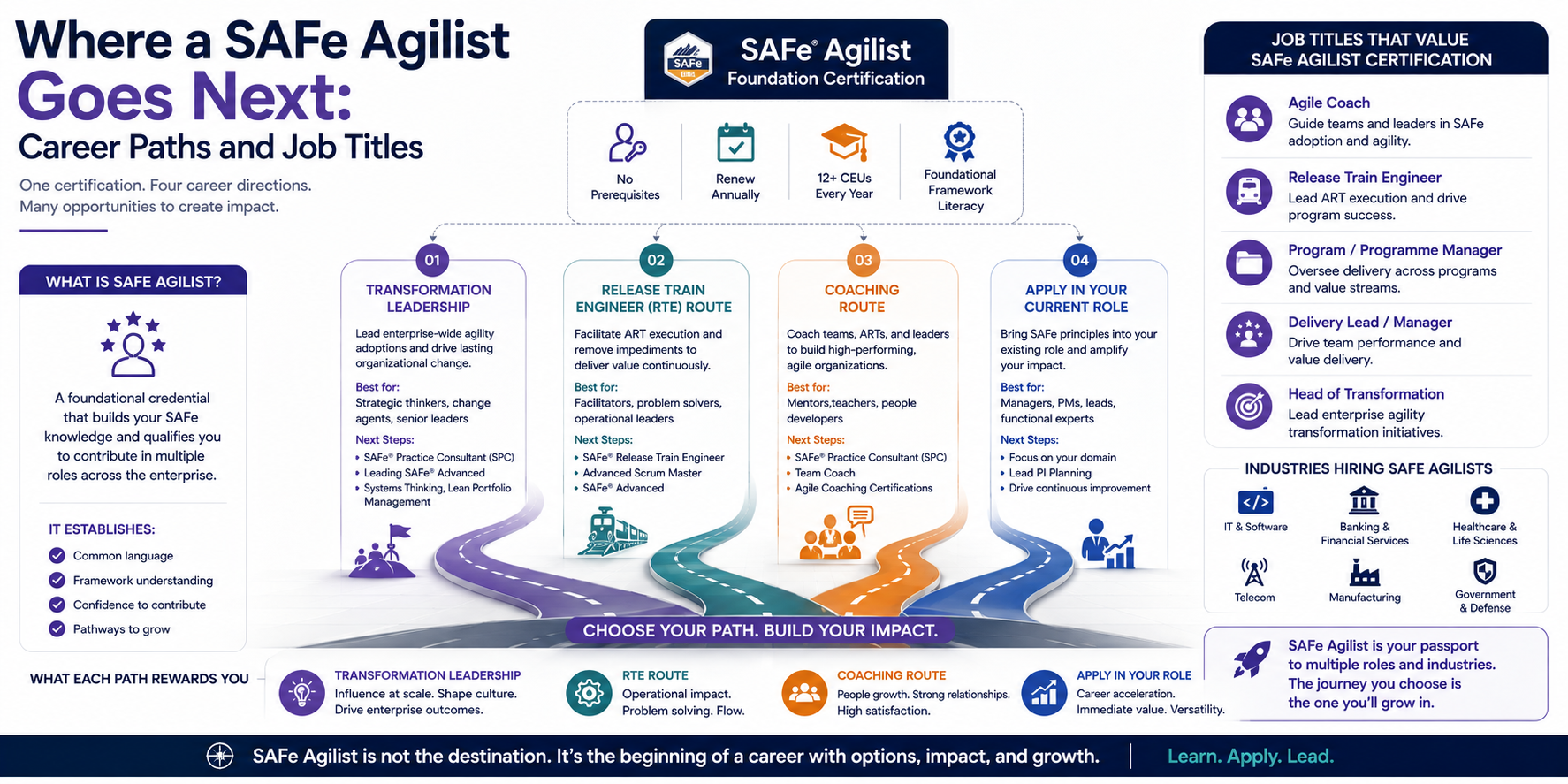
A SAFe Agilist certification does not map to a single job title, which is the first thing to understand about it. It is a framework credential rather than a role credential, so it qualifies you to work inside a SAFe organisation in several different capacities: leading a transformation, running an Agile Release Train, coaching teams, or carrying the framework into a management role you already hold. The paths diverge sharply after that, and they pay differently.
Key Highlights
- SAFe Agilist is a foundational-level certification with no prerequisites, so it is frequently the entry point into the SAFe credential family rather than a mid-career step.
- The credential renews annually and Scaled Agile requires a minimum of 12 Continuing Education Units each year to maintain it.
- Four distinct paths open after certification: transformation leadership, the Release Train Engineer route, the coaching route, and applying the framework inside an existing management role.
- The Release Train Engineer is the most common next certification for a SAFe Agilist who wants an operational role rather than an advisory one.
- Job titles rarely say SAFe Agilist. They say Agile Coach, Release Train Engineer, Programme Manager, Delivery Lead or Head of Transformation, with the credential listed as a requirement.
- Scaled Agile positions SAFe Agilist as foundational, which means it establishes framework literacy rather than proving hands-on delivery experience.
What the certification actually qualifies you to do
The honest answer is that it qualifies you to be in the room.
Leading SAFe teaches the framework at the level a leader needs: how an Agile Release Train is structured, what happens in PI Planning, how portfolio funding works, and why the Lean-Agile principles produce the behaviours they do. What it does not do is certify that you have run any of it. That distinction matters when you are reading job adverts, because employers use the credential as a filter for framework literacy and then interview for the experience separately.
This is also why the credential works differently depending on where you already sit. For a delivery manager in an organisation that has just announced a SAFe adoption, it is immediately useful, because the vocabulary and the reasoning are what the next twelve months will run on. For someone with no Agile background hoping the certificate alone will produce a role, it will not.
The four paths, and who each one suits
Transformation leadership
The path most aligned with what the course actually teaches. Titles here include Transformation Lead, Head of Agile, Agile Programme Director and occasionally Chief of Staff in organisations that run change centrally.
The work is organisational rather than team-level: sequencing which value streams adopt SAFe first, building the case with executives, and dealing with the structural obstacles that stop adoption sticking. Leading SAFe spends its later modules on exactly this, and the SAFe implementation roadmap is the artefact most of this work is organised around.
Suits people who already have organisational credibility. It is not an entry-level path, whatever the certification level says, and the common failure is a newly certified delivery manager being handed a transformation remit without the authority to change how anything is funded or governed.
The Release Train Engineer route
The most common operational next step, and the one with the clearest title.
An RTE facilitates the ART: running PI Planning, tracking dependencies across teams, removing impediments that individual Scrum Masters cannot reach, and holding the train to its cadence. It is a hands-on role with a defined remit, which makes it easier to hire for and easier to describe on a CV than transformation work.
Most people on this path take the SAFe RTE certification after Leading SAFe, since the RTE course assumes the framework knowledge that Leading SAFe establishes. The pairing is common enough that some employers list both.
Suits experienced Scrum Masters and delivery managers who want scope beyond a single team without leaving delivery.
The coaching route
Agile Coach and Enterprise Agile Coach titles, working across teams rather than owning any of them.
The work is closer to the Lean-Agile leadership material in the course: changing how leaders behave, not just how teams plan. Our piece on Lean-Agile leadership covers the substance of that shift.
Worth being clear about a hiring reality here. Coaching roles are competitive and most employers weight demonstrated coaching experience well above certification. The credential opens the conversation and does not win it.
Applying it in the role you already hold
The least discussed path and probably the most common in practice.
A large share of Leading SAFe attendees are not changing jobs. They are product managers, engineering managers, PMO leads and business owners whose organisation has adopted SAFe, and who need to function inside it. The credential here is not a career move at all. It is the price of participating properly in PI Planning and portfolio conversations.
If that is you, the course pays for itself in the first PI rather than at the next salary review.
The job titles that actually list this credential
Titles rarely name the certification. They name the role and list the credential as a requirement.
| Title | What the role does | Typical prior background |
| Release Train Engineer | Facilitates the ART, runs PI Planning, manages cross-team dependencies | Scrum Master, delivery manager |
| Agile Coach | Coaches teams and leaders across an organisation | Scrum Master, consultant |
| Programme Manager | Runs a programme inside a SAFe structure | Traditional programme or project management |
| Delivery Lead / Delivery Manager | Owns delivery for a product area | Project management, engineering management |
| Transformation Lead | Owns the adoption itself | Consulting, senior delivery, operations |
| Product Manager | Owns the ART Backlog and what the train builds | Product, business analysis |
The pattern worth noticing: none of these are entry-level roles, and the credential is almost never the primary qualification. It is the filter that gets a CV read.
How the credential compares to the alternatives
If you are choosing between certifications rather than deciding what comes after one, the comparison matters more than the path.
The SAFe Agilist and SAFe Scrum Master split is the one people get wrong most often. SAFe Agilist is the framework and leadership view. SAFe Scrum Master is the team-level execution view within SAFe. They are not sequential and neither is a prerequisite for the other.
Against team-level Scrum credentials, the difference is scope. A Certified ScrumMaster qualification covers one team practising Scrum. SAFe Agilist covers many teams operating as a train inside a portfolio structure. People coming from a CSM background usually find the vocabulary familiar and the scale unfamiliar, which our comparison of CSM and SAFe Agilist works through.
There is also a distinction inside the SAFe family itself between the SAFe Agilist and the SAFe Practitioner credentials, covered in our piece on certified SAFe Agilist versus certified SAFe Practitioner.
What each path rewards, and what it punishes
The four routes look similar from outside the framework and reward almost opposite things once you are inside it. Choosing badly costs a year.
Transformation leadership rewards political credit and punishes technical depth. The work is persuading finance to fund differently and persuading directors to give up control of their teams. Knowing the framework in detail helps very little if nobody in the room reports to you or owes you a favour. People from consulting and operations do well here. Excellent delivery managers frequently do not, and it is rarely because they lack the knowledge.
The Release Train Engineer route rewards facilitation stamina and punishes a need for authority. An RTE has no line management over anyone on the train. Everything is achieved by making dependencies visible and getting people to act on them voluntarily, twelve weeks at a time. If you find running a room energising, this is the best-defined role the credential leads to. If you need positional authority to get things done, it will be exhausting.
Coaching rewards patience and punishes wanting credit. The output is other people improving, which is invisible on any dashboard and hard to point at in an appraisal. It is also the path most exposed to organisational mood, because coaching budgets are cut first.
Staying put rewards context and punishes nothing. You already know where the bodies are buried, which is worth more than any credential. The limitation is that the ceiling is set by your existing role rather than by the certification.
The honest summary is that these are four different jobs sharing one entry qualification. Deciding which one suits you is a question about temperament rather than about SAFe, and it is worth answering before spending money on the next credential.
Getting the first role, not just the credential
The gap between certified and hired is where most of the frustration in this field sits, and it has a consistent shape.
Employers hiring for SAFe roles are screening for two things: whether you know the framework, and whether you have operated at the scale the role requires. The certification answers the first completely and the second not at all. Every piece of advice worth giving is about closing the second gap.
Get into the events before you need them. PI Planning, ART Sync, System Demo, Inspect and Adapt. Attending as an observer is usually possible inside your own organisation and is worth more than any additional reading. If you are not yet confident you would follow what is happening in the room, the free Leading SAFe practice test is a quick way to check your framework grounding first. You will also discover fairly quickly whether facilitation energises you or drains you, which decides the RTE question.
Take a piece of the train's work. Facilitating a breakout in PI Planning, owning the dependency board, running one Inspect and Adapt workshop. These are delegable and most RTEs are glad to hand them over. One of them on a CV outperforms a second certification.
Learn to describe outcomes rather than activities. The interview question is almost always some version of what changed because you were there. Attended PI Planning is not an answer. Reduced a recurring cross-team dependency by moving one piece of work into a different team's backlog is.
Be honest about the scale you have worked at. Claiming enterprise transformation experience on the strength of a two-day class is transparent to anyone who has done it, and it is the fastest way to lose a room.
What it does for earnings, honestly
Certification correlates with higher pay in this field, but the correlation runs mostly through the roles it opens rather than through the certificate itself. An RTE earns more than a Scrum Master because the remit is larger, not because of the credential on the CV.
Our data on SAFe Agilist salary and the wider picture on certified SAFe Agilist salary covers the reported figures by region. Read them as the range for the roles rather than as a premium the certificate produces on its own.
The sharper point for planning: the earnings step happens when scope changes, and scope usually changes when you move from a single team to a train or a portfolio. The credential is the qualifying condition for that move in a SAFe organisation, which is a real but indirect effect.
How long each path takes to become real
A rough sense of timescale, because the certification marketing implies these transitions are faster than they are.
Into an RTE role. Realistically twelve to twenty-four months from certification if you are starting as a Scrum Master with a single team, and faster if your organisation is standing up new trains and needs people. The binding constraint is exposure to multiple teams rather than knowledge, and organisations mid-adoption create that exposure much faster than stable ones.
Into coaching. Slower and less predictable. Coaching roles are usually filled by people who were already coaching informally, and the credential formalises something visible rather than creating an opening. Two to three years is common, and consultancies are a faster route in than internal roles.
Into transformation leadership. This is not a progression from certification at all. People arrive at it from senior delivery, consulting or operations, and take Leading SAFe because the role requires the vocabulary. If you are not already senior, this path does not open through certification.
Applying it where you are. Immediately. This is the only one that pays back inside a single Program Increment, which is the strongest argument for it.
The pattern across all four: the credential removes a barrier rather than creating momentum. What creates momentum is exposure to the framework operating at scale, and that is available inside your current organisation far more cheaply than through another course.
Keeping the credential once you have it
Scaled Agile requires a minimum of 12 Continuing Education Units each year to maintain SAFe Agilist certification. The renewal cycle is annual, which is a shorter cadence than several comparable credentials, and it is worth budgeting for rather than discovering.
CEUs come from a range of activities including further Scaled Agile courses, relevant conferences, and other structured learning. If you are already on one of the four paths above, the next certification you take usually covers the requirement in the year you take it.
What to do in your first year
A practical sequence for someone who has just certified and wants the credential to convert into something.
1. Get into a PI Planning event, in any capacity. Reading about it and sitting in it are different, and it is the fastest way to understand whether the operational path or the advisory path suits you.
2. Pick a direction within six months. The four paths diverge quickly and the experience that qualifies you for one does not obviously transfer to the others.
3. If the RTE route appeals, take the next certification while the framework knowledge is fresh. The course assumes it.
4. Build a specific example. Employers ask what you changed, not what you learned. One concrete instance of removing a cross-team dependency or reshaping a planning event beats a list of modules.
If you are still deciding whether the credential fits where you are heading, Leading SAFe certification training covers the full syllabus across two days, and the course target audience breakdown is a reasonable place to check whether your current role is in scope.
A short reality check before you spend more
Three things worth being honest with yourself about, because the certification industry will not raise them.
The credential is foundational. Scaled Agile classifies it that way deliberately, and employers read it that way. It establishes that you can work inside the framework. It does not establish that you have.
The market for SAFe roles tracks SAFe adoption, which is concentrated in large organisations with integration-heavy delivery. If you are in a small product company or a market where adoption is thin, the credential travels less well than the marketing suggests, and that is worth checking locally before planning a move around it.
And the most valuable next step is usually free. Getting inside a real PI Planning event, taking one piece of the train's work, watching an Inspect and Adapt workshop that goes badly. None of that costs anything, and all of it does more for a CV than a second certificate.
If you have decided the framework is where you are heading, Leading SAFe certification training is the entry point and includes the exam attempt.
Choosing your next step
The mistake worth avoiding is treating the certification as the destination. It establishes that you can work inside the framework, which is a starting condition rather than an achievement, and the four paths above pull in genuinely different directions.
Decide which one you are on before you spend money on the next credential, because the RTE route and the coaching route reward almost opposite kinds of experience. If your organisation is mid-adoption, the most valuable thing you can do in the next six months is get inside a real PI Planning event rather than take another course.
For the syllabus itself, Leading SAFe certification training runs the full two days and includes the SAFe Agilist exam attempt. You can check current Leading SAFe certification costs before booking, or use the free Leading SAFe practice test to see how much of the framework you already know.





 Lowest-Price Challenge











 Personalized Path


.webp)


 USA
USA  Canada
  India
India  UK
UK  Australia
  Singapore


