


 Call Us



Quick Answer
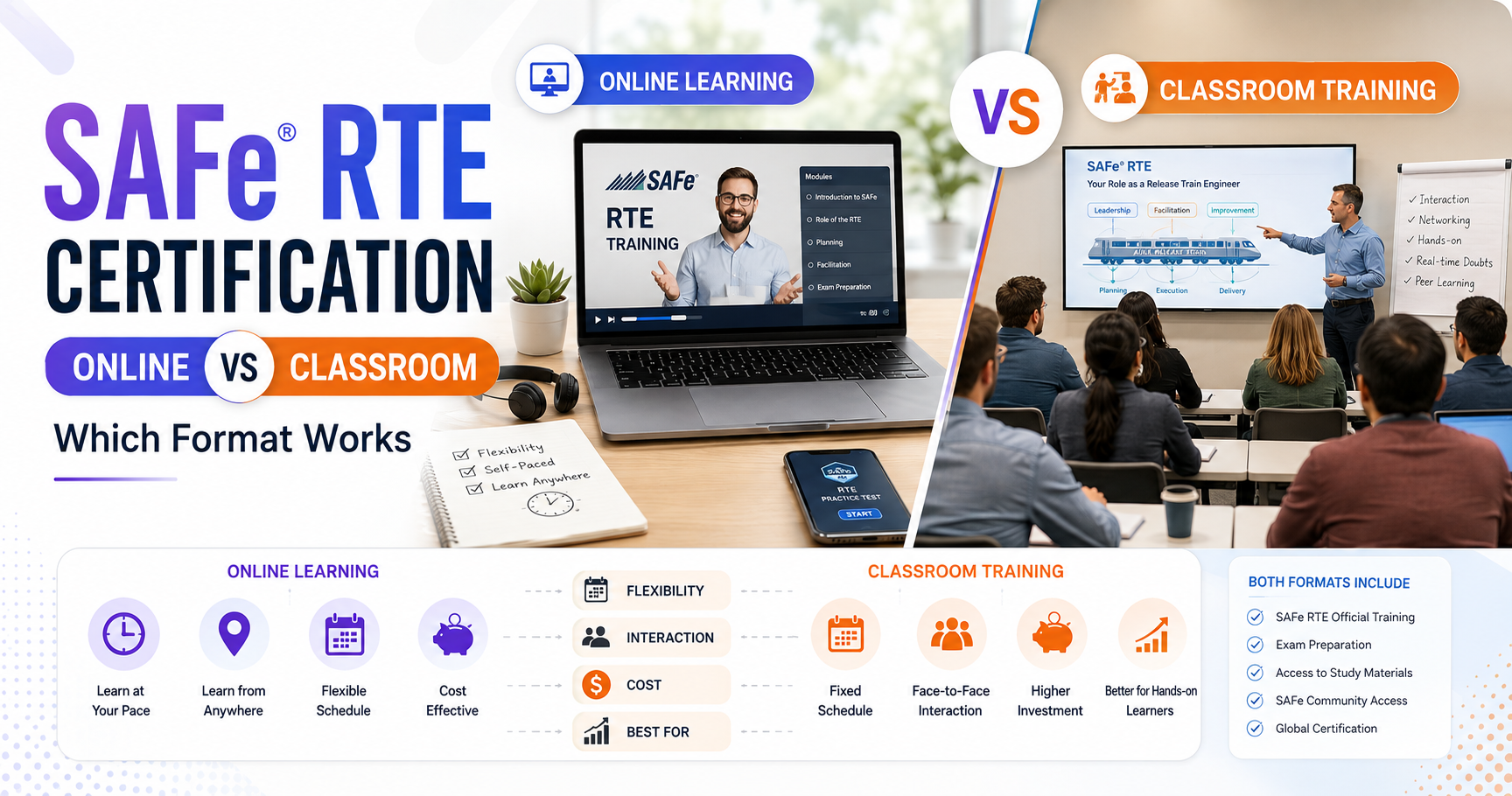
Both SAFe RTE training formats lead to the same certification and the same exam, so the format you choose should depend on your schedule, learning style, and how much in-person facilitation practice you want before running a real Program Increment, or PI, the 8 to 12 week timebox in which an Agile Release Train delivers value. Live online RTE training now uses interactive virtual classrooms with breakout rooms and remote labs, and multiple current sources describe it as comparable in rigor to in-person delivery. Classroom training still has an edge for practicing high-stakes facilitation skills like running a PI Planning event, since body language and room dynamics are harder to simulate on video. Course length, typically three days, and exam requirements do not change based on format, only how you attend does.
Key Highlights
- SAFe RTE training runs as a three-day, instructor-led program in both formats, according to multiple 2026 training provider listings.
- The certificate issued after passing the exam is identical regardless of delivery format, since Scaled Agile does not distinguish credentials by training mode according to multiple current training provider sources.
- Online delivery now commonly includes live virtual classrooms, breakout rooms, and remote labs for hands-on exercises, a shift from earlier, more passive e-learning formats.
- The exam itself is online and remotely proctored regardless of which training format you choose, so your exam day experience is the same either way.
- Training providers report both weekday and weekend batch options across Eastern US and Indian Standard Time zones, giving working professionals more scheduling flexibility online than most classroom options allow.
- Course pricing for RTE certification commonly falls in a broad USD 1,445 to 3,700 range across providers, and current sources do not show a consistent, clearly disclosed price gap between online and classroom formats specifically, since pricing is driven more by provider and region than delivery mode.
If you are choosing between online and classroom SAFe RTE training, you are not choosing between a real certification and a lesser one. You are choosing a learning environment. This guide breaks down what actually differs, cost, hands-on practice quality, scheduling, and how each format prepares you for the exam and for the job itself.
If you have not yet confirmed your eligibility, check the SAFe RTE certification prerequisites first. And if budget is the deciding factor, see the full SAFe RTE certification cost breakdown before you compare formats.
What Actually Differs Between Online and Classroom RTE Training
Both formats cover the same three-day curriculum, the same exam eligibility, and lead to the same credential. The real differences sit in delivery mechanics, not content depth.
| Factor | Online (Live Virtual) | Classroom (In-Person) |
| Course length | Typically 3 days, same curriculum hours as classroom | Typically 3 days |
| Certification issued | Identical certificate to classroom completion | Identical certificate to online completion |
| Hands-on exercises | Delivered via breakout rooms and remote labs | Delivered via in-room group work and physical program boards |
| Facilitation practice realism | Good for discussion-based exercises, harder to replicate full-room dynamics | Higher realism for practicing PI Planning facilitation and reading a room |
| Scheduling flexibility | Weekday and weekend batches across multiple time zones commonly available | Fixed to a physical location and set schedule, generally less flexible |
| Travel and venue cost | None | Possible travel, accommodation, and time-away-from-work costs |
| Networking | Possible through breakout rooms and course forums, generally lighter | Stronger, in-room networking with peers and instructor |
| Exam format | Online, remotely proctored, identical for both training formats | Online, remotely proctored, identical for both training formats |
Cost Comparison: Is Online Actually Cheaper
Overall SAFe RTE course pricing spans roughly USD 1,445 to 3,700 depending on provider, region, and included extras, according to current training provider and aggregator listings. Current sources do not consistently break out a specific online discount versus classroom premium the way some other certification markets do. What they do confirm is that classroom formats often carry additional, indirect costs.
| Cost Factor | Online | Classroom |
| Course fee | Comparable to classroom fee at most providers, format itself is not the main price driver | Comparable to online fee at most providers, format itself is not the main price driver |
| Travel | None | Possible, if the venue is not local to you |
| Accommodation | None | Possible for multi-day, out-of-town sessions |
| Time away from work | Lower, since you can often join from your own desk | Higher, especially for out-of-town venues |
For a full breakdown of exam fees, retake costs, and renewal charges regardless of format, see the complete SAFe RTE certification cost guide.
Which Format Prepares You Better for the Exam
The SAFe RTE exam is the same 60 question, 120 minute, remotely proctored test regardless of which training format you completed, according to multiple current exam format sources. Neither format has a documented pass rate advantage in current public sources, since providers do not typically disclose pass rates split by delivery mode. What does vary is how well each format reinforces the scenario-based judgment the exam tests.
- Online courses tend to lean on structured digital exercises and case studies, which map closely to the exam's scenario-based question style.
- Classroom courses tend to lean on live role-play and physical program board exercises, which build intuition faster for practical, on-the-job facilitation but require you to translate that experience back into exam-style multiple choice reasoning yourself.
Broader research on training formats supports the idea that neither format has an inherent knowledge-retention disadvantage. Some learning industry research reports online formats can even show retention advantages when courses include interactive elements like frequent quizzes, according to a 2026 report from Skillademia on online course completion statistics, though this research covers general online learning, not SAFe training specifically, so treat it as directional rather than SAFe-verified.
Which Format Prepares You Better for the RTE Job Itself
This is where the formats genuinely diverge, and it matters more than exam prep alone. The RTE role is fundamentally about facilitating rooms full of people, running PI Planning, ART sync events, and Inspect and Adapt workshops, where reading body language, managing side conversations, and directing a physical program board are core skills.
Classroom training gives you more direct practice at exactly that: standing in front of a room, managing a physical program board, or the visual board ARTs use to map features against team capacity and dependencies, and handling live group dynamics. Online training, even with breakout rooms and remote labs, simulates a different skill set, since managing a remote PI Planning session is itself an increasingly common part of the modern RTE job. If your organization runs distributed or hybrid ARTs, online training arguably better mirrors your actual working environment.
In short, choose classroom if your ART meets in person and you want maximum facilitation reps before day one. Choose online if your ART is distributed or hybrid, since you will be practicing in the same conditions you will work in.
Scheduling and Logistics Compared
Current provider listings show online RTE batches running across both Eastern US time and Indian Standard Time zones, with both weekday and weekend options. Classroom sessions are tied to a physical venue and a fixed multi-day block, which works well if you can clear your calendar but is harder to reschedule if a conflict comes up. If you are transitioning into the RTE role from a related position, timing matters. See our guides on moving from Scrum Master to Release Train Engineer or from Project Manager to Release Train Engineer for how training timing fits into a broader transition plan.
A Simple Decision Framework
| Your Situation | Better Fit |
| You work on a distributed or hybrid ART already | Online |
| You want maximum live facilitation practice before your first PI Planning | Classroom |
| You have a tight, unpredictable schedule | Online, for flexible weekday and weekend batch options |
| You value in-person networking with peers who may become future ART colleagues | Classroom |
| You are traveling or relocating and want to avoid added travel cost | Online |
| You learn best through visible group energy and immediate in-room feedback | Classroom |
Once you have chosen a format, the SAFe RTE certification process guide walks through registration, course completion, and exam scheduling steps that apply to either path. And if you are still validating whether the certification is worth the investment at all, our analysis on whether SAFe RTE certification is worth it in 2026 covers the broader return on investment question. When you are ready to enroll, you can review current batch options on the SAFe RTE certification training page.


_1738229154.jpg)





 Lowest-Price Challenge











 Personalized Path


.webp)


 USA
USA  Canada
 India
India UK
UK Australia
 Singapore


