


 Call Us



Last updated: 7 October 2026. Pricing and features checked on 7 October 2026.
Quick Answer
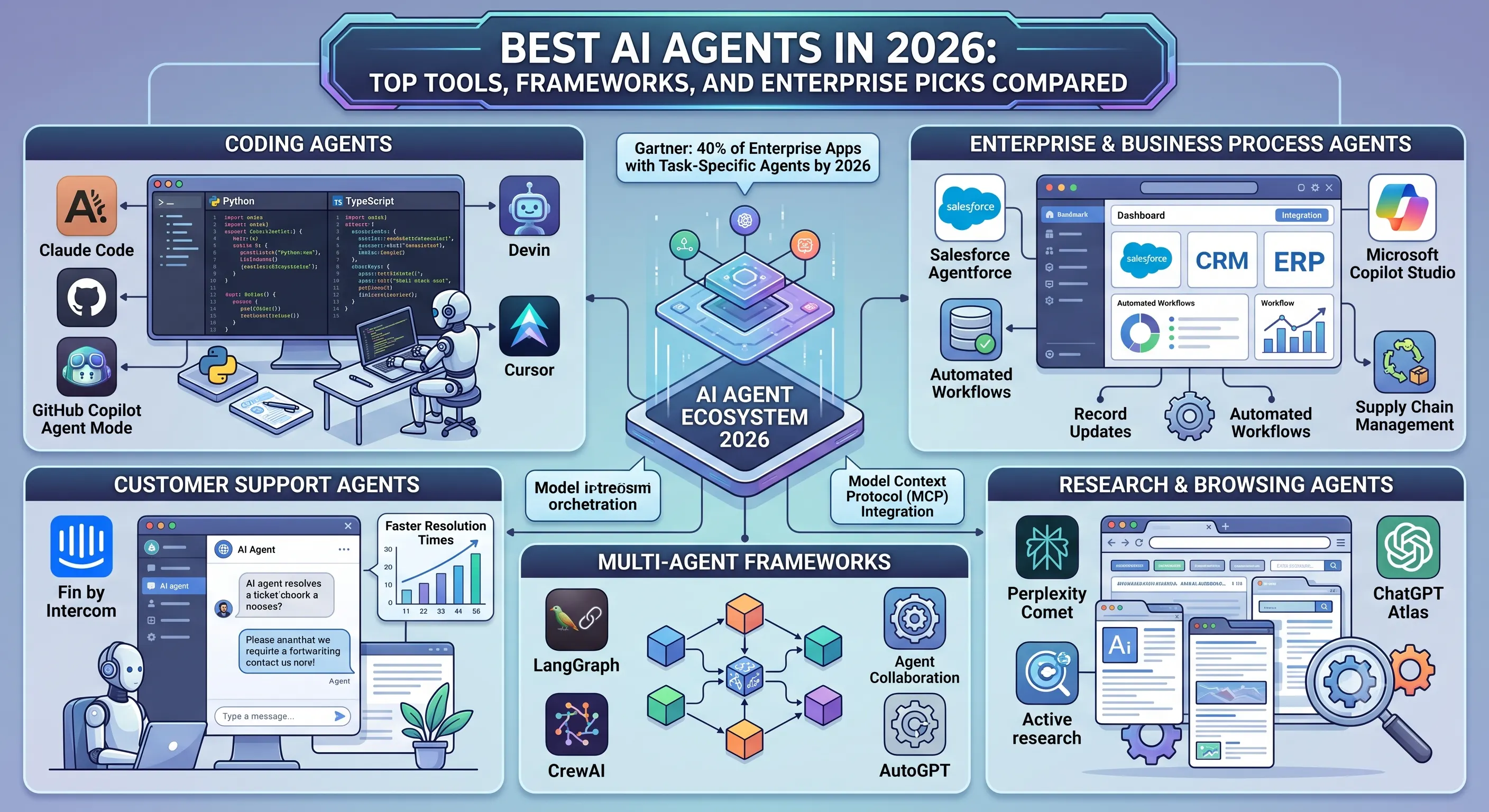
The best AI agents in 2026 fall into seven practical categories: coding agents such as Claude Code, GitHub Copilot agent mode, Cursor and Devin; general-purpose agents such as ChatGPT Work, Claude and Gemini Deep Research; enterprise process agents like Salesforce Agentforce and Microsoft Copilot Studio; customer-support agents such as Fin by Intercom; research and browsing agents including Perplexity Comet and ChatGPT Atlas; no-code agent builders like n8n, Zapier Agents and Dify; and open frameworks like LangGraph, CrewAI and AutoGen for teams building their own. Most individual plans cost between $10 and $20 a month to start, while enterprise platforms are priced on usage or custom contracts. There is no single best agent: the right choice depends on the task, your existing stack and how much autonomy you can govern safely.
Key Highlights of Best AI Agents 2026
- An AI agent plans, decides, and executes multi-step work with tools; a chatbot mainly answers questions one turn at a time.
- Coding agents lead adoption: Cursor, Claude Code, Codex, GitHub Copilot, and Cline are the most cited developer tools for 2026, according to Faros AI's 2026 developer review.
- 79% of companies report adopting AI agents and 66% of adopters see measurable value, per PwC, but only 23% of organizations are actually scaling an agentic system, according to McKinsey.
- The global agentic AI market is estimated between roughly $9 billion and $19 billion in 2026 depending on methodology, with most forecasts projecting 40%+ compound annual growth through the early 2030s.
- Open frameworks like LangGraph, CrewAI, and AutoGPT let developers build custom multi-agent systems instead of relying only on vendor products.
- Governance, cost per task, and integration depth now matter as much as raw model capability when enterprises pick an agent to deploy in production.
What Is an AI Agent, and How Is It Different From a Chatbot
An AI agent is software that can plan a sequence of steps, choose and call tools, act on external systems, and keep working toward a goal with limited human involvement at each step. A chatbot, by contrast, is built to hold a conversation. It answers a question or completes one instruction, then waits for the next prompt.
According to IBM's comparison of AI agents and AI assistants, the core distinction is autonomy: a chatbot responds to predefined inputs, while an AI agent can plan, decide, and execute tasks independently across systems. A simple way to remember it: a chatbot talks, an agent acts.
In practice, a modern AI agent typically combines four pieces:
- A reasoning model (a large language model such as Claude, GPT, or Gemini) that decides what to do next.
- Tools the agent can call, such as a code editor, a terminal, a browser, a CRM API, or a search index.
- Memory or state that lets the agent track progress across a long-running task instead of starting over each turn.
- A control loop that lets the agent observe the result of an action, correct course, and try again until the task is done or it hits a limit.
This is why coding agents can open a file, edit it, run the test suite, read the failure, and fix the bug without a human typing each command. It is also why the distinction matters for buyers: paying for "an AI agent" implies paying for a system that takes actions with consequences, not just one that drafts text.
The Main Categories of AI Agents in 2026
Most named products in the market in 2026 fall into one of seven practical buckets. Understanding the category first makes it much easier to shortlist a specific tool.
- Coding agents: Automate or assist software development, from autocomplete to fully autonomous pull requests.
- General-purpose agents: Assistants such as ChatGPT Work, Claude and Gemini Deep Research that can browse, use tools and complete multi-step tasks, not just answer questions.
- Enterprise and business-process agents: Sit inside CRM, ERP, or workflow platforms and take action on records, tickets, and approvals.
- Customer-support agents: Handle inbound support conversations end to end, resolving tickets without a human agent when possible.
- Research and browsing agents: Navigate the live web, read pages, compare information, and complete multi-step tasks inside a browser.
- No-code agent builders: Visual platforms such as n8n, Zapier Agents, Dify and Make that let business teams build agents without writing code.
- Multi-agent frameworks: Open-source or developer-first toolkits used to build custom agents and orchestrate several agents working together.
The sections below cover named, currently relevant products in each category, based only on details that are corroborated by the vendor's own documentation or by multiple independent reviews.
How We Selected These AI Agents
We started from the tools most often named in 2026 developer surveys, analyst reports and vendor documentation, then grouped them by the job they do rather than ranking them on one global score. Each tool was assessed on five criteria: reliability and task completion, integration depth including MCP support, governance and human-in-the-loop controls, pricing transparency, and how much engineering effort it takes to reach production. We included a tool only when its core capabilities were confirmed in the vendor's own documentation or by at least two independent reviews, and we flag vendor-reported figures, such as completion or resolution rates, as vendor claims. Pricing and features were last checked on 7 October 2026.
Best AI Coding Agents
Coding is the category where agentic AI is most mature, because code execution gives an agent a fast, verifiable feedback loop: run the tests, read the error, fix the bug.
Claude Code and the Claude Agent SDK (Anthropic)
Anthropic built Claude Code as an agentic coding tool that runs in the terminal, the desktop app, and inside IDEs. It can read files, run shell commands, edit code across a repository, and call external tools through the open Model Context Protocol (MCP), a standard Anthropic introduced in November 2024 for connecting AI systems to outside data and tools. MCP has since been donated to the Agentic AI Foundation, a Linux Foundation project co-founded by Anthropic, Block, and OpenAI, and MCP SDK downloads have passed 400 million a month according to Anthropic's own reporting. The Claude Agent SDK exposes the same engine that powers Claude Code as a Python and TypeScript library, so developers can build their own autonomous agents that understand a codebase, edit files, run commands, and execute complex workflows outside the CLI. Extensibility comes through primitives such as CLAUDE.md project instructions, reusable skills, subagents, slash commands, and hooks. Teams building agentic AI workflows on Claude, including retrieval-augmented generation and multi-agent orchestration, can build that skillset through a course such as Simpliaxis's Agentic AI Engineering with Claude Training, which covers building agents, RAG pipelines, and tool integration hands-on.
Best for: Developers who want deep codebase reasoning in the terminal or IDE.
Watch out for: Usage limits on lower plans; cost rises on large codebases.
GitHub Copilot Agent Mode and the Autonomous Coding Agent
GitHub Copilot now ships two distinct agentic modes. Agent mode works interactively inside VS Code and JetBrains (agent mode became generally available on JetBrains as of March 2026): it can edit multiple files across a codebase, run terminal commands, observe the output, fix errors it introduces, and iterate until a task is done, largely without step-by-step direction. A separate capability, the autonomous coding agent, works as a background worker: assign it a GitHub issue and it independently branches the repository, writes code on GitHub Actions runners, runs tests, and opens a pull request for review. GitHub reports agent mode's repository indexing delivers roughly 2x higher throughput and 37.6% better retrieval accuracy compared to early 2025, and Copilot moved to usage-based AI credits for most paid plans starting June 1, 2026.
Best for: Teams already on GitHub who want issues turned into pull requests.
Watch out for: Usage is billed in GitHub AI Credits, which makes monthly cost harder to predict.
Cursor
Cursor is an AI-native code editor built around an Agent mode for longer background tasks, a Composer feature for multi-file edits, and native MCP support for connecting external tools. Cursor 3.0, which launched in April 2026, added an "Agents Window" for running background agent tasks and handing them off to the cloud. Pricing runs on a tiered model: a limited free tier, a Pro plan around $20 a month with a monthly credit pool for model usage, and Team plans that split into Standard and Premium tiers with different usage allowances, according to multiple 2026 pricing breakdowns. Cursor is popular with developers who want tight control over large, existing codebases rather than fully autonomous ticket resolution. (source)
Best for: Developers editing large existing codebases.
Watch out for: Moderate learning curve; team sharing of cloud agents needs setup.
Devin (Cognition)
Devin, built by Cognition, is positioned as an autonomous software engineer rather than a coding assistant. Given a task description, it plans, writes code, runs tests, debugs, and iterates inside its own cloud sandbox that includes a Linux shell, code editor, and browser, largely without step-by-step supervision. Cognition has reported that Devin completes roughly 75% of assigned tasks without human intervention, with the remaining 25% needing a human to step in. Because each Devin session runs in its own sandbox, users can assign multiple tickets in parallel. After acquiring Windsurf in 2025, Cognition rebranded it as Devin Desktop and now bundles it with Devin CLI, Devin Review for automated pull request analysis, and DeepWiki for codebase documentation. (source)
Best for: Running many independent tickets in parallel.
Watch out for: Completion rate is vendor-reported; needs clear requirements.
Cline and Codex
Cline (an open-source, IDE-native coding agent) and OpenAI's Codex are also consistently named among the leading coding agents in 2026 developer surveys, though independent, verifiable specifics on Codex's current feature set were less consistent across sources at the time of writing, so treat exact capability claims for that specific product with caution until you confirm them on OpenAI's own documentation.
Best Enterprise and Business-Process Agents
Enterprise agents live inside existing business systems and take action on records: updating a CRM opportunity, resolving a support case, or triggering an approval workflow.
Salesforce Agentforce
Salesforce Agentforce is built to take independent action across sales, service, and marketing workflows: updating records, resolving support cases, qualifying leads, and managing multi-step processes. The Agentforce 360 update added "Intelligent Context," powered by Salesforce's Data 360 platform, which automatically extracts and structures a company's unstructured data so agents can ground their answers in business-specific information, plus a voice-first architecture for real-time voice agents. On pricing, Salesforce offers Agentforce access at no extra cost to Enterprise Edition customers and above through Salesforce Foundations, alongside consumption-based Flex Credits, a per-conversation pricing model, and higher-tier Agentforce 1 Editions for organizations that need larger built-in credit allocations, according to Salesforce's own pricing page and independent 2026 pricing breakdowns. Because most advanced deployments also require Data Cloud, several 2026 analyses put realistic first-year costs for mid-market Agentforce rollouts well into six figures, so budget for the platform, not just the license.
Best for: Organisations already running Salesforce.
Watch out for: Data Cloud and platform costs on top of licences.
Microsoft Copilot Studio Agents
Microsoft Copilot Studio lets organizations build agents that combine structured workflow steps with adaptive, model-driven reasoning. In 2026, Microsoft made "computer-using agents" generally available, letting an agent interact directly with websites and desktop applications through the user interface the way a person would. Microsoft Agent 365 became generally available as a centralized control plane for managing agent identity, security posture, and governance across an environment, and Copilot Studio added evaluation tooling that can generate test cases from real analytics and run evaluations programmatically to measure agent quality at scale. Real-time voice agents can now use the GPT-5-Chat model across both voice and digital messaging channels.
Best for: Governed agents inside Microsoft 365.
Watch out for: Most value only inside the Microsoft stack.
Why This Category Matters for Operations Teams
Unlike coding agents, enterprise process agents are judged less on raw autonomy and more on how safely they operate inside systems of record. Teams evaluating this category typically start with a narrow, low-risk workflow (routing a lead, drafting a case update for approval) before expanding scope, which lines up with the adoption data below in the evaluation section.
Best Customer-Support Agents
Fin by Intercom
Fin, built by Intercom, is one of the most widely cited AI customer-support agents in 2026, with capabilities to analyze, train, test, and deploy across a support operation. Intercom's own published figures put Fin's resolution rate in the roughly 67% to 76% range across more than 12,000 customers, with some deployments exceeding 85%. Independent reviews and case studies, however, report a wider real-world range, often closer to 42% to 65%, depending heavily on the quality of a company's help center content and how repetitive its ticket volume is. That gap between vendor-reported averages and independently observed results is a useful reminder to pilot any support agent on your own ticket data before committing to a resolution-rate target.
Best for: High ticket volume with a strong help centre.
Watch out for: Real-world resolution rates often below vendor averages.
Best Research and Browsing Agents
Browsing agents extend an AI model into the live web: reading a page, clicking, filling a form, comparing options across tabs, and reporting back with a result, rather than just summarizing static search results.
Perplexity Comet
Perplexity's Comet, which launched in July 2025 and is built on Chromium, puts Perplexity's answer engine at the center of a full browser. Its agentic behavior runs inside the browser itself, and by 2026 it had expanded from a desktop-only tool to cover iOS, Android, macOS, Windows, and iPad. A distinctive design choice is that Comet operates on a session-only basis for its agentic actions, so browsing activity does not persist as an ongoing history between sessions, which appeals to users who want cited, source-backed answers without long-term tracking.
Best for: Cited research without long-term history.
Watch out for: Fewer workflow and deliverable outputs.
ChatGPT Atlas and Operator-Style Agents
OpenAI announced ChatGPT Atlas on October 21, 2025, shipping it first for macOS across Free, Plus, Pro, and Go tiers, with Windows, iOS, and Android still unreleased as of mid-2026 according to independent trackers. Atlas is built to move from finding information to executing tasks: locating vendors, checking contract pages, extracting pricing terms, drafting a follow-up email, and filing the result somewhere useful, all inside one agentic session. This class of tool sits alongside OpenAI's broader agent tooling, including the Agents SDK for developers building code-based agent logic.
Best for: End-to-end web task execution.
Watch out for: macOS first; other platforms rolling out.
Best General-Purpose AI Agents
Direct answer: General-purpose AI agents are assistants that can take actions, not just answer. The leading options in 2026 are ChatGPT Work for multi-step tasks and deliverables, Claude for long-context reasoning and analysis, Gemini Deep Research for cited reports, Perplexity Computer for long-running multi-model workflows, and Manus for autonomous task execution. Most start at around $20 a month, with heavy-use tiers near $200.
ChatGPT Work (OpenAI)
ChatGPT Work, which replaced the earlier ChatGPT agent mode, uses your apps, files, tools and browser to turn goals into finished deliverables such as documents, decks, spreadsheets, sites and reports while you stay in control. It is available on all ChatGPT plans on desktop, and on Plus, Pro, Business, Enterprise and Edu on web and mobile.
Claude (Anthropic)
Beyond Claude Code, the Claude app works as a general-purpose agent for long documents, analysis and tool use through MCP connectors, with Projects for persistent workspaces. Plans start free, with Pro at $20 a month and Max from $100 a month.
Gemini Deep Research (Google)
Gemini Deep Research browses large numbers of sources and returns a fully cited long-form report that exports to Google Docs. It is available on the free Gemini plan with limits, and Google AI Pro costs $19.99 a month in the US.
Perplexity Computer
Perplexity Computer breaks a goal into subtasks and routes each one to a specialised model, running long tasks with persistent memory. It is available on Perplexity Pro and Max, which cost $17 and $167 a month respectively when billed annually.
Manus
Manus is an autonomous agent that decomposes a goal into subtasks and completes them with built-in tools for browsing, coding and data analysis. Paid plans start at $20 a month.
Best No-Code and Low-Code AI Agent Builders
Direct answer: The best no-code AI agent builders in 2026 are n8n for technical teams that want to self-host, Zapier Agents for teams already running Zapier automations, Dify for visual agent building with built-in retrieval, and Make for high-volume automation where cost per run matters. They let operations, marketing and product teams build agents on a visual canvas instead of writing code.
n8n
n8n is an open-source workflow platform with a visual builder, an AI Agent node that supports memory, tool calling and human approval steps, and code nodes for JavaScript or Python when a stock node is not enough. It can be self-hosted, which keeps customer data on your own infrastructure. The Community Edition is free to self-host, and n8n Cloud Starter costs €20 a month billed annually.
Zapier Agents
Zapier Agents let you describe an agent in plain language and give it access to your connected apps, live data sources and existing Zaps. Its main advantage is reach across thousands of app connections. A free tier includes 400 activities a month, and Agents Pro starts at about $33 a month billed annually. Activity-based billing can be hard to forecast for multi-step agents.
Dify
Dify is an open-source, low-code platform for building agents through a drag-and-drop interface. It supports hundreds of models and ships retrieval-augmented generation, function calling and ReAct strategies out of the box, which makes it a fast route from idea to working prototype for non-specialist teams. Dify Cloud has a free Sandbox plan, and Professional costs $590 a year.
Make
Make is a visual automation platform where AI steps sit alongside routers, filters and per-module error handling. It suits high-volume workflows where only one or two steps need reasoning. A free plan includes 1,000 credits a month, and paid plans start at $9 a month for 5,000 credits.
Best for / Watch out for: No-code builders are the fastest way for business teams to ship a first agent, but most cap reasoning depth and bill per task or credit, so model your volume before committing. For teams that want to move from building simple flows to designing governed agent systems, the Agentic AI Foundation Training Course covers the underlying concepts.
Multi-Agent Frameworks and Open-Source Building Blocks
Not every team wants a packaged product. Many engineering teams build custom agents on open frameworks, particularly when a workflow needs several specialized agents cooperating on one task.
LangGraph
LangGraph, from the LangChain team, models an agent workflow as an explicit state graph with checkpointing, streaming, and human-in-the-loop primitives. That graph-based structure maps cleanly onto production requirements such as audit trails and rollback points, which is why several 2026 comparisons describe it as the most battle-tested option for stateful, production-grade multi-agent systems, and note it overtook CrewAI in GitHub stars in early 2026 on the strength of enterprise adoption.
Best for: Production, stateful multi-agent systems.
Watch out for: Steeper learning curve than CrewAI.
CrewAI
CrewAI is a standalone multi-agent orchestration framework built around a role-based mental model: each agent gets a defined persona, a set of tools, and a specific task inside a larger "crew." Its main advantage is speed of initial setup. Developers consistently report getting a working multi-agent prototype running faster with CrewAI's abstractions than with most alternatives, which makes it a common starting point for proof-of-concept work before a team decides whether to graduate to a more structured framework.
Best for: Fast role-based prototypes.
Watch out for: Debugging multi-agent behaviour takes iteration.
AutoGPT
AutoGPT pioneered the idea of a fully autonomous agent that pursues a goal with minimal human intervention, breaking it into subtasks, executing them, and evaluating the results iteratively. With more than 167,000 GitHub stars, it remains a reference point for long-running, independent agent tasks, even as newer frameworks have added more structured control over autonomy.
Best for: Long-running autonomous experiments.
Watch out for: Less structured control than newer frameworks.
Google Antigravity
Google Antigravity is Google's agent-first development platform for building and managing AI agents. It is available as a desktop app, a CLI, a Python SDK and a full IDE, and is offered at no charge to individual developers.
AutoGen
AutoGen is Microsoft's open-source framework for multi-agent conversations, with an event-driven architecture, support for Python and .NET, and AutoGen Studio for visual prototyping. It is free under the MIT licence; teams run their own production infrastructure.
OpenAI Agents SDK
The OpenAI Agents SDK is a lightweight Python framework released in March 2025 for multi-agent workflows, with built-in tracing and guardrails and compatibility with many model providers.
Other Frameworks Worth Knowing
The framework landscape expanded quickly through 2026: OpenAI shipped its own Agents SDK, Google released its Agent Development Kit (ADK) and later the Antigravity platform, and Hugging Face released the lightweight Smolagents library. Microsoft's Semantic Kernel and Google's newer frameworks are also frequently included in side-by-side comparisons for teams standardizing on a specific cloud ecosystem.
Comparison Table: Best AI Agents by Category
| Agent or Framework | Category | Best For | Starting Price |
|---|---|---|---|
| Claude Code / Claude Agent SDK | Coding agent | Terminal and IDE coding, custom agent builds | Included in Claude Pro at $20/month ($17/month billed annually); Max from $100/month |
| GitHub Copilot | Coding agent | In-IDE help and issue-to-PR automation | Free tier; Pro $10/month, Pro+ $39/month, Max $100/month; usage billed in GitHub AI Credits |
| Cursor | Coding agent | Large codebase edits with developer control | Free Hobby plan; Pro $20/month; Teams $40/user/month |
| Devin | Coding agent | Parallel ticket resolution | Free tier; Pro $20/month; Max $200/month; Teams $80/month plus $40 per seat |
| OpenAI Codex | Coding agent | Sandboxed coding tasks inside ChatGPT | Limited on Free and Go; expanded on Plus and Pro |
| ChatGPT Work | General-purpose | Multi-step tasks and finished deliverables | All plans on desktop; Plus, Pro and business plans on web and mobile |
| Gemini Deep Research | General-purpose / research | Cited long-form research reports | Free with limits; Google AI Pro $19.99/month (US) |
| Perplexity Computer | General-purpose / research | Long-running multi-model workflows | Perplexity Pro $17/month, Max $167/month (billed annually) |
| Manus | General-purpose | Autonomous multi-step task execution | Paid plans from $20/month |
| Salesforce Agentforce | Enterprise process | CRM, sales and service automation | Add-ons from $125/user/month; Flex Credits $500 per 100,000; or $2 per conversation |
| Microsoft Copilot Studio | Enterprise process | Governed agents inside Microsoft 365 | $200/month per 25,000 Copilot Credits or pay-as-you-go; included for Microsoft 365 Copilot users |
| Fin (Intercom) | Customer support | Automated ticket resolution | From $0.99 per Fin outcome, plus Intercom seats from $29/seat/month (billed annually) |
| Perplexity Comet | Browsing agent | Cited research without persistent history | See Perplexity plans |
| ChatGPT Atlas | Browsing agent | Task execution across web tabs | Included with ChatGPT plans |
| n8n | No-code builder | Technical teams that want to self-host | Free self-hosted Community Edition; Cloud Starter €20/month (billed annually) |
| Zapier Agents | No-code builder | Teams already running Zaps | Free 400 activities/month; Pro from about $33/month (billed annually) |
| Dify | Low-code builder | Visual agents with built-in RAG | Free Sandbox and open-source edition; Professional $590/year |
| Make | No-code builder | High-volume automation with a few AI steps | Free 1,000 credits/month; paid from $9/month for 5,000 credits |
| LangGraph | Open framework | Stateful production multi-agent systems | Open source; LangSmith Plus $39/seat/month |
| CrewAI | Open framework | Fast role-based multi-agent prototypes | Free Basic plan (50 executions/month); Enterprise custom |
| AutoGen | Open framework | Custom multi-agent conversations | Free (MIT licence) |
| AutoGPT | Open framework | Long-running autonomous tasks | Free; pay only for model API usage |
Prices are starting prices in USD unless stated, checked on 7 October 2026 on each vendor's pricing page. Plans and prices change often, so confirm on the vendor's site before buying.
Which AI Agent Should You Choose?
Direct answer: Start from the job and the team that will own the agent. Developers should start with a coding agent, business teams with a no-code builder, enterprises with a platform that matches their system of record, and engineering teams building products with an open framework.
| If you are | Start with | Why |
|---|---|---|
| A developer working in an existing codebase | Claude Code or Cursor | Deep codebase context and fast feedback from running tests |
| An engineering lead clearing a backlog | Devin or GitHub Copilot coding agent | Parallel, ticket-level work that ends in a pull request |
| A Salesforce or Microsoft 365 organisation | Agentforce or Copilot Studio | Agents act inside the systems you already govern |
| A support leader | Fin | Built for ticket resolution; pilot on your own data first |
| An ops or marketing team without developers | Zapier Agents, Make or Dify | Visual building and large app catalogues |
| A technical team with compliance needs | n8n (self-hosted) | Data stays on your infrastructure |
| A team building a custom agent product | LangGraph, CrewAI or AutoGen | Full control over orchestration, memory and evaluation |
| An individual wanting a personal agent | ChatGPT Work, Claude or Gemini Deep Research | Low setup and around $20 a month to start |
How Enterprises Evaluate and Choose an AI Agent
Picking an agent product is no longer a model-quality question alone. Most 2026 evaluation frameworks converge on four practical dimensions.
- Reliability and task completion. How often does the agent finish a task correctly without a human stepping in, and how consistent is that rate across similar tasks? Cognition's own figure for Devin, around 75% task completion without intervention, is a useful example of vendors publishing this metric directly, and it is worth asking any vendor for their equivalent number.
- Cost and token efficiency. Agent pricing has shifted toward usage-based credits (Cursor's credit pools, GitHub's AI credits, Salesforce's Flex Credits and per-conversation pricing), which means the real cost of an agent depends on how many tool calls and reasoning steps a task actually takes, not just a flat subscription fee. BCG and Forrester's 2026 surveys put the median time-to-value on agent deployments at 5.1 months, with sales development agents paying back in about 3.4 months and finance or operations agents closer to 8.9 months, so cost modeling needs a realistic time horizon.
- Integration depth. An agent is only as useful as the systems it can safely act inside. This is why MCP adoption, native connectors (Salesforce's Data 360, Microsoft's Connector Registry-equivalent tooling), and API access matter as much as the underlying model.
- Governance and oversight. Analysts increasingly recommend frameworks such as CLEAR (Cost, Latency, Efficacy, Assurance, Reliability) for evaluating agentic systems, alongside explicit governance structures that define what an agent can access, how its actions are monitored, and when a human must approve a step. This matters because production deployment is still uneven: S&P Global Market Intelligence and McKinsey found 31% of enterprises have at least one AI agent in production, with banking and insurance leading at 47% and healthcare and government trailing at 18% and 14% respectively. Weak governance is also a leading cause of project failure; more than 40% of agentic AI projects are projected to be cancelled by the end of 2027 due to escalating costs, unclear business value, or inadequate risk controls, according to widely cited 2026 industry forecasts.
A practical shortlist process looks like this: define one narrow, measurable workflow; pilot two or three candidate agents against real historical data for that workflow; measure completion rate, cost per completed task, and how often a human had to intervene; and only then decide whether to expand scope. Teams that skip the narrow pilot and go straight to broad rollout are the ones showing up in the cancellation statistics above.
Agentic AI Skills and Why Training Now Matters
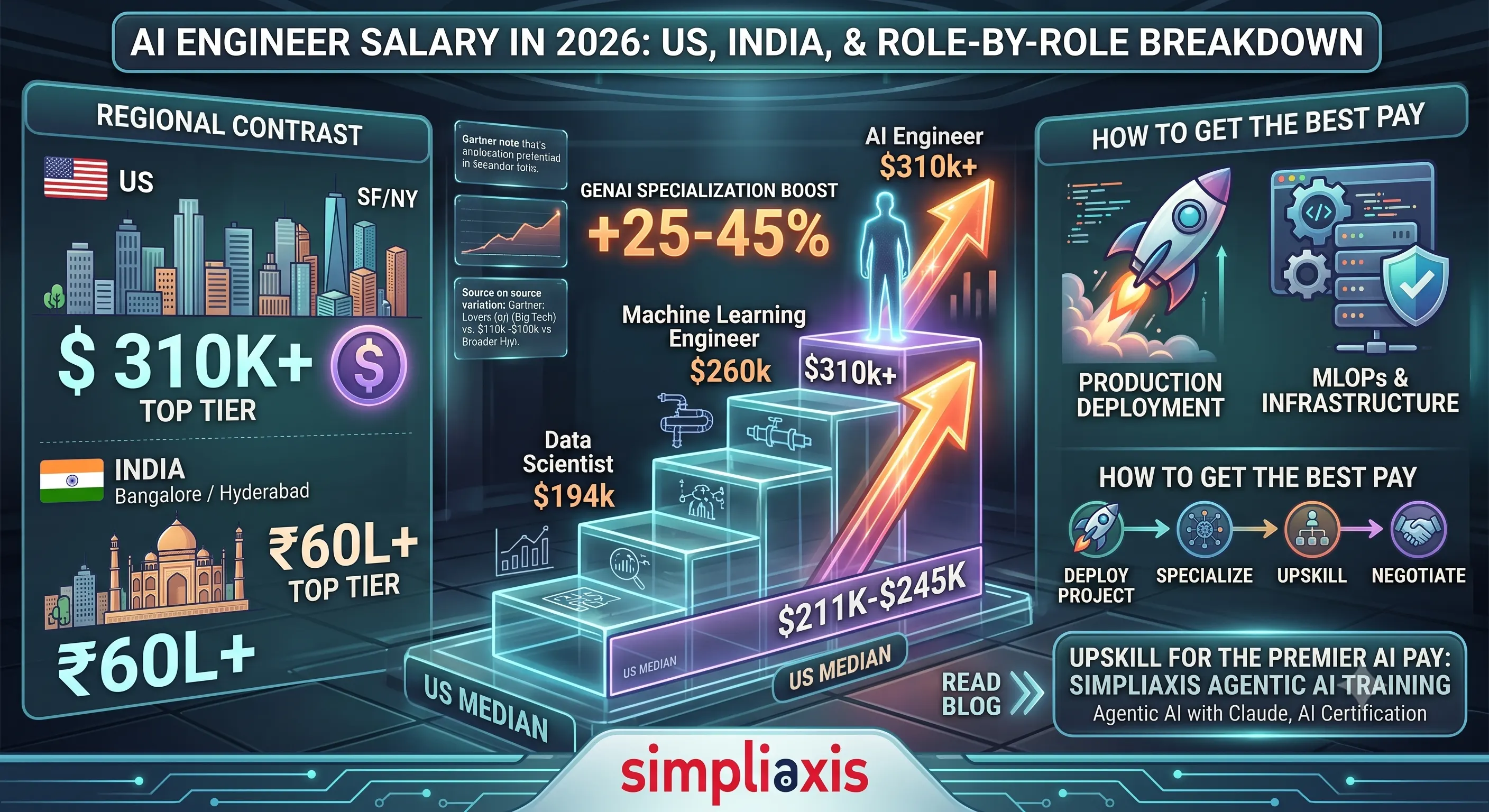
The rapid growth in agent products has created a parallel surge in demand for people who can build, deploy, and govern them. U.S. job postings mentioning "agentic systems" grew from 151 in 2024 to over 16,500 in 2025, and the share of tech job postings naming "AI agent" skills rose from under 1% in 2024 to over 9% in early 2026, according to multiple 2026 hiring-trend analyses. Compensation trackers from the same period show agent-focused roles (agent engineer, AI systems architect, generative AI and agentic platform engineer) commanding a 30% to 60% premium over equivalent generalist cloud engineering roles.
The skills behind those roles cluster into a few areas: understanding how large language models reason and where they fail, tool orchestration and API integration, multi-agent design patterns, and responsible deployment practices, including the governance dimension covered above. Familiarity with frameworks like LangGraph, CrewAI, and AutoGen is frequently cited as the practical dividing line between someone who can describe agentic AI in theory and someone who can ship a working system.
For teams building this capability in-house, structured training closes the gap faster than ad hoc experimentation. Simpliaxis offers several paths depending on where a team is starting from: the Agentic AI Foundation Training Course for professionals who need a grounded introduction to building, deploying, and managing autonomous agents that reason, plan, and use tools; the Agentic AI Practitioner Training Course for hands-on work building, deploying, and monitoring agents alongside retrieval-augmented generation and multi-agent systems; and the Applied Agentic AI Certification Training Course for teams that want a more applied, project-based path. Professionals who want a lighter entry point into the broader generative AI skill set before specializing in agents can also start with Simpliaxis's Introduction to Generative AI Training Course.
Key Takeaways
- An AI agent plans and acts across multiple steps using tools; a chatbot mainly answers one question or instruction at a time.
- Coding agents (Claude Code, GitHub Copilot, Cursor, Devin) are the most mature category, because code execution gives them a fast, verifiable feedback loop.
- Enterprise process agents (Salesforce Agentforce, Microsoft Copilot Studio) focus on safe, governed action inside systems of record rather than raw autonomy.
- Customer-support agents like Fin show a real gap between vendor-published resolution rates and independently observed results, so pilot on your own data first.
- Research and browsing agents like Perplexity Comet and ChatGPT Atlas extend AI from summarizing the web to completing tasks inside it.
- Open frameworks like LangGraph, CrewAI, and AutoGPT let teams build custom multi-agent systems when a packaged product does not fit.
- Enterprises should evaluate agents on reliability, cost and token efficiency, integration depth, and governance, not model capability alone.
- Agentic AI skills are now a distinct, fast-growing, well-compensated career track, and structured training accelerates the move from theory to shipped systems.







 Lowest-Price Challenge











 Personalized Path


.webp)


 USA
USA  Canada
 India
India UK
UK Australia
 Singapore


