


 Call Us



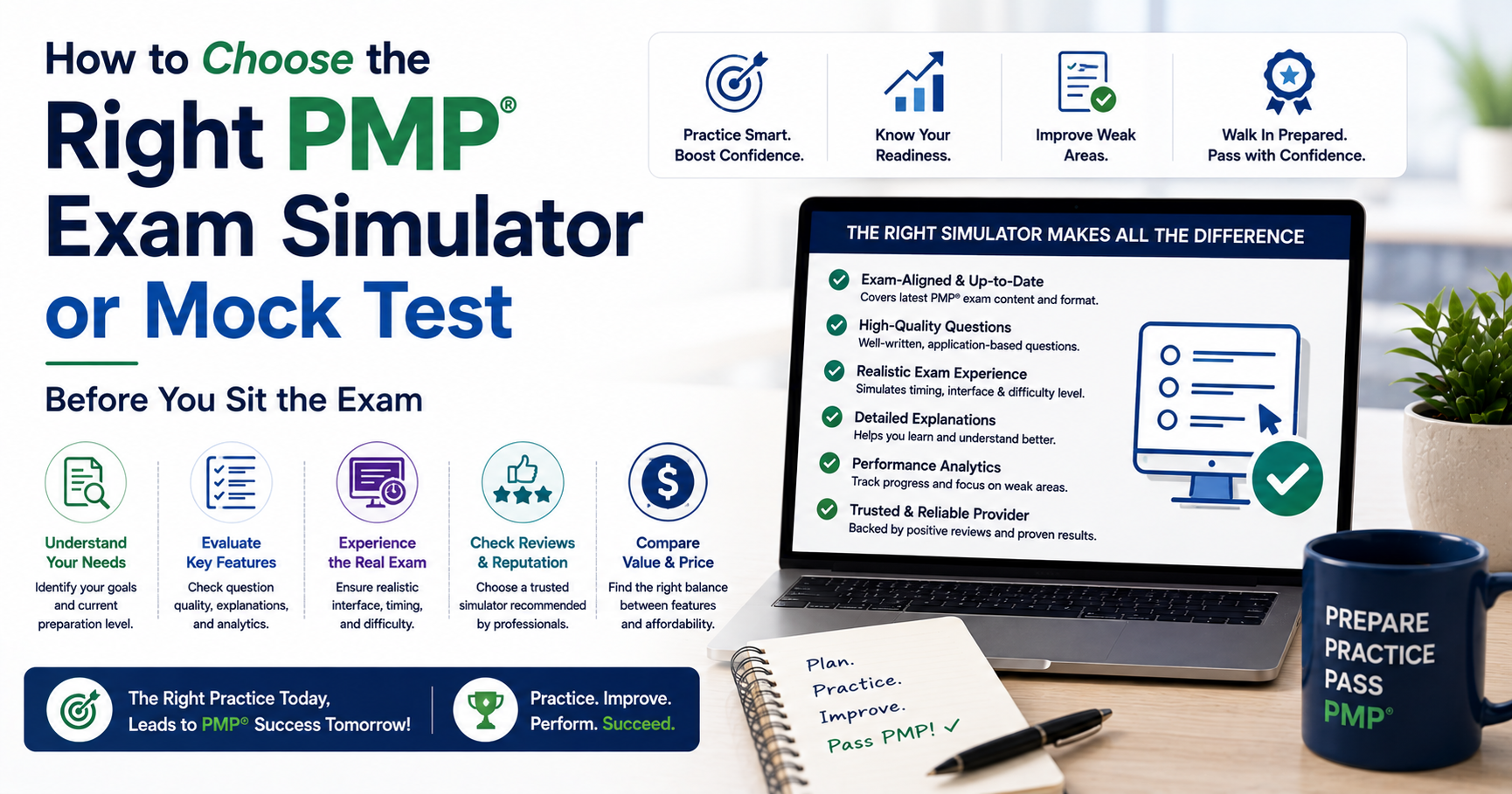
A PMP exam simulator or mock test is worth paying for only if its question bank mirrors the current PMI Examination Content Outline, mixes situational and scenario-based questions in roughly the same ratio as the real exam, and gives you domain-level scoring rather than a single pass or fail number.
Most candidates need somewhere between six and ten full-length mock exams and 800 to 1,500 unique practice questions before they are genuinely ready, started early enough to leave time for review, not crammed into the final week. The right tool tells you where you are weak across the three exam domains; a poor one just tells you how well you memorised its own question bank.
Key Highlights of PMP Exam Simulator
- The current PMI Examination Content Outline weights People at 33%, Process at 41% and Business Environment at 26%, so any simulator whose mock exams do not reflect roughly that split is testing you on the wrong exam.
- Situational and scenario-based items make up the large majority of the real PMP exam, and analysts who have reviewed the exam blueprint put the figure at 70 to 80% or higher, so a bank built mostly on "which of the following best defines" questions is not exam-representative.
- Real exam questions tend to run longer and carry more embedded, partly irrelevant detail than cheap mock questions, which is one reason candidates who score well on a weak simulator can still feel blindsided on exam day.
- PMI itself sells a full-length, PMI-authorised PMP Practice Exam through its own shop, built specifically to mirror the question style, structure and timing of the certification exam.
- Most training providers and PMP forums converge on six to ten full-length mock attempts and 800 to 1,500 practice questions as the realistic volume needed to walk in ready, not the first mock you happen to complete.
- A mock score only means something if the bank behind it is current: brain-dump content that reproduces real exam items violates PMI's Code of Ethics and the Candidate Agreement every applicant signs, and can put your certification at risk.
- AI-generated question sets are spreading fast in PMP prep, but published research on AI-authored multiple-choice questions in other credentialing fields shows accuracy and relevance are the weakest points, so unreviewed AI questions should stay supplemental, not your core bank.
Why the Simulator You Pick Matters More Than the Number of Questions You Grind Through
The PMP exam is not primarily a recall test, so a mock test that only checks whether you remember definitions will not prepare you for it. PMI designs the exam around judgement under pressure: given a messy, multi-paragraph project scenario with some relevant and some irrelevant detail, can you pick the best next action among several defensible-looking options.
That is a fundamentally different skill from recalling isolated facts about the PMP certification syllabus, and it is why a candidate can score 90% on an outdated question bank and still feel the real exam bears "almost nothing in common" with what they drilled, a gap several exam-prep reviewers have documented directly from candidate feedback.
This is precisely why "which simulator is best" is the wrong first question. The better question is what specific job you need the tool to do for you at this stage of your preparation: build foundational recall, rehearse situational judgement under a countdown clock, or diagnose exactly which of the three domains is weak enough to sink your result.
Different tools do these jobs at very different levels of fidelity, and a candidate who is deep in study mode has different needs than one two weeks from exam day. The PMP practice test is built around this distinction, separating topic-wise drilling from full-length, timed simulation so candidates can move from foundation-building to exam-day rehearsal without switching providers.
What Actually Makes a PMP Exam Simulator "Real Exam Accurate"?
A simulator earns the label "accurate" only when five specific things line up with the real PMP exam PMI administers, not when its marketing copy simply says so. Vague claims of being "updated for the latest exam" are not evidence; explicit, checkable alignment is.
Criterion | Why it matters | What a good simulator does |
| Alignment to the current Examination Content Outline | PMI weights the three domains unevenly, and a mismatched bank will over-drill you on the wrong area | States explicitly that its question mix follows People 33%, Process 41% and Business Environment 26%, matching PMI's published ECO |
| Situational-to-definitional question ratio | The real exam is dominated by scenario judgement, not vocabulary recall | Uses multi-paragraph, scenario-based items as the default format rather than the exception |
| Question length and complexity | Real exam items typically run far longer and carry more embedded detail than cheap mock questions | Writes questions with realistic length and at least one deliberately irrelevant detail, not one-line prompts |
| Domain-level scoring and analytics | A single overall percentage hides which of the three domains will actually fail you | Breaks every result down by People, Process and Business Environment, and ideally by task within each domain |
| Realistic timing and interface | Time pressure and screen navigation are part of what the real exam tests, not incidental to it | Runs a genuine countdown across sections, mirrors the flag-for-review and question-navigation behaviour of the real test |
| Update cadence against PMI's exam changes | PMI periodically revises the ECO, and a stale bank quietly drifts out of scope | Publishes a visible revision date and version number tied to the current outline, not a static "updated 2023" badge |
Question bank size is often the first number candidates check, but size on its own tells you very little. A bank of 3,000 recycled definitional questions is worth less than a bank of 800 well-written situational ones, because volume without the right question type just lets you memorise a narrower set of wrong habits faster. When you compare tools, ask for a sample question from each of the three domains before you buy, not just the total question count on the sales page.
Scoring and analytics deserve more attention than most buying guides give them. PMI itself does not report your PMP result as a raw percentage; it rates each domain as Above Target, Target, Below Target or Needs Improvement and issues an overall pass or fail based on a statistical, psychometric process rather than a fixed cut score.
A simulator that only hands you "you scored 74%" is not preparing you to read your own result the way PMI actually presents it. Look for tools that report performance by domain and, ideally, by the underlying task within each domain, the same structure candidates see in PMI's own exam preparation resources.
How Many Full-Length PMP Mock Exams Do You Actually Need, and When Should You Start?
Most candidates who pass on their first attempt complete somewhere between six and ten full-length, timed mock exams and work through roughly 800 to 1,500 unique practice questions across their study period, according to the consensus view among PMP training providers and exam-prep forums, including PM PrepCast's own community discussions.
That range is wide because it depends on your starting point: a candidate coming from years of hands-on project delivery typically needs fewer repetitions to convert existing judgement into exam-ready pattern recognition than someone studying the PMBOK Guide as their first formal exposure to the discipline.
Timing your first full mock matters as much as the total count. Sitting a full 180-question, 240-minute simulation before you have covered the material mostly measures anxiety, not readiness, and can be discouraging enough to derail momentum early in a study plan. The more useful sequence spreads full mocks across the study window rather than clustering them at the very end.
Study phase | Recommended activity | What you are testing for |
| Early study (first 30 to 40% of your plan) | Short, topic-isolated question sets of 15 to 30 items per knowledge area, no full mocks yet | Whether you can apply a concept in isolation before mixing it with others |
| Mid study (next 30 to 40%) | Two to three full-length, timed mock exams, spaced roughly a week apart | Domain-level weaknesses and early stamina under time pressure |
| Final two to three weeks | Remaining full mocks (bringing the total to roughly six to ten), reviewing every wrong and every lucky-guess answer | Consistency across domains and exam-day pacing, not just a final score |
| Final 48 to 72 hours | No new full mock; light review of flagged weak areas only | Confidence and recall, not fresh diagnostic information |
PMI's own PMP Practice Exam (product code EL329) is built as a full-length simulation of the actual test, delivered across three timed sections that mirror the real exam's structure, aligned to the current Examination Content Outline, with unlimited retakes and performance results broken out by domain.
Sitting this alongside a commercial simulator gives candidates a useful cross-check: if your score on PMI's own practice product diverges sharply from your score on a third-party simulator, that gap itself is diagnostic information about which tool's question style is closer to the real thing.
How to Read a PMP Mock Exam Score Without Fooling Yourself
A mock exam score is only informative relative to the quality of the bank that produced it, so the same percentage can mean opposite things on two different tools. Scoring 85% on a free, outdated bank built around PMBOK definitions tells you almost nothing about readiness for a scenario-heavy, current-format exam; scoring 75% on a rigorously updated, situational-question simulator is a genuinely strong signal.
Score on a high-quality, current-format mock | What it typically signals |
| Below 60% | Foundational gaps remain; keep studying by knowledge area before attempting another full mock |
| 60% to 65% | Often described by exam-prep analysts as the "danger zone": booking the real exam now leaves the outcome largely to chance |
| 70% to 75% | A reasonable indicator that you are on track to meet PMI's overall passing bar, provided the domains are balanced rather than one propping up the average |
| 75% to 80% | The band most commonly cited by training providers as the realistic target before scheduling the actual exam |
| Above 80% | Strong readiness signal, particularly if the score holds steady across People, Process and Business Environment rather than spiking in just one |
Domain balance matters more than the headline number. Because PMI reports Above Target, Target, Below Target or Needs Improvement separately for each of the three domains rather than a single blended percentage, a candidate who is strong in Process but weak in Business Environment can still fail overall even with a respectable average mock score. Before you trust any percentage, check the domain breakdown behind it; if your simulator cannot show you that breakdown, it cannot tell you whether you are actually ready.
It is also worth re-sitting the same full mock only after a meaningful gap and a genuine review cycle, not back-to-back on the same day. Repeating a test you partly remember inflates the score without improving underlying judgement, which defeats the purpose of using a simulator at all.
Free vs Paid PMP Practice Tests: What You Actually Trade Off
Free PMP practice questions are genuinely useful for an early gut check, but they were never built to carry a candidate all the way to exam readiness on their own. Free sources typically offer somewhere between 50 and 200 questions each, and even combined across several reputable free sources most candidates end up with roughly 400 to 600 usable, quality-checked questions, well short of the 800 to 1,500 most training providers recommend working through overall.
Dimension | Free practice tests | Paid exam simulators |
| Typical volume | 50 to 200 questions per source, combined 400 to 600 across multiple free sites | 800 to 2,000+ questions, often across six to ten full-length exams |
| Update cadence | Frequently static; some still reflect earlier PMBOK editions and outdated ECO weightings | Vendor-maintained revision cycles tied to PMI's current outline, usually with a visible version date |
| Question style | Often definitional or vocabulary-based, sometimes shorter than real exam items | Predominantly situational and scenario-based, closer to real exam length and complexity |
| Analytics | Usually a single overall score, little or no domain breakdown | Domain-level and often task-level performance reporting |
| Explanations | Inconsistent; sometimes missing entirely for wrong answers | Detailed rationale expected for both correct and incorrect options |
The realistic strategy most candidates land on is layered rather than either-or: use free questions early to confirm basic comprehension of a topic cheaply, then invest in one paid simulator with a current, well-reviewed question bank for the full-length, timed rehearsal that actually predicts exam-day performance. Resources such as Simpliaxis's practice questions with explanations are designed for that early diagnostic stage, before candidates move on to full simulation.
Red Flags That Signal a Low-Quality or Outdated PMP Question Bank
Several warning signs reliably predict a question bank that will waste study time or actively mislead a candidate about their readiness. None of these require insider knowledge to spot; they are visible on the product page or in the first few sample questions.
- Marketing language that says "updated for the latest exam" without naming a specific ECO version, revision date or PMBOK edition it is aligned to.
- Questions phrased mainly as "which of the following best defines…" rather than multi-sentence scenarios, which signals the bank was built for an earlier, more definitional exam format.
- No visible breakdown of results by domain (People, Process, Business Environment), leaving you with a single score you cannot actually act on.
- Suspiciously specific wording that reads like a leaked real exam item rather than an original question; these are brain-dump products, and using them can violate PMI's Code of Ethics and the Candidate Agreement every applicant signs, putting a certification at risk of annulment.
- Free samples that never mention timing, sections or a countdown clock at all, suggesting the tool was never designed to rehearse exam-day pacing in the first place.
- Explanations that restate the correct answer without explaining why the other three options are wrong, which is a weak substitute for the reasoning candidates need to build.
- A domain split in the sample exam that clearly does not resemble People 33%, Process 41%, Business Environment 26%, which means the mock is silently over- or under-testing you relative to the real exam.
The ethics point is worth taking seriously rather than treating as a formality. Every PMP applicant signs a Candidate Agreement committing to PMI's Code of Ethics and Professional Conduct, and sharing or using illegitimately compiled real exam questions breaches that agreement; PMI has the authority to annul a result or bar a candidate from retaking the exam for a period if a violation is identified. Choosing a simulator built on original, licensed questions is not just about quality, it protects the credential itself, and it is worth revisiting PMI's official PMP certification requirements if you are ever unsure what counts as legitimate preparation material.
Are AI-Generated PMP Practice Questions Worth Using?
AI-generated question sets are now common in PMP prep tools, and they are a useful supplement but a risky sole source. Generative tools can produce large volumes of plausible-looking scenario questions quickly, which is genuinely appealing given how many situational items the real exam contains, but published research on AI-authored multiple-choice questions in other high-stakes credentialing contexts found that while the structure of AI-generated items was often sound, their accuracy and, in particular, their relevance to the tested content were rated as the weakest points compared with human-authored questions.
For PMP preparation specifically, that translates into a practical rule: treat AI-generated questions as supplemental volume for extra repetition, not as your primary diagnostic tool for domain readiness. A reviewed, human-vetted question bank with detailed rationales should remain the backbone of your full-length mocks, with any AI-generated material used only after you have confirmed, through your own knowledge of the topic, that the "correct" answer and its explanation are actually right. Ask any provider using AI-generated content whether a subject-matter reviewer checks items before publication; if they cannot answer that clearly, treat the bank as unreviewed.
A Practical Checklist for Choosing Your PMP Exam Simulator
Working through these steps in order, before you pay for anything, keeps the decision grounded in what the tool can actually demonstrate rather than what its marketing claims.
- Check the alignment statement. Confirm the provider names the specific Examination Content Outline version and domain weighting (People 33%, Process 41%, Business Environment 26%) its questions are built against.
- Request or preview a sample from each domain. Read one People question, one Process question and one Business Environment question before buying, and judge length, scenario complexity and whether more than one answer looks defensible, as on the real exam.
- Confirm domain-level scoring exists. Do not proceed with a tool that only outputs a single overall percentage with no breakdown by domain or task.
- Test the timing and interface on a free trial. A genuine countdown, section structure and question-flagging behaviour should be present, not just a static list of questions with no clock.
- Verify the explanations, not just the answer key. Good explanations address why the three incorrect options are wrong, not only why the chosen answer is right.
- Cross-check against PMI's own practice exam. Sitting PMI's PMI-authorised practice product alongside a commercial simulator gives you a benchmark for how closely the commercial tool's difficulty and style match the real exam.
- Plan the volume and sequence, not just the purchase. Decide up front roughly how many full mocks (six to ten) and how many total questions (800 to 1,500) fit your study timeline, and space full mocks across that timeline rather than leaving them all for the final week.
Candidates who want a single provider that covers foundation-building drills and full-length, timed simulation without switching tools partway through their study plan often start with a structured PMP certification training programme that bundles both, rather than assembling free questions from several unrelated sources and hoping the coverage adds up. It also helps to work from an up-to-date PMP certification guide so the study plan and the mock-exam schedule are built around the same current requirements.
Conclusion
Choosing a PMP exam simulator is really a question of trust in five specific, checkable things: current ECO alignment, a realistic situational-question ratio, honest domain-level scoring, genuine timing pressure and a visible update cadence. None of that requires guessing, because every one of those five points can be verified from a sample question or a product page before money changes hands.
The candidates who walk into the test centre calm are rarely the ones who took the most mock exams; they are the ones who took mocks built to the same blueprint PMI actually uses, read their domain scores honestly rather than chasing a flattering overall percentage, and stopped relying on free or brain-dump content the moment it stopped matching the real exam's structure. Get those five things right and the number of practice tests you need stops being a guessing game and becomes a straightforward, trackable plan.









 Lowest-Price Challenge











 Personalized Path


.webp)


 USA
USA  Canada
 India
India UK
UK Australia
 Singapore


