


 Call Us



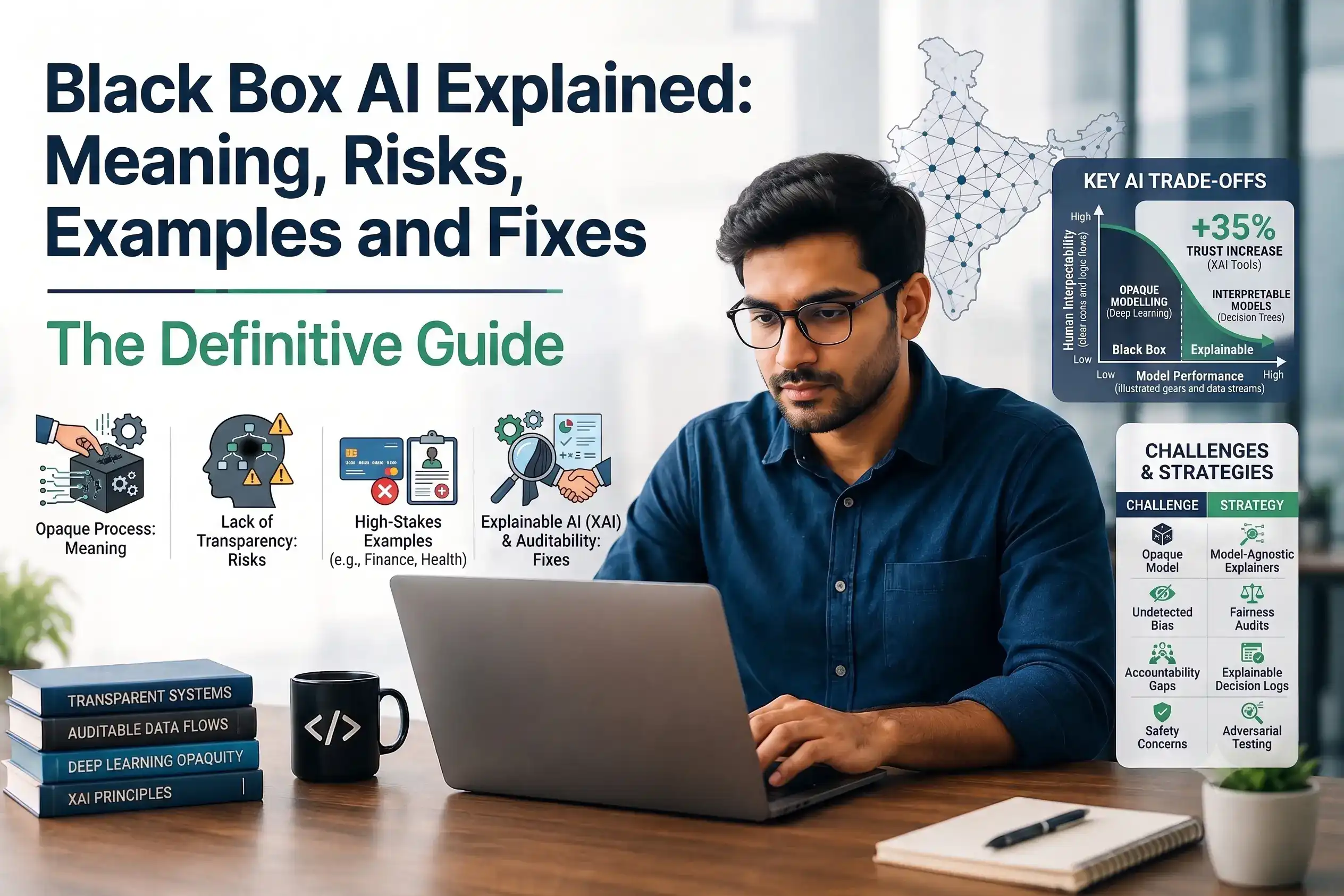
Black box AI refers to any artificial intelligence system where you can see the data going in and the decision coming out, but not the reasoning in between. Deep neural networks, the technology behind most modern AI including large language models, image recognition and recommendation engines, are the most common example because they make predictions by adjusting millions or billions of internal parameters in ways no human can trace step by step. This opacity becomes a real problem when black box systems make consequential decisions about hiring, lending, medical treatment or criminal justice, which is why regulators and researchers have built an entire field, explainable AI (XAI), to make these systems more transparent and accountable.
Key Highlights of Black Box AI
- Black box AI describes systems whose internal decision logic is hidden or too complex for humans to interpret directly, even when the inputs and outputs are visible.
- Deep learning models, random forests, gradient boosted machines and large language models are the most common black box architectures in use today.
- Documented real-world failures, including a biased hiring algorithm and a criminal risk-assessment tool, show why opacity is not just a theoretical concern.
- Explainable AI (XAI) techniques such as SHAP and LIME let teams approximate and audit what a black box model is actually doing without rebuilding it from scratch.
- The EU AI Act's transparency obligations for high-risk systems, GDPR's rules on automated decisions, and the NIST AI Risk Management Framework are pushing organizations to document and explain AI decisions rather than treat them as unquestionable.
- Demand for professionals who understand AI governance, explainability and responsible deployment is growing quickly as regulations take effect through 2026.
What Is Black Box AI
Black box AI is any artificial intelligence system whose internal workings are not visible or understandable to the people using it or affected by it. The term borrows directly from engineering, where a "black box" is any component you can test by observing its inputs and outputs without needing to know what happens inside. Applied to AI, it means a model can take in a resume, a medical scan or a loan application and produce a hire or reject decision, a diagnosis, or a credit score, without offering a human-readable account of which factors drove that specific outcome.
This is different from a system simply being complicated. A tax calculation spreadsheet with a thousand formulas is complicated, but every formula can be traced. A deep neural network is opaque in a deeper sense: even the engineers who built it typically cannot say with precision why the model weighted one pattern in the data more heavily than another for a specific prediction, because the "reasoning" is distributed across millions or billions of numerical parameters adjusted during training, not written as explicit rules.
The opposite of black box AI is often called "white box" AI or interpretable AI, referring to models such as linear regression or small decision trees where the decision path can be read directly. In between sits explainable AI (XAI), a set of techniques and practices designed to make black box models more transparent after the fact, which is covered in detail later in this article.
How Black Box AI Models Actually Work
Most black box systems today are built on deep learning, a branch of machine learning that uses artificial neural networks organized into layers of interconnected nodes, loosely inspired by neurons in the brain. Data passes through these layers, and at each one the network performs a calculation, adjusts numerical weights, and passes a transformed signal to the next layer. A modern large language model or image classifier can have many layers and an enormous number of these weights, all tuned simultaneously during training on large datasets.
Several specific model families are commonly described as black box:
- Deep neural networks, including the transformer architectures behind large language models, which power chatbots, coding assistants and generative image tools.
- Random forests, which combine the votes of hundreds or thousands of individual decision trees, making the aggregate decision hard to summarize even though each individual tree is readable.
- Gradient boosted machines such as XGBoost or LightGBM, widely used in finance and marketing because of their accuracy, but similarly difficult to explain in aggregate.
- Generative adversarial networks (GANs), used for image and video generation, where two networks train against each other in ways that are difficult to fully audit.
The core reason these models are opaque is a tradeoff that has held for most of modern machine learning: the model architectures that achieve the highest accuracy on complex, high-dimensional data (images, language, sensor streams) tend to be the least interpretable, while simpler, fully transparent models (linear regression, single decision trees) tend to be less accurate on the same problems. Choosing a black box model is frequently a deliberate tradeoff of accuracy for transparency, not an oversight.
Black Box AI vs Explainable AI (XAI)
Explainable AI (XAI) is the direct counterpart to black box AI: a set of principles, tools and design practices intended to make an AI system's outputs understandable to the humans who rely on them. The U.S. National Institute of Standards and Technology (NIST) distinguishes two related ideas within XAI: explainability, which describes the internal mechanisms of how a system works, and interpretability, which describes the meaning of the system's output in context. Both matter, because a technically accurate explanation of internal math is not useful if a loan officer or a doctor cannot connect it to the decision in front of them.
| Dimension | Black Box AI | Explainable AI (XAI) |
| Transparency of decision logic | Hidden or too complex to trace directly | Exposed through techniques that approximate or surface the model's reasoning |
| Typical model types | Deep neural networks, large language models, random forests, gradient boosted machines | Linear/logistic regression, single decision trees, or black box models paired with explanation layers (SHAP, LIME) |
| Accuracy on complex data | Often highest on unstructured data like images, text and audio | Native interpretable models can trail on very complex data; explained black box models keep the underlying accuracy |
| Auditability | Difficult; requires specialized tools or reverse engineering | Designed for auditing, compliance review and bias testing |
| Regulatory fit | Increasingly restricted for high-risk uses without added safeguards | Aligned with EU AI Act, GDPR and NIST AI RMF expectations |
In practice, most organizations do not choose one over the other in absolute terms. They keep the black box model for its accuracy and layer explainability techniques on top so a human can still answer the question "why did the system decide this," which is exactly what regulators are now requiring for high-risk use cases.
Why Black Box AI Is a Problem
Opacity is not automatically dangerous. Nobody worries that a black box AI model deciding which movie to recommend cannot fully explain itself. The problem is concentrated in decisions with real consequences for people's lives, money, health, freedom or opportunity. Four risks come up repeatedly:
Undetected Bias
A model trained on historical data will reproduce the patterns in that data, including patterns that reflect past discrimination. Because a black box model does not expose which features drove a given decision, biased outcomes can persist for a long time before anyone notices the pattern in aggregate results.
Lack of Accountability
When a black box system denies someone a loan, flags them as high-risk, or rejects their job application, "the algorithm decided" is not a satisfying or, in many jurisdictions, a legally sufficient answer. Someone has to be able to say specifically what factors led to that outcome and whether they were applied fairly.
Difficulty Debugging Errors
When a black box model makes an obviously wrong prediction, engineers often cannot pinpoint the exact cause the way they could with traditional software, because there is no single line of code to trace. This makes both fixing and preventing recurrence of the error harder.
Erosion of Trust
Doctors, loan officers, judges and other professionals who are expected to act on an AI system's recommendation are understandably reluctant to do so, or to defend that decision to a patient or client, when they cannot understand the reasoning behind it themselves.
Real-World Examples and Case Studies
The risks above are not hypothetical. Several well-documented cases illustrate exactly how black box opacity has caused real harm.
Amazon's Scrapped Hiring Algorithm
Amazon built an internal recruiting tool to score job applicants' resumes on a five-star scale using patterns learned from a decade of past hiring data. Because the majority of resumes for technical roles in that historical data came from men, the model learned to treat maleness as correlated with a strong candidate profile, and it reportedly penalized resumes containing the word "women's" (as in "women's chess club captain") and downgraded graduates of two all-women's colleges. Amazon's team could not simply edit a rule to fix this, because the bias was distributed across the model's learned weights rather than any single line of logic, and the project was scrapped in 2018.
The COMPAS Recidivism Algorithm
COMPAS, a proprietary risk-assessment tool used by courts in multiple U.S. states to help predict the likelihood a defendant would reoffend, became a landmark example of the black box problem in criminal justice after an investigation found it flagged Black defendants as future criminals at almost twice the rate of white defendants, while making the opposite mistake, incorrectly labeling white defendants as low risk, more often. Because the underlying scoring logic was not fully disclosed or interpretable, defendants and their attorneys had limited ability to challenge specific risk scores.
IBM Watson for Oncology
IBM's Watson for Oncology was built to recommend cancer treatments and was trained partly on hypothetical cases rather than sufficient real-world patient data. Oncologists at partner hospitals reported that its recommendations frequently did not match their own clinical judgment, and an internal report was later reported to show the system had produced "unsafe and incorrect" treatment suggestions in test scenarios. Because physicians could not see why Watson reached a given recommendation, trust in the tool collapsed, and it is widely cited as a cautionary case for deploying black box AI in high-stakes healthcare settings without adequate explainability.
Credit Scoring and Loan Denials
In the United States, the Consumer Financial Protection Bureau has stated plainly that lenders cannot rely on "black box" underwriting models if doing so prevents them from giving applicants the specific, accurate reasons required by law when a credit application is denied. This has directly shaped how banks deploy machine learning in underwriting, pushing many toward explainable models or black box models paired with explanation techniques so they can still produce a compliant adverse-action notice.
Where Black Box AI Is Used Today
Despite the risks above, black box models remain in widespread use because, for many problems, they are simply the most accurate option available. Common applications include:
- Conversational AI and generative tools: large language model based chatbots and coding assistants generate fluent, contextually relevant text using architectures too complex to trace decision-by-decision.
- Facial recognition and biometric authentication: used to unlock devices and, more controversially, in law enforcement and surveillance contexts.
- Recommendation engines: the systems behind personalized shopping, streaming and social media feeds.
- Fraud detection: banks and payment processors use deep learning to flag suspicious transactions in real time.
- Autonomous and driver-assist systems: perception models that identify pedestrians, lanes and obstacles from camera and sensor data.
- Hiring, lending and insurance underwriting: the highest-scrutiny category, precisely because of the case studies above.
Agentic AI systems, which combine large language models with the ability to take multi-step actions on a user's behalf, add a further layer of complexity, because now the opacity applies not just to a single prediction but to a chain of decisions and tool calls. Understanding how these agents reason and where their decision boundaries lie is an emerging skill area in its own right, covered in more depth in this guide to intelligent agents in AI.
The Regulatory Landscape: EU AI Act, GDPR and NIST
Governments and standards bodies have moved from treating explainability as a nice-to-have to writing it into binding requirements and formal frameworks.
The EU AI Act
The European Union's AI Act classifies systems used in areas like hiring, credit scoring, education and law enforcement as "high-risk," and Article 13 requires that these systems be designed so their operation is "sufficiently transparent to enable deployers to interpret a system's output and use it appropriately." Providers must supply documentation covering the system's purpose, performance, known limitations, and instructions for how to interpret its outputs, and most of the Act's substantive provisions become applicable from August 2026, with penalties for high-risk system violations reaching into the tens of millions of euros or a percentage of global revenue.
GDPR and the Right to an Explanation
Under the EU's General Data Protection Regulation, Article 22 gives individuals the right not to be subject to a decision based solely on automated processing that produces legal or similarly significant effects on them, and related articles require organizations to provide meaningful information about the logic involved in that automated decision. This is often referred to informally as a "right to explanation," and it directly targets black box systems used for consequential decisions about individuals.
NIST's AI Risk Management Framework
In the United States, the National Institute of Standards and Technology's AI Risk Management Framework (AI RMF 1.0) lists "explainable and interpretable" as one of the core characteristics of trustworthy AI, alongside being valid and reliable, safe, secure, privacy-enhanced, and fair with harmful bias managed. NIST separately published foundational principles for explainable AI systems, specifying that explanations should be meaningful to their intended audience, accurate reflections of the system's actual process, and honest about the system's limits and confidence.
How Explainable AI Techniques Open the Black Box
Rather than abandoning accurate black box models, most organizations pair them with explainability techniques that approximate or expose their reasoning after the fact. The two most widely adopted methods are:
SHAP (SHapley Additive exPlanations)
SHAP is grounded in game theory and treats each input feature as a "player" contributing to the model's output, calculating each feature's fair share of credit for a given prediction based on its marginal contribution across many possible feature combinations. It can produce both a local explanation (why did the model decide this for this one case) and a global explanation (which features matter most across the whole model), and optimized variants such as Tree SHAP make it practical to run on large models.
LIME (Local Interpretable Model-Agnostic Explanations)
LIME takes a different approach: for a single prediction it needs to explain, it generates many slightly altered versions of that input, observes how the black box model's output changes, and fits a simple, interpretable model (like a linear regression) to approximate the black box's behavior in that local neighborhood. It is fast and model-agnostic but, unlike SHAP, only explains individual predictions rather than the model as a whole.
Other Approaches
- Counterfactual explanations, which answer "what would have needed to be different about this input for the model to decide differently," a format regulators favor because it maps naturally onto an adverse-action notice.
- Model cards and datasheets, standardized documentation that discloses a model's training data, intended use, known limitations and performance across subgroups.
- Attention visualization, used with transformer-based language models to show which parts of an input the model weighted most heavily, though this is an approximation rather than a full explanation of the model's reasoning.
- Inherently interpretable models, choosing a transparent model like a decision tree or generalized additive model from the outset when the accuracy tradeoff is acceptable, avoiding the black box problem entirely for that use case.
Anyone building or evaluating models with these methods will typically first need a solid grounding in the underlying artificial intelligence and machine learning fundamentals that these explainability layers sit on top of, since XAI tools interpret a model rather than replace the need to understand how it was built.
Pros and Cons of Black Box AI
| Advantages | Disadvantages |
| Typically the highest accuracy available for complex, unstructured data like images, audio and natural language | Decision logic cannot be directly inspected, making errors and bias harder to catch |
| Scales well to very large, high-dimensional datasets | Creates accountability gaps when decisions affect people's rights, finances or health |
| Requires less manual feature engineering than traditional statistical models | Increasingly restricted or penalized under regulations like the EU AI Act for high-risk uses |
| Well-suited to tasks with no obvious rule-based logic, like language generation or image recognition | Harder to earn the trust of end users and domain experts (doctors, judges, loan officers) |
Best Practices for Managing Black Box AI Risk
- Match model choice to stakes. Reserve fully opaque, highest-accuracy models for lower-stakes applications, and prefer interpretable models or heavily instrumented black box models for hiring, lending, healthcare and legal use cases.
- Document everything. Maintain model cards covering training data sources, known limitations, intended use cases and performance broken out by demographic subgroup.
- Run independent bias audits. Test outcomes across protected characteristics before deployment and on an ongoing basis after launch, not just once at build time.
- Keep a human in the loop. For consequential decisions, ensure a qualified person can review, question and override the model's recommendation, and can access an explanation (via SHAP, LIME or a similar method) before finalizing the decision.
- Build in an appeals path. Give affected individuals a clear, accessible way to contest a decision, consistent with GDPR's right to human intervention on automated decisions.
- Map obligations to regulation. Classify AI systems by risk level under frameworks like the EU AI Act and NIST AI RMF, and align documentation and testing to the applicable tier before, not after, deployment.
Careers and Skills in Responsible, Explainable AI
As the EU AI Act's obligations take effect and NIST's framework becomes a de facto baseline even outside the United States, demand is rising fast for professionals who can bridge technical AI work with governance, risk and compliance. Roles in AI governance, model risk management, responsible AI engineering and AI product management increasingly expect working knowledge of explainability techniques, bias testing and regulatory documentation, not just model-building skills. Professionals looking to move into this space can build a structured foundation through the AIGP: AI Governance Professional certification, which covers AI risk assessment, compliance strategy and governance frameworks aligned to global standards, or the PMI Certified Professional in Managing AI (PMI-CPMAI) certification, which focuses on managing AI projects responsibly, including transparency, bias monitoring and accountability practices. For those building the underlying technical skills first, Simpliaxis's generative AI certification programs provide hands-on grounding in the model types, including large language models, that are most commonly cited as black box systems today.
Key Takeaways
- Black box AI refers to the opacity of a model's internal decision process, not necessarily to bad intent or poor performance.
- Deep neural networks, large language models, random forests and gradient boosted machines are the most common black box architectures in production today.
- Documented failures like Amazon's scrapped hiring tool, the COMPAS recidivism algorithm and IBM Watson for Oncology show the real-world stakes of undetected black box bias and errors.
- Explainable AI techniques, especially SHAP and LIME, let organizations keep the accuracy of black box models while adding after-the-fact transparency for audits, compliance and human review.
- The EU AI Act, GDPR and the NIST AI Risk Management Framework are converging on the same expectation: high-stakes AI decisions must be explainable, documented and open to human challenge.
- Skills in AI governance, model risk management and explainability are becoming a distinct, in-demand career track alongside traditional AI and machine learning engineering.
Frequently Asked Questions
1. What is the simplest definition of black box AI?
Black box AI is any AI system where you can observe the input and the output but cannot directly trace or fully understand the internal reasoning that connects the two.
2. Is ChatGPT or a similar chatbot a black box AI?
Yes. Large language models are built on deep neural network architectures with billions of parameters, and even their developers cannot fully trace why a specific response was generated for a specific prompt, which makes them a textbook example of black box AI.
3. What is the opposite of black box AI?
The opposite is often called "white box" or interpretable AI, referring to models whose decision logic can be read directly, such as linear regression or a single decision tree. Explainable AI (XAI) sits between the two, adding transparency tools on top of black box models rather than replacing them.
4. Are black box AI models illegal?
Black box models themselves are not illegal, but using them without adequate transparency in regulated, high-stakes contexts, such as credit decisions in the United States or high-risk applications under the EU AI Act, can violate specific legal requirements to provide explanations or documentation.
5. What are the main techniques used to explain black box models?
The two most widely used techniques are SHAP, which calculates each input feature's contribution to a prediction using game theory, and LIME, which approximates a black box model's local behavior around a single prediction using a simpler, interpretable model.
6. Why not just always use interpretable models instead of black box models?
Interpretable models such as linear regression or small decision trees are transparent by design, but on complex, high-dimensional data like images, audio and natural language, they typically cannot match the accuracy of deep learning based black box models, so most organizations use black box models paired with explainability techniques rather than giving up accuracy entirely.
7. How does the EU AI Act affect black box AI specifically?
The EU AI Act requires "high-risk" AI systems, a category that includes hiring, credit scoring, education and law enforcement applications, to be designed so their outputs can be interpreted appropriately by the people deploying them, with most obligations applying from August 2026 and significant penalties for noncompliance.
8. Can a black box AI model be biased even if no one intended it to be?
Yes. Bias in black box AI usually comes from patterns already present in the historical training data, such as a past hiring pattern that favored one group, rather than from any explicit rule written by a developer, which is exactly why the bias can go undetected without dedicated auditing.







 Lowest-Price Challenge











 Personalized Path


.webp)


 USA
USA  Canada
  India
India  UK
UK  Australia
  Singapore


