


 Call Us



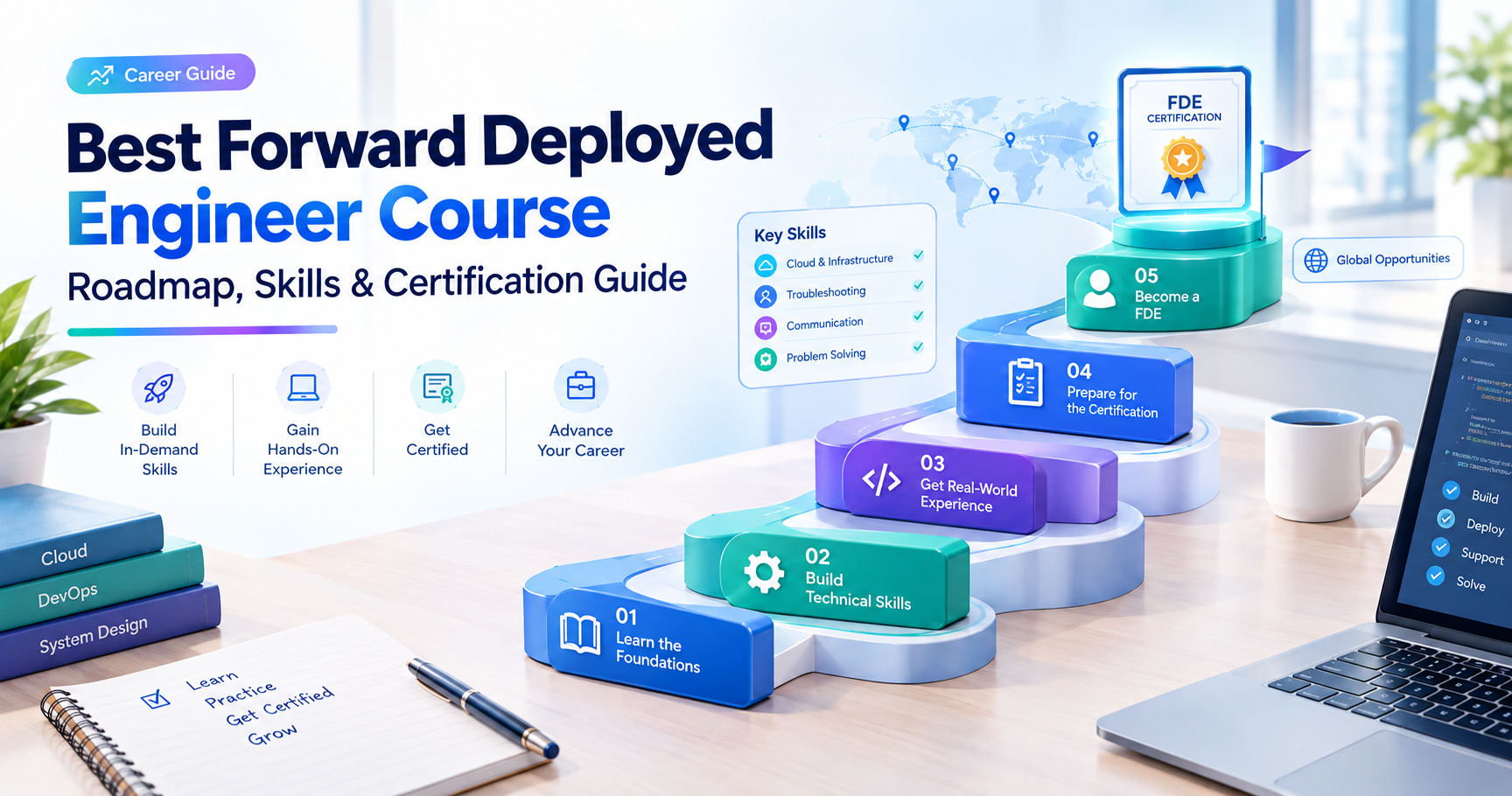
A good forward deployed engineer course needs to cover four things in sequence: Python and AI/ML foundations, RAG and AI agent development with frameworks like LangChain and LangGraph, production deployment with FastAPI and Docker on a real cloud platform, and a capstone project you build, deploy, and can defend in an interview. Self-paced video courses are cheap but rarely include live instruction or a graded capstone; corporate bootcamps often require 5-plus years of experience. Look for a program with live instruction, hands-on labs, and a genuine deployment project, not just video lectures and a multiple-choice exam.
Key Highlights of Forward Deployed Engineer Course
- The FDE training market has grown fast in 2026, with new certification bodies, bootcamps, and university-linked programs launching within months of each other.
- Course quality varies enormously. One well-known self-paced option carries a 2.3-out-of-5 rating from students; some corporate bootcamps explicitly exclude anyone with under 5 years of experience.
- The single differentiator that separates a real FDE course from a generic AI course is deployment: building an API, containerizing it, and shipping it to a cloud environment, not just prototyping in a notebook.
- A capstone project is the strongest signal to employers, stronger than a certificate badge alone, according to every hiring-focused source reviewed for this guide.
- There is no universally recognized, industry-standard FDE certification body yet, comparable to how PMP is standardized for project management, so curriculum quality matters more than the badge itself.
What a Genuinely Good Forward Deployed Engineer Course Must Cover
Because there is no single accredited body defining this role the way PMI defines PMP, course quality varies enormously. Before comparing any specific program, use this checklist against whatever you are considering.
Programming and software engineering foundations: Python, object-oriented design, and clean production-grade code, not just scripting exercises.
Machine learning and LLM fundamentals: model development, evaluation, prompt engineering, and how transformers actually work under the hood.
Retrieval-Augmented Generation (RAG): building retrieval pipelines end to end, including chunking, embeddings, and a vector database, not just calling a pre-built API.
AI agent and multi-agent development: tool calling, workflow orchestration with frameworks like LangChain or LangGraph, and evaluation and observability.
Real deployment: API development with FastAPI, containerization with Docker, and shipping to an actual cloud environment such as AWS, Azure, or GCP.
A capstone project: a complete, defensible, end-to-end build you can walk an interviewer through, not a quiz score.
Live instruction and mentor access, since ambiguity-handling and client communication, the two most-cited FDE soft skills, are far harder to learn from pre-recorded video alone.
Types of Forward Deployed Engineer Courses Available in 2026
| Format | Typical duration | Strengths | Watch-outs |
| Self-paced video course | 10-30 hours | Low cost, flexible, good for a first orientation | No live feedback; ratings vary widely; rarely includes a graded capstone |
| Certification-exam-only prep | Weeks | Structured syllabus, practice exams | Tests knowledge recall, not deployment ability |
| Corporate bootcamp | 60-80 hours | Deep, current technical content | Often requires 5-plus years of experience; built for enterprise teams, not individual career-switchers |
| Live instructor-led program with capstone | 40-70 hours | Structured lifecycle, mentor access, a real deployed project to show employers | Higher time commitment than a video course |
Multiple-choice certification exams are useful as a knowledge checkpoint, but no source reviewed for this guide, from hiring managers quoted in industry press to the course providers themselves, treats a certification badge alone as sufficient. The evidence that actually moves an interview forward is a project you built and deployed yourself.
Self-Paced vs Live Forward Deployed Engineer Courses: Which Should You Pick
The format table above lists the tradeoffs. Here is how to actually decide between them.
Choose self-paced video content if you already have solid Python and cloud fundamentals. You just need RAG and agent concepts on your own schedule. It works as a first orientation. The low cost makes it a reasonable way to confirm the role interests you before committing to anything bigger.
Choose a live, instructor-led course if you are building the full stack from scratch. The same goes if you have tried self-paced learning before and stalled without accountability. Live cohorts force a pace and give you a mentor to ask when you get stuck on a deployment error late at night. They almost always attach a graded capstone rather than a quiz.
There is a middle path worth knowing about too. Some programs mix format: live sessions for the hardest concepts, like agent orchestration and deployment. Recorded content covers material you can absorb solo, like basic Python review. That hybrid structure usually gives you the accountability of live instruction without paying for live time on content you already know.
Forward Deployed Engineer Bootcamp vs Structured Course: Key Differences
"Bootcamp" and "structured course" get used almost interchangeably in marketing copy, but they usually mean different things in practice.
A bootcamp, in the corporate training sense used above, is typically built for existing engineering teams inside a company. It runs over a short, intense window and is often gated behind a 5-plus-year experience requirement. It assumes deep prior context and moves fast because everyone in the room already shares a baseline.
A structured, live-instructor-led course, by contrast, is usually built for individual learners at a range of experience levels. It runs over several weeks rather than a few intense days, and builds the full lifecycle from Python foundations up rather than assuming it. It trades speed for completeness.
If your employer is sending an existing team through training together, a bootcamp format usually fits. If you are an individual career-switcher, or an engineer moving into this specialization on your own, pick a structured multi-week course with a capstone instead. It is built for your situation, not for teams that already share a technical baseline.
Forward Deployed Engineer Skill Roadmap, Stage by Stage
- Foundations (Weeks 1-2): Python fundamentals, object-oriented programming, data preprocessing, and exploratory data analysis, so you are not learning basic syntax at the same time as advanced concepts.
- Machine learning and LLM core (Weeks 2-4): Model development and evaluation, prompt engineering, and LLM fundamentals across major providers like OpenAI, Anthropic, and Google Gemini.
- RAG and retrieval (Weeks 4-6): Building Retrieval-Augmented Generation pipelines with a real vector database (FAISS, Pinecone, Weaviate, or pgvector), including chunking and re-ranking strategies.
- AI agents and orchestration (Weeks 6-8): Agent design, tool integration, function calling, and multi-agent workflows using LangChain or LangGraph.
- Deployment and operations (Weeks 8-10): FastAPI for serving, Docker for containerization, Redis where needed, and shipping to a cloud platform with basic observability using tools like LangSmith or Langfuse.
- Capstone (Final 1-2 weeks): One complete, deployed AI agent or RAG application, built end to end, that you can defend in a technical interview.
Forward Deployed Engineer Roadmap for Complete Beginners
The stage-by-stage roadmap above assumes you can already write working code. If you are starting from zero, add a stage before it.
Spend your first 4 to 6 weeks purely on programming fundamentals: Python syntax, data structures, functions, and basic object-oriented programming. Keep AI content out of this stage entirely. Trying to learn prompt engineering and Python syntax in the same week is the single most common reason beginners stall out of FDE-track courses early.
Once you can comfortably write and debug a Python script without following a tutorial line by line, move on. Start the Foundations stage from the main roadmap above. Everything after that point assumes working code fluency, not familiarity. Do not skip ahead just because a concept sounds interesting.
If you are choosing a course as a true beginner, favor one with entry-level prerequisites clearly stated. Be honest with yourself about whether you actually meet them. A course built for engineers with 1 to 2 years of experience will move faster than a true beginner can absorb, certification or not.
Forward Deployed Engineer Course for Freshers: What to Expect
Freshers face a different question than beginners with time to spare: which course actually gets you hire-ready fastest, not just which one teaches the most.
Most courses built for freshers compress the roadmap above into a tighter, more guided sequence. There is less room to explore tangents and more graded checkpoints along the way. That structure works in your favor if you are new to the field. It forces steady progress instead of leaving pacing entirely up to you.
The one requirement not to compromise on as a fresher is the capstone. Without production experience to point to, your deployed project is the only concrete evidence you can put in front of an interviewer. A fresher-friendly course that skips a real capstone in favor of a certificate quiz leaves you with nothing to talk through. That gap shows up in the exact interview round where freshers usually lose ground to more experienced candidates.
Inside the Simpliaxis Forward Deployed Engineering Program
Measured against the checklist above, the Simpliaxis Forward Deployed Engineering Program covers the full lifecycle in one structured, live-instructor-led track rather than splitting it across a video course and a separate certification exam.
- 60 hours of instructor-led live virtual training, plus hands-on labs, take-home assignments, quizzes, and a mid-term assessment.
- Full technical stack: Python, NumPy, Pandas, Scikit-learn, TensorFlow, and Keras for ML foundations; LangChain, LangGraph, and LlamaIndex for AI agent and RAG development.
- Production tooling: FastAPI, Docker, and Redis for deployment; FAISS, Pinecone, Weaviate, and PostgreSQL with pgvector for retrieval.
- Cloud deployment experience across AWS Bedrock AgentCore, Azure OpenAI, and Azure AI Foundry.
- Evaluation and observability practice with LangSmith and Langfuse, plus dedicated coverage of Responsible AI and AI governance, an area most competitor courses skip entirely.
- A capstone AI agent development project designed to be industry-agnostic, so it is defensible regardless of which sector you interview into.
The program is delivered live online, never in person, and is open to software engineers, developers, testers, and architects. Full curriculum and schedule details are on the Forward Deployed Engineering Program page.
Why the Capstone Project Requirement Matters More Than Any Badge
Every keyword variation in this guide, certification, bootcamp, course, roadmap, points back to the same underlying question: can you prove you can do the job. The capstone is the one course component that actually answers it.
A multiple-choice exam tests recall under timed conditions. A capstone tests something closer to the real job. It asks you to take an ambiguous goal and build a working system against it. Then it asks you to explain why you made a specific technical decision. That is precisely what an FDE interview's decomposition and system design rounds probe for.
This is also why course comparisons in this guide keep returning to the same filter. A course with weak instruction but a genuine, defended capstone still leaves you with usable proof. A course with polished video content and a quiz at the end leaves you with a certificate and nothing to walk an interviewer through. When you are down to two options and unsure which to pick, default to whichever one ends in a real deployed project.
When to Choose the Forward Deployed Architect Program Instead
If you already have hands-on engineering experience and are aiming at architecture-level ownership of AI deployments, system design decisions, governance, and cross-account technical strategy, rather than the individual-contributor build-and-deploy work covered above, the Forward Deployed Architect Program extends the same lifecycle with deeper architecture and governance coverage.
Forward Deployed Engineer Course vs AI Engineer Certification: What's the Difference
| Dimension | Generic AI Certification (Microsoft, Google, AWS, IBM) | Forward Deployed Engineer Training |
| Monthly search volume | ~1,700 for "AI engineer certification" | Lower; FDE-specific terms are a narrower category |
| Core coverage | Core AI concepts, cloud AI services, responsible AI practices | Building and deploying a working AI system inside a real client environment |
| Depth vs breadth | Prioritizes breadth over depth | Goes deep on one specific outcome |
| Typical format | Mostly proctored multiple-choice exams | Hands-on build and deployment work |
| Typical duration | 10 hours to 6 months | Longer, deployment-focused programs |
| Coding prerequisite | Often none required | Assumes you already know how to code |
| Built for | Career switchers and managers who need overview knowledge | Engineers shipping production systems |
| Best if you need | A broad AI literacy credential for your resume | Proof you can ship a RAG pipeline to a client's cloud |
| Source | Dataquest's 2026 comparison of these programs | This guide's FDE course evaluation criteria |
Is a Forward Deployed Engineer Certification Worth It in 2026?
Short answer: only if the certification comes with real deployment practice attached to it. On its own, a badge tells an employer you passed a test. It does not tell them you can build and ship a RAG pipeline under pressure.
Every hiring-focused source reviewed for this guide makes the same point in different words. A capstone project outweighs a certificate badge in an interview. That does not make certification worthless. Take a certification with a structured curriculum, a real capstone, and mentor access, like GSDC's program or a live instructor-led course. It gives you both the credential and the proof of work at the same time.
Where certification alone falls short is when it replaces practice instead of proving it. A 40-question exam you passed after watching a few hours of video will not survive a technical interview's decomposition round. Treat the certificate as a resume line, and treat the project you built to earn it as the thing that actually gets you hired.
Best Forward Deployed Engineer Online Courses in India: What to Look For
India's FDE training market is still young enough that pricing is inconsistent across providers. NovelVista's 2026 cost breakdown notes that fees depend on format, learning depth, trainer involvement, and whether a program is built for individuals or corporate teams. There is no single standard rate. Short workshops run cheapest, university-backed programs run highest, and most individual certification programs land somewhere in between.
That inconsistency makes the evaluation checklist below more important in India than in markets with a more mature training ecosystem. A handful of India-focused programs have entered the market, including university-linked options like IIT Roorkee's Forward Deployed AI Engineering certificate. These now sit alongside corporate-style bootcamps and live instructor-led tracks from providers like Simpliaxis.
When comparing India-specific options, check the same things you would check anywhere: live instruction versus pre-recorded video, a graded capstone, and current tooling. Add one India-specific question. Does the live schedule actually work for your time zone and job, or is it recorded for a different region's working hours? A "live" course scheduled for US daytime hours is effectively self-paced for most Indian professionals.
Stackable Certifications and Courses Worth Pairing with FDE Training
An FDE-focused course does not have to be the only credential on your resume. A few adjacent, narrower certifications can reinforce specific pieces of the skill set if you want extra depth in one area.
A dedicated RAG certification course sharpens the retrieval half of the stack: chunking strategy, embedding choice, and re-ranking. It goes deeper than a general FDE program has time for. An AI agent development course does the same for orchestration, going deeper into multi-agent patterns than most FDE curricula cover in their agent module. A LangChain or LangGraph-specific course is worth adding if your target employer's job postings name that framework directly, since some interviewers ask framework-specific questions.
None of these replace the core FDE training covered in this guide. They work as add-ons after you have the full lifecycle down, not substitutes for it. Stack them the way you would stack any specialization: broad foundation first, narrow depth second. Add the narrow layer only in the direction your target job postings actually point toward.
See the full Forward Deployed Architect Program curriculum for prerequisites and schedule.
How to Evaluate Any Forward Deployed Engineer Course Before You Pay
- Ask for the module-by-module syllabus, not just a marketing outline, and check it against the checklist earlier in this article.
- Confirm whether instruction is live or pre-recorded, and whether you get direct access to an instructor or mentor for questions.
- Check whether there is a graded, deployed capstone project, not just a multiple-choice exam at the end.
- Look up independent reviews, not just testimonials on the provider's own site, since course quality in this space varies widely.
- Confirm the tools and frameworks taught are current. A course still centered on older RAG patterns without agent orchestration frameworks is already behind the 2026 hiring bar.
- Check prerequisites honestly. A course built for 5-plus-year veterans will move too fast for a 1 to 2 year engineer, and one built for total beginners will bore a senior engineer.
Conclusion
If you are evaluating options against the checklist in this guide, the Forward Deployed Engineering Program covers the complete lifecycle in a single, live, instructor-led track with a real capstone project. If you already have deployment experience and want to move toward architecture-level ownership, look at the Forward Deployed Architect Program.



_1789732210.png)





 Lowest-Price Challenge











 Personalized Path


.webp)


 USA
USA  Canada
 India
India UK
UK Australia
 Singapore


