


 Call Us



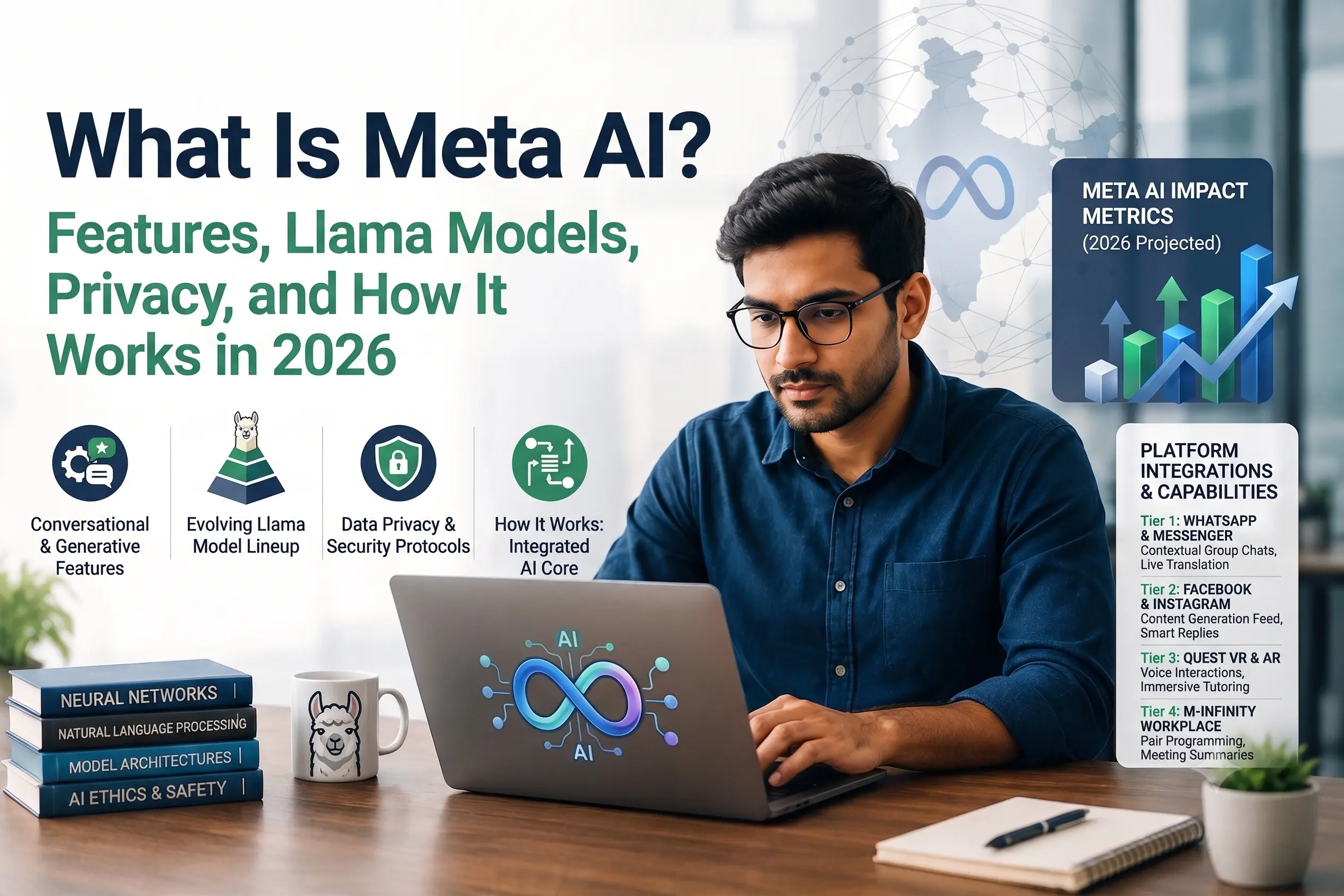
Meta AI is Meta's free artificial intelligence assistant, built on the company's Llama family of large language models and integrated directly into WhatsApp, Instagram, Facebook, and Messenger, as well as available through a standalone Meta AI app and website. It can hold conversations, answer questions, generate and edit images, and respond by voice, and it also powers the Meta AI glasses experience on Ray-Ban Meta smart glasses. As of 2026, it runs primarily on Llama 4 (Scout and Maverick), reaches users in more than 40 countries, and remains a topic of ongoing privacy debate in the European Union over how it uses personal data for training.
Key Highlights of Meta AI
- Meta AI is free to use and embedded across Meta's family of apps, meaning most people already have access to it without installing anything new.
- It is powered by Llama 4, specifically the Scout and Maverick model variants, with Llama 3 still available for developers who want an older, widely tested open-weight option.
- Core capabilities include text chat, image generation and editing, a full-duplex voice mode, and integration with Ray-Ban Meta smart glasses.
- Availability has expanded steadily, from an initial rollout in roughly 22 countries to more than 40 countries and over a dozen languages, including a more limited version launched in the European Union in 2025.
- Meta has faced sustained scrutiny from European regulators and privacy advocates over its default opt-in approach to using Facebook and Instagram user data for AI training.
- Meta has separately rolled out a Meta Business Agent for WhatsApp Business, extending the same underlying AI technology into automated customer service for companies.
What Is Meta AI
Meta AI is the umbrella name for the artificial intelligence assistant that Meta Platforms builds into its consumer apps and devices. Unlike a standalone chatbot you have to seek out, Meta AI is designed to show up wherever people already spend time: inside a WhatsApp chat thread, in the Instagram search bar, on the Facebook feed, in Messenger conversations, and now on the lenses of Ray-Ban Meta smart glasses. It is also available directly at meta.ai and through a dedicated Meta AI mobile app for iOS and Android.
At its core, Meta AI behaves like other general-purpose AI assistants: it answers questions, summarizes information, helps draft text, brainstorms ideas, and holds multi-turn conversations that remember context within a session. What sets it apart from a plain chatbot is the depth of its integration into Meta's existing social products and its multimodal abilities, which extend to generating and editing images from natural-language prompts and responding out loud in a natural-sounding voice.
Meta positions Meta AI as a free, everyday utility rather than a premium product, which is a meaningfully different distribution strategy from subscription-first assistants. For businesses and teams evaluating how large language models like Llama fit into real workflows, understanding tools such as Meta AI is a useful starting point before going deeper into building custom AI agents, which is where structured learning paths like an introduction to generative AI course or a prompt engineering training course become relevant.
How Meta AI Works: The Llama Models Behind It
Meta AI is not a single fixed model. It is a product layer sitting on top of Meta's Llama family of large language models, and the specific model doing the work has changed as Meta has released newer Llama generations.
As of 2026, the assistant runs primarily on Llama 4, which Meta introduced in two production variants:
- Llama 4 Scout, a lighter, faster model tuned for quick responses and efficient deployment, notable for supporting an unusually long context window that allows it to process very large amounts of text or conversation history in a single request.
- Llama 4 Maverick, a larger model built for stronger performance on complex reasoning, image understanding, and general chat quality, and generally treated as the workhorse model behind the main Meta AI assistant experience.
Meta also previewed a much larger model during the Llama 4 launch, codenamed Llama 4 Behemoth, described as a frontier-scale model with hundreds of billions of active parameters. However, as of mid-2026, Behemoth has not been publicly released; multiple technology outlets report that Meta has used it internally as a "teacher" model to help train Scout and Maverick rather than shipping it as a standalone product. Treat any specific claims about Behemoth's public availability with caution, since Meta has not issued an official release date.
Alongside Llama 4, Meta continues to maintain the earlier Llama 3 family as an openly available set of weights that developers, researchers, and companies can download and fine-tune for their own applications, separate from the consumer-facing Meta AI assistant. This dual-track approach, a polished consumer product on newer models plus openly downloadable weights for builders, is part of why Meta describes its Llama strategy as "open" even though Meta AI itself is a closed, hosted product.
Functionally, when someone messages Meta AI in WhatsApp or types a prompt into the Meta AI app, the request is routed to the appropriate Llama-based model, processed with the relevant conversation context, and the response, whether text, an image, or synthesized speech, is returned inside the same interface the person was already using. This is different from most competing assistants, which typically require opening a separate app or browser tab.
Architecturally, Llama 4 marked Meta's shift to a mixture-of-experts design, meaning the model is built from multiple specialized sub-networks and only activates the subset relevant to a given request rather than running the entire model for every query. This is part of why Llama 4 Scout can be deployed efficiently while still supporting a very long context window, reportedly extending into the millions of tokens, which lets it process large documents, long chat histories, or extended codebases in a single pass. Maverick trades some of that raw efficiency for stronger reasoning and image-understanding quality, which is why Meta generally treats it as the default model behind the main assistant experience rather than Scout.
It is worth noting that "Meta AI" as a brand name refers to the product experience, while "Llama" refers to the underlying model family. A developer building a custom application with Llama weights is not automatically building "Meta AI", and conversely, using Meta AI as a consumer does not require any awareness of which specific Llama version answered a given prompt, since Meta can and does switch model versions behind the scenes as newer Llama releases become available.
Where Meta AI Is Available
Meta AI launched first in the United States in 2023 and has expanded its geographic footprint considerably since. Reporting through 2026 indicates the assistant is available in more than 40 countries and over a dozen languages, spanning regions including North America, Latin America, parts of Africa, South Asia, and Oceania, with markets such as Brazil, the United Kingdom, and the Philippines added in more recent expansion waves.
The European Union has followed a distinctly separate and slower path. Meta AI launched in the EU only in March 2025, later than most other major markets, largely because of regulatory uncertainty under the General Data Protection Regulation (GDPR) and the EU AI Act. The EU version of Meta AI at launch was limited to text conversations, did not include image generation or editing, was trained without using EU users' personal data, and supported a smaller set of European languages than the assistant's full global rollout. Meta has also stated it will withhold some future multimodal AI models from the EU market, citing a lack of regulatory clarity, meaning EU users may continue to receive a delayed or reduced feature set relative to other regions for the foreseeable future.
Availability also extends into hardware. Meta AI is built into Ray-Ban Meta smart glasses as a voice-activated assistant, and Meta has signaled experimental plans to bring it to Meta Quest headsets as well, positioning the assistant as a cross-device layer rather than a single app.
Key Features of Meta AI
Meta AI's feature set has grown well beyond basic text chat. The main capabilities as of 2026 include the following.
Conversational Chat
Like other large language model assistants, Meta AI can answer factual questions, explain concepts, help with writing and editing, brainstorm ideas, and hold a multi-turn conversation. Inside WhatsApp, Instagram, and Messenger, this shows up as a chat thread you can message directly, similar to messaging a contact.
Image Generation and Editing
Through the standalone Meta AI app and website, users can generate original images from text prompts and edit existing photos using natural-language instructions, such as changing a background, restyling a photo, or combining elements from multiple images. This functionality has generally rolled out to global markets before reaching the EU, where it was withheld at launch for regulatory reasons.
Voice Mode
Meta AI supports a voice conversation mode built on full-duplex speech technology, meaning it is designed to handle natural back-and-forth spoken conversation, including a demo mode users can toggle on to test a more fluid, human-like voice interaction rather than a strict turn-by-turn exchange.
Meta AI App and Discover Feed
Meta consolidated its glasses companion experience (previously called Meta View) into the Meta AI app, which now serves double duty as both the home for managing Ray-Ban Meta smart glasses and a standalone AI assistant interface. The app includes a "Discover" feed showing examples of how other users are prompting and using the AI, functioning as a kind of public gallery of AI interactions.
Smart Glasses Integration
On Ray-Ban Meta glasses and Meta's newer AI-powered display glasses, Meta AI functions as a hands-free voice assistant, letting wearers ask questions, get information, translate speech, or identify objects in their field of view without touching a phone.
Meta Business Agent for WhatsApp
Separate from the consumer assistant, Meta has built AI agent tools for businesses on the WhatsApp Business Platform. The Meta Business Agent, rolled out globally in 2026, lets companies automate customer service tasks such as answering frequently asked questions, tracking orders, recommending products, booking appointments, and escalating complex issues to a human agent, with integrations reported for platforms like Shopify and Zendesk. This is designed to supplement, not replace, existing support teams.
Privacy and Data Considerations
Privacy has been the single most contentious issue surrounding Meta AI, particularly in Europe, and anyone evaluating the assistant for personal or business use should understand the key facts.
Meta uses public content people post on Facebook and Instagram, along with interactions with Meta AI itself, as part of the data used to train and improve its AI models, under a legitimate interest basis rather than requiring users to actively opt in first. This default opt-in structure means users who want to prevent their data from being used for AI training must proactively submit an objection, rather than the reverse.
Beginning around May 27, 2025, Meta started using certain personal data from EU users' Facebook and Instagram accounts to train its AI systems, including Meta AI and its underlying Llama models. This move triggered significant pushback:
- Privacy regulators in Belgium, France, and the Netherlands raised concerns and encouraged users to object before the training began.
- A German regional data protection authority (Verbraucherzentrale NRW) sent Meta a cease-and-desist letter demanding it halt AI training on EU user data, threatening legal action.
- The advocacy group NOYB (None of Your Business) specifically criticized Meta's opt-out design, arguing that GDPR requires clear, informed, opt-in consent for this kind of data processing rather than a buried objection mechanism.
- Meta has stated the European Data Protection Board issued an opinion affirming that its legitimate-interest approach can be compliant with GDPR guidance, and that it provides EU users a clear mechanism to object.
For users who want to limit how their data is used, Meta provides an objection process through the Privacy Center in Facebook and Instagram settings, under a section covering how Meta uses information for generative AI models and features, with a specific "right to object" form. Legal analysts note that EU and UK users have stronger enforceable rights to have such objections honored under GDPR, while the process is less guaranteed for users in the United States and other regions without equivalent data protection law.
Separately, Meta's decision to withhold certain future multimodal AI models from the EU market, first reported in mid-2024, reflects an ongoing pattern of Meta treating the EU as a distinct, more cautious regulatory environment for AI releases compared with the rest of the world.
Anyone using Meta AI for sensitive business or personal communications should review Meta's current privacy policy and AI terms directly, since data practices in this area have changed multiple times and are likely to continue evolving as regulation matures.
Meta AI vs ChatGPT vs Gemini
Meta AI competes most directly with OpenAI's ChatGPT and Google's Gemini, though each has a different core strategy. Meta AI's advantage is distribution: it is embedded directly into apps that billions of people already use daily, rather than requiring a separate download or subscription. ChatGPT has generally led on general-purpose writing, reasoning, and tool use, while Gemini has emphasized very large context windows and deep integration with Google's own products such as Search, Gmail, and Android.
| Aspect | Meta AI | ChatGPT | Gemini |
| Underlying model | Llama 4 (Scout, Maverick) | OpenAI's GPT series | Google's Gemini series |
| Primary distribution | WhatsApp, Instagram, Facebook, Messenger, standalone app, smart glasses | Standalone app and web, API, Microsoft Copilot integration | Google Search, Gmail, Docs, Android devices, standalone app |
| Cost | Free | Free tier plus paid subscription tiers | Free tier plus paid subscription tiers |
| Notable strength | Ubiquity across existing social and messaging apps, hands-free glasses integration | Writing quality, step-by-step reasoning, broad tool ecosystem | Very large context windows, multimodal understanding, Google Workspace integration |
| Model openness | Llama weights available for developers (separate from the hosted assistant) | Closed model, API access only | Closed model, API access only |
For organizations deciding which model family to build on for internal tools or customer-facing AI agents, the practical differences often matter more than headline benchmark scores: Llama's availability as downloadable weights makes it attractive for teams that want to self-host or fine-tune, which is part of why it shows up in professional training curricula that also cover OpenAI and Google models, such as an agentic AI foundation training course that works across Meta Llama, OpenAI, Anthropic, and Google Gemini models.
Practical Use Cases for Meta AI
Meta AI's real-world usage spans both individual consumers and businesses.
For Individual Users
- Quick answers and research inside an existing WhatsApp or Messenger conversation, without switching apps.
- Creative image generation and photo editing for social posts, directly inside Instagram or the Meta AI app.
- Hands-free assistance through Ray-Ban Meta smart glasses, such as asking questions, getting translations, or identifying what the wearer is looking at.
- Voice-based conversations for a more natural, spoken interaction compared to typing.
For Businesses
- Automated 24/7 customer support on WhatsApp Business through the Meta Business Agent, covering FAQs, order status, appointment booking, and lead qualification.
- Integration with existing commerce and support tools, with reported connections to platforms such as Shopify and Zendesk.
- Escalation workflows that route complex queries to human support staff when the AI agent cannot resolve them.
Teams building or managing this kind of AI-driven customer workflow, rather than just using the consumer assistant, typically need broader skills in prompt design, agent orchestration, and generative AI fundamentals, which is the gap that courses like generative AI training for business analysts and IT consultants and a generative AI course for software developers are designed to close.
Pros and Cons of Meta AI
| Pros | Cons |
| Free to use with no subscription required | Data practices have drawn sustained regulatory scrutiny, especially in the EU |
| Built directly into apps most people already use daily | Feature set is uneven by region, with the EU version historically more limited |
| Supports text, image generation and editing, and voice in one assistant | Some flagship capabilities (like Behemoth) remain unreleased or delayed |
| Extends to hardware through Ray-Ban Meta smart glasses | Default opt-in data use requires users to proactively object if they want to limit training use |
| Underlying Llama models are also available as open weights for developers | Business-grade agent features are newer and less battle-tested than established rivals |
Key Takeaways
- Meta AI is a free assistant built on Meta's Llama models, embedded in WhatsApp, Instagram, Facebook, Messenger, a standalone app, and Ray-Ban Meta smart glasses.
- It runs primarily on Llama 4 (Scout and Maverick) as of 2026, while the larger Behemoth model remains unreleased to the public.
- Availability has expanded to more than 40 countries, with the European Union receiving a later, more limited rollout due to regulatory requirements.
- Core features include text chat, image generation and editing, full-duplex voice mode, and hands-free smart glasses assistance.
- Meta's use of user data for AI training has drawn significant regulatory and privacy advocacy pushback, especially in the EU, centered on its default opt-in, opt-out-to-object model.
- Compared with ChatGPT and Gemini, Meta AI's main advantage is built-in distribution across apps people already use, while its underlying Llama models remain relevant to developers through openly available weights.
- Businesses can access a related Meta Business Agent on WhatsApp for automated, AI-driven customer service.
Frequently Asked Questions
1. What is Meta AI used for?
Meta AI is used for everyday conversational tasks such as answering questions, drafting text, and brainstorming, as well as generating and editing images, having voice conversations, and, through Ray-Ban Meta glasses, providing hands-free assistance. Businesses also use a related product, the Meta Business Agent, to automate customer service on WhatsApp.
2. Is Meta AI free?
Yes. Meta AI is free to use across WhatsApp, Instagram, Facebook, Messenger, the standalone Meta AI app, and meta.ai, with no subscription fee for the core assistant experience.
3. What Llama model powers Meta AI?
As of 2026, Meta AI runs primarily on Llama 4, using the Scout and Maverick model variants. A larger model previewed as Llama 4 Behemoth remains unreleased publicly and has reportedly been used internally rather than shipped as a consumer product.
4. Is Meta AI available in the European Union?
Yes, but with more limits than in other regions. Meta AI launched in the EU in March 2025 with text-only conversation support at first, without image generation, and without being trained on EU users' personal data, reflecting the region's stricter regulatory environment.
5. How does Meta use my data to train Meta AI?
Meta uses public content shared on Facebook and Instagram, along with interactions with Meta AI, to help train and improve its AI models, generally on a legitimate-interest, opt-out basis rather than requiring active opt-in consent first. Users can submit an objection through the Privacy Center in their account settings.
6. Can I opt out of Meta AI training on my data?
You can submit an objection request through Facebook or Instagram's Privacy Center under the section covering how Meta uses information for generative AI. EU and UK users generally have stronger legal grounds for that objection to be honored than users in regions without equivalent data protection regulation.
7. How is Meta AI different from ChatGPT and Gemini?
The biggest practical difference is distribution: Meta AI is embedded directly inside apps like WhatsApp and Instagram that people already use, while ChatGPT and Gemini are typically accessed through their own dedicated apps or through integration into OpenAI's or Google's respective product ecosystems. Meta's Llama models also differ in that some versions are released as open weights for developers, unlike the closed models behind ChatGPT and Gemini.
8. Does Meta AI work on Ray-Ban Meta smart glasses?
Yes. Meta AI is built into Ray-Ban Meta smart glasses and Meta's newer AI-powered display glasses as a hands-free, voice-activated assistant, managed through the Meta AI app, which also replaced the earlier Meta View companion app.
9. Can businesses use Meta AI for customer service?
Yes. Separate from the consumer assistant, Meta offers a Meta Business Agent on the WhatsApp Business Platform, which businesses can use to automate customer support tasks such as answering FAQs, checking order status, booking appointments, and qualifying leads, with the option to escalate more complex conversations to a human team member.
10. Does Meta AI remember previous conversations?
Meta AI retains context within an ongoing conversation so it can refer back to earlier messages in that thread. The extent to which it retains and reuses information across separate, unrelated conversations depends on Meta's current memory and personalization settings, which users can typically review and manage in their account's AI settings.


_1787554072.webp)






 Lowest-Price Challenge











 Personalized Path


.webp)


 USA
USA  Canada
  India
India  UK
UK  Australia
  Singapore


