


 Call Us



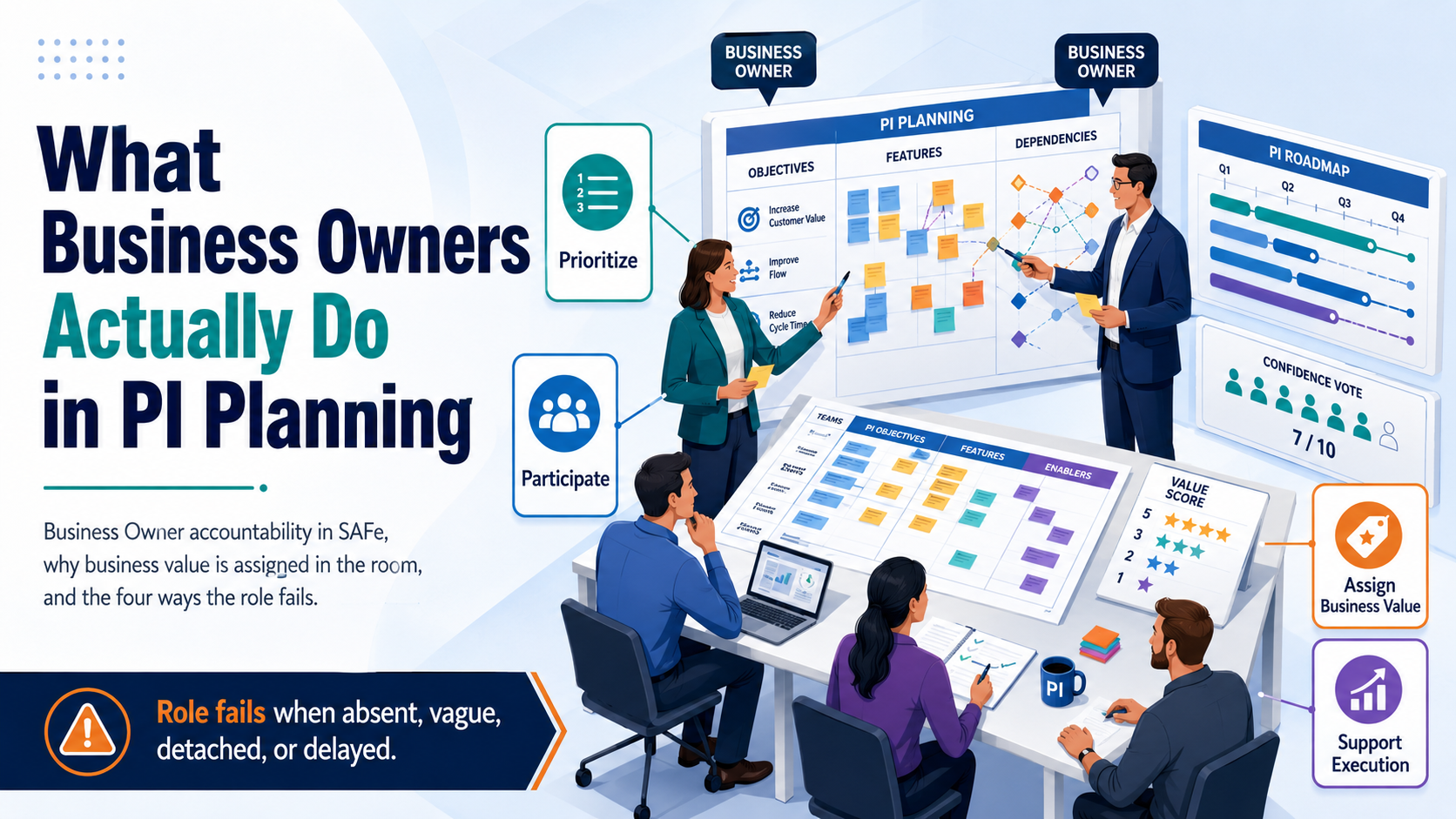
Business Owners are a small group of stakeholders with primary business and technical responsibility for the value an Agile Release Train delivers, and their defining act is assigning business value to PI Objectives during PI Planning, in the room, with the teams present. That last part is the whole point and it is the part most organisations quietly drop. Doing it afterwards by email produces the same numbers and none of the effect.
Key Highlights
- Scaled Agile defines Business Owners as a small group holding primary business and technical responsibility for the value delivered by an Agile Release Train.
- Their central responsibility is assigning business value to team PI Objectives during PI Planning, with teams present.
- The value of the exercise is the conversation, not the number. Teams learn what leadership actually prioritises and leadership learns what teams believe is achievable.
- Business value is assigned to committed objectives, which are what predictability is measured against; uncommitted objectives are excluded so teams can stretch safely.
- The most common failure is Business Owners who do not attend PI Planning, which leaves the value assignment to whoever is available and drains the number of meaning.
- Business Owner is an accountability rather than a job title, and organisations frequently appoint people with neither the authority nor the context to hold it.
Who a Business Owner actually is
Not a job title. An accountability, held by people whose day job is something else.
A Business Owner is typically a senior stakeholder with genuine responsibility for the outcome the train exists to produce. Depending on the organisation that might be a business unit head, a product executive, a senior architect, or whoever owns the profit and loss for the area the train serves. The framework specifies a small group rather than an individual, and small is doing real work in that sentence. A large group cannot hold a genuine conversation with each team about relative value, which is the activity the accountability exists for.
Two things disqualify someone in practice even when the org chart suggests otherwise. Not having the authority to change priorities, which makes their assignment of value non-binding. And not having enough context to judge relative value between objectives, which makes it arbitrary.
Organisations that appoint Business Owners by availability rather than by these two tests end up with the role filled and the accountability unheld.
What they do during the event
PI Planning runs over two days and Business Owners are active throughout rather than appearing at the end.
Before and at the opening. Business context. Business Owners or an executive set out where the business is, what changed, and what matters this Program Increment. Teams cannot prioritise sensibly without this and it is frequently delivered as a status update rather than as direction.
During team breakouts. Circulating. Teams draft objectives and Business Owners move between them answering questions about relative priority. This is the least visible and most useful thing they do, because a question answered in a breakout prevents a plan built on a wrong assumption.
At the value assignment. The defining activity. Teams present their draft PI Objectives and Business Owners assign business value to each, typically on a simple scale, in conversation with the team.
At the confidence vote and plan adjustment. Where confidence is low, the plan changes. Business Owners are part of deciding what comes out, which is a business decision rather than a delivery one.
Why the assignment happens in the room
This is the part worth understanding properly, because it is what gets lost.
The number itself is almost worthless. A team objective valued at eight rather than five tells you very little in isolation. What produces value is the argument that arrives at the number.
Three things happen in that conversation and none of them happen by email.
Teams learn what leadership actually prioritises, as opposed to what the strategy deck says. Priorities stated abstractly are agreeable to everyone. Priorities expressed as relative value between two specific pieces of work are informative, and frequently surprising to the team.
Leadership learns what is achievable. A Business Owner assigning high value to an objective the team considers marginal will hear why. Sometimes the team is wrong. Often the Business Owner did not know about a dependency, a constraint, or a piece of technical work that has to happen first.
Both sides commit in front of each other. The team commits to the objective and the Business Owner commits to it mattering. That mutual visibility is what makes the commitment stick through the PI when something else becomes urgent.
Remove the room and you get a number with no shared understanding behind it. The artefact looks identical and the effect is gone, which is the signature of the whole category of anti-pattern covered in our piece on SAFe anti-patterns.
Committed against uncommitted, and why it matters here
Business value attaches to committed objectives.
SAFe distinguishes committed PI Objectives, which the team is confident of delivering and which predictability is measured against, from uncommitted objectives, which sit in the plan and are excluded from that measure.
The distinction exists so teams can plan optimistically without being penalised for missing a stretch. It is the mechanism that makes honest planning safe.
Business Owners undermine it in two ways, both common. Assigning high business value to uncommitted objectives creates pressure to treat them as commitments, which removes the safety and teaches teams to stop stretching. And treating uncommitted objectives as missed commitments in a review does the same thing more directly.
A Business Owner who understands this distinction is worth a great deal to a train. One who does not will degrade planning honesty within two PIs without ever intending to.
The four failure modes
Not attending. The most common and the most damaging. Business value gets assigned by whoever is in the room, usually a delegate without authority, and the number becomes administrative. Teams learn quickly that the exercise is ceremonial. The secondary cost is worse than the primary one: once teams conclude that leadership does not engage with the plan, the quality of the objectives themselves drops, because there is no audience worth writing them for.
Attending only for the value assignment. Arriving for the session and leaving is better than absence and much worse than participation, because the breakout questions never get asked and the assignment happens without context. It also produces the worst version of the exercise: a senior person scoring objectives they have not discussed, in front of teams who know they have not discussed them, which damages credibility on both sides.
Assigning value without engaging. Numbers distributed evenly, or high value assigned to everything, which is the same as assigning none. If every objective is an eight, the exercise has communicated nothing.
Changing priorities outside the event. Where a Business Owner assigns value in PI Planning and then redirects the team three weeks later, the plan becomes fiction and the next planning event will be treated accordingly. Direction changes are legitimate; making them outside the cadence is what causes the damage.
How to get Business Owners to show up properly
This is one of the more practical problems a SAFe Agilist or Release Train Engineer has to solve, and it is rarely solved by explaining the framework.
Make the ask specific and small. Two days of attendance is a hard sell to an executive diary. The business context slot, the breakout circulation and the value assignment is a clearer and more defensible ask.
Show them what their absence costs. The most effective argument is a concrete example: an objective the train invested a PI in that turned out not to matter, which a Business Owner in the room would have caught in a breakout.
Give them something they want from it. Executives attend when they get information they cannot get elsewhere. PI Planning genuinely offers that, since it is the only place where every team's plan and every dependency is visible at once. Frame it as intelligence rather than as a ceremony.
Prepare them. Most Business Owners have never been told what the role involves. A twenty-minute briefing before their first event, covering the value scale and the committed versus uncommitted distinction, prevents most of the failure modes above.
Getting this right is squarely leadership work rather than process work, which is why it sits in Leading SAFe certification training alongside the rest of the Lean-Agile leadership material.
The value scale, and how to use it without wrecking it
The mechanics of the assignment are simple and the ways to break them are not obvious.
Business value is typically assigned on a small scale, commonly one to ten, per team PI Objective. The scale is relative rather than absolute: a ten means more valuable than an eight to this business right now, not that it is worth a specific sum.
Three practical failures recur.
Compression at the top. Everything scored eight, nine or ten. Understandable, since Business Owners are reluctant to tell a team its work is low value, and it destroys the exercise. If everything is high value, no prioritisation has occurred and the teams have learned nothing about what leadership actually cares about.
Treating it as a reward. Assigning higher value to a team that performed well last PI, or to work that is difficult. Value is about business worth, not effort or merit, and conflating them teaches teams to bid for difficulty.
Negotiating it upward. Teams lobbying for higher numbers because they are perceived as a performance measure. This happens when business value gets reported as an achievement metric rather than used as a planning input, and it is a reporting design failure rather than a team failure.
The corrective for all three is the same: force spread. If a Business Owner must use the low end of the scale for something, they have to decide what matters least, which is the decision the whole exercise exists to extract.
What Business Owners do outside PI Planning
The role does not stop when the event ends, though the framework is lighter on this.
They stay available for the questions that arise mid-PI, particularly when a plan needs to change and someone has to decide what comes out. That decision is genuinely theirs rather than the train's, and a Business Owner who is unreachable at that moment forces a delivery function to make a business tradeoff it is not accountable for. They participate in the System Demo, where integrated functionality is shown, since that is where their assumptions get tested against something working. And they are present at Inspect and Adapt, where the measured results of the PI are reviewed.
The through-line is that Business Owners are accountable for value rather than for delivery. The train delivers. They are answerable for whether what it delivered was worth building, which is a different question and a harder one.
How the role differs from the ones next to it
Business Owner is confused with two adjacent accountabilities regularly enough that separating them is worth doing explicitly, and it appears on the exam.
Against Product Management. Product Management owns the ART Backlog and decides what the train builds. Business Owners hold business and technical responsibility for the value delivered and assign business value to objectives. Put simply, Product Management decides what to build, Business Owners say how much it is worth. Both are senior, both are business-facing, and conflating them is a common exam error as well as an organisational one.
Against the Product Owner. A Product Owner works at team level, owning the team backlog. The scope difference is an order of magnitude, and the Product Owner is a full-time role while Business Owner is an accountability carried alongside another job.
Against a sponsor. In a traditional structure, a sponsor funds a project and receives reports. A Business Owner participates in planning, assigns relative value in the room, and stays available through the Program Increment. The difference is participation rather than oversight, and it is the single hardest part of the role to convey to executives who have only ever sponsored.
Getting these boundaries right matters beyond the exam, because organisations that appoint a sponsor and call them a Business Owner get sponsorship behaviour: attendance at the beginning, a report at the end, and no presence in between. That is exactly the failure mode described above, and it usually stems from a naming problem rather than an unwillingness. Explaining what the role actually involves is often enough to fix it, and it is part of what Leading SAFe certification training equips leaders to do.
Briefing a new Business Owner
Most people appointed to this never receive an explanation of it, which accounts for a large share of the failure modes above. A twenty-minute conversation before their first event prevents nearly all of them.
Five things to cover.
What the accountability is. Business and technical responsibility for the value the train delivers. Not delivery, which the train owns. Value, which is a harder question and theirs.
Why they need to be in the room. The number is not the deliverable. The conversation is. Explaining this once, before the event, is the single highest-return thing you can do, because most executives assume the assignment is administrative and would happily delegate it.
How the scale works. Relative, not absolute. And they must use the low end for something, or the exercise communicates nothing.
Committed against uncommitted. That uncommitted objectives are excluded from predictability deliberately, and treating them as commitments will stop teams stretching within two Program Increments.
What the teams will ask them. Priority questions during breakouts, usually about tradeoffs between two pieces of work. Warning them this is coming means they arrive prepared rather than deflecting.
Delivered as a briefing rather than as training, this lands well with senior people who would resist being sent on a course. It is also the point at which many Business Owners realise the role is more interesting than they assumed, since PI Planning is the only place in most organisations where every team's plan and every dependency is visible at once.
For leaders who want the full picture rather than a briefing, Leading SAFe certification training covers the accountability alongside the rest of the framework, and the free Leading SAFe practice test is a quick way to check how well the role boundaries are already understood.
The short version
If you take one thing from this: the number is not the deliverable, the conversation is.
An organisation can produce a complete set of PI Objectives with business value assigned to each, and have gained nothing, because the assignment happened in a spreadsheet. The same organisation can produce a messier set arrived at through argument in a room and have a train that knows what matters and leadership that knows what is possible.
The framework specifies the room for that reason, and it is one of the first things dropped when PI Planning is compressed for convenience. Compression is usually justified on cost, and the calculation almost never includes what a train spends building the wrong thing for twelve weeks because nobody senior was available to say so at the point it was still cheap to change.
For leaders working out what their own accountability looks like inside a SAFe adoption, Leading SAFe certification training covers the Business Owner role alongside the rest of the framework across two days, and the free Leading SAFe practice test is a quick way to check how well you already know who owns what.








 Lowest-Price Challenge











 Personalized Path


.webp)


 USA
USA  Canada
  India
India  UK
UK  Australia
  Singapore


