


 Call Us



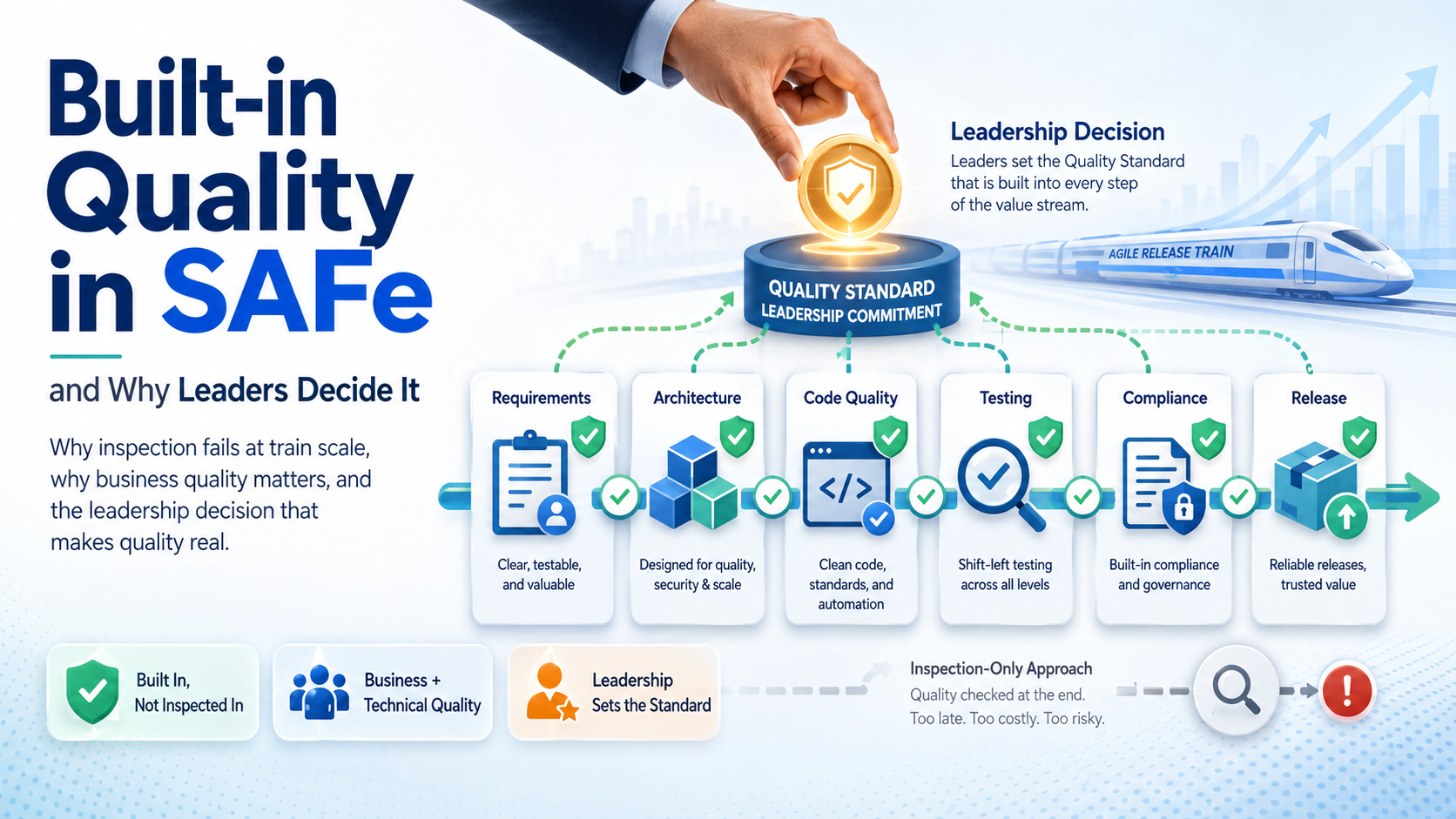
Scaled Agile defines Built-in Quality as a set of practices helping ensure that the outputs of Agile teams, in business and technology domains alike, meet appropriate quality standards throughout the process of creating customer value. The phrase doing the work is throughout the process. Quality assessed at the end is inspection, and inspection at scale does not work, because by the time many teams have integrated, finding a defect and finding who caused it are different problems.
Key Highlights
- Scaled Agile defines Built-in Quality as practices ensuring team outputs meet appropriate quality standards throughout the process of creating customer value, not at the end of it.
- The definition explicitly covers business domains as well as technology, which most implementations quietly ignore.
- Quality is not a phase, a team or a gate in SAFe. It is a property of how work is done, which makes it a leadership decision rather than an engineering one.
- The economic argument is that defects found late cost disproportionately more, and at train scale late means after integration across many teams.
- Leaders decide it by what they do under deadline pressure, not by what the definition of done says.
- A definition of done that gets suspended when a date is at risk was never a standard; it was a preference.
Why inspection stops working at scale
The argument for building quality in rather than testing it in is usually made at team level, where it is persuasive and optional. At train scale it stops being optional.
With one team, a defect found in a testing phase is traceable. The team wrote the code, they know what changed, and the fix is local. Late testing is inefficient and survivable.
With ten teams integrating into one solution, a defect found after integration may have been introduced by any of them, may only appear in combination, and may require coordinated changes across several. The cost of finding it and the cost of fixing it both rise sharply, and neither is predictable.
That is why the framework treats quality as intrinsic rather than as a stage. It is not a moral position about craftsmanship. It is an observation about what happens to defect economics when the number of integrating teams goes up.
The business domain half nobody implements
The definition covers outputs of Agile teams in business and technology domains. That second half is genuinely part of the framework and is almost universally skipped.
Business-domain quality means the quality of the decisions and artefacts produced upstream of engineering. Requirements that are clear enough to act on. Features whose acceptance criteria are agreed rather than assumed. PI Objectives that describe an outcome rather than restating a backlog item.
The reason it gets ignored is that engineering quality has visible mechanisms and vocabulary while business quality has neither. Nobody runs a test suite against a Feature description.
The consequence is real though. A train can have excellent technical practices and still deliver the wrong thing efficiently, because the defect was introduced before any code existed. Where an organisation is investing heavily in engineering quality and still delivering poorly, this is usually where the problem sits, and it is worth checking before concluding the teams need better tooling.
What leaders actually control
Leaders do not write tests. What they control is whether the standard holds when it becomes inconvenient, which is the only thing that determines whether it is a standard at all.
The moment that decides it is entirely predictable. A date is at risk, the work is nearly done, and the remaining gap is testing, review or documentation. Someone senior asks whether that part can be deferred just this once.
Whatever is said in that meeting becomes the organisation's actual quality policy, regardless of what any document says. Say yes once and everyone learns the standard is negotiable under pressure, which means it will be negotiated every time pressure appears, which is most of the time.
That is why this sits in a leadership course rather than an engineering one. The practices are well understood and widely documented. Whether they survive contact with a deadline is a leadership behaviour, and it is the same behaviour pattern our piece on SAFe certification requirements traces through the rest of the framework.
The Definition of Done as the mechanism
The Definition of Done is where Built-in Quality becomes concrete. It states what has to be true before work is considered complete, and it applies uniformly rather than case by case.
Two properties make it work. It is agreed in advance, so it is not being negotiated while under pressure. And it is binary, so an item either meets it or does not, which removes the judgement call that pressure exploits.
The failure mode is a Definition of Done that is aspirational rather than enforced. Where items are routinely accepted that do not meet it, the definition has become a description of good practice rather than a gate, and the organisation has quality theatre.
A useful test: ask when something last failed acceptance for not meeting the Definition of Done. If nobody can recall an instance, either the teams are extraordinary or the definition is not being applied.
Where quality fits across the levels
Built-in Quality operates at more than one level and organisations tend to implement only the team layer.
At team level it covers the practices producing the increment: how code is written, reviewed, tested and integrated, plus the Definition of Done that governs acceptance.
At train level it covers whether the combined output actually works. This is what the System Demo tests, by showing integrated functionality across all teams rather than a sequence of team demonstrations. A train whose System Demo is not genuinely integrated has no train-level quality mechanism, whatever its teams are doing.
At solution and portfolio level it covers whether what is being built is fit for its regulatory, architectural and business context.
The layer most often missing is the middle one, and it is the one that matters most at scale, because it is where the defects that individual teams cannot see actually surface. Our guide to the Leading SAFe curriculum covers what the System Demo is supposed to produce.
The relationship with the architectural runway
Quality and runway degrade together and for related reasons, which is worth understanding because they are usually treated as separate concerns.
When SAFe DevOps certification is exhausted, teams build Features on foundations that were not designed for them. The work is harder, the shortcuts are more tempting, and the resulting code is more fragile.
When quality practices are suspended under deadline pressure, the foundation gets worse, which shortens the runway further.
The two form a loop, and organisations under sustained delivery pressure travel around it repeatedly without recognising it as a single phenomenon. Delivery slows, the response is more pressure, quality is deferred, the foundation degrades, delivery slows further.
Breaking it requires spending a Program Increment on foundation and quality work with no Feature output, which is precisely the decision that is hardest to make when delivery is already behind. It is also the only thing that works.
The five practice areas, and what leaders should ask about each
Built-in Quality covers more than testing, and a leader who knows the areas can ask useful questions without any technical knowledge.
Flow quality. Whether work moves through the system cleanly or accumulates in review, waiting and rework. The question to ask is how much of a typical item's elapsed time is spent waiting rather than being worked on. The answer is usually uncomfortable and it points at handoffs rather than effort.
Architecture quality. Whether the foundation supports what is being built on it. This connects directly to the architectural runway, and the question is whether comparable work is taking longer than it did two Program Increments ago.
Code quality. The practices producing the increment: review, standards, automated checking. Not something a non-technical leader should evaluate directly, and the useful question is whether the practices are agreed and consistent across teams or vary by team.
Release quality. Whether releasing is routine or an event. Where a release requires a weekend, a war room and a rollback plan everyone has rehearsed, quality is being managed by heroics rather than built in.
System quality. Whether the integrated whole works, which is what the System Demo exists to show.
Asking one question in each area gives a leader a genuine picture in twenty minutes, and it is a far better use of time than reviewing a test coverage report.
Why quality problems present as delivery problems
A pattern worth recognising, because the misdiagnosis is nearly universal.
Quality does not usually fail visibly. Nothing announces itself as a quality problem. What happens is that delivery slows, estimates drift upward, and more of each Program Increment goes to fixing things rather than building them.
Leadership sees a delivery problem. The natural responses are more pressure, more people or more oversight, and all three make it worse. Pressure produces more shortcuts. New people add coordination cost to a codebase that is already hard to work in. Oversight adds process without addressing the cause.
The way to distinguish the two is flow distribution: what proportion of capacity is going to defects and rework rather than to new work. Where that proportion has been rising across several Program Increments, it is a quality problem being experienced as a delivery problem, and adding capacity will not fix it.
That diagnostic sits in the measurement material Leading SAFe certification training covers, and it is one of the more immediately useful things a leader takes from the two days. The free Leading SAFe practice test is a quick check on whether you hold the underlying vocabulary.
What good looks like without reading any code
Five signals a non-technical leader can assess.
The Definition of Done is written down and someone can produce it. If it exists only as shared understanding, it will not survive pressure.
Something failed acceptance recently. Evidence the gate is real.
The System Demo shows integrated functionality. Ask whether the demonstration runs against combined work or a sequence of branches.
Defect volume is visible in flow distribution. If nobody knows what proportion of capacity goes to defects, quality is not being managed, it is being experienced. Our piece on Lean Portfolio Management training covers why this measure surfaces the problem first.
Nobody has been asked to skip testing this quarter. Or, if they have, the answer was no and people know it.
All five are answerable in conversation, which makes this a genuinely usable diagnostic for a SAFe Agilist assessing an implementation from outside engineering.
The pressure conversation, and how to hold it
Since the deciding moment is predictable, it is worth preparing for.
Do not argue for quality in the abstract. Under deadline pressure, an appeal to standards sounds like obstruction. The argument has to be economic.
Name what deferring costs, specifically. Not that quality matters, but that skipping this now means the defect surfaces after integration, where finding it costs multiples of finding it now, and that cost lands inside the same Program Increment.
Offer the alternative. Reduce scope rather than reduce quality. This is the trade the framework wants and it is available in almost every case where it is not offered.
If the answer is still to defer, name it as a decision. Record that the standard was suspended for this item, and revisit it. What corrodes an organisation is not the occasional exception; it is exceptions becoming invisible and therefore routine.
Holding that conversation well is a substantial part of what a SAFe Agilist is for, and it is the material Leading SAFe certification training works through as leadership behaviour rather than as process.
Scope against quality
The framework is unambiguous here and it is worth stating plainly, because organisations reach for the wrong lever by default.
When a Program Increment is at risk, the variable is scope. Objectives get reduced, uncommitted objectives are dropped, work moves to the next increment. Quality is not the variable.
The reason is not idealism. Reducing quality does not reduce work, it defers it, and it defers it to a point where it costs more and is less predictable. An organisation that repeatedly trades quality for dates is borrowing at an unfavourable rate and is doing so without recording the debt.
This is also why the distinction between committed and uncommitted PI Objectives exists. Uncommitted objectives are the designed release valve, excluded from predictability measurement precisely so teams can stretch without the pressure landing on quality when the stretch does not come off.
Where an organisation has no uncommitted objectives and consistently commits to its full capacity, it has removed the mechanism and quality becomes the only remaining variable.
What the exam asks
Built-in Quality sits within the Team and Technical Agility domain, which carries 7 to 9 percent of the SAFe Agilist paper, so roughly three or four questions.
Expect definitional recall on what Built-in Quality means and on the Definition of Done. Expect the scope-not-quality trade to appear, possibly as a scenario. And expect at least one question that tests whether you know the definition covers business domains as well as technology, since that is the part most candidates have never encountered in practice.
The weighting is low, the material is finite, and the marks are cheap. Our breakdown of the the SAFe Agilist certification process covers where the heavier weightings actually sit, and the free Leading SAFe practice test will tell you whether this area needs any attention at all.
Where to start if quality is already poor
A short sequence, since the situation most organisations are actually in is recovery rather than prevention.
Measure what proportion of capacity goes to defects and rework. Not to build a case for investment. To establish a baseline, because without one any improvement is unprovable and the work will be deprioritised.
Enforce the Definition of Done on new work only. Retrofitting the standard across everything is impossible and attempting it kills the initiative. New work meets the bar; existing work is improved when touched.
Fix the release process before the code. Where releasing is an event requiring heroics, that fear drives batching, and batching makes every quality problem worse. Making release routine is usually the highest-return single change available.
Say no once, publicly. The first time a deadline is at risk and the standard holds, the organisation learns what is actually true. Nothing else you do carries the same weight, and no amount of documentation, tooling or training substitutes for it. People calibrate on what happened, not on what was stated.
That last one is the whole subject compressed, and it is why this is a leadership topic rather than an engineering one.
Why this is worth a leader's attention at all
A closing argument, since quality can look like an engineering concern a leader should delegate.
Delegating it does not work, for one structural reason. The people who own the practices do not own the decision that matters, which is whether the practices hold when a date is threatened. That decision sits with whoever can approve the exception, and it is made in public.
An organisation can hire excellent engineers, adopt every recommended practice, and still have poor quality, because the standard is suspended four times a year and everyone knows it. Conversely an organisation with ordinary practices and an unbreakable standard will improve steadily, because the practices get better under a constraint that does not move.
That asymmetry is why it belongs in a leadership course. Leading SAFe certification training covers Built-in Quality alongside the leadership behaviours it depends on, and current certification costs are listed separately.
The short version
Built-in Quality is one of the few parts of the framework where the practices are uncontroversial and the implementation still fails, because the failure is not technical.
Every organisation agrees quality should be built in. What separates the ones where it is from the ones where it is not is a single recurring decision, made under pressure, about whether the standard holds. That decision belongs to leadership and it gets made in public, which means everyone learns the answer immediately.
The practical implication is that improving quality at scale rarely starts with tooling or practices. It starts with holding the line once, visibly, when it is expensive to do so.
If you are leading an adoption, Leading SAFe certification training covers Built-in Quality alongside the leadership behaviours that determine whether it survives, across two days including the exam attempt. Current certification costs are listed separately.







 Lowest-Price Challenge











 Personalized Path


.webp)


 USA
USA  Canada
  India
India  UK
UK  Australia
  Singapore


