


 Call Us



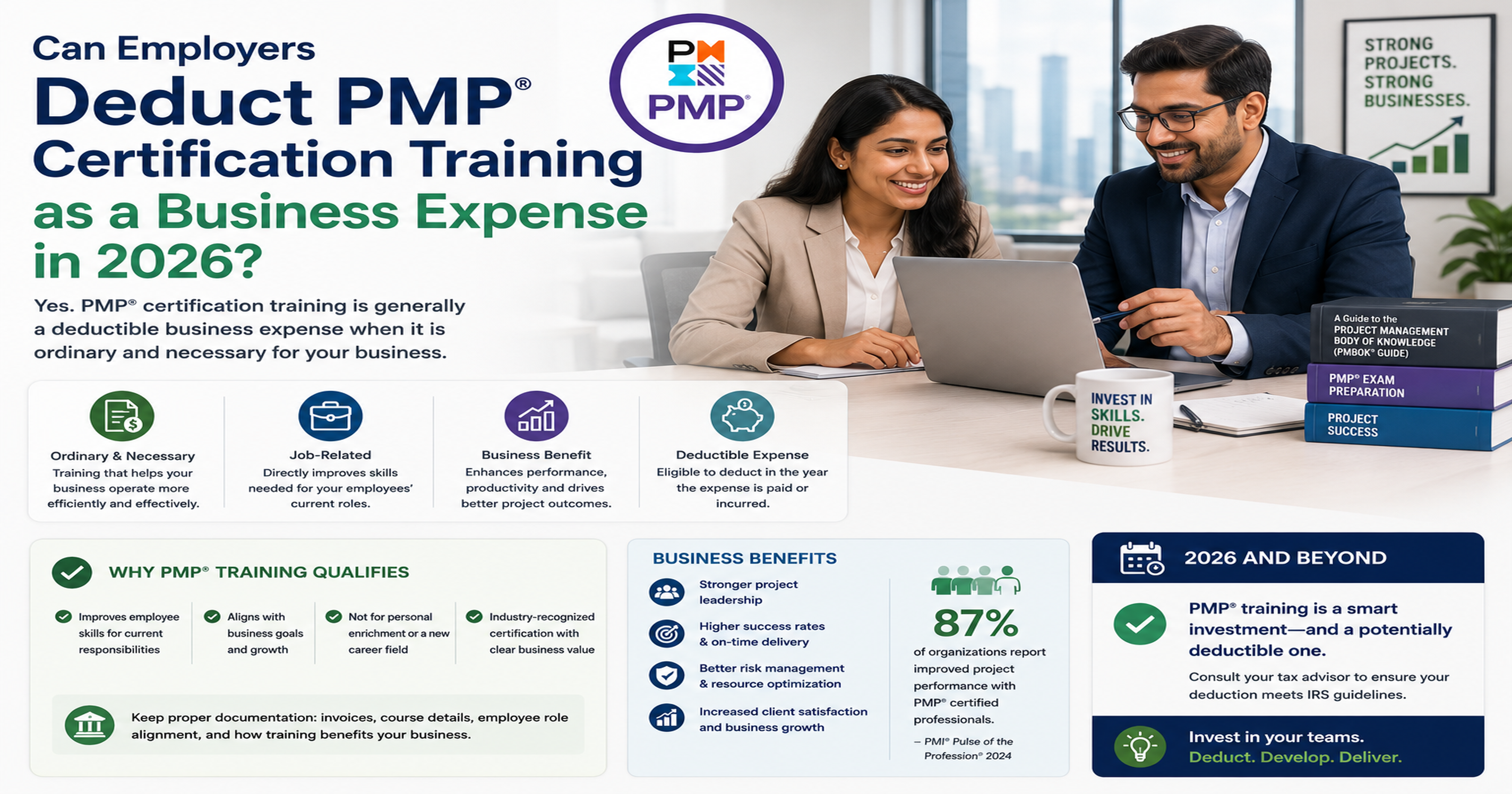
In most cases, yes. When a company pays for an employee's PMP certification training, the cost is generally deductible as an ordinary and necessary business expense under IRS rules, provided the certification maintains or improves skills the employee already uses in their current role rather than qualifying them for a new profession. In the United States, employers can also run a Section 127 educational assistance programme that lets them reimburse up to $5,250 per employee per year completely tax free, on top of the standard business expense deduction.
In the United Kingdom, HMRC generally treats employer funded, work related training as an allowable expense under the wholly and exclusively test, and it is not normally taxed as a benefit in kind on the employee. Whether a claim actually qualifies still depends on how the training is documented, who it is offered to, and how closely it ties to the employee's present job.
Key Highlights: Can Employers Deduct PMP Certification Training As a Business Expense?
- PMP certification costs paid by an employer are typically deductible as an ordinary and necessary business expense, provided the training maintains or improves an employee's existing job skills rather than preparing them for a new trade.
- A Section 127 educational assistance programme lets US employers reimburse up to $5,250 per employee per year tax free, a limit that also has to absorb any qualifying student loan repayment assistance offered under the same plan.
- Training that qualifies an employee for a genuinely new trade or business, rather than their present one, loses the tax free and deduction advantages under IRS guidance and Treasury Regulation 1.162-5.
- UK employers can generally deduct work related training costs under the wholly and exclusively test, and HMRC does not usually treat it as a taxable benefit in kind for the employee.
- A written, non-discriminatory training policy that is offered on similar terms across the eligible workforce is central to qualifying for tax-advantaged treatment on both sides of the Atlantic.
- Since PMI's July 2026 exam update, the Business Environment domain now carries 26% of exam content, which strengthens the case that PMP training builds governance and compliance skills directly tied to an employee's current duties.
- Certifying a whole project team through corporate or group training usually lowers the per-head cost and produces the kind of consistent documentation that supports a clean tax deduction claim across multiple employees.
What Makes Employer-Paid PMP Training a Deductible Business Expense?
An employer-paid PMP certification is deductible when it passes the same test the IRS applies to any staff training cost: it must be an ordinary expense, meaning common and accepted in the employer's field, and a necessary one, meaning helpful and appropriate for running the business. For a company that manages projects, whether in construction, IT, pharmaceuticals or professional services, paying for a project manager's PMP certification training fits squarely inside that definition because project management is the function the role already performs.
The more specific rule that governs education costs sits in Treasury Regulation 1.162-5, which is what determines whether training counts as maintaining or improving an employee's existing skills, as opposed to preparing them for a different occupation. Costs that meet the minimum requirements of a job, or that qualify someone for a new trade or business, fall outside the deduction, while costs that sharpen skills already required in the current role stay inside it. A working project coordinator who becomes PMP certified is refining an existing skill set, which is why most tax guidance treats this scenario as squarely deductible rather than borderline.
Scenario | Likely Tax Treatment |
| Employee already manages projects and the employer pays for PMP exam and training | Deductible, since the certification maintains and improves current job skills |
| Employer pays for a junior analyst's PMP training to move them into a project management role for the first time | More likely challenged as training for a new trade or business, so treatment needs closer review |
| Employer reimburses PMP renewal fees and PDU-earning courses for a certified project manager | Generally deductible as maintaining an existing professional qualification |
| Employer pays tuition toward an unrelated degree with no connection to the employee's job | Not deductible as job-related training, though other education benefit rules may apply |
A practical starting point for any employer is to have the training itself delivered through a documented, PMI-aligned programme. Reviewing a structured PMP certification training course syllabus alongside the employee's current job description is a simple way to show the link between the training and the existing role, which is exactly the evidence a tax adviser or auditor will ask for if the deduction is ever questioned.
How Does the IRS Section 127 Educational Assistance Programme Apply to PMP Training?
Section 127 of the Internal Revenue Code lets an employer run a formal educational assistance programme that reimburses up to $5,250 per employee per year completely tax free, and that amount does not need to show up as wages on the employee's Form W-2. The IRS confirmed in its updated frequently asked questions on Section 127 that this limit holds for 2025 and 2026, and that the same $5,250 ceiling has to cover both traditional tuition-style assistance and any qualified student loan principal or interest payments made under the same plan, so an employer offering both benefits needs to track the combined total per employee.
To use Section 127, the assistance has to run through a separate written plan set up exclusively for the benefit of employees, not simply an informal understanding that the company will "sort out" a course fee. The plan has to be communicated to eligible staff, and it cannot discriminate in favour of highly compensated employees, officers or shareholders.
The IRS has also published a sample plan template, Publication 5993, that smaller employers can adapt rather than drafting a policy from scratch. Because a Section 127 programme sits outside the ordinary and necessary business expense test altogether, it works as an additional, simpler route to tax-free treatment, especially useful for the exam fee, the official PMI membership, study materials and the training course itself, all of which fall within the kind of "tuition, fees and similar expenses" the programme covers.
Where the total cost of certifying an employee, exam fee, training course and materials combined, comes in under $5,250, a Section 127 plan can make the entire outlay tax free to the employee while still counting as a deductible business cost to the employer. A useful reference point when budgeting against that ceiling is a full PMP certification cost breakdown, since exam fees, training and renewal costs together often sit comfortably inside the annual cap for a single employee.
Where the "New Trade or Business" Rule Can Undo the Deduction
The most common reason an employer's PMP training deduction gets challenged is the new trade or business disqualifier. Under IRS guidance set out in Publication 970, Tax Benefits for Education, education costs are not deductible, and cannot be sheltered as a working condition fringe benefit, when the training is part of a programme of study that will qualify the individual for a new trade or business, even if the employee has no intention of actually changing jobs. This is a facts-and-circumstances test, not a formality, so an employer moving an administrative assistant with no prior project responsibilities straight into a PMP-focused programme is on shakier ground than one certifying a project coordinator who has already been running project schedules and budgets for a year or more.
The safest position is to fund PMP training for employees whose current job description already includes project planning, scheduling, budgeting, risk management or stakeholder coordination responsibilities, since the certification is then plainly reinforcing duties the person already performs. Employers who are unsure where a particular role sits on that line typically get a short written opinion from their tax adviser before committing training budget to it, rather than assuming every certification automatically qualifies.
How Does HMRC Treat Employer-Funded PMP Training in the UK?
UK employers can generally deduct the cost of PMP training for staff against corporation tax provided the expenditure is incurred wholly and exclusively for the purposes of the business. HMRC guidance is clear that this test looks at the purpose of the spending, not whether a direct commercial payback can be proven, and that an employee gaining personal satisfaction or a portable qualification from the course does not, by itself, disqualify the expense, as long as the training is genuinely relevant to the job they do.
On the employee side, HMRC's specific guidance on expenses and benefits for training payments confirms that training which is necessary for the employee's job, or that helps them do that job better, can usually be paid for or reimbursed without creating a taxable benefit in kind, so the employee does not pick up an income tax charge on the value of the course. This work related training exemption is separate from, and generally more generous than, the £50 trivial benefit exemption that applies to small non-cash perks, so employers should not assume the £50 limit caps what can be spent on staff training. Training that is purely recreational, or unconnected to the employee's actual duties, does not qualify for this treatment and would need to be reported as a benefit instead.
One area HMRC scrutinises more closely is training paid for a director or an employee connected to the business owner. The practical test HMRC applies, and one worth an employer applying to itself before claiming the deduction, is whether the same cost would have been incurred for an unconnected employee doing the same job. If the answer is yes, the wholly and exclusively test is on solid footing.
Where Does PMP Training Sit in the Company's Accounts?
Most finance teams record employer-paid PMP training under one of two headings: a general Training and Development or Education expense line, or, where the cost runs through a formal Section 127 style plan, under an Employee Benefit Program line item. Neither treatment is universally "correct"; the choice usually follows how the company already structures its chart of accounts and whether the spending sits inside a documented benefits plan or is approved case by case as ordinary operating expenditure.
Accounting Treatment | When It Typically Applies | Tax Implication |
| Training & Development expense (operating expense) | Ad hoc or role-specific training approved outside a formal benefits plan | Deductible if it meets the ordinary and necessary and job-relevance tests |
| Employee Benefit Program expense | Costs paid through a documented Section 127 educational assistance plan | Deductible to the employer and tax free to the employee up to $5,250 per year |
| General and Administrative expense | Training that supports company-wide capability rather than one department | Deductible subject to the same underlying tests |
Whichever line item is used, the underlying documentation should be the same: an invoice or receipt from the training provider, a record of the employee's job title and responsibilities at the time of training, and, in the US, a reference to the written plan the reimbursement was paid under if one exists. This is also the point at which many PMO and finance teams decide it is simpler to buy training centrally through one provider for a cohort of project managers rather than approving scattered individual reimbursements, since a single invoice covering several employees under one training agreement is easier to file and defend than a dozen separate expense claims.
What Documentation Does an Employer Need to Claim the Deduction Safely?
An employer does not need a large compliance department to support a PMP training deduction, but a few pieces of paperwork make the position far more defensible if it is ever reviewed.
- Written training policy: a short document stating which roles are eligible for certification funding and on what terms, so the offer is not seen as an ad hoc perk for one favoured employee.
- Non-discriminatory eligibility: the policy should not, in practice, only ever benefit owners, officers or the most highly paid staff, which matters specifically for Section 127 plans in the US.
- Job description on file: a record showing the employee's duties already include project management activity, tying the certification back to their current role rather than a future one.
- Provider invoices and receipts: itemised billing from the training organisation and PMI, kept for as long as the employer's normal expense record retention period requires.
- Plan document, where used: for US employers running a formal educational assistance programme, the written plan itself, ideally modelled on the IRS's own sample template, Publication 5993.
Employers weighing whether a certification is worth funding in the first place, rather than just how to document it, often start by reviewing independent analysis on whether PMP certification is worth it for the roles they are considering, since the answer to that question shapes which employees the training policy should actually cover.
How Do L&D and PMO Managers Build the Business Case for Certifying a Whole Team?
The strongest business case for funding PMP certification treats the tax treatment as one line inside a wider total cost of ownership calculation, not the headline reason to invest. Reported figures on PMP-driven outcomes vary by organisation, but several training providers cite double-digit gains in on-time, on-budget project delivery after teams adopt a standardised methodology, alongside salary data showing PMP-certified project managers commanding a meaningful premium over uncertified peers in similar roles.
An L&D manager building a case for leadership should pair those outcome figures with the hard cost side: exam fees, training delivery, study materials, PDU maintenance and the employer's own administrative time, then net off whatever portion is tax deductible or falls under a tax-free reimbursement cap.
Certifying a single employee and certifying an intact project team are different budgeting exercises. A single reimbursement is easy to approve informally, but scaling that to ten, twenty or fifty project managers works far better through a structured programme purchased once, rather than repeated one-off approvals.
This is precisely the scenario corporate and group training is built for: an employer negotiates one agreement covering a cohort of staff, receives consolidated invoicing that is simple to file against a training and development or employee benefit expense line, and can apply the same eligibility criteria and documentation to every participant, which is exactly what supports a clean, non-discriminatory claim rather than a patchwork of individual reimbursements.
Factor | Individual Reimbursement | Corporate/Group Training |
| Cost per employee | Typically higher at list price per person | Often reduced through negotiated group rates |
| Documentation for tax purposes | Separate invoice and approval per employee | One agreement and invoice covering the cohort, easier to audit |
| Consistency of eligibility criteria | Varies by manager or department | Applied uniformly, supporting the non-discrimination requirement |
| PMO scheduling and delivery | Staggered, harder to plan around project timelines | Can be scheduled around the team's actual project calendar |
Where an employer plans to enrol fifteen or more staff into PMI membership alongside the certification, it is also worth checking PMI's own group membership terms, since bulk membership fees can run below the individual renewal rate. A summary of what membership actually includes is set out in this overview of the benefits of PMI membership, which is useful background when a PMO is deciding whether to fund membership as part of the same training budget line as the exam and course fees.
Building the Total Cost of Ownership Picture
A complete business case should walk through exam fees, training delivery cost, materials, membership and renewal together, rather than presenting the exam fee in isolation, since PMI's exam pricing has changed more than once in 2026 and is likely to keep shifting. A current PMP exam fee reference is a sensible starting point for that calculation, and it should be read alongside the training provider's own quote rather than treated as the full cost of certifying someone.
Once the gross figure is in hand, the employer nets off whatever falls inside a Section 127 tax-free reimbursement in the US, or a straightforward wholly and exclusively deduction in the UK, to arrive at the genuine after-tax cost per certified employee, which is the number that actually belongs in an L&D budget submission.
Why the July 2026 PMP Exam Update Matters to the Tax Question
PMI's Examination Content Outline took effect on 9 July 2026, aligning the exam with the PMBOK Guide 8th Edition and significantly re-weighting the domains tested. Business Environment now accounts for 26% of exam content, alongside People at 33% and Process at 41%, and the exam itself runs to 180 questions, of which 170 are scored and 10 are unscored pretest items, according to PMI's own explanation of the updated exam. That Business Environment weighting covers governance, compliance, regulatory and organisational-context tasks, the kind of material that maps directly onto duties a working project manager, PMO analyst or compliance-adjacent role already carries.
For the tax question specifically, this shift arguably strengthens, rather than weakens, the "maintains or improves current skills" argument for most employer-funded PMP training, because a larger share of the exam now tests governance, risk and compliance competencies that sit inside many project managers' existing job descriptions, rather than narrow scheduling technique alone. PMI does not publish an official minimum passing pe
Cost Component | Typically Covered Under Section 127 (US) | Typically Deductible as Ordinary Business Expense |
| PMI membership fee | Yes, as a fee similar to tuition | Yes |
| PMP exam fee | Yes | Yes |
| Structured training course or bootcamp | Yes | Yes |
| Study materials, practice exams, books | Yes | Yes |
| PDU-earning courses for renewal | Yes | Yes, as maintaining an existing credential |
rcentage for the exam, and employers should treat any specific "pass mark" figure they see quoted online as an industry estimate rather than a published PMI standard; most current estimates place the practical bar at around 61%, though this is not confirmed by PMI itself.
Should an Employer Pay for the Exam, the Training Course, or Both?
Employers do not have to choose one or the other, and in practice most that fund PMP certification cover the full path: PMI membership, the exam fee, a structured training course and study materials, since all of these typically qualify for the same tax treatment as a single package rather than needing separate justification.Where employers most often draw a line is not on which of these components qualifies, but on which employees the offer is extended to, since a policy that only ever funds the exam for one or two favoured staff looks very different, from a documentation standpoint, to one that funds the full path for every project management role that meets defined eligibility criteria.
Conclusion
The core answer holds across both major jurisdictions covered here: employer-paid PMP certification training is generally deductible, and in the US can also be delivered tax free to the employee up to $5,250 a year through a Section 127 plan, provided the training reinforces skills the employee already uses rather than launching them into a new trade or business.
The mechanics differ between the IRS's ordinary and necessary test and HMRC's wholly and exclusively rule, but the underlying logic is the same in both systems: tie the training to the current role, document eligibility so it is not seen as favouring a select few, and keep clean records of what was paid and to whom.
For an employer thinking beyond a single employee, the real budgeting question is rarely whether PMP training is deductible at all, since in the overwhelming majority of cases it is, but whether the certification is being purchased and documented in a way that scales cleanly across a team, which is exactly where a structured, centrally arranged training programme tends to outperform a series of individual reimbursement requests.







 Lowest-Price Challenge











 Personalized Path


.webp)


 USA
USA  Canada
 India
India UK
UK Australia
 Singapore


