


 Call Us



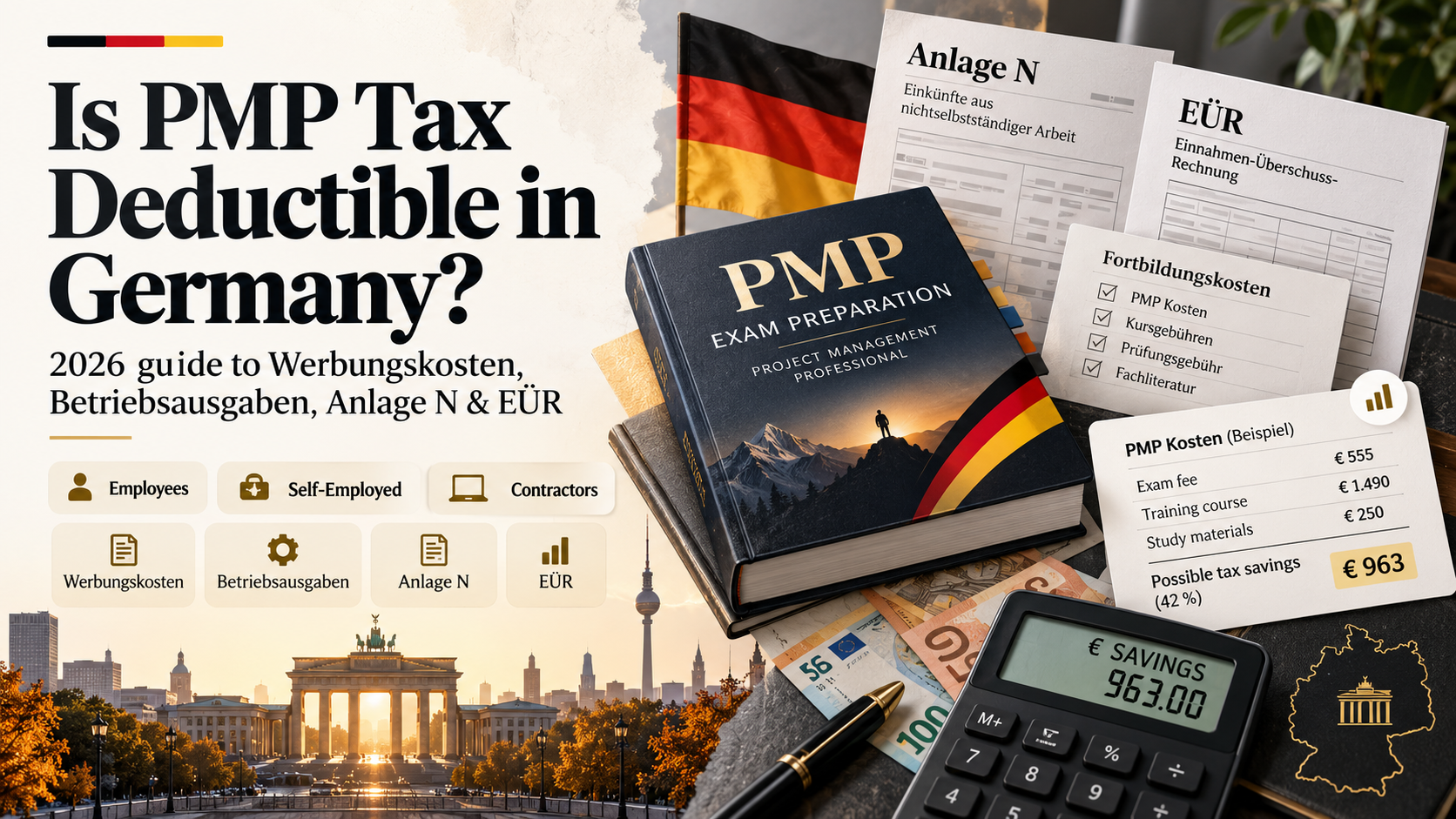
Yes, PMP certification costs are generally tax deductible in Germany, but the mechanism depends entirely on how you work. Employed project managers claim the exam fee, training course, PMI membership and study materials as Werbungskosten (income-related expenses) on Anlage N, with no upper limit once the annual flat-rate allowance is exceeded. Self-employed and freelance project managers deduct the same costs as Betriebsausgaben (business expenses) through Anlage EÜR or Anlage S. In both cases, the deciding factor is that PMP counts as Fortbildung (continuing professional education) rather than a first-time qualification, which is precisely the category that gets the most favourable tax treatment under German law.
Key Highlights: Is PMP Certification Tax Deductible in Germany?
- PMP costs fall under Fortbildungskosten, not Ausbildungskosten, because they build on an existing career rather than funding a first degree or first vocational training.
- Employees deduct PMP costs as Werbungskosten on Anlage N; there is no statutory cap on Fortbildungskosten, unlike the €6,000 annual limit that applies to Ausbildungskosten claimed as Sonderausgaben.
- Self-employed and freelance project managers deduct the same costs as Betriebsausgaben under Section 4(4) of the Einkommensteuergesetz (EStG), reported via Anlage EÜR or Anlage S.
- The deduction only pays off once total Werbungskosten exceed the Arbeitnehmer-Pauschbetrag, a flat allowance of €1,230 for the 2025 tax year according to German tax guidance published by outlets such as steuertipps.de and sevdesk.
- If your employer pays for PMP training and the training predominantly serves the employer's operational interest, the benefit is typically tax-free and free of social security contributions for the employee.
- Only the portion you personally paid is deductible; any amount reimbursed by an employer or covered by a grant must be excluded from your claim.
- This article is general information, not individual tax advice; confirm your specific situation with a Steuerberater (German tax adviser) before filing.
Werbungskosten or Betriebsausgaben? The Two Paths Depend on How You Work
German tax law does not have a single "certification deduction" the way some countries do; instead it routes the same underlying cost through one of two established expense categories depending on your employment status. If you are employed under a Dienstverhältnis (an employment contract) and receive a salary reported on a Lohnsteuerbescheinigung, your PMP costs are Werbungskosten, deducted against your employment income on Anlage N of the Einkommensteuererklärung. If you invoice clients as a freelancer or run your own consultancy, the same costs are Betriebsausgaben, deducted against business profit under Section 4(4) EStG and reported via Anlage EÜR (Einnahmenüberschussrechnung) for many freelance project managers, or Anlage S for those classified under freiberufliche Tätigkeit.
The practical effect is similar either way: the cost reduces taxable income before your marginal tax rate is applied. The mechanics of documentation, timing and forms differ, which is why this guide treats employed and self-employed project managers as two separate filing tracks rather than one generic answer.
A smaller group of project managers sit in both categories in the same tax year, for example an employed PM who also freelances part-time. In that case, PMP costs are allocated to whichever activity they most directly serve; if the certification supports both, many Steuerberater advise splitting the cost proportionally between Anlage N and Anlage EÜR, with clear documentation of the rationale.
Is PMP a "Fortbildung" or an "Ausbildung"? Why the Label Changes Your Deduction
Whether a cost counts as Fortbildungskosten or Ausbildungskosten is the single most consequential classification question in German training tax law, and PMP falls clearly on the favourable side. According to guidance summarised by Haufe and steuertipps.de, Ausbildungskosten apply narrowly to a first vocational training (erste Berufsausbildung) or a first degree (Erststudium) undertaken outside an existing employment relationship. Fortbildungskosten cover everything that follows: education undertaken after you already have a completed qualification or are already working in a field, intended to maintain, deepen or extend existing professional skills.
Because PMP candidates must already hold professional project management experience and, in most cases, a prior degree or equivalent work history to sit the exam, PMP training is treated as Fortbildung in essentially every realistic case for practising project managers. This matters because Ausbildungskosten can only be claimed as Sonderausgaben (special expenses), capped at €6,000 per year according to German tax guidance, and they provide no benefit in a year with no taxable income to offset. Fortbildungskosten, by contrast, are deductible in full as Werbungskosten or Betriebsausgaben with no statutory ceiling, and any loss they create can typically be carried forward (Verlustvortrag) to reduce tax in future years, a distinction also set out in the Bundesministerium der Finanzen's official Lohnsteuer-Handbuch guidance on training costs.
If you are weighing whether to pursue a PMP certification training course in Germany as a next step in an existing project management career, this distinction is good news: you are not funding a new career from scratch in the eyes of the Finanzamt, you are investing in the one you already have, and the tax code treats that investment generously.
What Specifically Qualifies: Exam Fee, Course, Membership, Materials and Travel
Direct answer: the PMP exam fee, an accredited preparation course, PMI membership taken to access member exam pricing, study materials, and reasonable travel and subsistence connected to the certification are all recognised categories of Fortbildungskosten under German guidance, provided each cost has a genuine and documented professional connection.
| Cost item | Typically deductible? | Notes |
|---|---|---|
| PMP exam fee (paid to PMI) | Yes | Deductible even though PMI is a foreign, US-based body; what matters to the Finanzamt is the professional purpose and a proper invoice, not the provider's location. |
| PMI membership fee | Yes, in the year it is genuinely tied to certification or maintenance | Commonly justified because membership unlocks the discounted member exam fee and access to the PMBOK Guide; see Simpliaxis's overview of the benefits of PMI membership for what the fee covers. |
| Accredited training course (live, online or blended) | Yes | Course and seminar fees are explicitly named in German guidance on Fortbildungskosten (e.g. lohnsteuer-kompakt.de, VLH). |
| Study materials, practice exams, prep books | Yes | Treated like Fachliteratur (professional literature), a long-recognised deductible category. |
| Travel to a training venue or exam centre | Yes, at actual cost or the standard kilometre allowance | Reported guidance cites 0.30 EUR per km for 2025, rising to 0.38 EUR per km from 2026 according to lohnsteuer-kompakt.de. |
| Meal allowances (Verpflegungspauschale) on multi-day training | Yes, at fixed daily rates | Guidance cites a domestic rate of 14 EUR for qualifying absence days connected to the training. |
| PDU-earning webinars and renewal-cycle content | Yes, in the renewal year they are incurred | Same Fortbildung logic applies to maintaining an existing certification, not only to first obtaining it. |
One qualifying condition applies across every row in that table: you must have paid the cost yourself, and it must not have already been reimbursed tax-free by an employer or covered by a grant. Where you have supplemented a training budget yourself, for example topping up an employer contribution to attend a more comprehensive PMI-authorised PMP training provider, only your own out-of-pocket share is deductible.
How Employed Project Managers Claim PMP Costs: Anlage N Step by Step
Employed project managers report PMP costs as Werbungskosten within Anlage N of the annual Einkommensteuererklärung, in the section covering Fortbildungskosten, which guidance from skill-sprinters.de places broadly in the Werbungskosten lines of that form.
- Collect every invoice. Keep the PMI exam confirmation and receipt, your training provider's invoice, PMI membership receipt, and any receipts for materials, travel and meals connected to the certification.
- Total your Werbungskosten for the year. Add PMP-related costs to any other job-related expenses, such as home office costs, professional literature or a second commute.
- Compare the total against the Arbeitnehmer-Pauschbetrag. Guidance from steuertipps.de and sevdesk confirms this flat allowance stands at €1,230 for the 2025 tax year and is unchanged for 2026; itemising only helps once your real Werbungskosten exceed this figure, since the Finanzamt grants the flat amount automatically regardless of receipts.
- Enter the itemised figure on Anlage N. If filing via ELSTER (the official German online tax portal) or a tax software product, the Fortbildungskosten fields sit alongside other Werbungskosten categories; several German tax guides describe this as appearing around lines 41 to 75 of Anlage N, though exact line numbers can shift between tax years and forms should always be checked against the current year's official version.
- Retain, rather than submit, your receipts. Guidance from the North Rhine-Westphalia state tax authority's Fortbildungskosten page confirms that supporting documents generally do not need to be attached to the return itself, but must be produced on request if the Finanzamt asks.
If your only Fortbildungskosten in a year are PMP-related, comparing your likely total spend against that threshold is worth doing before you register; Simpliaxis's PMP certification cost breakdown is a useful starting point for estimating the exam fee, course fee and materials together, and most realistic totals comfortably exceed €1,230, making itemising worthwhile purely on the arithmetic.
How Self-Employed and Freelance Project Managers Claim PMP Costs
Self-employed and freelance project managers deduct PMP costs as Betriebsausgaben, directly against business profit, rather than as a personal itemised deduction against salary income. According to guidance summarised by GULP and erfolg-als-freiberufler.de, this follows from Section 4(4) EStG, which allows any expense caused by the business activity to reduce taxable profit.
In practice, this route is procedurally simpler than the employee path because there is no equivalent flat-allowance threshold to clear first; every legitimate Betriebsausgabe reduces profit from the first euro.
| Step | What to do |
|---|---|
| 1. Book the expense | Record the PMP exam fee, course fee, membership and materials as Fortbildungskosten within your bookkeeping, typically in the same expense category as Fachliteratur and Reisekosten. |
| 2. Complete Anlage EÜR | Freelancers using cash-basis accounting (Einnahmenüberschussrechnung) report the total under the training/professional-development expense line, which guidance from time2invoice.de and fuer-gruender.de places on Anlage EÜR page 2. |
| 3. Complete Anlage S if applicable | Project managers operating as freiberuflich (a liberal profession) rather than gewerblich (a trade) additionally summarise their profit on Anlage S, which flows the Anlage EÜR result into the main tax return. |
| 4. Deduct input VAT where registered | VAT-registered freelancers who are not using the Kleinunternehmerregelung (small business VAT exemption) can typically reclaim the Vorsteuer (input VAT) charged on German-issued training invoices, separately from the income tax deduction. |
| 5. Keep the paper trail | Contracts, invoices, participation certificates and payment proof should be retained to demonstrate the professional link, as advised by erfolg-als-freiberufler.de. |
One frequently asked nuance concerns PMI itself being a US-based, not German, invoicing entity. Reputable German tax guidance is consistent on this point: the provider's country of establishment does not disqualify an expense, provided there is a genuine professional purpose and a proper invoice or receipt naming the payer and the service.
If Your Employer Pays: When Employer-Funded PMP Training Stays Tax-Free
Direct answer: employer-funded PMP training is generally tax-free for the employee and free of social security contributions, provided the training is judged to serve the employer's own operational interest rather than being primarily a personal benefit. Guidance summarised by the Deutsche Rentenversicherung and by sbk.org explains that German case law, including rulings referenced by the Bundessozialgericht, asks whether qualification-improvement, rather than a disguised salary top-up, is clearly the dominant purpose (das überwiegend eigenbetriebliche Interesse).
Where that test is met, the employer's payment is not treated as a geldwerter Vorteil (a taxable benefit in kind), so the employee reports nothing extra on Anlage N for that portion, and the employer avoids additional payroll tax and social security liability on it. This is one of several reasons many employers structure project management upskilling as organisation-funded training rather than leaving individual staff to self-fund and later claim Werbungskosten. Businesses evaluating this route for a wider group of project managers, rather than a single individual claim, often look at structured options such as corporate and group training programmes, which can consolidate PMP preparation for a whole project delivery team under a single, clearly work-related training agreement rather than a patchwork of personal reimbursements.
Where an employer only partially reimburses PMP costs, for example covering the exam fee but not the course, the employee can still claim the unreimbursed portion as Werbungskosten on Anlage N, exactly as described in the earlier employee section, as long as it is clear which part was paid personally.
Worked Example: What a PMP Investment Actually Saves in Tax
This example is illustrative only, uses rounded and approximate Euro figures, and should not be read as a guarantee of any specific refund; actual outcomes depend on your full tax return, marginal rate and church tax status.
| Item | Approximate cost (EUR) |
|---|---|
| PMI exam fee (non-member rate, converted from USD) | €620 |
| PMI annual membership | €120 |
| Accredited German-market PMP training course | €900 |
| Study materials and practice exams | €150 |
| Total out-of-pocket spend | €1,790 |
For an employed project manager whose other Werbungskosten already exceed the €1,230 flat allowance, the full €1,790 is additional taxable-income reduction. At an illustrative marginal income tax rate of 42 percent, a rate commonly cited for upper-middle income German employees before the top rate band, that produces an approximate tax saving of €752, plus a proportionate reduction in the solidarity surcharge and church tax where applicable.
The effective net cost of the certification falls from €1,790 to roughly €1,038, before counting any salary uplift the credential itself may support. For context on that upside, PMP-certified professionals in Germany report materially higher average compensation than non-certified peers, according to Simpliaxis's PMP certification salary guide for Germany.
The core lesson generalises beyond this specific figure: because Fortbildungskosten are uncapped, the tax saving scales roughly linearly with your marginal rate and total spend, which is why higher earners and freelancers with strong profit years tend to see the largest proportional benefit from claiming every eligible line item rather than only the exam fee.
Documentation the Finanzamt Expects
A clean, retrievable paper trail is what converts an eligible expense on paper into an accepted deduction in practice. Based on guidance from steuern.de and dasfinanzen.de, the Finanzamt typically expects the following where a Fortbildungskosten or Betriebsausgaben claim is queried.
- The training provider's invoice or receipt, ideally itemising exam fee, course fee and materials separately.
- PMI's own payment confirmation for the exam fee and any membership charge.
- A certificate or confirmation of participation showing course dates and content.
- Travel tickets, mileage logs or accommodation receipts where transport or overnight stays are claimed.
- Evidence of the professional link, such as a job description or employer confirmation, if your role title does not obviously indicate project management duties.
- Proof of any employer reimbursement, so that only the net, self-funded amount is claimed.
Receipts generally do not need to be filed with the return itself but must be produced if the Finanzamt asks, so the practical discipline is retention rather than pre-emptive submission.
Do Aufstiegs-BAföG or the Bildungsprämie Apply to PMP?
Direct answer: Aufstiegs-BAföG and the Bildungsprämie are separate public funding schemes, not tax deductions, and PMP does not automatically fit either one, so most project managers should treat the tax route as the primary lever and public funding as a secondary check worth ten minutes of research rather than an assumption.
Aufstiegs-BAföG (formally the Aufstiegsfortbildungsförderungsgesetz, AFBG) funds structured Aufstiegsfortbildungen, career-advancement qualifications such as Meister, Techniker or Fachwirt programmes, typically requiring a minimum number of course hours; official guidance from the federal Aufstiegs-BAföG programme describes funding of course and exam fees up to a stated ceiling, split between a non-repayable grant portion and a repayable loan portion. Whether a specific PMP delivery format meets the AFBG's course-hour and programme-type criteria varies by provider and by the awarding Land authority, so this is a case-by-case check with the relevant regional funding office rather than a blanket yes.
The Bildungsprämie is a smaller federal co-funding scheme aimed at individual continuing-education costs below a modest per-course ceiling, subject to income limits and typically requiring pre-approval before the course starts. It is far more commonly used for shorter, lower-cost courses than for a certification-plus-exam package the size of PMP.
Neither scheme changes the tax analysis above: funding received under either programme is not itself taxed as income in the way it is used, but any subsidised portion of the cost, like any employer-paid portion, must be excluded from a personal Werbungskosten or Betriebsausgaben claim, since you can only deduct what you actually paid yourself.
Conclusion
For German project managers, the tax question around PMP has a clear structural answer even though the exact euro figure differs by individual: because PMP is Fortbildung rather than Ausbildung, the exam fee, course, membership and materials are deductible in full, with no statutory cap, either as Werbungskosten against employment income on Anlage N or as Betriebsausgaben against business profit on Anlage EÜR or Anlage S.
The practical decision that matters most is not whether PMP qualifies, it does, in essentially every realistic case for a working project manager, but which filing track applies to you, whether your total Werbungskosten clear the €1,230 flat allowance, and whether any part of the cost was already reimbursed tax-free by an employer or a public funding scheme. Get those three things right, keep your invoices, and the German tax system does the rest of the work of lowering your effective certification cost. As with any individual tax position, confirm the specifics against your own Steuerbescheid with a qualified Steuerberater before you file.





 Lowest-Price Challenge











 Personalized Path


.webp)


 USA
USA  Canada
  India
India  UK
UK  Australia
  Singapore


