


 Call Us


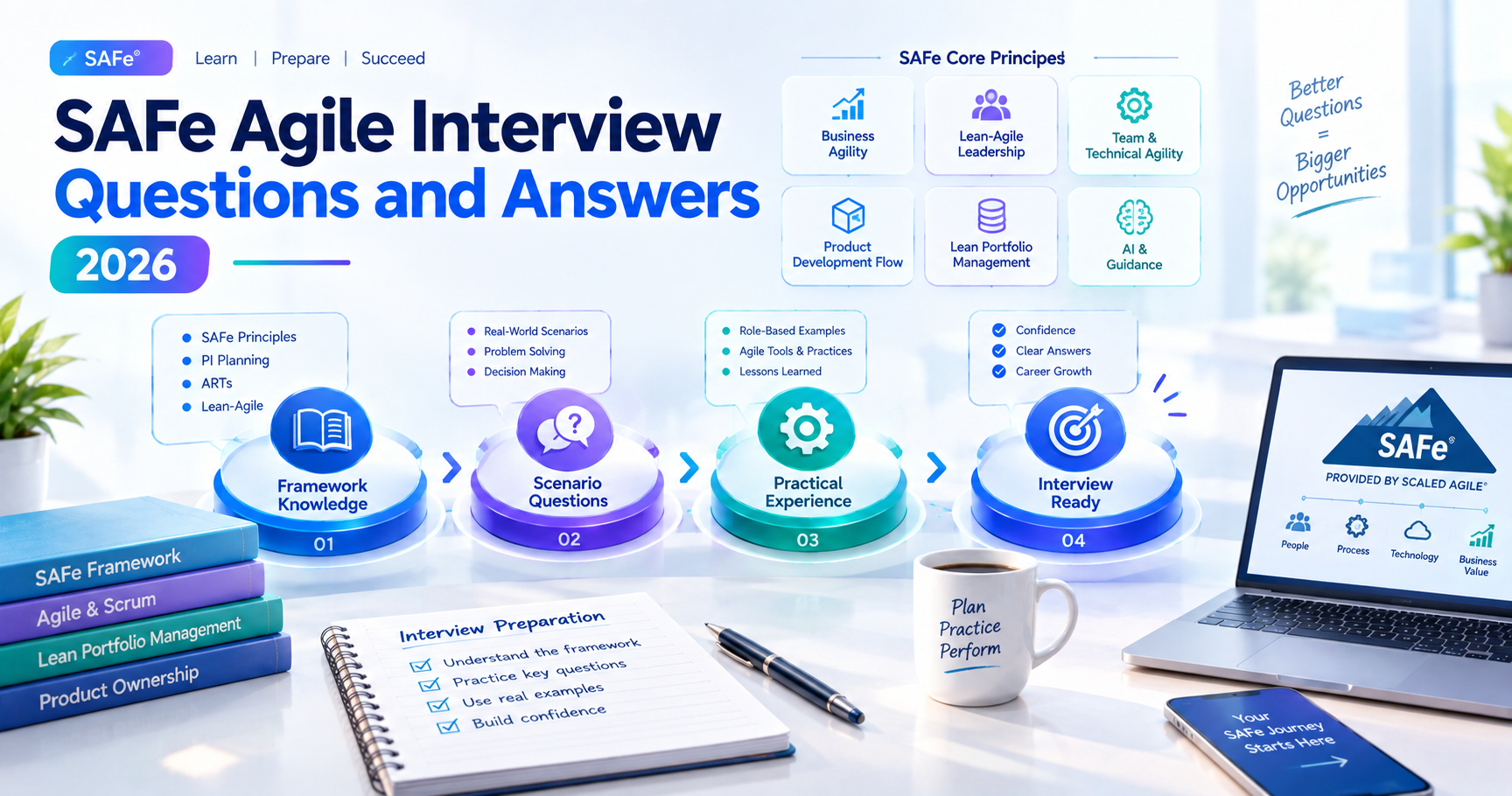
SAFe agile interview questions generally fall into four groups: framework fundamentals (what SAFe is, how it differs from plain Scrum, and core concepts like PI Planning and Agile Release Trains), role-specific questions tied to whichever SAFe certification you hold or are targeting (SAFe Scrum Master, Product Owner/Product Manager, or Release Train Engineer), scenario-based questions that test how you would handle a real cross-team conflict or dependency, and behavioral questions using the STAR method. Interviewers in 2026 increasingly expect candidates to connect SAFe theory to how AI-assisted planning and coordination tools are changing day-to-day execution.
Key Highlights of SAFe Agile Interview Questions
- SAFe interviews almost always open with the same question, in some form: how is SAFe different from plain Scrum, so prepare a crisp, confident answer to that first.
- Role matters more than framework knowledge alone. An SSM, a POPM, and an RTE get meaningfully different follow-up questions after the fundamentals.
- Scenario and behavioral questions, not definitions, are where most candidates actually lose points, according to every recruiter-facing source reviewed for this guide.
- SAFe 6.0, released March 15, 2023 and still the current version through 2026, introduced updated guidance on AI, Big Data, and cloud that increasingly shows up in senior-level interviews.
- PI Planning is the single most-asked concept across every SAFe role, since it is the event every SAFe practitioner, regardless of title, participates in.
SAFe Fundamentals: Questions Every Candidate Gets Asked
Regardless of which SAFe role you are interviewing for, expect these first.
1. What is SAFe, and how is it different from plain Scrum?
SAFe coordinates multiple Agile teams working toward a shared solution, using structures like the Agile Release Train and PI Planning that plain Scrum does not define. Scrum organizes one team's sprints. SAFe organizes many teams' work across a quarter-long Program Increment.
2. When would you recommend SAFe over basic Scrum?
SAFe fits organizations running five or more interdependent Agile teams, needing portfolio-level visibility, or operating in regulated industries. For a single team or startup, plain Scrum or Kanban is usually lighter and more effective.
3. What is a Program Increment (PI), and how long does it run?
A Program Increment is a timeboxed cycle, typically 8 to 12 weeks (four to five sprints), during which an Agile Release Train delivers value and validates it through a System Demo.
4. What is an Agile Release Train (ART)?
An ART is a long-lived team of Agile teams, typically 50 to 125 people, that plans, commits, and delivers together within a PI, aligned around a shared mission and value stream.
5. What are the core competencies of a SAFe enterprise?
SAFe 6.0 defines seven: Team and Technical Agility, Agile Product Delivery, Enterprise Solution Delivery, Lean Portfolio Management, Organizational Agility, Continuous Learning Culture, and Lean-Agile Leadership.
For the official framework diagram and current guidance article-by-article, Scaled Agile Inc.'s framework site is the primary source interviewers expect you to be familiar with. For a deeper side-by-side breakdown, see our companion resource on SAFe vs Agile.
PI Planning Interview Questions
6. Walk me through how PI Planning actually works?
PI Planning is a two-day event where every team on an Agile Release Train plans the upcoming Program Increment together. Day one covers business context and architecture, followed by team breakout sessions. Day two resolves dependencies and risks, closing with a confidence vote.
7. How do you handle dependencies discovered during PI Planning?
I make dependencies visible immediately on a dependency board, then get the affected teams to negotiate a resolution together. Anything unresolved becomes a tracked risk, using ROAM: Resolved, Owned, Accepted, or Mitigated.
8. What happens if a team cannot commit to its plan during PI Planning?
The team flags it during the confidence vote and works with the RTE and Product Management to descope or adjust priorities before the PI starts, rather than silently accepting an unrealistic plan.
For a full walkthrough of the event structure, see our guide to PI Planning.
SAFe Scrum Master (SSM) Interview Questions
9. How is a SAFe Scrum Master's role different from a regular Scrum Master's?
A SAFe Scrum Master facilitates Scrum at the team level, like a traditional Scrum Master, but also joins Scrum of Scrums, coordinates with other teams' Scrum Masters, and keeps the team's work aligned with the ART's PI objectives.
10. How do you support your team during Scrum of Scrums?
I bring forward the team's cross-team blockers honestly rather than optimistically, and carry back decisions the team needs to act on, so Scrum of Scrums stays a short, useful sync rather than status theater.
11. What challenges come up when scaling Scrum with SAFe, and how do you address them?
The most common challenge is dependency management across teams that previously worked in isolation. I address it with visible dependency boards and proactive coordination during PI Planning, not just process fixes.
12. How would you coach a team that sees SAFe ceremonies as overhead?
I would find out what specifically feels like overhead, since that feedback is often legitimate, then fix the actual problem rather than defending the ceremony on principle. Agile practices should earn their place.
Preparing for this role specifically? See the SAFe Scrum Master Certification training page for the current syllabus and exam format.
SAFe Product Owner/Product Manager (POPM) Interview Questions
13. What is the difference between a SAFe Product Owner and a SAFe Product Manager?
The Product Owner works at the team level, managing the team backlog and accepting stories within a single Agile team. The Product Manager works at the Program level, owning the Program Backlog and Vision across the whole Agile Release Train. Both roles collaborate closely but operate at different altitudes.
14. How do you prioritize the backlog in a SAFe environment?
I use Weighted Shortest Job First (WSJF), scoring items on cost of delay against job size, so the backlog reflects economic priority rather than whoever asks loudest. I revisit the ranking regularly as new information changes the inputs.
15. How do you handle conflicting priorities from multiple stakeholders across an Agile Release Train?
I anchor the conversation back to the Program's shared Vision and PI Objectives, use WSJF scoring to make the tradeoff explicit and data-informed rather than political, and involve the Release Train Engineer when the conflict needs cross-team resolution.
Preparing for this role specifically? See the SAFe Product Owner/Product Manager Certification training page.
Release Train Engineer (RTE) Interview Questions
16. What are an RTE's core responsibilities during a Program Increment?
The RTE facilitates PI Planning and ART events, manages risks and dependencies across teams, helps resolve impediments teams cannot solve themselves, and drives improvement through the Inspect and Adapt workshop at the end of each PI.
17. How do you manage risk across an entire Agile Release Train?
I surface risks explicitly during PI Planning and categorize them using ROAM (Resolved, Owned, Accepted, Mitigated), keeping ownership visible so risks do not silently slip through the cracks between teams.
18. How does an RTE's role differ from a traditional Project Manager's?
An RTE serves the ART as a facilitative leader, focused on flow and removing impediments across teams, rather than directing task assignments the way a project manager often does. The RTE serves the teams, not manages them.
Preparing for this role specifically? See the SAFe RTE Certification training page.
Scenario and Behavioral Interview Questions in SAFe
These are where most candidates lose points, since they cannot be answered from memorized definitions. Use the STAR method (Situation, Task, Action, Result) and keep answers specific.
19. Describe a time you had to resolve a dependency conflict between two teams on the same Agile Release Train?
Two teams on the same ART hit a wall during PI Planning. Team A needed an API from Team B two sprints before it was scheduled. Your task is to unblock Team A without wrecking Team B's existing commitments.
Bring both Product Owners and the System Architect together fast. Propose a stubbed API contract so Team A can build against it while Team B finishes the real work later. Both teams keep their PI Objectives, and the dependency stays visible on the Program Board for the rest of the increment. Interviewers want proof you caught this in planning, not after it became a live blocker.
This is a good spot to also mention Scrum of Scrums. That's often where a dependency like this should get flagged days before it becomes urgent.
20. Tell me about a PI where a team failed to meet its committed objectives. How did you handle it?
Frame this with real numbers, not vague disappointment. Say the team delivered 2 of 5 PI Objectives in full, partly delivered 2, and missed 1 because of a vendor delay outside its control. Your job in the Inspect and Adapt workshop is to separate execution problems from external blockers, since each needs a different fix.
A quick 5 whys found the partial misses came from stories written too broadly in PI Planning, which hid integration complexity. The fix was breaking those stories down further before the next PI, not just telling the team to estimate better. Being honest about the shortfall built more trust with leadership than padding the numbers ever would.
21. How would you respond if a Product Manager kept changing Program Backlog priorities mid-PI?
Lead with the principle: a PI exists to protect team execution. SAFe trades flexibility at PI boundaries for stability inside them. Your response should split genuine emergencies from reactive reshuffling, since only the first justifies a mid PI change.
When a change is real, make the trade explicit. Something else comes out of scope, and the team sees that trade happen instead of quietly absorbing extra work. If the pattern repeats across multiple PIs, treat it as a signal. Backlog refinement and Business Owner alignment before PI Planning weren't solid, and that's worth fixing instead of tolerating.
22. Describe how you would introduce SAFe to a team that has only ever worked in single-team Scrum?
Don't open with terms like Agile Release Train, WSJF, or PI. Open with the problem SAFe solves: their work now affects other teams, and nobody on the team can see those dependencies yet.
Map their current backlog against other teams' known work before naming the Program Board as the fix. Have them shadow one Scrum of Scrums before their first PI Planning. Keep their existing sprint length and Definition of Done intact wherever you can. The team adopts SAFe because it solves a problem they already feel, not because they got new vocabulary.
23. How do you measure whether an Agile Release Train is actually delivering business value, not just completing story points?
Name the actual mechanisms interviewers expect. Business Owners score each PI Objective's business value before the PI starts, then rate the actual value delivered after. Flow metrics matter too, since story point output can rise while cycle time and work in progress quietly get worse.
Watch for a specific gap: a train hitting 95 percent of its point commitment for two PIs while Business Owner satisfaction with delivered value drops. That gap is exactly what business value scoring and flow metrics are built to catch. Naming it shows you understand the difference between predictable effort and an actual outcome. Bring up the ART's Inspect and Adapt workshop too, since that's where these value gaps usually get named out loud.
A pattern runs through all five answers above. Name the exact SAFe artifact you used, like the Program Board, ROAM, WSJF, or flow metrics. That habit is what separates a generic behavioral answer from one that proves you've actually run a PI, not just studied one.
How to Prepare for a SAFe Interview: A Practical Checklist
- Master the fundamentals first (SAFe vs Scrum, PI Planning, ART structure) before drilling into role-specific questions, since every interview opens there.
- Identify your target role and go deep on that section: SSM, POPM, or RTE questions above, not all three unless the role is genuinely cross-functional.
- Prepare two or three real scenario stories from your own experience using the STAR method, even if your SAFe experience is limited to training simulations.
- Review SAFe 6.0's current guidance on AI and Lean Portfolio Management, since 2026 interviewers increasingly probe how candidates think about AI-assisted planning.
- If you are not yet certified, build your fundamentals through structured training rather than scattered blog posts, since certification training explicitly covers the terminology interviewers expect you to use precisely.
If you are starting from the fundamentals, the Leading SAFe 6.0 Certification is the standard entry point covering everything in the fundamentals section above.
Conclusion
Interview prep works best on top of a real certification foundation. Start with Leading SAFe 6.0 for the fundamentals every SAFe interview tests, then move to your target role: SAFe Scrum Master, SAFe Product Owner/Product Manager, or SAFe Release Train Engineer. Browse the full SAFe course catalog for advanced and master-level certifications once you have your first role secured.


HowtoEstablishOne_1788350087.png)
_1788349430.jpeg)
_1738229179.jpg)



 Lowest-Price Challenge










 Personalized Path


.webp)


 USA
USA  Canada
 India
India UK
UK Australia
 Singapore


